Prompt payment laws by state set four clocks on a first-party property or auto insurance claim: the insurer must acknowledge the notice, accept or deny the claim, write to the claimant at fixed intervals while it is undecided, and pay once it is accepted. Many states follow the NAIC's model regulation, which allows 15 days to acknowledge, 21 days after proof of loss to decide and a written explanation every 45 days while the investigation runs. Several large states depart from it: California allows 40 days to decide but wants a letter every 30, Florida requires residential property claims to be paid or denied within 60 days of notice, Texas pays damages of 18% a year for missed deadlines, and Washington rewrote its clocks in October 2026. On any single file, the clock most likely to break is not the longest one but the next one due when the file goes quiet.
Tracking those clocks file by file is one of the jobs of Claims Cycle Time Monitoring, Botminds' solution that watches every open property and auto claim for the days it spends waiting. This guide covers first-party property and auto claims under insurance regulation. Health plans' prompt-pay rules for provider claims, which share the name, are a different body of law and are not covered here. The rules below were read at their official or Cornell LII sources on 27 October 2026; check the current text before relying on any of them.
How often a pending claim must hear from the insurer in writing
What do prompt payment laws require of an insurer?
They require four things, each on its own clock: an acknowledgement of the claim, a decision, written explanations while the decision is pending, and payment once liability is accepted. The national template is the NAIC's Unfair Property/Casualty Claims Settlement Practices Model Regulation (Model 902), which says every insurer, upon receiving notification of a claim, shall "within fifteen (15) days, acknowledge the receipt of such notice unless payment is made within that period of time". The first-party claimant must be told of acceptance or denial within 21 days of properly executed proofs of loss, and an insurer that needs longer must say why within those 21 days and then every 45 days.
Payment has its own rule in the model. The insurer must "tender payment within thirty (30) days of affirmation of liability, if the amount of the claim is determined and not in dispute". Undisputed amounts under one coverage are to be paid within 30 days even when another coverage on the same claim is still open. A model is not law, though: each state adopts its own version, and the differences are where files go wrong.
One more clock appears in almost every version and is easy to forget: the reply to the claimant's own messages. Model 902 wants an appropriate reply within 15 days to any communication that reasonably suggests a response is expected. A customer's second call asking when the car will be fixed starts that clock again.
Prompt pay statutes by state: the four clocks side by side
The table compares the NAIC model with six states whose rules were read for this guide. The starting events matter as much as the numbers: some clocks run from notice of the claim, some from proof of loss, and Texas runs its decision clock from receipt of everything the insurer asked for.
Acknowledge, decide, write, pay: seven rulebooks compared
| Rulebook | Acknowledge | Decide | While undecided | Pay once accepted |
|---|---|---|---|---|
| NAIC Model 902 | 15 days after notice | 21 days after proofs of loss | Reasons within 21 days, then every 45 days | 30 days after liability is affirmed, if the amount is not in dispute |
| California, 10 CCR 2695 | 15 calendar days after notice | 40 calendar days after proof of claim | Written notice of the need for more time, then every 30 calendar days | 30 calendar days after acceptance |
| Florida, §627.70131 (residential property) | 7 calendar days after a claim communication | Pay or deny within 60 days of notice | On request, a written status within 30 days of a complete proof of loss (§627.7142) | Within the 60 days; late payments bear interest from the date of notice |
| Ohio, 3901-1-54 | 15 days after notice | 21 days after proof of loss | Notice within the 21 days, then at least every 45 days | 10 days after acceptance, if the amount is determined and not in dispute |
| Pennsylvania, 31 Pa. Code ch. 146 | 10 working days after notice | Investigation within 30 days of notice; decision 15 working days after proofs of loss | Written explanation at 30 days, then every 45 days | No day count in §§146.5–146.7 |
| Texas, Ins. Code ch. 542 | 15 days after notice, with investigation started and items requested | 15 business days after all requested items arrive | One notice of the reasons, then a decision within 45 days of it | 5 business days after notice of acceptance |
| Washington, WAC 284-30 as amended (from 18 Oct 2026) | 10 business days after notice | Investigation and decision within 30 calendar days of notice | Reasons within the 30 days, then every 30 calendar days | Not compared here |
Three differences cause most mistakes in a multi-state book. California's decision clock is the most generous at 40 days, yet its status letters come fastest. Pennsylvania counts its investigation clock from notice, not proof of loss, so a file can owe a written explanation before any proof of loss has arrived. Florida's 60-day rule counts from notice of an initial, reopened or supplemental claim, and the state's insurance regulator may extend it after an emergency by no more than 30 days.
How long does insurance have to pay a claim?
Once a claim is accepted, between 5 business days and 30 days in the rules compared here: 5 business days in Texas, 10 days in Ohio, 30 calendar days in California and 30 days under the NAIC model, provided the amount is settled. Before acceptance, the decision clock governs, and Florida folds both into one deadline: a residential property claim must be paid or denied within 60 days of notice unless factors beyond the insurer's control prevent it.
What a late payment costs differs more than the deadline. In Florida, a payment made after the 60 days bears interest at the statutory judgment rate, counted from the date the insurer received notice of the claim (§627.70131(7)(a)). In Texas, an insurer that delays payment beyond the applicable period, or more than 60 days where no other statute sets one, owes damages under §542.060: interest at 18% a year plus reasonable attorney's fees. Ohio and Pennsylvania treat a missed deadline as an unfair claims practice that a regulator can sanction, without a statutory interest rate in the sections read here.
What a missed clock can add to one claim
18%a year
damages on the claim amount in Texas, plus attorney’s fees
60days
after notice, Florida’s pay-or-deny deadline on residential property claims
30days
the most Florida’s regulator may add to that deadline after an emergency
Texas prompt payment of claims act, clock by clock
Texas's rules are subchapter B of chapter 542 of the Insurance Code, titled "Prompt Payment of Claims", and they read as a sequence. Within 15 days of notice the insurer must acknowledge the claim, start any investigation and request every item it reasonably believes it will need. It must then accept or reject in writing within 15 business days of receiving those items, or say within that period why it needs more time, and decide within 45 days of that notice. Payment follows within five business days of acceptance.
The statute tells courts how to read it: "This subchapter shall be liberally construed to promote the prompt payment of insurance claims." Its trigger is written notice, defined as any written notification that reasonably apprises the insurer of the facts of the claim. Two practical consequences follow for a claims desk. Further requests are allowed only when the investigation makes them necessary, so the day-15 request sets the pace of the file. And after a declared weather catastrophe the deadlines stretch by only 15 days, so a surge does not suspend the clocks.
Washington rewrote its claim clocks on 18 October 2026
Washington's amended claims rules, adopted by the Insurance Commissioner as WSR 26-17-089 and effective 18 October 2026, move the decision clock from proof of loss to notification of the claim. Under amended WAC 284-30-380, the insurer must tell a first-party claimant whether the claim is accepted or denied within 30 calendar days of the notification of claim, where the old rule allowed fifteen working days from fully completed proofs of loss. If it needs more time, it must say so within those 30 days, give all of the reasons, and then write every 30 calendar days.
The acknowledgement clock changed too, from ten working days to 10 business days, and the investigation must be complete within 30 calendar days of notification unless it cannot reasonably be done in that time. The commissioner's stated purpose was "additional clarity on the minimum standards of claims handling activities that increasingly rely on technology for evaluation of claims." The compiled code on the legislature's site still showed the old text on 27 October 2026, so a team copying clocks from it would have copied the wrong ones.
Unfair claims settlement practices by state: where the clocks come from
Most of the clocks in this guide sit in regulations issued under a state unfair claims settlement practices act, and many of those acts are modelled on NAIC Model 900. The model lists practices such as "Failing to acknowledge with reasonable promptness pertinent communications with respect to claims arising under its policies" and refusing to pay claims without a reasonable investigation; the regulations then turn "reasonable promptness" into day counts. That is why the numbers differ while the duties look alike.
The acts are enforced by regulators, usually through market conduct examinations that test a sample of files. A practice must ordinarily be frequent enough to be a business practice; Ohio's rule puts it bluntly: "A single act is not a business practice." Examiners therefore count. In a 2025 Pennsylvania examination of hail claims at two affiliated insurers, all five violations cited in 150 homeowner files were status letters not sent on time under §146.6 (Docket MC25-02-002). The violation examiners found was the one a quiet file produces.
Section 146.6 gives an insurer 30 days from notice to finish investigating unless that cannot reasonably be done; when it cannot, the insurer owes a written explanation of the delay at 30 days and every 45 days after, saying when a decision may be expected. That letter is the duty a quiet file misses.
Which clock breaks first when a file goes quiet?
The next one due, and on most open files that is a status letter rather than the decision itself. A decision clock is visible: it is on every adjuster's mind and on most diary systems. A status letter falls due because nothing happened, which is exactly when nobody is looking at the file. Pennsylvania's letter at day 30 from notice, California's every 30 days, Washington's every 30 days now, all arrive on files that are waiting on someone.
Take a fictional sample from the solution's demonstration data, a homeowners water claim in Pennsylvania. Joel and Amara Nakamura are in a hotel at $165 a night; the restoration contractor's moisture logs are missing, so the adjuster cannot decide the claim; and the next written explanation under §146.6 is due on Wednesday 14 October. Nothing about the claim is wrong except that it is waiting, and the waiting is what puts the letter at risk.
A Pennsylvania file waiting on a contractor, with its clock beside it
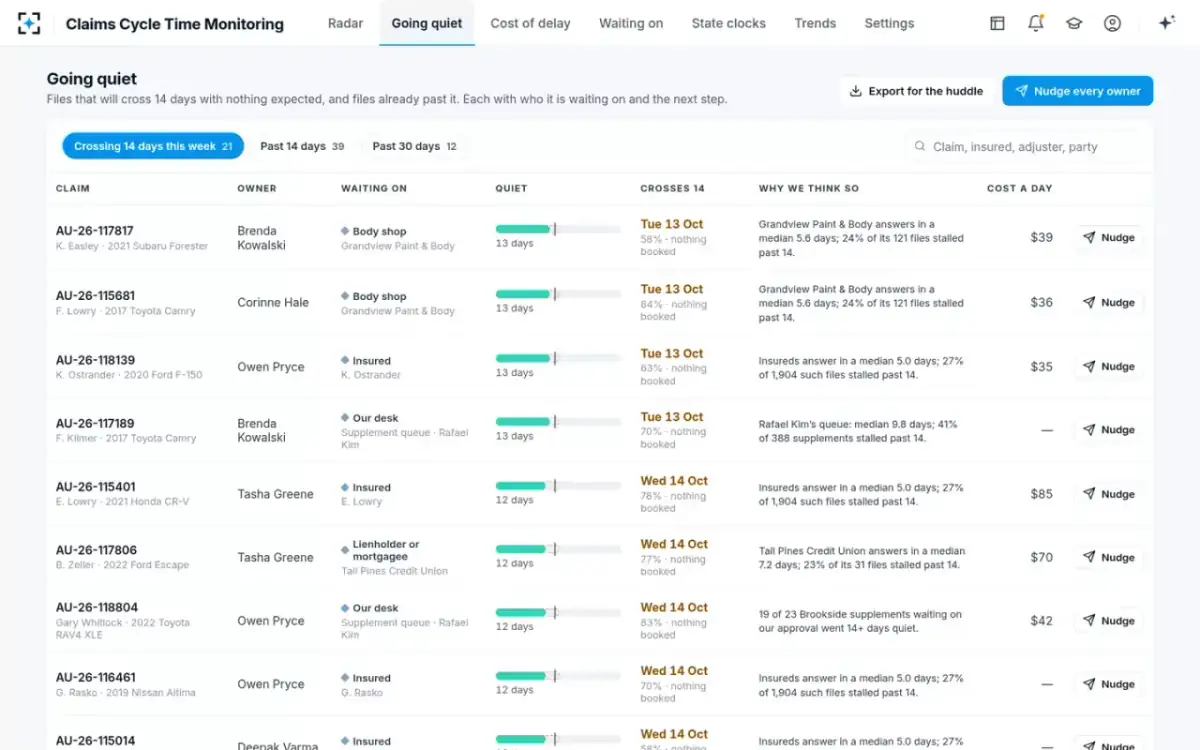
How Claims Cycle Time Monitoring tracks the state clocks
In Claims Cycle Time Monitoring, one agent, the state clock keeper, tracks the acknowledgement, decision, status-letter and payment clocks on each open file under the rules of the state where the file sits, and drafts the letters as they come due. In the sample team those are Ohio, Pennsylvania and Michigan files. The adjuster reviews and sends every letter; the agent never sends one, and nothing reaches a customer until a person does.
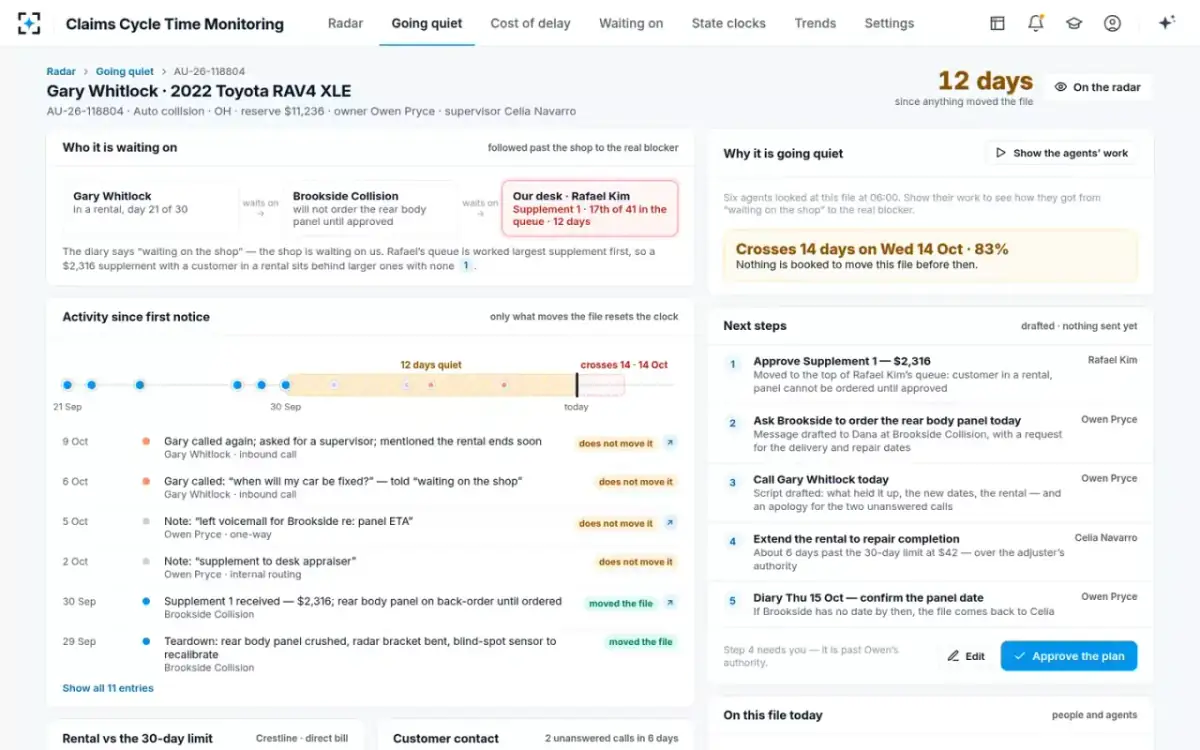
The useful part is the combination. A clock alone is a calendar entry. Beside it, the solution shows why the file is still open and who it is waiting on, so the letter can say something true and the next step can be sent the same morning.
Why the file is still open: the quiet stretch and its cause
The general method for tracking deadlines on a total loss, a narrower case with its own state rules, is set out in total loss rules by state.
Building a state clock table a desk can trust
- Record the trigger, not just the number
Notice, proof of loss, all requested items or acceptance. Twenty-one days from the wrong event is a wrong deadline.
- Say whether days are calendar, working or business days
Pennsylvania counts working days for acknowledgement and decision, Texas business days for decision and payment.
- Keep the recurring duty separate from the one-off deadline
The every-30 or every-45 status letter is the clock most often missed.
- Store the source and the date it was read
Washington’s compiled code lagged its October 2026 amendment; the register order was current.
- Note the exceptions that stop or extend a clock
Florida tolls its clocks while a policyholder misses a 10-day request for material information; Texas adds 15 days after a declared catastrophe.
- Count late letters as a share of letters due
That is the error ratio a market conduct examiner computes.
A table built this way is also the basis for the measures in claims management KPIs, where clocks at risk sit beside quiet days and the daily cost of waiting.
Questions people ask
Where can I find prompt pay statutes by state?
In each state's insurance code and the claims-handling regulation issued under its unfair claims settlement practices act; there is no single official compilation. The NAIC publishes the model regulation (Model 902) most states adapted, which is a useful map of what to look for in each state's own text.
What is a state prompt payment act?
A statute or regulation that sets deadlines for an insurer to acknowledge, decide and pay claims, often with a penalty for missing them. Texas has one by name, subchapter B of Insurance Code chapter 542; most states put the same duties in unfair claims practices regulations, such as Ohio Adm. Code 3901-1-54 or 31 Pa. Code chapter 146.
What does the Texas Prompt Payment of Claims Act require?
Acknowledgement, the start of the investigation and a request for needed items within 15 days of notice; a written decision within 15 business days of receiving those items, or a notice of reasons and a decision within 45 days of it; and payment within five business days of acceptance. Missing them makes the insurer liable for 18% a year on the claim plus attorney's fees, outside chapter 542A suits.
Do unfair claims settlement practices laws differ by state?
Yes, in their numbers more than their duties. Many are modelled on NAIC Model 900, but the day counts vary: a decision 21 days after proof of loss in Ohio, 40 calendar days in California, 30 calendar days from notification in Washington since 18 October 2026.
What is the NAIC Unfair Claims Settlement Practices Act?
Model 900 is the NAIC's model statute listing unfair claims practices, from misrepresenting policy provisions to failing to acknowledge communications promptly. It applies when an act is committed flagrantly and in conscious disregard of the act, or often enough to indicate a general business practice. The companion Model 902 turns those duties into deadlines.
How long does an insurance company have to pay a claim?
It depends on the state and on whether the claim has been accepted. After acceptance, the rules compared here allow 5 business days in Texas, 10 days in Ohio and 30 calendar days in California; Florida requires a residential property claim to be paid or denied within 60 days of notice.