A claim aging report lists open claims by how long each has been open, usually in buckets such as 0–30, 31–60, 61–90 and over 90 days, with the adjuster, the line and the next diary date. It answers "how old is the inventory?" and nothing else. Two files of the same age can be in opposite states: one received a supplement yesterday, the other has collected nothing but notes for two weeks. Neither the age nor the diary date tells them apart, because a note, a routed task or a voicemail resets a diary just as well as a decision does. What separates them is the date of the last activity that actually moved the file.
Reading for that date is what Claims Cycle Time Monitoring, Botminds' solution for open property and auto claims, does each morning: it marks every activity as moving the file or not, and counts the quiet days since the last one that did. This guide takes one fictional sample file through both views. The claimant, shop, carrier and dates are invented; the rules quoted are real and were read on 27 October 2026.
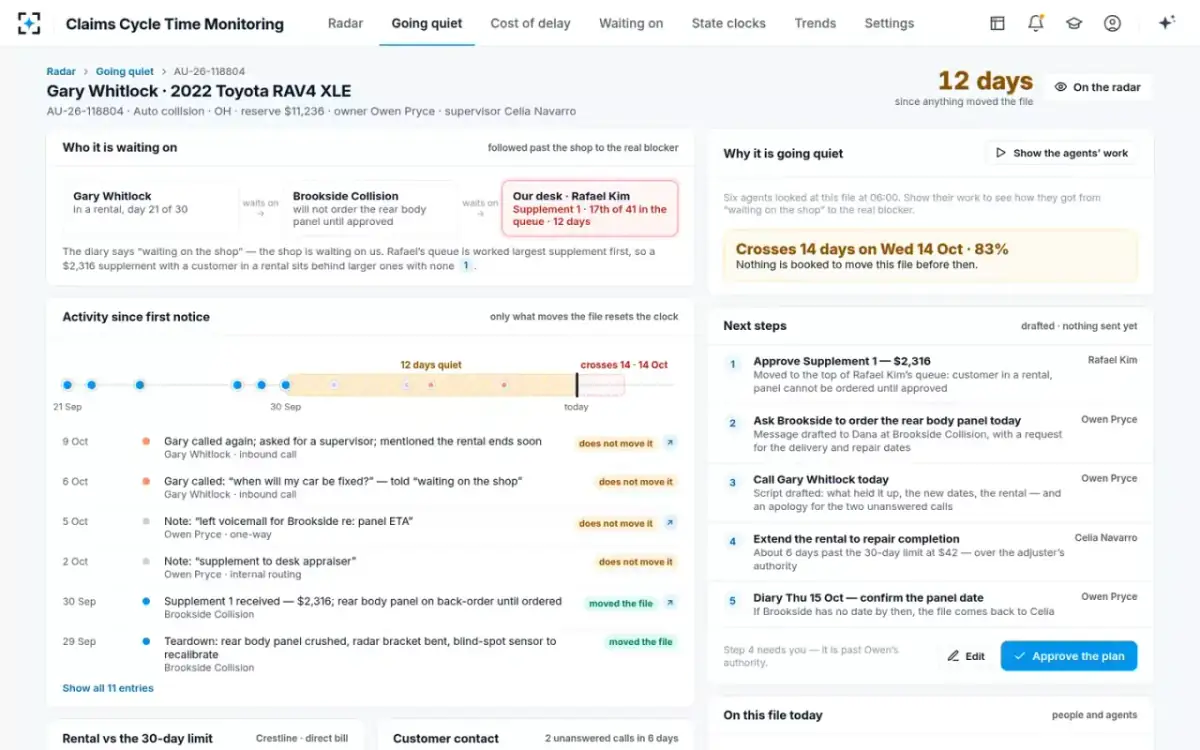
The same file, two readings: a busy diary and a file that has not moved since 30 September
What the diary shows: Teardown by the shop: rear panel crushed, radar bracket bent, a sensor to recalibrate.
Did it move the file?: Yes. A document arrived that changes the repair.
What the diary shows: Supplement 1 received from the shop, $2,316; rear body panel on back-order until ordered.
Did it move the file?: Yes. The last entry that moved the file.
What the diary shows: Note: “supplement to desk appraiser”.
Did it move the file?: No. Internal routing.
What the diary shows: Note: “left voicemail for shop re: panel ETA”.
Did it move the file?: No. A one-way call.
What the diary shows: Customer called: “when will my car be fixed?”, told “waiting on the shop”.
Did it move the file?: No. A status call; nothing about the claim changed.
What the diary shows: Customer called again and asked for a supervisor; mentioned the rental ends soon.
Did it move the file?: No. And now an escalation.
What does an insurance aging report list?
An insurance aging report lists each open claim with its age, and usually its claim number, line of coverage, date of loss, adjuster, reserve and next diary date, sorted or bucketed by age. Its columns follow the data regulators already require insurers to keep. Ohio's claims rule, for example, says the claim data "shall include number, line of coverage, date of loss and date of payment or date of denial or date when claim is closed without payment". Age is simply today minus the date the claim was reported.
That makes the report cheap to produce and easy to trust. It is also what auditors and finance teams expect, because age drives reserve and inventory reviews. The problem is only what a supervisor reads into it. Sorted oldest first, an aging report sends attention to old files that may be moving properly, and away from young files that have stopped.
Why an accurate aging report still misses the stuck file
Because it measures the right thing correctly and the wrong thing for the purpose. On the sample file the report is accurate: the claim was reported on 21 September and is 21 days old on 12 October, well inside any normal bucket. The diary is accurate too: the last entry is from 9 October, three days earlier. Both say the file is young and being worked. Neither says that nothing has moved it since 30 September, that the body shop is waiting on the carrier's approval of its supplement, or that the customer has asked for a supervisor.
Every entry after 30 September was real work by someone. A desk routed the supplement, an adjuster called the shop, the customer called twice. None of it changed the state of the claim, and each entry reset the diary. That is the precise sense in which a busy diary is not a moving file: activity is being recorded, and the claim is not progressing.
Activity since first notice, with the quiet stretch shaded
What counts as activity on a claim?
For measuring progress, an activity counts when it changes what the claim is waiting for: a document received, money moving, a decision made, or something settled with a party. Everything else is a record of effort, which matters for the file but not for the clock. The solution's defaults draw the line in exactly that place, and each team can move it.
Activity on a claim: what resets the quiet clock by default, and what is only recorded
| Activity | Resets the quiet clock? | Why |
|---|---|---|
| A document arrives (estimate, supplement, report, invoice, payoff letter) | Yes | The file now holds something it was waiting for. |
| A payment is issued or a reserve changes | Yes | Money or the insurer’s view of the claim has moved. |
| An approval or coverage decision | Yes | The next party can act. |
| A two-way conversation with the customer or a party | Yes | Something can be agreed in it. |
| A note on the file | No, recorded | It describes the claim without changing it. |
| Routing between the insurer’s own desks | No, recorded | The work changed hands; the claim did not move. |
| An outbound voicemail or unanswered email | No, recorded | An attempt, with no answer yet. |
| A diary date pushed forward | No, recorded | It moves the reminder, not the file. |
The line has to be written down before anyone reports a number, because the measure is only as honest as its definition. If notes reset the clock, quiet days collapse into diary age. In the sample's morning sweep, 1,827 of the 2,914 activities read on 318 open files were notes, routing or one-way calls. Counted as progress, they would have hidden most of the team's stuck files.
One sample morning: activity recorded against activity that moved a file
2,914
activities read on 318 open files
1,087
moved a file
63%
of activities did not move a file
1,827 of 2,914, our arithmetic
Does a voicemail count as claim activity?
It counts as a record, not as progress. A voicemail left for a shop or a customer is evidence that someone tried, and it belongs on the file; examiners reconstruct what happened from exactly these entries. But nothing about the claim has changed until somebody answers. Ohio's rule makes the record duty explicit: an insurer must be able to rebuild what it did on any claim from documentation suited to the claim's type and size (Ohio Adm. Code 3901-1-54(D)(2)). A voicemail entry satisfies the record; it does not satisfy a status letter or a decision.
The distinction matters most for the customer's own calls. A customer who calls twice in four days and is told both times that the file is waiting on someone else has not been helped, and the second call is where escalations start. In the sample, the second unanswered call is one of the two triggers that alert the customer experience lead. The path from that call to a regulator's inbox is traced in how a quiet file reaches the department of insurance.
"I left the shop two voicemails. In the system that looks like work."
Owen Pryce, adjuster on the fictional sample team
Open claims report or claims activity log: which one an examiner reads
An examiner reads the activity log. An open claims report says what is outstanding; the log says what was done and when, which is what claims regulations test. California requires insurers to record the dates on which each material document was received, processed and transmitted, and to keep claim files in enough detail that "pertinent events and the dates of the events can be reconstructed". Market conduct examiners then sample files and check the dates against the deadlines.
The result of such a test is rarely about age. In a 2025 Pennsylvania examination of hail claims at two affiliated insurers, examiners reviewed 150 homeowner files; all five violations they cited were status letters not sent on time under 31 Pa. Code §146.6 (Docket MC25-02-002). A status letter is due precisely when a file is waiting, so the files most likely to miss one are the quiet files an aging report does not flag.
Status letters: where a busy diary does the most damage
A diary that is reset by notes hides the moment a written explanation falls due. Pennsylvania requires one at 30 days from notice if the investigation is not complete, and every 45 days after that (§146.6); California requires written notice every 30 calendar days until a decision (10 CCR 2695.7(c)(1)). Neither rule is satisfied by a voicemail or a note, and neither pauses because the file is busy.
Nor does an insurer's own effort stop the clock. Florida tolls its residential claim deadlines when a policyholder fails to provide requested material information within 10 days, but only for requests made in time: "Tolling under this paragraph applies only to requests sent by the insurer to the policyholder or a representative of the policyholder at least 15 days before the insurer is required to pay or deny the claim" (§627.70131(8)(b)). A file whose request went out late, or never went out because the diary looked busy, keeps its deadline.
Claims aging by waiting party: the buckets that point to a fix
Age buckets say how many files are old; waiting-party buckets say whom to call. On the sample team's morning, the 39 files past 14 quiet days split across seven parties, and each group needs a different action: the insured needs a call or a list of what is missing, a body shop needs a parts date, a lender needs a payoff request chased, and the insurer's own desk needs an approval. Sorted this way, the report becomes a work plan for the huddle rather than an inventory.
Files past 14 quiet days on a sample team, by who they wait on
How to build a claim aging report that reads movement
Keep the age columns and add the ones that show movement. The changes need no new data, only the existing activity typed and read in order. The checklist below is what a supervisor needs on one line per file.
Seven columns that turn an aging report into a movement report
- Date of the last activity that moved the file
Typed by kind: document, payment or reserve, decision, two-way conversation.
- Quiet days
Today minus that date. Sort by this, not by age.
- Who the file is waiting on, and since when
Followed past the first party: a shop may be waiting on your supplement desk.
- What is booked next
An inspection, a parts date, a recorded statement. A quiet file with a booking is less urgent than one without.
- Unanswered customer contacts
Count inbound calls and messages since the last two-way conversation.
- The next state deadline
Status letter or decision, with the state’s rule and trigger.
- The daily meter
Rental, storage or hotel per day, from the bills.
How Claims Cycle Time Monitoring reads a diary
The solution's activity reader goes through every note, task, document, payment, call and vendor update on every open file each morning and marks each one as moving the file or not, citing the entry behind every last-activity date. It is read-only on the claim system: it never edits or deletes a note. Internal routing, a one-way voicemail and a pushed diary are recorded, not counted as progress. The other agents then name the waiting party, predict the next crossing of 14 quiet days and draft a next step for the adjuster to send.
What resets the quiet clock is a setting, kept as a version
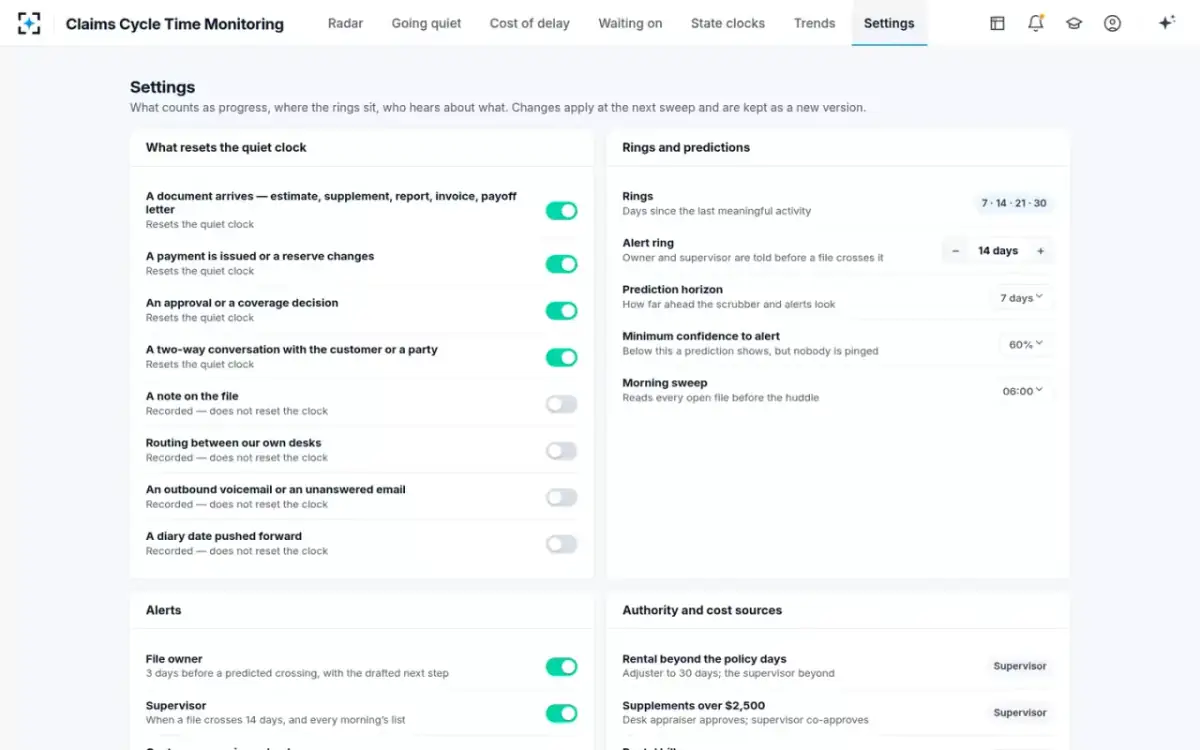
Read this way, the sample file is not a 21-day-old claim with recent activity but a claim quiet for 12 days, waiting on the carrier's own supplement desk, predicted to cross 14 days on Wednesday 14 October with nothing booked. That is the reading a supervisor can act on the same morning, and the measure behind it is set out in what claim cycle time should count.
Questions people ask
What is claims aging?
The age of open claims, measured as days since each was reported, usually grouped into buckets such as 0–30, 31–60, 61–90 and over 90 days. It is used for inventory, reserve and staffing reviews; it does not show whether a claim is moving.
What is an open claims report?
A list of every claim not yet closed, with its owner, line, dates and reserve. It is the starting point for an aging report and for supervisors' reviews, and becomes far more useful with the date of the last activity that moved each file and the party it waits on.
What is a claims activity log?
The dated record of everything done on a claim: notes, calls, documents, payments, reserve changes and decisions. Regulators require it in substance; California, for example, requires the dates each material document was received, processed and sent, so that events can be reconstructed.
Is a claim aging report required by regulators?
Not as a report format. Regulators require the claim data behind it to be kept and retrievable, such as Ohio's claim number, line, date of loss and date of payment, denial or closing without payment, and they examine files for timeliness against state deadlines.
How often should a claim aging report be run?
Weekly or monthly is enough for an age-based inventory view. A movement view, sorted by quiet days, earns its keep only daily, because the files it finds can cross a threshold or miss a status letter within days.