An insurance pending claim is a claim that has been reported and is still open: the insurer has not yet finished investigating, decided whether to accept or deny it, or paid it. "Pending" describes the claim's status, not its cause. A claim can be pending because the insurer is waiting for documents from the policyholder, a report from an adjuster, an estimate or invoice from a shop or contractor, a payoff letter from a lender, or an approval inside the insurer itself. The last of these is the one least often named. A file whose note says "waiting on the shop" may be waiting on a shop that is itself waiting for the insurer to approve a supplement.
Finding the real owner of each wait is what Claims Cycle Time Monitoring does: Botminds' solution reads every open property and auto file each morning, follows each wait past the first party to the one who must act, and drafts the step that would move it, for a person to send. This guide explains what pending means, what the rules require while a claim is pending, and how often the wait turns out to be the insurer's own. The examples are from a fictional sample book of claims.
Four pending claims, followed to the party that must act
AU-26-118804 · auto, Ohio
Looks like: Waiting on the body shop, says the diary
- Customer in a rental, day 21 of 30
- Body shop will not order the panel until the supplement is approved
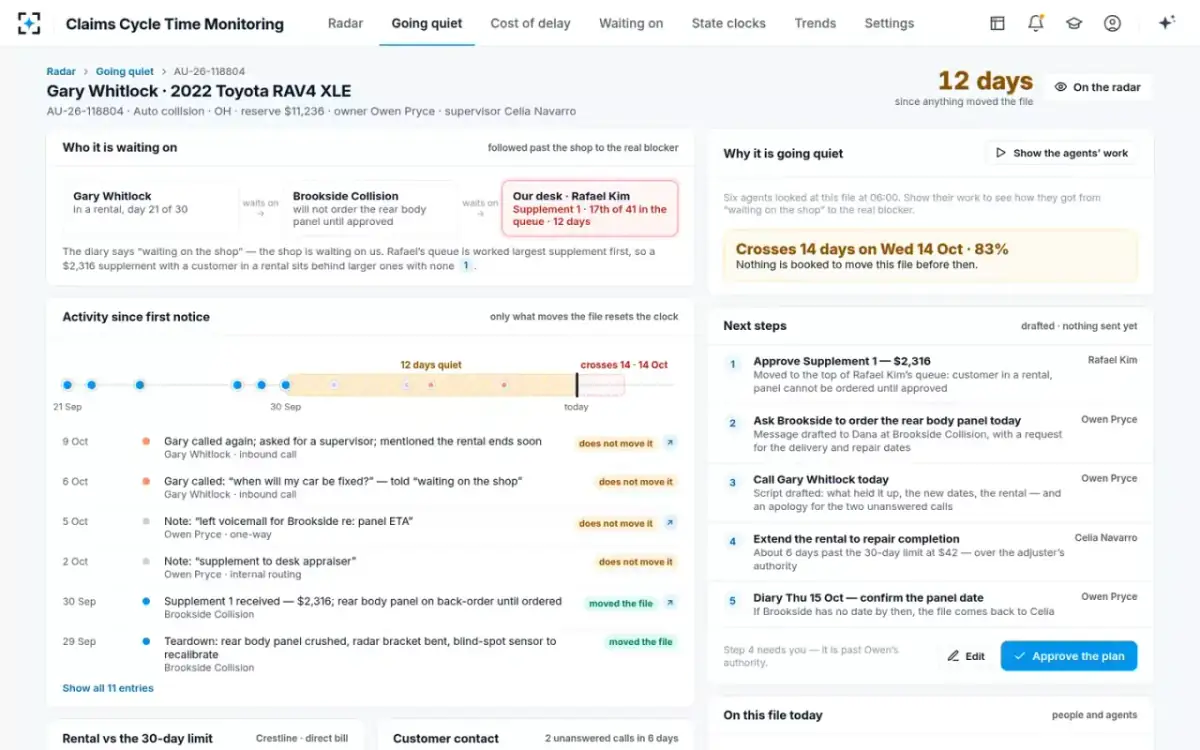
- Supplement 17th of 41 in the insurer’s queue
Who must actThe insurer’s supplement desk
AU-26-117189 · auto
Looks like: Pending a supplement
- Supplement waiting for review
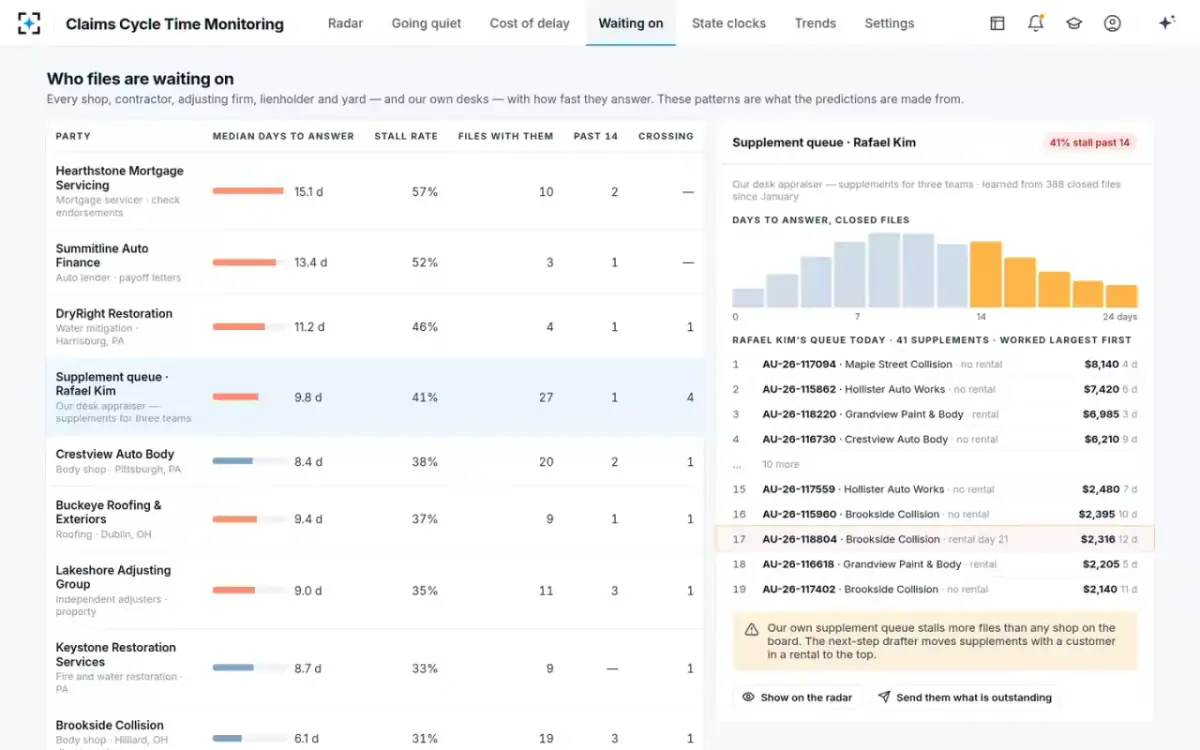
- Insurer’s queue answers in a median 9.8 days
Who must actThe insurer’s supplement desk
PR-26-40917 · water loss, Pennsylvania
Looks like: Pending a decision
- Family in a hotel at $165 a day
- Restoration contractor’s moisture logs still missing
- Written explanation of the delay due Wed 14 Oct
Who must actThe contractor; the status letter is the insurer’s
AU-26-117350 · auto, Ohio
Looks like: Pending a decision
- Payoff letter from the auto lender not yet received
- Written notice that more time is needed due Fri 16 Oct
Who must actThe lender; the notice is the insurer’s
What does pending claim mean?
A pending claim is an open claim awaiting a decision or payment. In practice it covers everything between the acknowledgement and the last payment: investigation, inspection, estimates and supplements, the coverage decision, settlement and payment. Insurers and their portals use the word as a single status, which is why a policyholder looking at "pending" for three weeks cannot tell whether anyone is working on the claim.
The rules expect more than the word. While a decision is pending, the insurer must keep the claimant informed in writing at fixed intervals in many states: every 30 calendar days in California and, since 18 October 2026, in Washington; at 30 days and every 45 days in Pennsylvania; at least every 45 days in Ohio. In Texas, an insurer that cannot accept or reject a claim in time must, within that same period, give the claimant "the reasons that the insurer needs additional time" and then decide within 45 days (§542.056(d)).
Why is my claim pending?
Because someone has not yet done the next thing, and the useful question is who. On a property or auto claim the usual candidates are five: the policyholder (a signed authorisation, a contents list, photos), a vendor (a shop's supplement, a contractor's moisture logs, an independent adjuster's report), a lender or mortgage servicer (a payoff letter, an endorsement), the insurer's own staff (a review, an approval, a payment run), or a dispute that one side has raised. The status will not say which; the adjuster can.
The rules give claimants a right to the reasons. California requires the insurer's written notice of the need for more time to say what additional information it needs and why it cannot yet decide; Pennsylvania requires each letter sent while an investigation remains incomplete to give the reasons more time is needed and the date a decision can be expected (31 Pa. Code §146.7(c)(1)). A pending claim whose letters do not name what it is waiting for is a sign that nobody has asked.
While a claim is pending, an insurance company must still answer
Pending is not a pause. The insurer must still reply to the claimant's messages within the state's deadline, 15 days in Ohio and under the NAIC model, 15 calendar days in California and 10 business days in Washington, and it must still pay what is not in dispute. The NAIC's model regulation asks insurers to pay undisputed amounts under one coverage within 30 days where the payee is known and the payment would close out that coverage, even if other parts of the claim remain open (Model 902 §7F). Florida's 60-day rule applies to the claim or a portion of the claim, so a partial payment can be due while the rest is pending (§627.70131(7)(a)).
The clocks stop only in defined cases. Florida tolls its residential property deadlines when the policyholder fails to provide requested material information within 10 days, and only if the insurer asked at least 15 days before its deadline, or during mediation or another agreed dispute process (§627.70131(8)). A claim pending on the insurer's own queue tolls nothing.
What is a claim waiting on? Follow the chain past the first party
A claim is waiting on the party who must act next, and finding it often takes more than one step. The note on the file records the first party in sight: the shop, the contractor, the customer. The real owner may be further down the chain, as when a shop will not order a back-ordered part until the insurer approves its supplement. Measured on closed files, the parties a book waits on answer at very different speeds, and the insurer's own desks sit on the same list as everyone else.
Median days to answer, by the party a sample book’s files wait on
Read that way, the sample's numbers overturn the usual assumption that delay is someone else's. Its supplement desk answered more slowly than any body shop on the board, and on the radar 65 of the book's open files, one in five, were waiting on the insurer's own desks that morning. A team that believes its pending claims are waiting on outsiders sends outsiders reminders; one that sees its own queue fixes the queue.
Does a supplement waiting on approval count as delay?
Yes, and it is the insurer's delay. Once a shop has sent a supplement, the next move belongs to the insurer: review, re-inspect if it chooses, and answer. Some states now time that answer: Washington's amended rule, in force since 18 October 2026, gives the insurer five business days to respond in writing to supplemental estimates (WAC 284-30-390, as amended), and California sets six business days for any re-inspection it chooses to make. The shop, the customer and the rental all wait in the meantime.
In the sample, Gary Whitlock's $2,316 supplement arrived on 30 September and sat 17th of 41 in a queue worked largest supplement first, behind larger supplements with no rental running. His rental was on day 21 of the 30 his policy pays for. Once it was approved on 12 October, the shop ordered the panel for 19 October and finished the repair on 27 October. Who waits on whom at each turn of a supplement is set out in detail in who waits on an auto body supplement.
One auto claim from supplement to repair: twelve of 27 days were the insurer’s
- Waiting on the insurer’s approval12 d
- Panel on order7 d
- Repair8 d
The waiting-on chain on the claim, followed past the shop
What a pending claim's status should say
A useful status names the party, the item and the next date. "Pending" says none of the three; "waiting on the shop" names a party, wrongly in the sample case. On Gary Whitlock's file, a true status on 12 October would have read: the body shop is waiting for the insurer to approve a $2,316 supplement; it is being approved today; the panel is due on 19 October. That is also, almost word for word, what the written notices required by California, Pennsylvania, Ohio and Washington ask for while a claim is undecided: the reasons, and when a decision or the next step can be expected.
The drafted call script in the sample follows that pattern: what held the file up, the new dates, the rental, and an apology for the two unanswered calls. The adjuster decides whether to use it, and makes the call himself.
Business insurance pending claims: longer chains, the same question
Commercial property claims wait on more parties, and for longer: forensic accountants for business income, engineers, multiple contractors, building owners and tenants, sometimes several insurers. The question is the same, who must act next, but the chain is longer and the waits compound. Florida's 60-day pay-or-deny rule covers commercial structures only up to 10,000 square feet and not commercial policies covering structures or contents in more than one state, so many larger business claims run without that outer limit (§627.70131(7)(b)–(c)).
Even there, the insurer's own approvals sit in the chain: reserve authority, coverage positions, advances. A business owner told the claim is pending on "documentation" deserves to know which document, from whom, and whether the insurer has everything it needs to make a partial payment in the meantime.
Waiting on ourselves: the queues inside the insurer
The insurer's own queues are where pending claims wait most invisibly, because the file notes describe them as someone else's. The supplement desk is one. Others are coverage review, payment approval, authority approvals and the payment run itself. Texas allows five business days from notice of acceptance to payment and Ohio ten days from acceptance once the amount is settled (3901-1-54(G)(6)), so a claim accepted and then held in a payment queue can breach a rule while every note says "approved".
Where an insurer’s own desks hold pending claims, and the fix for each
- Supplement review
Order the queue by customer impact as well as size: a small supplement holding a car in a rental goes first.
- Authority approvals
In the sample, a rental past the policy days needs the supervisor; flag it in the plan instead of waiting for the next review.
- Coverage review
Name the open question and the document that answers it, in the status letter the rules already require.
- Payment after acceptance
Track the days from acceptance to payment as a separate clock; Texas allows five business days.
- Undisputed amounts
Pay what is not in dispute while the rest is pending, as the NAIC model and Florida’s rule contemplate.
- Internal routing
A file routed between desks has changed hands, not moved; do not let the routing note reset any clock.
How Claims Cycle Time Monitoring finds waits on the insurer
The solution's waiting-on classifier names who each open file is waiting on and since when, and follows the chain when that party is itself waiting on the insurer; every waiting party it names carries the evidence, such as the shop's message that a part will not be ordered until approval. It never reassigns a file. The insurer's own queues are listed alongside every shop, contractor, adjusting firm, lender and yard, with the same measures: median days to answer, stall rate and files waiting.
Who files are waiting on, with the insurer’s own desks on the same list
From there the drafts follow: the approval to request, the message to the shop, the call to the customer with a true status, the extension to decide before the rental ends. The adjuster sends, the desk appraiser approves and the supervisor decides past authority. The measures that show how much of a book waits on the insurer are set out in claims management KPIs that lead the money, and the comparison with a claim system's own diary in claims management systems software vs cycle time monitoring.
Questions people ask
How long can an insurance claim be pending?
There is usually no single limit, but there are deadlines inside it: decision clocks such as 21 days after proof of loss in Ohio or 40 calendar days in California, and status letters while the decision is pending. Florida comes closest to an outer limit for residential property, requiring payment or denial within 60 days of notice unless factors beyond the insurer's control prevent it.
What does a pending status mean on a business insurance claim?
The same as on a personal claim: open and not yet fully decided or paid. Business claims tend to wait on more parties, such as accountants, engineers and several contractors, and some, like larger multi-state commercial property claims in Florida, fall outside the state's 60-day rule.
Can part of a claim be paid while the rest is pending?
Often, yes. The NAIC model asks insurers to pay undisputed amounts within 30 days where the payee is known and the payment would close out that coverage, and Florida's 60-day rule applies to a portion of a claim as well as the whole.
Does a pending claim stop the insurer's deadlines?
No. Deadlines stop only in defined cases, such as Florida's tolling when a policyholder misses a timely 10-day request for material information. A claim waiting in the insurer's own queue does not toll anything.
How can I find out what my pending claim is waiting on?
Ask the adjuster, in writing, which document or decision the claim is waiting for and from whom. In states such as California and Pennsylvania, the insurer's written notices while a claim is undecided must give the reasons more time is needed.