An auto body supplement request form is the shop's request to the insurer to pay for damage found after the first estimate, usually once the car is torn down, and it is answered faster when it carries an itemized supplemental estimate, a photo of each new part and the reason the damage could not be seen before. No state prescribes a single form; carriers use their own. What states do prescribe is the insurer's turn. Washington now gives the insurer five business days to answer a supplement in writing, California six business days to re-inspect if it chooses to, Massachusetts three to inspect in person, and New York two to re-inspect for hidden damage. The shop's turn and the owner's turn have no such clock, so a supplement is fastest when each party knows exactly what the next one needs.
This guide follows one supplement around the circle. Estimate & Supplement Review is Botminds' software for reviewing estimates, supplements and repair invoices line by line against the photos, with a desk appraiser deciding every line and signing the note back to the shop. The example is a fictional sample file in Ohio: a rear-ended 2022 Honda Accord, a fictional shop, carrier and people. The rules quoted are real and current as of October 2026.
Who holds an auto body supplement, turn by turn
Turn 1
The shop
Teardown, the supplement and its photos
In California, a new itemized estimate after teardown and the owner’s authorization before work continues.
Sample fileTeardown Thu 8 Oct · supplement S1 sent Fri 9 Oct, 16:12
Turn 2
The insurer
Review, any re-inspection, the written answer
A clock in some states: 5 business days to answer in writing in Washington; 6 to re-inspect in California.
Sample fileReviewed in 41 seconds on Friday · signed note sent Mon 12 Oct, 09:31
Turn 3
The owner
Approval of the changed repair, and any amount the insurer does not pay
In California, the shop must notify the insurer of owner-approved changes before continuing.
Sample fileRepair agreed at $5,529.02 so far; $535.00 waits on a photo from the shop
What is a supplement in an insurance claim?
A supplement is an additional estimate, written after the first one, for damage or repair steps the first estimate did not include. On a car it usually follows teardown: once the bumper cover is off, the bent reinforcement or crushed absorber behind it can be seen and priced. Massachusetts, which licenses auto damage appraisers, defines the trigger precisely. If a shop or claimant, "after commencing repairs, discovers additional damaged parts or damage that could not have been reasonably anticipated at the time of the appraisal, either may request a supplementary appraisal."
A supplement is not a second claim. It adds to, or changes, lines on the same repair, which is why it has to be read against the original estimate: some lines are new, some change an operation (a repair becomes a replace), and some repeat work the original already paid for. Washington's amended rule now makes it an unfair practice to fail to consider additional loss-related damage that the claimant or the shop discovers after assessing the damage or during repairs (WAC 284-30-390(6), as amended). How to read the lines themselves is covered in how to read a body shop estimate.
Why does the body shop need a supplement?
Because the first estimate is written from the outside of the car, and much of the damage in a collision is behind panels that only come off in the shop. A field appraiser photographing a rear impact sees the bumper cover; the reinforcement bar, energy absorber, trunk floor and sensors behind it are hidden until teardown. California's repair rules recognise this directly. A shop performing a teardown must first give the customer an estimate for the teardown itself, and afterwards "an itemized estimate for parts and labor necessary for the required repair", and then obtain the customer's authorization to repair.
In the sample file, that is exactly what happened. Nora Quist, the carrier's field appraiser, photographed the Accord on Saturday 26 September, two days after it was rear-ended at a light in Grove City. The original estimate, 38 lines and $4,120.02, was written on 29 September and agreed on 1 October. Kestrel Auto Body tore the rear down on Thursday 8 October and sent supplement S1 the next afternoon: 12 lines, $3,186.40, with six teardown photos. Most of it was the hidden damage that teardown is for. Two lines were not.
What goes on an auto body supplement request form
A request that gets a fast answer carries the supplemental estimate itself, itemized line by line, plus the evidence for each new line. Massachusetts writes the first half into regulation: the shop "shall complete a supplemental appraisal prior to making the request." Its faster route, the expedited supplemental appraisal, requires the request to take the form of an itemized supplemental appraisal prepared by the shop's licensed appraiser, with whatever supporting documentation the insurer and shop have agreed.
What a supplement request should carry to be answered in one pass
- The supplemental estimate, itemized
Every line with its operation, part, labor type, hours and rate, numbered so it can be matched to the original estimate.
- A photo of each part added or changed
Taken at teardown, with the part in frame and in focus. A sensor in shadow or out of frame is the commonest reason a line waits.
- What changed on each line
New, changed (for example repair to replace) or repeated. A replace that supersedes a repair should say so.
- Why it could not be seen before
Hidden behind a panel removed at teardown, or found during repair. This is the Massachusetts test, and the question every reviewer asks.
- Measurements and printouts
Frame measurements, scan reports and calibration requirements, where a line depends on them.
- The owner’s authorization, where required
In California the shop needs the customer’s authorization for the changed repair and must tell the insurer of approved changes that alter the payment.
Washington adds a rule about the form's channel rather than its content. An insurer may not require a claimant or the repair facility to use only an internet application to send claim information; it must also accept email, post, fax or delivery in person (WAC 284-30-390(1)(b)(iv), as amended). A portal can be the convenient route for a supplement request, but not the only one.
How long does insurance take to approve a supplement?
It depends on the state, and on whether the insurer wants to see the car again. Where a rule sets a clock, it runs on the insurer's turn only, and it is short: two to six business days in the four states covered here. Washington's amended rule is the most direct. Insurers must "respond in writing to the claimant and claimant's repair facility with its determination of amounts covered within five business days of insurer's receipt of any supplemental damage estimates and final invoice." If it rejects any damage, it must cite the policy language, explain its position in relation to the facts of the loss, or both.
The insurer’s turn on an auto supplement, in business days
The New York clock is often misquoted. Its regulation says a second inspection to evaluate open items or "hidden damage discovered upon commencement of repairs, such inspection shall be performed within two business days following the date of notice"; the four-business-day figure applies only when the repairs are sublet and the car has to be re-inspected somewhere other than the original shop. At the re-inspection the insurer must hand over its detailed written estimate.
California's rule is built around a choice. The insurer does not have to re-inspect for a supplement, but if it decides to, it must ask for the car and inspect it "within six (6) business days after receiving the request for a supplemental estimate". It may ask for photos instead, but only within three business days of the request and with a warning that it may still re-inspect. Requests can go to the shop the claimant chose, which is where the car is.
Who waits on whom: the three turns of a supplement
The rules time the insurer, but most of a supplement's elapsed time usually sits elsewhere: in the shop's queue before teardown, in the request waiting for a photo, and in the owner's decision on a changed repair. Each party waits on a different thing, and each delay looks like someone else's from where they sit.
The people on one supplement, and what each one waits for
Today
Writes the supplement after teardown, then waits for the insurer’s answer before parts can be ordered with confidence.
With agents
Gets a written answer line by line, with the photo behind each amount not agreed and what to send to change it.
Still theirs: Owns the repair plan and the supplement’s accuracy.
Today
Waits for photos that show the part on each new line, and for the original estimate to compare against.
With agents
Starts from every line already matched to the original and to the earliest photo of the same part.
Still theirs: Decides every line and signs the note.
Today
Waits for large disputes to reach the top of the appraiser’s queue before co-signing.
With agents
Co-signs from a phone with the photo and the reason on each disputed line.
Still theirs: The second signature on large disputes.
Today
Waits on both, and sees neither side’s reasons unless someone sends them.
With agents
Sees a written answer with reasons, in Washington within five business days, and can ask to be copied on shop and insurer messages.
Still theirs: Authorizes the changed repair and pays anything the policy does not.
The owner's turn is the least visible. In California a shop that repairs to an insurer's estimate must tell the customer, in writing, that it is the customer's responsibility to contact the insurer for approval of payment for the repairs the customer has authorized, unless the insurer's approved amount is already on the estimate. And when the customer authorizes changes, the shop must notify the insurer of approved changes that would alter the payment "prior to continuing with the repair". A supplement, in other words, legally passes through the owner even when shop and insurer talk directly.
Who pays for a supplement?
The insurer pays for covered damage the supplement correctly adds, under the same coverage and deductible as the original repair; it does not pay twice for work already priced, or for parts the evidence shows were not damaged in this loss. In the sample file the $500 collision deductible had already been taken on the original estimate, so the supplement's agreed lines were not reduced again. Where the insurer pays less than a shop's estimate, Washington requires it to disclose all of the reasons, with a reasonable explanation of the cited policy provision, and to document them in the claim file.
What the owner may owe is the difference when they choose a repair that costs more than the insurer's covered amount. Washington's rule requires that the claimant be told this: a claimant who goes to a facility whose overall cost exceeds the insurer's estimate "must be advised that he or she may be responsible for any additional amount above the insurer's estimate." Whether an amount is covered at all is a separate question, and disputes over the amount, rather than coverage, are what the policy's appraisal clause exists to settle.
One supplement, from teardown to a signed note
Laid out on a calendar, the sample file shows where the time goes. Fifteen days passed between the crash and the supplement, almost all of it before the insurer had anything to review. The insurer's turn, from the supplement arriving on Friday afternoon to the signed note reaching the shop on Monday morning, was one business day.
Where one supplement’s eighteen days went
- To field photos2 d
- Estimate agreed5 d
- Waiting for teardown7 d
- Shop1 d
- Insurer’s turn3 d
Inside the insurer's turn, the review itself took 41 seconds. As S1 arrived at 16:12 on Friday, the estimate reader matched its 12 lines to the original (11 new, one changed from repair to replace), the photo tagger boxed 28 parts across the six teardown photos and twelve field photos, and the evidence linker tied ten of the twelve lines to a photo. On Monday morning Marcus Bell, the desk appraiser, opened a supplement that was already read.
Monday morning: every supplement already read, with its photo support
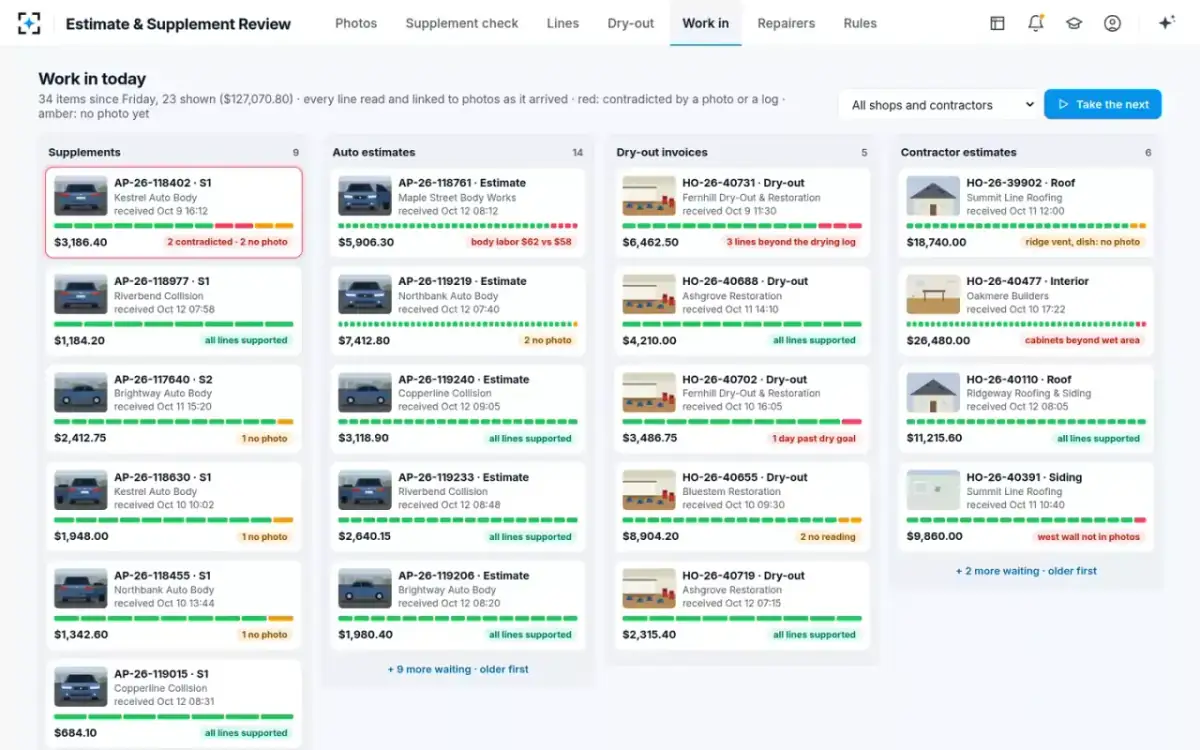
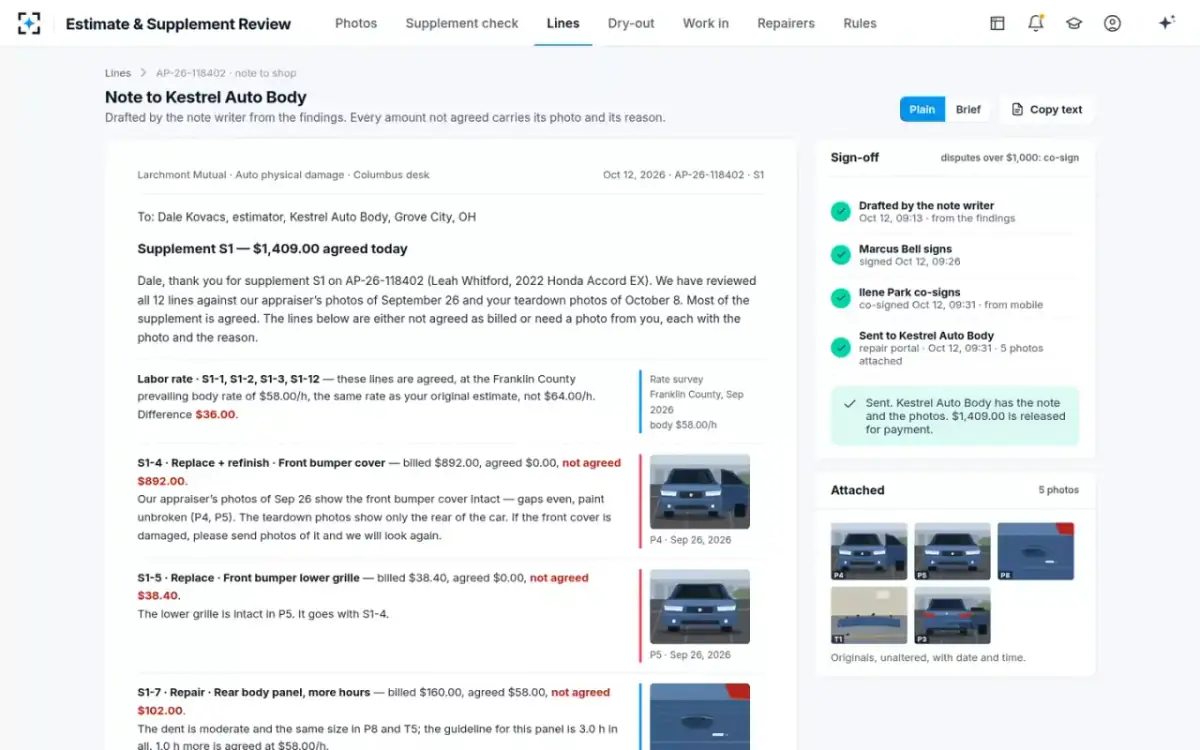
Of the $3,186.40, $1,409.00 was agreed that morning: the hidden rear damage, confirmed on the teardown photos, with only the labor rate adjusted. $1,242.40 was not agreed, mostly a front bumper cover and grille on a rear-impact car whose front the field photos showed intact. And $535.00, a rear parking sensor and its calibration, was held because no photo showed the sensor clearly. Held is not cut: the shop was asked for a close photo, and the lines wait for it. The supervisor co-signed the note from her phone at 09:31 and it went to the shop through the repair portal with five photos attached.
Signed, co-signed and sent with the photos
How Estimate & Supplement Review shortens the insurer's turn, and what it does not do
The solution works on the insurer's turn only. It reads the supplement the moment it arrives, matches each line to the original estimate, puts every new line beside the earliest photo of the same part, checks rates, guideline hours and overlaps, and drafts the note. The desk appraiser then decides each line and signs. Nothing is sent without that signature, and a line with no photo is held while a photo is requested, never cut.
It does not speed up teardown, part supply or the owner's decision, and it cannot answer a supplement whose photos do not show the part. What it changes is the shape of the insurer's answer. A shop that receives, for its front bumper line, "Our appraiser’s photos of Sep 26 show the front bumper cover intact — gaps even, paint unbroken (P4, P5). The teardown photos show only the rear of the car. If the front cover is damaged, please send photos of it and we will look again." knows what to do next, and the owner can see the reason too. How the photo comparison works, part by part, is set out in AI vehicle damage detection: damaged, intact or not clear.
Questions people ask
Is there a standard auto body supplement request form?
No state prescribes one form for every insurer; carriers and shops use their own. Massachusetts comes closest by rule: the shop must complete an itemized supplemental appraisal before requesting a supplementary appraisal, and an expedited request must be an itemized supplemental appraisal prepared by the shop's licensed appraiser.
Can the insurer make the shop use its portal for supplements?
Not as the only channel in Washington. Since 18 October 2026 an insurer there must let the claimant and the shop send claim information by email, post, fax or in person, and may not require an internet-based application alone.
Does the insurer have to re-inspect the car for a supplement?
It depends on the state. In California and New York re-inspection is the insurer's choice, but its timing is regulated once it decides to. California allows six business days after the request, New York two business days for hidden damage (four if the work is sublet), and Massachusetts requires a personal inspection within three business days unless insurer, shop and claimant agree to the expedited process. In Washington, a claimant who disagrees after a virtual inspection can require an in-person inspection within five business days, or another time both agree.
What happens to a supplement line the insurer will not pay?
The insurer must say why. In Washington it must cite the policy language, explain its position against the facts of the loss, or both, and disclose all of the reasons it paid less than the shop's estimate. In California an adjusted estimate must identify each adjustment and its cost.
Can a supplement be filed after the car is repaired?
A shop's final invoice can raise amounts after repair, and Washington's five-business-day written-answer rule covers "supplemental damage estimates and final invoice" alike. Whether a late supplement is covered depends on the policy and the evidence; a supplement for a part never photographed before it was replaced is the hardest to support.