Water mitigation invoice review is the check of a restoration contractor's dry-out bill against the evidence of the job: the drying log, the moisture readings and the job photos. Most of a dry-out invoice is equipment-days, air movers and dehumidifiers billed per unit per day, so the central question is simple: on what day did each affected material reach its dry goal, and was equipment billed after that day or in numbers no photo shows? The drying log answers it, because a properly kept log records a reading at every point every day until the goal is met. Federal flood guidance says drying done to the industry standard normally finishes in under 72 hours. An invoice that runs longer should carry the reason in its own log.
Estimate & Supplement Review is Botminds' software for checking estimates, supplements and invoices line by line against their evidence, with a named person deciding every line. For property claims its drying log checker finds the day each reading point met the dry goal and counts the equipment seen in the job photos against the units and days billed. The example below is a fictional sample claim: a dishwasher leak in a fictional Ohio home and a fictional contractor's invoice. The guidance cited is real; FEMA's applies by its terms to flood claims under the National Flood Insurance Program, and is quoted here because it is detailed, public and current guidance on paying for drying.
Four numbers that frame a dry-out invoice
48hours
EPA: the outer edge of the 24 to 48 hours in which to dry water-damaged areas and items to prevent mold
72hours
FEMA: drying done to the industry standard normally finishes in less
24hours
FEMA: the longest gap between drying log entries until the goal is met
10–15%
FEMA: beyond this, invoiced dehumidifier capacity over the formula should not be paid
How long should water mitigation take?
Usually two to three days of mechanical drying, once wet materials that cannot be saved are removed. The EPA's household guidance is that "It is important to dry water-damaged areas and items within 24-48 hours to prevent mold growth." FEMA's flood claims manual says that when drying is done to the industry standard it "supports prompt completion of drying, normally less than 72 hours", and that if drying charges exceed three days the drying log must give the reason and supporting evidence.
Longer jobs are not wrong in themselves. Dense materials, cold weather and concrete in contact with wet soil can all extend drying; FEMA's manual notes that the industry's standard of care is against prolonged drying of concrete in contact with soil, which should generally be left to dry on its own once drying is otherwise complete. The point for a reviewer is that a long job explains itself in its log. An invoice for six days of equipment with a log showing every reading at goal on day three does not.
The dry goal and the dry standard
The dry goal is the moisture level a wet material must reach, and it is set from the same material where the water never reached. FEMA's structural drying bulletin defines the two terms. The dry goal is "the target moisture level for affected materials which require drying"; the dry standard is the moisture content of unaffected or known dry materials in the building, used to establish that goal. The 2025 manual puts it plainly: readings of unaffected materials "are used as the dry goal for each type of affected material".
That makes the reference reading the most important number on the log. In the sample claim, the unaffected wall read 9.6% and the carrier's rule set the goal for drywall at 12%, or within two points of the unaffected reference. Every reading point in the kitchen reached the goal on day three and finished between 9.8% and 10.1%.
The sample kitchen’s drying log: three reading points, one dry day
| Reading point | Day 1 | Final reading | At or below the 12% goal |
|---|---|---|---|
| Wall A, behind the dishwasher | 38% | 10.0% | Day 3 |
| Wall B | 31% | 9.8% | Day 3 |
| Toe kick C | 27% | 10.1% | Day 3 |
| Unaffected wall (reference) | 9.6% | 9.6% | Never wet |
Water mitigation drying log template: what a proper log contains
A drying log is a daily record of the air and the materials, kept from the first day until every point reaches its goal. FEMA's bulletin describes it as "a record of daily temperature and relative humidity readings of both indoor and outdoor air, plus moisture readings and the recorded location of affected and unaffected building materials, as well as the drying goal and dry standard for the affected materials." The 2025 manual turns that into a list an adjuster can check.
What FEMA’s flood claims manual says a properly completed drying log includes
- Air, inside and out, every day
Daily temperature and relative humidity of indoor and outdoor air.
- Every reading point, located
Moisture readings and the location of the affected materials being dried and of unaffected materials, which set the dry goal.
- What the machines are doing
Daily temperature and humidity from the building’s HVAC output and from every dehumidifier deployed.
- Each dehumidifier, each day
Make, model and capacity of every unit deployed that day.
- Each heater, each day
Make, model and capacity of any supplemental heaters.
- Air movers by type and number, each day
So a declining count can be seen as surface water is removed.
- The volume being dried
Cubic volume of the affected air space, which sizes the dehumidification.
- No skipped days
An entry at least every 24 hours until the goal is met; a log that skips a day of monitoring is not complete.
Outside flood insurance, no federal rule prescribes a log, and carriers and contractors work to the industry's own drying standard (FEMA cites the IICRC S500 standard, published by a non-profit certification body). But the content above is what any reviewer needs to answer the invoice's central question, and the absence of an item is itself a finding: in the sample queue, one dry-out invoice was flagged for missing readings.
How many air movers per square foot?
FEMA's bulletin sizes air movers from what is exposed and wet, not from floor area alone. On day one it allows one air mover per 16 linear feet of exposed perimeter wall sheathing, and at least one per room or closet with salvageable floors; with interior walls removed, the per-room minimum gives way to a larger volume of air. For a typical two-day job drying surface and bound water, day two should carry half of day one's air movers; for three days, days two and three together should equal day one. Its worked example, a 2,000 square foot slab home with walls opened to four feet, allows 15 air movers on day one and 8 on day two.
FEMA’s sizing rules for drying equipment on flood claims
| Equipment | Rule in FEMA’s guidance | Worked example in the bulletin |
|---|---|---|
| Air movers, day 1 | One per 16 linear feet of exposed perimeter wall sheathing; at least one per room or closet with salvageable floors; by area, about one per 60 to 400 square feet depending on what was removed | 2,000 sq ft ÷ 135 sq ft = 15 air movers |
| Air movers, later days | Two-day job: day 2 is 50% of day 1. Three-day job: days 2 and 3 together equal day 1. Bound water only: the same each day | Day 2: 8 air movers; 23 over the job |
| Low-grain refrigerant dehumidifiers | Cubic feet of affected space ÷ 50 = pints a day needed (AHAM rating) | 2,000 sq ft × 8 ft ÷ 50 = 320 pints a day |
| Desiccant dehumidifiers | Cubic feet ÷ 60 × 2 = airflow needed in cubic feet a minute | Not used in the example |
| Tolerance | Invoiced capacity “within an arm’s reach” of the formula is honoured; beyond 10% to 15% over, the excess should not be paid | 340 pints a day supplied against 320 needed |
How many dehumidifiers do I need?
Enough capacity for the volume of wet space, not a number of units. FEMA's formula for low-grain refrigerant units divides the affected volume in cubic feet by 50 to get the pints a day of rated capacity needed; its example of a 2,000 square foot area with 8-foot ceilings needs 320 pints a day, met by three 70-pint units and one 130-pint unit, 340 in all. Standard refrigerant units should not be counted. For a reviewer, the question on an invoice is whether the units billed add up to roughly the capacity the volume needs, and whether the count falls as the job dries.
The 2025 manual adds the signs of a job that ran longer than it should. A drying invoice that shows insufficient dehumidification capacity, uses only carpet driers when the water was above floor level, "does not show a declining use of air movers", or does not bring in heaters in the last part of drying does not follow industry standards, and FEMA directs that such invoices be priced by the adjuster's own allowance, however thorough the log appears.
The sample dry-out: six days billed, three needed
Take the sample claim as it runs through the solution. Fernhill Dry-Out & Restoration billed $6,462.50 across 16 lines for drying a 420 square foot kitchen after a dishwasher leak: six air movers and two dehumidifiers a day for six days, plus extraction, baseboard removal, a two-foot flood cut and antimicrobial. The drying log showed all three reading points at the 12% goal on day three. The day-one job photo showed four air movers, not six.
Equipment-days billed on the sample invoice, against the day the walls were dry
- Days 1–3, seen in photos12
- Days 1–3, in no photo6
- Days 4–6, after the dry goal18
- Days 1–36
- Days 4–6, after the dry goal6
What the drying log checker showed the estimator
The drying log checker did not cut anything. It showed the property estimator, Tom Okoro, three things on one screen: the readings against the goal, with days four to six shaded as billed after it; the units seen in the job photos against the units billed; and the antimicrobial billed on the dining room, which the moisture map shows was never wet. The figure put to him to agree was $4,658.90 of the $6,462.50 billed, and nothing goes to the contractor until he signs.
The dry-out invoice against its drying log and job photos
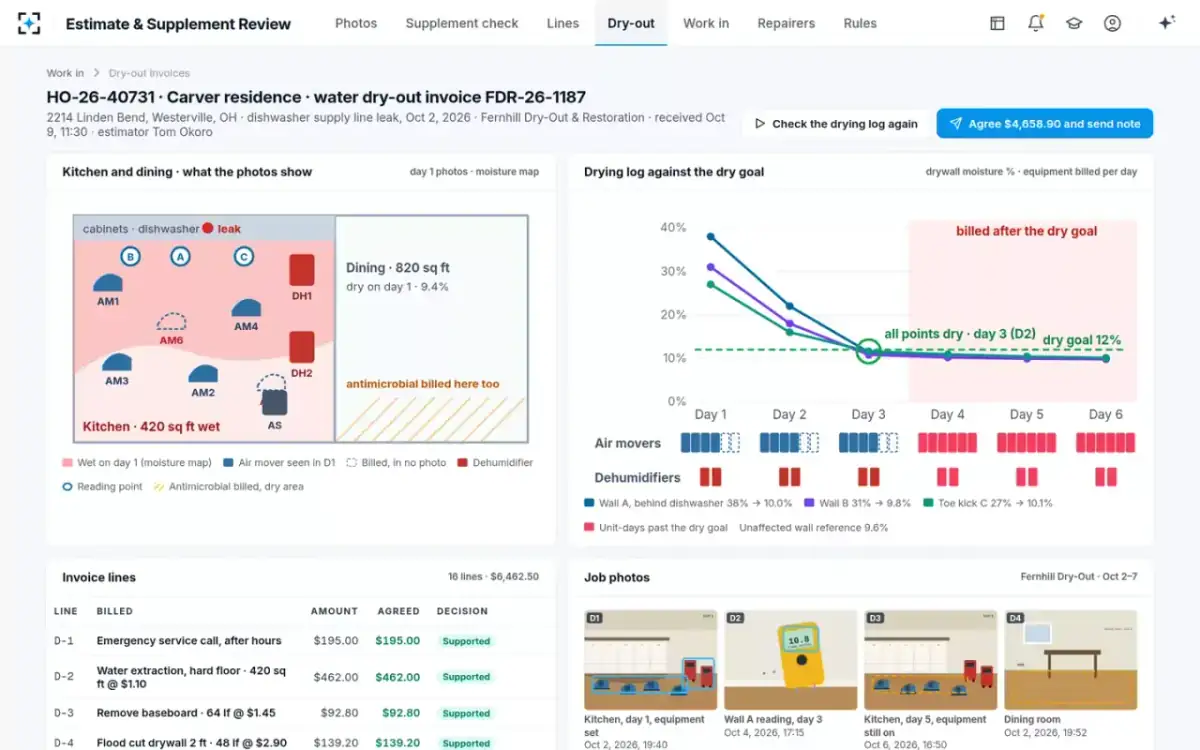
One dry-out line, as invoiced and as the log reads it
The invoice: 6 a day × 6 days = 36 unit-days.
The drying log and photos: 4 seen in the day-1 photo; all points at goal on day 3. 12 unit-days evidenced.
The invoice: 2 a day × 6 days = 12 unit-days.
The drying log and photos: 2 seen; needed until day 3. 6 unit-days evidenced.
The invoice: Kitchen and dining room.
The drying log and photos: Dining room read 9.4% on day 1 and was never wet.
The invoice: Billed by area and length.
The drying log and photos: Supported by the moisture map and day-1 photos.
The invoice: —
The drying log and photos: A reading after day 3 above the goal, or a photo of the other two air movers.
Water mitigation invoice dispute: the scope, the clock and the written reasons
Disputes are cheapest before the equipment runs, when the scope is agreed. Washington now makes the insurer's turn on a mitigation scope a regulated clock: it is an unfair practice to fail "to approve the first party claimant's scope of mitigation or to provide the first party claimant with an approved scope of mitigation within five business days after receipt of the scope of mitigation from the first party claimant", where the policy requires the claimant to protect the property. If the insurer rejects the scope, it must disclose why it does not meet technical or industry standards, including a dollar itemization of the disapproved items (WAC 284-30-330(20)-(21), as amended, in force since 18 October 2026).
On the invoice itself, the same discipline applies. Each amount not agreed needs its reading or photo and its dollars, and a note should say what the contractor can send to change it. The drying log checker in the solution never rejects a log; where readings are missing it asks for them. The full list of what a property review tool should prove before you rely on it is in how to pilot estimate review on last quarter's files, and the same evidence rule for auto supplements is in a supplement decision that holds.
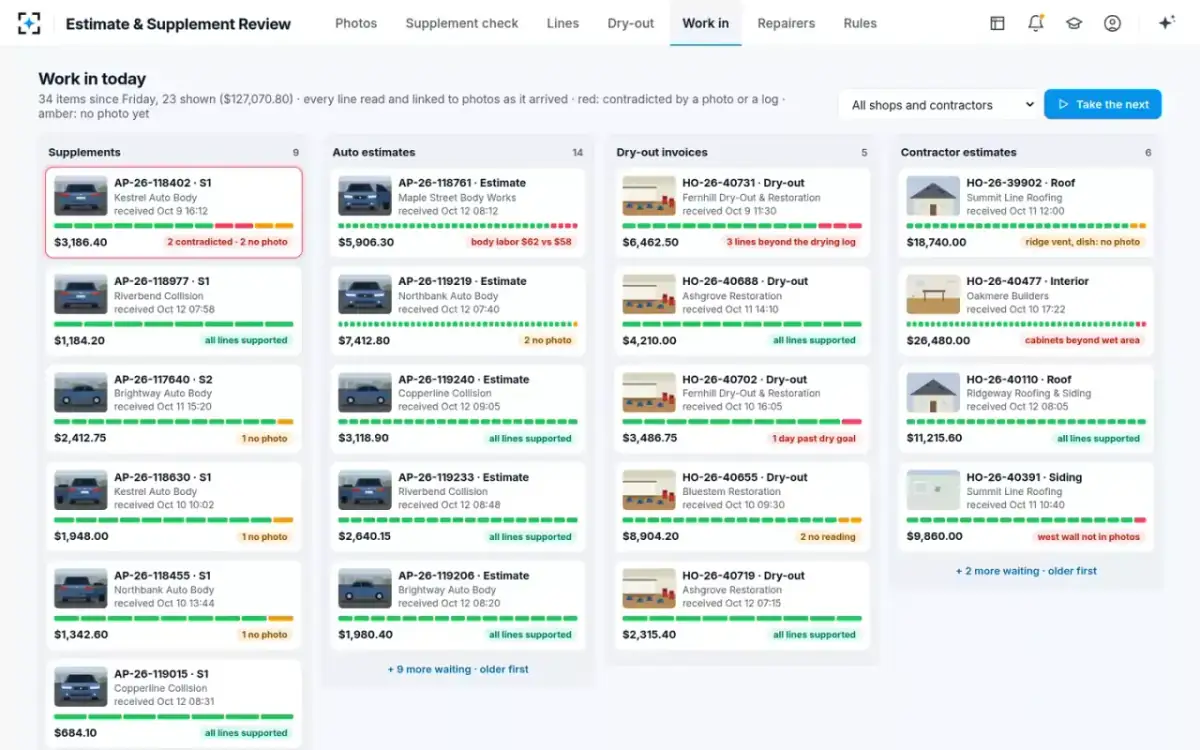
Dry-out invoices in the queue, each with its drying-log finding
Questions people ask
What should a water mitigation invoice sample include?
Each line with its unit, quantity and price: emergency call, extraction by area, materials removed by length or area, and equipment by type, units and days. It should come with the drying log and the job photos; FEMA's flood guidance treats a drying invoice without a properly completed log as unsupported and has the adjuster determine an allowance instead, for no more than 72 hours.
Is billing air movers after the walls are dry allowed?
A contractor can bill what it ran, but an insurer reviewing the invoice can question equipment-days after the log shows the goal met. FEMA's flood guidance expects air movers to decline as surface water is removed and requires the log to justify any drying beyond three days.
Should antimicrobial be paid on a room that was never wet?
The moisture map is the evidence. In the sample claim the dining room read 9.4% on day one, below the 12% goal, so antimicrobial billed there was shown to the estimator as unsupported. FEMA's bulletin calls for cleaning and treating salvageable materials before drying begins, which presupposes they were affected.
What is a water mitigation invoice audit?
A line-by-line check of the invoice against the scope, the drying log, the moisture map and the photos, usually by the carrier's property estimator or an independent reviewer. FEMA's bulletin recommends an independent review by a qualified third party where charges with a drying log go beyond its guidance, without letting the reviewer override the policy.
Does homeowners insurance follow FEMA's drying rules?
Not as such: FEMA's guidance governs flood claims under the National Flood Insurance Program. Homeowners claims follow the policy, state law and the industry's drying standard, but FEMA's published rules are a detailed government reference for what a reasonable drying invoice looks like.