To read a body shop estimate, start with the header (who, which vehicle, which claim, which dates), then read each line for its six parts, operation, part, labor type, hours, rate and amount, and finish with the totals by labor type, parts, paint materials, sublet work and tax. The line is where the money is decided. "Replace · Rear bumper reinforcement · Part $412.00 · 1.2 h body @ $64.00 · $488.80", a line from the sample supplement, tells you what will be done, to which part, by which kind of labor, for how long, at what hourly rate, and what it adds up to. Read that way, an estimate stops being a wall of numbers and becomes a set of claims, each of which can be checked against a photo, a guideline time or a rate.
Reading lines is also exactly what estimate review is. Estimate & Supplement Review, Botminds' software for checking estimates, supplements and repair invoices against the photos, rates and policy, begins with an estimate reader agent that reads each line into those six parts and matches every supplement line to the original estimate as new, changed or repeated. The examples on this page are from a fictional sample claim: a rear-ended 2022 Honda Accord, a fictional Ohio shop and carrier, an original estimate of 38 lines and a supplement of 12.
The six parts of one estimate line
1Operation
Replace
What is done: replace, repair, remove and install, refinish, blend, sublet
2Part
Rear bumper reinforcement
Which part, and whether new OEM, aftermarket, used or reconditioned
3Labor type
Body
Body, refinish, frame, structural, mechanical; each has its own rate
4Hours
1.2 h
From the estimating system’s guideline, or entered by judgment
5Rate
$64.00 / h
The shop’s rate for that labor type; the insurer may pay a prevailing rate
6Amount
$488.80
Part price $412.00 plus 1.2 h × $64.00
How to read an auto estimate: header, lines, totals
The header identifies the claim and the car, and it matters more than it looks. New York's regulation lists what an insurer's estimate must contain at a minimum: the policyholder or owner and their address, the insurer and its adjuster's name, license number and phone, the vehicle's year, make, model, body style, mileage, VIN, plate, color and condition, the claim number, the date of the accident and "the date the vehicle was inspected". The inspection date is the one a reviewer uses most: it says when the photos behind the estimate were taken.
The lines follow, usually grouped by area of the car, and then the totals: parts, labor hours and dollars by labor type, paint and body materials, sublet work, tax, and any deductible or betterment taken. Massachusetts states the logic of the whole document in one sentence: the appraiser "shall itemize the cost of all parts, labor, materials, and necessary procedures required to restore the vehicle to pre-accident condition and shall total such items." A total that cannot be traced back to its lines is not an estimate a reviewer can check.
What the rules in five states say an auto repair estimate must show
| State and rule | What the estimate must show |
|---|---|
| New York · 11 NYCRR 216.7(b)(13), (b)(4) | Owner, insurer and adjuster with license number; vehicle details including VIN and mileage; claim number, accident date and inspection date; each item of damage with its paint, parts and labor hours; a separate line for paint-waste disposal |
| California · 16 CCR 3353, 10 CCR 2695.8 | Parts and labor described separately, each part listed and identified if used, rebuilt, reconditioned or aftermarket; any sublet repair stated; an insurer’s adjusted estimate must identify each adjustment and its cost |
| Massachusetts · 212 CMR 2.04(1)(e) | All parts, labor, materials and necessary procedures itemized and totalled; frame fixture rental shown; unrelated damage on a separate report or clearly segregated |
| Ohio · Ohio Adm. Code 3901-1-54(H) | A copy to the claimant; betterment and depreciation deductions itemized as dollar amounts on the estimate; the source of any like kind and quality parts |
| Washington · WAC 284-30-390(1)(b)(ii), as amended | Repair costs not covered, documented in writing with the policy language cited; on request, how labor and material costs and repair processes were determined |
The six parts of every estimate line
Every line, on a shop estimate, an insurer's estimate or a supplement, answers the same six questions, and New York requires the answer to three of them for each item of damage: it "must be detailed as to the paint, parts and labor hours it will require to repair that particular item." California's repair rules require the same separation from shops: "Parts and labor shall be described separately, and each part shall be listed in the estimate."
Operation says what will be done. The common ones are replace (a new part), repair (fix the existing part, priced in hours), remove and install (take a part off for access and put the same part back), refinish (paint), blend (partly refinish an adjacent panel so the color matches) and sublet (work sent to another business, such as an alignment or a sensor calibration). Part names it, and should say whether it is new from the vehicle maker, aftermarket, used or reconditioned. Labor type says which kind of technician's time is being billed. Hours are usually the estimating system's guideline time for that operation, or a judgment entry where the system has none. Rate is the hourly rate for that labor type. Amount is part price plus hours times rate, plus any materials tied to the operation.
What does R&I mean on an estimate?
R&I means remove and install, also read as remove and reinstall: the part is taken off to reach or protect something else and the same part goes back on, so the line carries labor hours but no part price. It is different from R&R, remove and replace, where the old part comes off and a new one goes on. In the sample supplement, line S1-4 carries "Part $588.00 · 1.0 h R&I · 2.5 h refinish · materials": a new front bumper cover, with an hour to remove and install the parts attached to it and two and a half hours to paint it.
R&I lines are where a supplement most easily repeats work. If the original estimate already removed and installed an assembly to repair a panel, and the supplement replaces a part inside the same assembly, the removal is already paid. A reviewer reads every R&I line on a supplement against the original estimate for the same assembly.
Labor types and labor rates on an auto estimate
Each hour on an estimate belongs to a labor type, and each type can have its own rate. California's prescribed labor rate questionnaire asks shops for a separate hourly rate for eight types: auto body and sheet metal, structural, frame, mechanical, refinish, aluminum repair, carbon fiber and fiberglass. The sample carrier's rate table uses five columns: body, refinish, frame, mechanical and paint materials, which is charged per refinish hour.
That is why the labor type matters as much as the hours. In the sample, Kestrel Auto Body billed frame set-up and measuring at $68.00 an hour, refinish at $58.00 and body at $64.00. The frame and refinish rates matched the sample's prevailing rates for Franklin County; the body rate was $6.00 above the $58.00 prevailing body rate, and above the shop's own original estimate. How a prevailing rate is set, and when an insurer may pay it instead of the shop's, is covered in the California auto body labor rate survey.
Parts: OEM, aftermarket, used and reconditioned
The part column should say what kind of part is being priced, and in several states the estimate must. California requires a shop's estimate to treat each listed part as new unless it is identified as used, rebuilt or reconditioned, and each new crash part as made by the vehicle's manufacturer unless it is identified as a non-OEM aftermarket part. Its Auto Body Repair Consumer Bill of Rights, which insurers must give to policyholders, promises an itemized estimate and invoice that identify all parts as new, used, aftermarket, reconditioned or rebuilt (10 CCR 2695.85).
An insurer's own estimate carries extra duties when it specifies non-OEM parts. In California the insurer must warrant that such parts are at least equal to the manufacturer's in kind, quality, safety, fit and performance, and say so in writing in any estimate prepared by or for it (10 CCR 2695.8(g)). In Ohio, an estimate that expects like kind and quality parts must name the location of the licensed salvage dealer they will come from (Ohio Adm. Code 3901-1-54(H)(4)). A reviewer reading a supplement checks that a part's type did not change silently between the original and the supplement.
Paint, materials and the lines regulators single out
Refinish labor brings paint and materials with it, and estimates price them in one of two ways: a materials rate per refinish hour, or a materials invoice. In the sample, the blend of the left quarter panel (line S1-6) is 1.4 refinish hours at $58.00 plus $53.20 of materials, which is $38.00 per refinish hour, the sample table's paint-materials rate. Massachusetts, where materials are often disputed, provides that if the formula of "dollars times hours" is not accepted by the shop or appraiser, a published manual or other documentation is used unless the parties negotiate otherwise.
New York singles out one line every insurer estimate there must carry separately: the cost of disposing of the hazardous waste generated by painting, calculated as the shop's annual disposal fees divided by its annual paint hours, times the paint hours on this repair (11 NYCRR 216.7(b)(4)). Massachusetts requires unrelated damage to be recorded on a separate report or clearly segregated, unless it is in the area of repair. Lines like these are small, but they are where the law tells you what a complete estimate looks like.
What are not included operations, and what is a P-page?
A not-included operation is a step the guideline time for an operation does not cover, so it has to be written as a line of its own: a frame set-up and measurement, for example, is not part of the time to repair a panel, which is why the sample supplement has it as a separate line, S1-8, 1.5 frame hours. Estimating systems publish explanation pages, often called procedure pages or P-pages, that say what each labor time includes and excludes; they are the reference a reviewer and a shop estimator argue from.
The law gives those pages weight. California forbids an insurer to prepare an estimate that deviates from the standards, costs or guidelines of the estimating software it uses where that would prevent a proper repair (10 CCR 2695.8(f)), and Montana forbids an insurer to "unilaterally disregard a repair operation or cost identified by an estimating system that the insurer and an automobile body repair business or location have agreed to utilize in determining the cost of repair." A reviewer who removes a not-included line needs a reason that holds against the system's own procedure pages.
Body shop estimate example: one supplement, line by line
The sample supplement shows how the six parts carry a review. Of its 12 lines, the estimate reader found 11 new and one changed: the rear bumper cover, which the original estimate had repaired in 3.0 body hours and the supplement now replaces. That change is the line most worth reading slowly.
One supplement line as the shop wrote it and as a reviewer reads it
Line S1-12, as written: Repair → replace
As the reviewer reads it against the original: Changed, not new: the original estimate repaired this cover (line O-2, 3.0 h body).
Line S1-12, as written: Rear bumper cover, part $387.10
As the reviewer reads it against the original: Supported: teardown photo T1 and field photo P1 show the cover damaged. A new part is justified.
Line S1-12, as written: 1.0 h body
As the reviewer reads it against the original: Reasonable for the replacement, but the 3.0 h repair on the same cover is now superseded.
Line S1-12, as written: $64.00 / h
As the reviewer reads it against the original: Prevailing body rate, and the shop’s own original rate, is $58.00: $6.00 less.
Line S1-12, as written: $451.10
As the reviewer reads it against the original: Agreed $271.10: part $387.10 + 1.0 h × $58.00 − the original repair, $174.00. Not agreed $180.00.
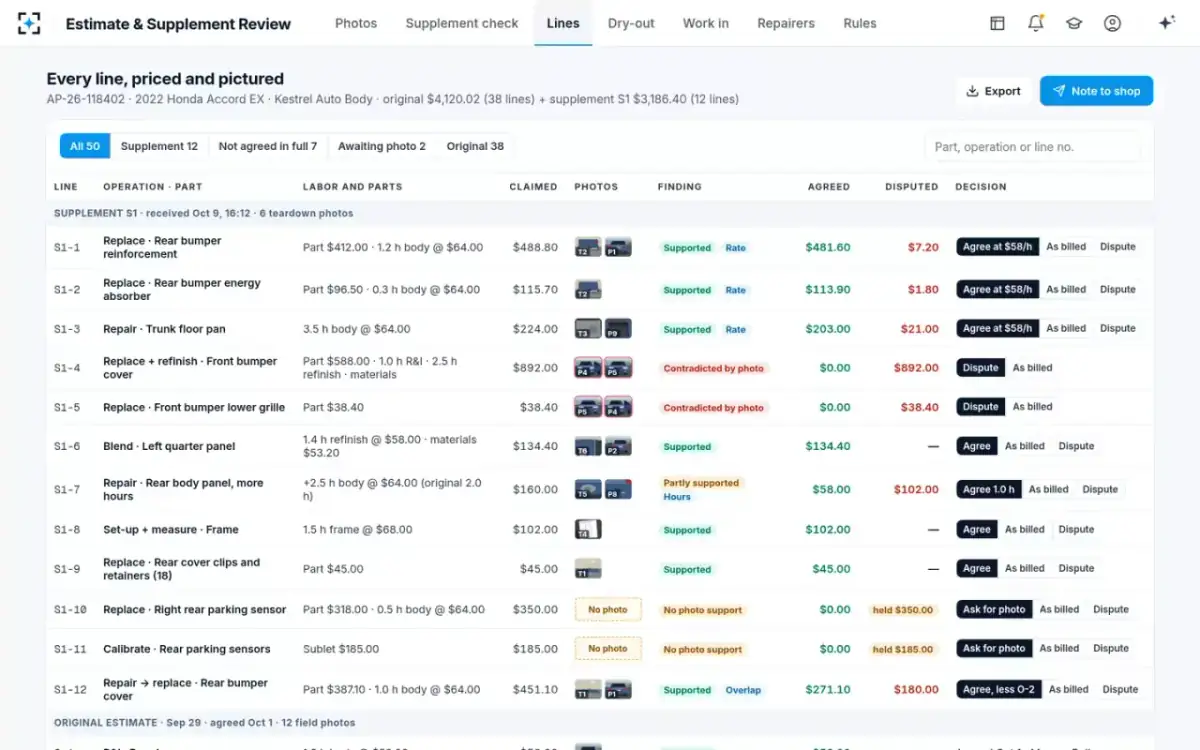
Reading the other lines the same way sorts the supplement quickly. The reinforcement, absorber, trunk floor, clips, frame set-up and blend are new lines for hidden damage, each with a teardown photo; they were agreed, the body-rate lines at $58.00. The rear body panel asked 2.5 more hours where the guideline for the damage shown allows 1.0 more. The front bumper cover and grille were new lines for parts the first photos showed intact. And the sensor and its calibration sublet had no photo, so they waited for one.
Every line of the original and the supplement, in one table
How a supplement adds, changes or double-counts
A supplement line is one of three things relative to the original, and each needs a different check. A new line adds a part or operation: check that a photo shows the part damaged and that it could not have been seen before teardown. A changed line alters an original line, most often repair to replace: check that the original line's hours come off. A repeated line bills something the original already paid: an R&I of the same assembly, a refinish already priced, a materials charge on hours already counted.
Reading a supplement against the original estimate
- Match every line to the original
New, changed or repeated. Keep the shop’s own line numbers so the note can refer to them.
- For new parts, find the photo
A teardown photo of the part, damaged. If the first photos show the same part intact, a person should look before paying.
- For changed operations, remove what is superseded
Repair hours on a panel now replaced; refinish on a panel now blended instead.
- Check the labor type against the rate
Body, refinish, frame and mechanical hours each at their own rate.
- Check hours against the guideline and the damage
Judgment hours above the guideline need a reason the photo supports.
- Check part types and sublets
OEM, aftermarket or used as before; a sublet invoice for work the shop says it sent out.
- Re-add the totals
Every total should be the sum of its lines, by labor type, parts, materials and tax.
Blend, overlap and included operations are where most of these checks become arguments; the thresholds behind them are set out in when to blend adjacent panels, and other lines reviewers question.
Online body shop estimate review: what the agents read, and what they leave to a person
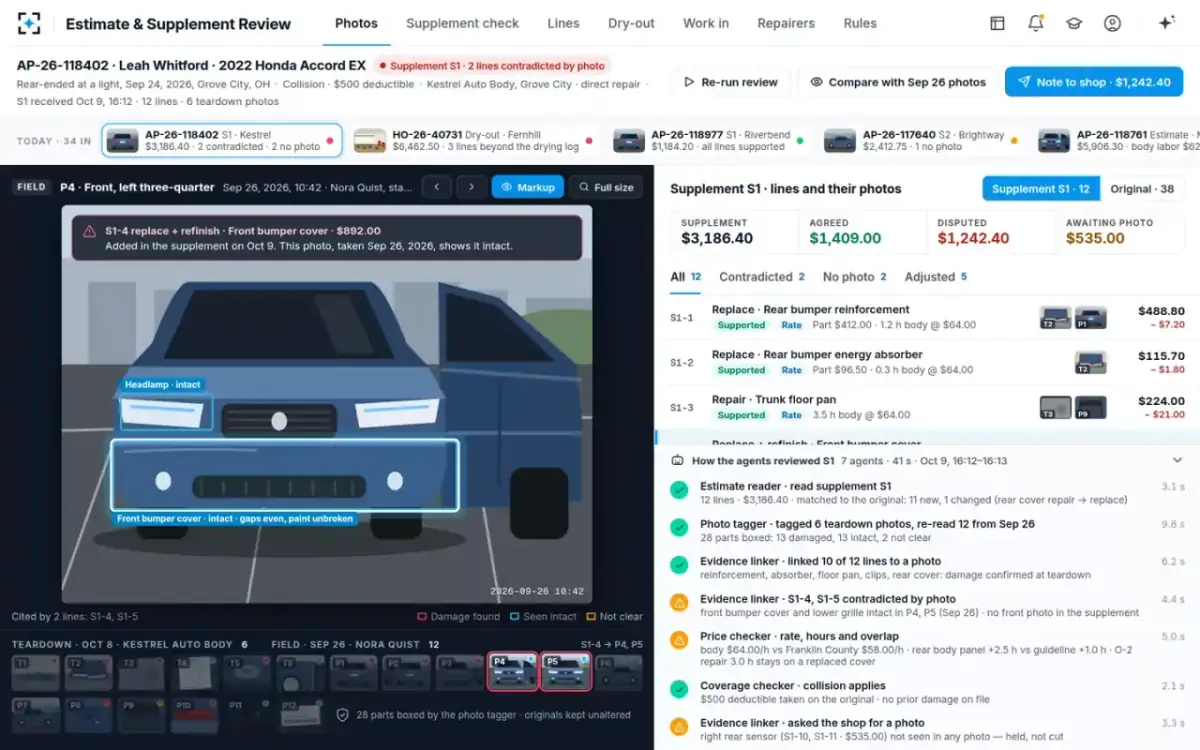
In the solution, the estimate reader reads every estimate, supplement and repair invoice into those six parts the moment it arrives, keeps the shop's own line numbers and never changes a line or an amount. The other agents then do the checks that need evidence: the photo tagger and evidence linker for the part, the price checker for rate, hours, overlap, included operations and blend, the coverage checker for the policy. On the sample supplement, all of this took 41 seconds. The decisions, and the signature on the note to the shop, stay with the desk appraiser.
How the agents read the supplement, step by step
Where the solution does not fit: it does not write estimates, and it does not tell a shop how to repair a car. It reads the estimate the shop or appraiser wrote and checks each line against the evidence. Washington now requires an insurer that pays less than a shop's estimate to disclose every reason, with the policy provision explained (WAC 284-30-390(2), as amended); a review that reads each line's six parts produces those reasons as a by-product.
Questions people ask
Can I get a copy of the insurer's estimate?
In the states covered here, yes. California and Ohio require the insurer to give the claimant a copy of the estimate a partial-loss settlement is based on, and New York requires the insurer's detailed written estimate to reach the insured or their designated shop within six business days of the claim. Washington requires a copy whenever the insurer prepares the repair estimate.
What is an auto estimate report sample supposed to include?
At least the claim and vehicle identity, the inspection date, and every item of damage with its parts, paint and labor hours, then the totals. New York's 11 NYCRR 216.7(b)(13) is the most complete published list of minimum contents; California requires parts and labor to be described separately, with each part listed.
What is overlap on an estimate?
Overlap is labor that two operations share, so paying both in full would pay some time twice. The commonest case on a supplement is a panel first estimated for repair and then replaced: the repair hours come off. On the sample supplement that removed $174.00, the original 3.0-hour repair on the rear bumper cover.
Why are there two labor rates on my estimate?
Because each labor type can have its own rate: body, refinish, frame, mechanical and others. California's labor rate survey collects a separate rate for eight labor types, and an insurer may pay a different prevailing rate for each.
What does "sublet" mean on a body shop estimate?
Work the shop sends to another business and bills through, such as a wheel alignment or a sensor calibration. California requires the shop to state any sublet repair with the estimate and, on request, name the facility doing it; the sample's $185.00 parking sensor calibration is a sublet line.