An AI car repair estimate, a repair estimate drafted by software from photos of the damage, can be used by an insurer in each state reviewed here, but only as the insurer's own estimate, with the insurer answerable for every line of it. Washington's amended claims rule, in force since 18 October 2026, is the most explicit: an insurer may not require a claimant to accept only photo-based evaluation as a condition of coverage, must inspect in person within five business days when a claimant disputes a virtual inspection, may not rely solely on a database, including estimating software, for its investigation, and must tell the claimant on request where its pricing data came from. California and New York allow photos or estimates in place of an inspection only on set terms, and Massachusetts requires its licensed appraisers to inspect in person. The answer to "can AI write the estimate?" is therefore yes, as a draft; in Washington a competent person must stand behind it, and everywhere the insurer must be able to explain it.
That is the line Estimate & Supplement Review is built on, from the other side of the desk: it does not write estimates, it reviews the ones shops send, line by line against the photos, rates and policy, and the desk appraiser decides every line and signs. This page maps the rules for anyone deploying AI in auto physical damage, whether to draft estimates or to review them. The rules are current as of October 2026; the examples come from a fictional sample claim.
"the insurance industry is changing their claim process from an in-person, on-site, loss examination to the use of artificial intelligence and photo-based loss adjusting to maximize efficiencies."
Washington Insurance Commissioner, explaining the 2026 claims rule (WSR 26-17-089)
Can an insurer require photo-only estimates?
Not in Washington. Since 18 October 2026 the state's motor vehicle claims rule says: "Insurers shall not require the claimant to agree to only photo-based evaluation of damage as a condition of coverage." The same rule requires the insurer, on notification of the claim, to tell the claimant they may ask for an in-person inspection by the insurer's adjuster or chosen repair expert, and bars making an internet application the only way the claimant or the repair facility can send claim information.
Elsewhere, photo estimates are permitted on terms. California lets an insurer ask for photographs or an estimate in place of a physical inspection, but "such a request must be made within three (3) business days after the insurer's receipt of the notice of claim or request for a supplemental estimate", with notice that it may still inspect. New York allows an insurer to ask for an estimate instead of a physical inspection where the loss reported is minor, within three business days, and to inspect within four business days of receiving the estimate if it has good reason. Massachusetts goes the other way: its appraisers must inspect the car personally and rely primarily on that inspection, although an insurer may choose not to assign an appraiser at all to a claim under $1,500 after the deductible.
Is a photo estimate legal?
Yes, in each of the states reviewed here, when it is used within that state's terms; what changes from state to state is who must look at the car, and when. Massachusetts is the strictest. Its rule for licensed auto damage appraisers says "The appraiser shall personally inspect the damaged motor vehicle and shall rely primarily on that personal inspection in making the appraisal", and photograph each damaged area as part of it; only supplements, by agreement of insurer, shop and claimant, may skip the personal inspection under an expedited process.
Photo and AI estimates in four states: what each rule allows
| State and rule | Photo or remote estimate allowed? | The condition |
|---|---|---|
| Washington · WAC 284-30-390, as amended 2026 | Yes, but not as the only option | No photo-only condition of coverage; in-person inspection within 5 business days on request after a disputed virtual one; the right to ask disclosed at notice of claim |
| California · 10 CCR 2695.8(e)(4) | Yes, in place of an inspection | Requested within 3 business days of the claim or supplement request, with notice that the insurer may still inspect within 6 business days |
| New York · 11 NYCRR 216.7(b)(10) | An estimate instead of inspection, for minor losses | Requested within 3 business days; any inspection within 4 business days of receiving the estimate |
| Massachusetts · 212 CMR 2.04(1)(a), (d), (i) | Not for the appraisal itself | Personal inspection and photographs by a licensed appraiser; claims under $1,500 after the deductible may be excluded from appraisal; supplements may be expedited without inspection only by agreement |
Can I ask for an appraiser to see the car in person?
In Washington, yes, and the insurer must tell you so when you report the claim. If you used a virtual inspection and disagree with the amount of loss, the insurer must accept your request for an in-person inspection and inspect the vehicle within five business days, or at another time you agree. If it cannot document damage in a photo you or your shop submitted, it must make reasonable efforts to get more documentation before rejecting coverage of that damage.
In other states, ask; the insurer chooses whether to inspect, but if it does, the timing is regulated: six business days in California, and in New York six business days for the first inspection after notice and two for a re-inspection of hidden damage. In Massachusetts an in-person inspection is the rule rather than the exception.
Who is accountable for an AI estimate?
The insurer, through a person it can show was competent. Washington's amended rule says that if the insurer prepares the repair estimate it must rely upon a competent person, and defines the term: "'Competent' in this subsection means the person has the subject matter expertise, relevant training, and experience to make valuations and decisions relating to the repair process." The same subsection adds that the insurer is responsible for the accuracy of its repair documentation, and a separate one that insurers are responsible for the accuracy of evaluations made on their behalf.
And no estimate may be the whole investigation. Washington's list of unfair practices now says that "A reasonable investigation may not rely solely on the use of a database, which includes, but is not limited to, estimating software and benchmarks gathered from one or multiple databases." An AI tool that turns photos into prices, used without a person checking the result against the evidence, is the case this sentence is written for.
The national template points the same way. The NAIC's model bulletin on insurers' use of AI says that "Decisions subject to regulatory oversight that are made by Insurers using AI Systems must comply with the legal and regulatory standards that apply to those decisions, including unfair trade practice laws." It is a model, binding only where a state adopts it. Legislatures are also testing harder lines: Florida's CS/CS/HB 527 (2026) would have barred reducing or denying a claim "based solely on the output of an AI system, algorithm, or machine learning system", but it died in the Senate Rules Committee on 13 March 2026 and is not law (bill history).
What must an insurer tell me about its estimating software?
In Washington, where its prices came from. The amended rule says: "If an insurer uses a database, survey, estimating software, or benchmarks to account for either material pricing, labor rate, or both, and upon request of the claimant, the insurer must provide the claimant with the date the data was collected, where the data was collected from, and which businesses provided the cost data to the database, survey, estimating software, or benchmarks." On request it must also explain in writing how labor and material costs and repair processes were determined, and any repair cost it says is not covered must be documented with the policy language cited.
For an AI estimating tool, that is a design requirement as much as a legal one. A model that produces a price without a traceable rate, parts price and labor time cannot answer the question. California has long required the same traceability of labor-rate surveys, down to the shops that responded; how the California prevailing rate is set shows what a fully documented rate looks like.
The obligation map: rule, control, evidence
For anyone putting AI into auto physical damage claims, each rule above becomes a control the process must have and a piece of evidence the file must hold. Laid out that way, the rules describe a workflow rather than a ban.
From rule to control to evidence, for an AI-assisted auto estimate
| Rule | Control in the process | Evidence in the claim file |
|---|---|---|
| No photo-only condition (WA) | The in-person option is offered at first notice and honoured on request | The disclosure, the request date and the inspection date |
| Not solely a database (WA) | A competent person checks the draft against photos and the car | Line-level findings with photos, and the person’s sign-off |
| Competent person (WA) | Named, qualified estimators approve AI drafts | Who approved each estimate, and their qualifications |
| Data source on request (WA) | Every rate and price comes from a dated, named source | Source, date and supplying businesses for each rate and price |
| Photos in place of inspection (CA, NY) | Requests sent inside 3 business days, with notice of a possible inspection | Request date and notice text |
| Personal inspection (MA) | AI drafts used only after a licensed appraiser’s inspection | The appraiser’s inspection record and photographs |
| AI program, where adopted (NAIC bulletin) | Written program, testing and oversight of vendor tools | Validation results and vendor due diligence |
AI collision repair estimate software: draft, review, decide
Software that drafts estimates from photos and software that reviews estimates sit on opposite sides of the same rules. A drafting tool has to show its prices and hand its draft to a competent person. A review tool has to show its evidence and leave the decision to one. The federal labor statistics agency already counts the first in its outlook for the occupation: "For example, computer software can evaluate photographs of damaged property and calculate an estimated claim amount." It also counts 13,500 insurance appraisers of auto damage in 2025, a number it projects will fall 9% by 2035.
An AI draft estimate, and what the rules make the insurer's estimate
AI draft from photos: Detected from the photos the claimant took.
The insurer’s estimate, as the rules require it: Checked by a competent person; more documentation sought before rejecting damage a photo does not show.
AI draft from photos: Not visible, so not estimated.
The insurer’s estimate, as the rules require it: Considered when the shop finds it; in Washington a written answer on any supplement within 5 business days.
AI draft from photos: From a database or model.
The insurer’s estimate, as the rules require it: From dated, named sources the claimant can ask about.
AI draft from photos: None.
The insurer’s estimate, as the rules require it: In person on request after a disputed virtual one (WA); by a licensed appraiser (MA).
AI draft from photos: Unclear.
The insurer’s estimate, as the rules require it: The insurer, through a named person with the expertise to decide.
What the research says about detecting damage from photos, and why dents and cracks are much harder than broken glass, is in AI vehicle damage detection, part by part. The short version for this page: the lines a supplement argues about are the lines detection handles worst, which is one more reason the rules keep a person in the loop.
Where Estimate & Supplement Review fits: agents recommend, a person decides
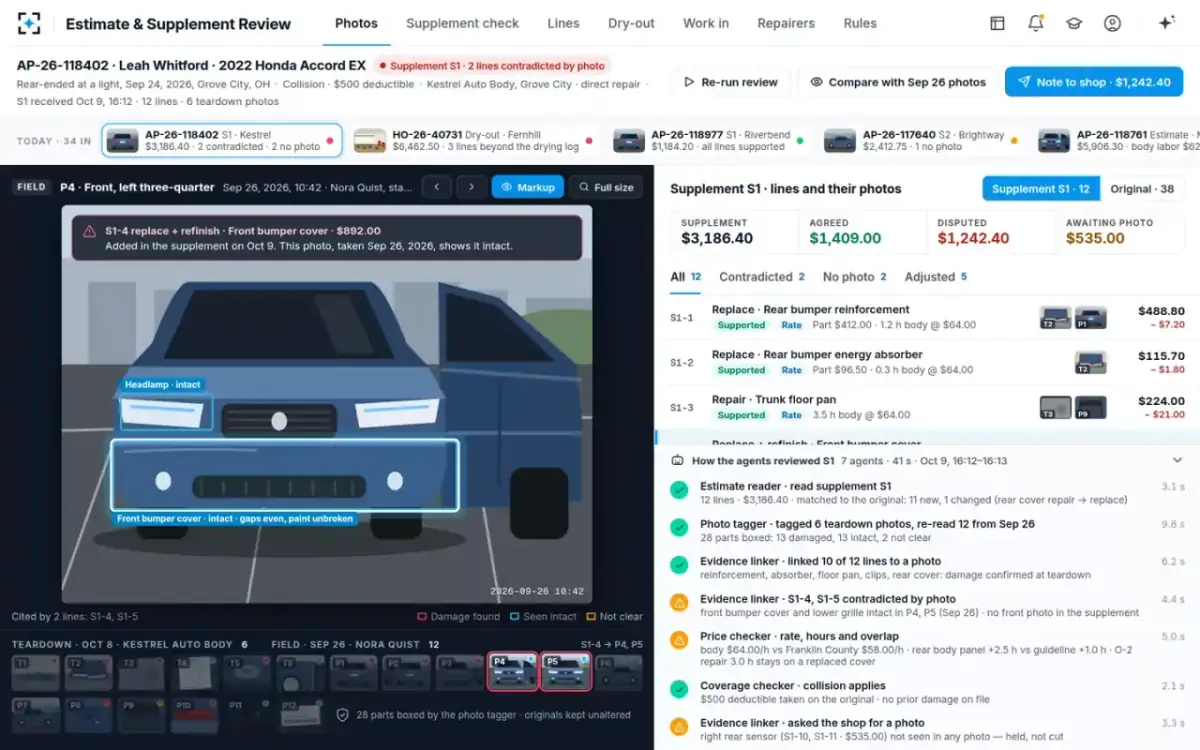
In the solution, seven agents read every estimate, supplement and invoice as it arrives and tie each line to the photos, the local rates and the coverage, but none of them decides. The estimate reader never changes a line or an amount; the photo tagger marks "not clear" rather than guessing; the evidence linker holds a line with no photo instead of cutting it; the coverage checker never denies coverage; the note writer never sends without the appraiser's signature. The rule that would let small, clean lines be agreed without a person is off unless a carrier turns it on.
One sample supplement, reviewed by agents and decided by people
41s
for seven agents to read 12 lines against 18 photos
0lines
agreed or cut by an agent; the appraiser decided, and two lines wait for a photo
2signatures
on the note: the appraiser’s and the supervisor’s
5photos
sent with the note, originals unaltered
What the agents did, step by step, before a person decided
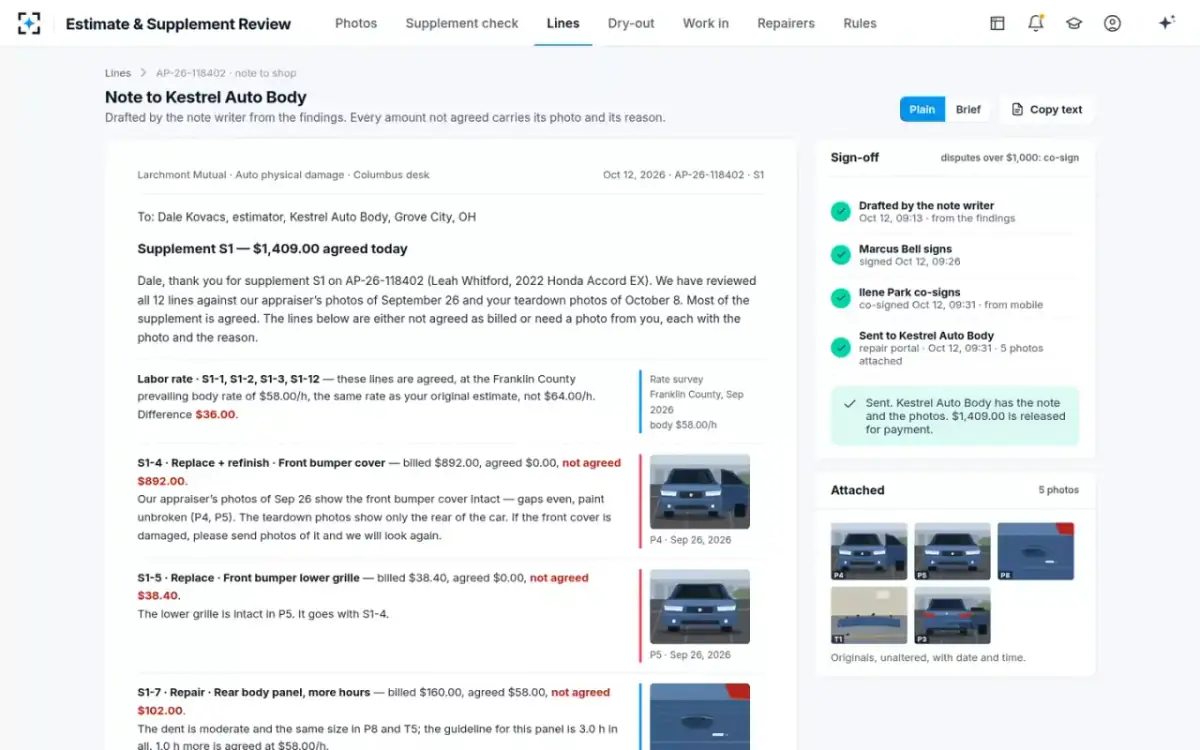
Signed by the appraiser, co-signed by the supervisor, sent with the photos
Before you let an AI estimate stand as the insurer's estimate
- A named, competent person approves it
With the expertise, training and experience Washington’s definition requires, and a record of the approval.
- The claimant can choose an in-person inspection
Offered at first notice in Washington and honoured within five business days after a disputed virtual one.
- Every price has a dated source
Rate, parts and materials, with where the data came from and who supplied it.
- Missing evidence leads to a request, not a cut
More photos or an inspection before damage is rejected.
- Supplements are answered in time
In Washington, in writing within five business days, with the policy language for anything not covered.
- The tool has been tested on your own files
Where your state has adopted the NAIC bulletin, testing and vendor oversight are part of the program it describes.
Questions people ask
What is an AI auto body shop estimate?
An estimate drafted by software from photos of the damage, usually by detecting damaged parts and pricing repairs from a database. Where Washington's rule applies, a reasonable investigation may not rely solely on a database, including estimating software, so a person has to check the draft.
Does my insurer have to tell me it used AI?
None of the state claims rules reviewed here requires a general AI disclosure on an auto estimate; the NAIC's model bulletin, where a state adopts it, expects insurers' AI programs to include processes for telling affected consumers that AI systems are in use. Washington does require the insurer, on request, to say when and where its pricing data were collected and which businesses supplied them, and to explain how labor and material costs were determined.
Is Florida's AI claims law in force?
No. CS/CS/HB 527 (2026), which would have required a qualified human professional to make all denial and claim payment reduction decisions, died in the Senate Rules Committee on 13 March 2026. It shows where legislatures are looking, not what the law is.
Can a shop refuse an insurer's photo estimate?
A shop writes its own estimate and can dispute the insurer's. In Washington the claimant can require an in-person inspection after a disputed virtual one, and the insurer must answer the shop's supplements in writing within five business days; in California the insurer that pays less must pay the difference, name a shop that will do the work for its figure, or reasonably adjust the shop's estimate line by line.
Does Estimate & Supplement Review write the estimate?
No. It reviews the estimates and supplements shops send, every line against the photos, rates, rules and coverage, and drafts the note back. The desk appraiser decides every line and signs.