The California auto body labor rate survey is an insurer's gathering of the hourly rates that auto body shops charge, used to set a "prevailing auto body rate" for an area, and California regulates how that survey is run, reported and used. Since 1 January 2017 an insurer that follows the Standardized Labor Rate Survey in 10 CCR 2695.81 earns a rebuttable presumption that the labor-rate part of its settlement was made in good faith; one that does not has to defend its rate some other way. For anyone who reviews estimates and supplements, the practical point is that a labor rate is never just a number in a price list. In California it is a survey result with a sample, a geographic area and a date after which it expires, and a cut to a shop's rate is only as strong as the survey behind it.
This matters on every supplement, because labor is billed line by line and a rate difference repeats across every hour. Estimate & Supplement Review is Botminds' software for checking estimates, supplements and repair invoices line by line against the damage photos, the policy and the prevailing local rates, with a desk appraiser deciding and signing every note. The worked example on this page is a fictional sample file: a supplement from a fictional Ohio body shop, priced against a fictional county rate table. The rules quoted are real and current as of October 2026.
The Standardized Labor Rate Survey in four numbers
1year
the longest a filed survey qualifies, unless its life is extended
16months
the oldest any labor rate in it may be: day 487 after collection
6shops
in the core of each shop’s geographic area, plus a one-mile ring
8labor types
each with its own prevailing rate, from sheet metal to carbon fiber
What is the California auto body labor rate survey?
It is any survey of shop labor rates that an insurer, or someone working for it, uses to set a prevailing rate for a specific area. The definition in 10 CCR 2698.91 is deliberately broad: a survey is "any gathering of information by an insurer, or on an insurer's behalf, from auto body repair shops regarding what auto body repair labor rate the repair shops charge, used to determine and set a specified prevailing auto body repair rate in a specific geographic area." If a carrier collects shop rates and turns them into a number its appraisers apply, that is a survey, whoever does the collecting.
Two things follow. No insurer is required to run one; the same section says so in plain terms (2698.91(j)). But an insurer that does run one must report it. Results go to the Department of Insurance's Custodian of Records within 30 calendar days of completing the survey, and at least once a year when the data change regularly. The public part of each filing lists every responding shop by name and address, the completion date, the number of shops surveyed, the prevailing rate for each area, a description of each area and the formula used. Anyone can obtain it by written request under the California Public Records Act.
The rest stays confidential: the shops that did not respond, the questionnaire, the area definitions, the insurer's direct-repair shops among the respondents, and the rate each shop reported. The Department can see all of it, along with any program or data used, and a carrier cannot hide behind a vendor: information obtained "through a third-party source shall not absolve the licensee of its responsibility" to produce it. Survey records must be kept for five years. And a filing is not an endorsement. Section 2698.91(k) forbids an insurer to represent that the Department has approved its survey or found its data accurate.
How is the prevailing auto body rate calculated?
Under the standardized survey, the prevailing rate is the rate at or below which a simple majority of the surveyed shops in an area charge. It is not an average and not a median in the statistical sense. The regulation gives its own example: six qualified shops in an area charge $64, $65, $66, $66, $71 and $73 an hour, and because four of the six charge $66 or less, "the prevailing rate in this example is $66."
In the regulation’s own example, the prevailing rate is $66, not the $67.50 average
The method matters for review. A rate checker that averages a list of shop rates, or that takes the rate of the shops a carrier happens to deal with, is not using California's method, even if its number lands close. The survey must also produce a separate prevailing rate for each type of labor the questionnaire asks about: auto body and sheet metal, structural, frame, mechanical, refinish, aluminum repair, carbon fiber and fiberglass. A refinish line priced at the body rate, or an aluminum repair priced at the steel rate, is checked against the wrong number.
Which shops count, and which rates are thrown out
Every shop registered with the Bureau of Automotive Repair as an auto body or paint shop has to be sent the questionnaire, and every one that responds, does not decline, and meets eight equipment and capability standards is counted. To help, the Department publishes a cleaned list each January; in its words, using the 2026 List of Automotive Repair Shops "will constitute compliance" with the requirement to survey all shops.
The eight standards are the questionnaire's second question. A counted shop must meet the Bureau's equipment rules, carry garage keeper's liability and workers' compensation cover, have equipment for simultaneous multiple body or structural pulls, a compliant spray booth, the ability to verify a four-wheel alignment by printout, the ability to remove and reinstall frame, suspension, engine and drive train parts or use a qualified sublet, compliant air-conditioning service, and a subscription to structural and alignment specifications for the vehicles it repairs. An insurer does not have to inspect shops to confirm them, but must exclude a shop it learns does not meet them.
Some rates are excluded outright. A discounted rate negotiated with any direct-repair program may not be used, though a direct-repair shop's posted, non-discounted rate may. And only a shop's own answer on the questionnaire counts: rates taken from the insurer's own estimates, from the estimating software it uses to write them, or from subrogation recoveries are barred. The questionnaire itself, set out word for word in 10 CCR 2695.82, asks only for the rate charged "for non-Direct Repair Program or other non-discounted auto body repair work", and shops must be given at least 30 calendar days to answer.
Body shop labor rates by zip code? California uses six shops and a one-mile ring
The standardized survey does not set rates by county or by zip code. Each shop gets its own geographic area, built from distances. The core is the six responding qualified shops nearest to it in a straight line (the shop itself and the five closest, if it responded), with ties at the edge added. The periphery adds every responding qualified shop within one mile beyond the farthest core shop. Distances are geocoded from each shop's address of record and reported to the thousandth of a mile.
One shop’s area under the standardized survey: six in the core, then a one-mile ring
- Core: the six nearest responding qualified shops, ties added
- Periphery: responding qualified shops within one more mile
- Outside the area, even 0.001 mile past the limit
Two consequences follow for anyone reviewing a supplement. First, the prevailing rate depends on which shop is doing the work. If the claimant has chosen a shop, the estimate uses the prevailing rate in that shop's area; if not, the shop where the estimate is prepared, or the registered shop the shortest driving distance away. An estimate written before a shop is chosen must say that a new estimate will follow, at that shop's area rate, once the claimant picks one. Second, a county rate table, however carefully compiled, is not this method. It may be a defensible way to set a rate in another state, but it will not earn California's presumption.
How old can a labor rate survey be?
A standardized survey stops qualifying one calendar year after it is filed, and on the day its oldest rate turns sixteen months old, counted as the 487th day after collection. Whichever comes first ends it. There is one way to stretch it: up to two years from filing and 28 months of data age (the 852nd day), provided every rate and every prevailing rate is adjusted once for inflation using the California Consumer Price Index for All Urban Consumers, no earlier than the day after the 335th day from filing, with the adjusted results sent to the Department within eight days.
Two clocks run on every California labor rate survey
| Clock | Starts | Standard limit | Extended limit, with one inflation adjustment |
|---|---|---|---|
| Filing age | The day the survey is submitted to the Department | One calendar year | Two years; the adjustment may be made once the 335th day after filing has passed |
| Data age | The day each shop rate was collected | Sixteen months: the 487th day | Twenty-eight months: the 852nd day |
| Reporting | The day the survey report is complete | File within 30 calendar days; at least yearly if the data change regularly | Adjusted results filed within eight days of the adjustment |
For a reviewer, this turns a rate into a dated, checkable number. A note that says "prevailing rate $58" is incomplete. A note that says which survey, filed when, for which shop's area, and for which labor type, can be checked by the shop, a supervisor or an examiner in a minute.
Can an insurer pay less than the shop's labor rate?
Yes, but in California only on one of three stated grounds when it uses the standardized survey to adjust a claimant's shop estimate. Section 2695.81(e)(2) lets an insurer bring a shop's quoted rate down only if it can show that the rate is higher than the prevailing rate for that labor type, higher than the shop's own posted rate, or higher than what the shop charged for the same labor on repairs completed in the previous 60 calendar days. The third ground needs at least three of the shop's own invoices on file, from work that was not discounted, and if those invoices show different rates the insurer may go no lower than the highest of them.
The rule cuts both ways. An insurer may pay less than the prevailing rate when the claimant's chosen shop charges less (2695.81(b)), and it may negotiate a rate above the prevailing rate where the repair or the area justify it (2695.81(e)(4)). And the regulation is careful about what an adjustment means: it "shall not be construed to imply that the repair shop must accept the amount offered for payment by the insurer or that the amount charged by the repair shop is excessive or unreasonable". The general settlement rule adds that an adjusted estimate must identify the specific adjustment to each item and its cost (2695.8(f)(3)), and an insurer may not tell a claimant that a shop does poor work solely because it did or did not take part in a labor rate survey.
A rate cut that can be checked: the survey card beside the line
What a California survey must be able to show
- Who was surveyed
- Every BAR-registered body or paint shop sent the questionnaire; only qualified respondents counted
- Area
- The chosen shop's six nearest responding qualified shops, plus a one-mile ring
- Labor type
- A separate prevailing rate for each of eight types
- Date
- Filed within the last year; no rate older than 16 months
- Method
- The rate at or below which a simple majority charge
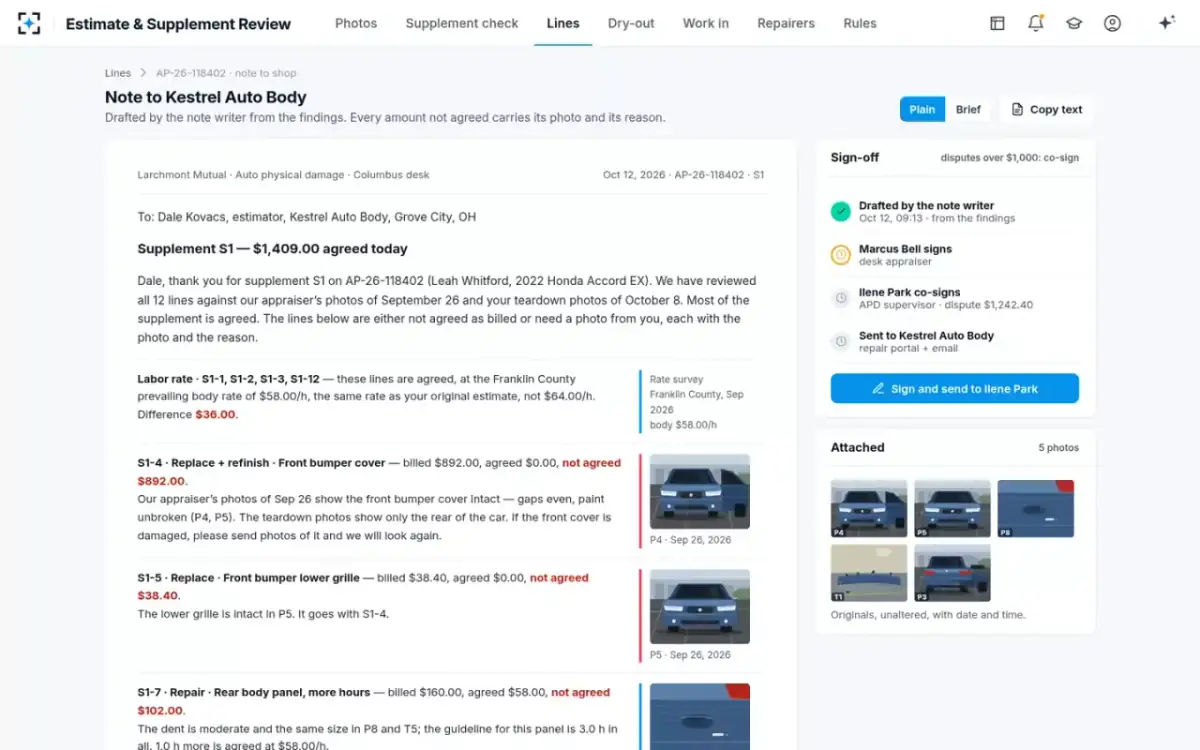
Line S1-1 · Replace rear bumper reinforcement
Part $412.00 · 1.2 h body @ $64.00 = $488.80
Agreed at $58.00/h = $481.60 · not agreed $7.20
Reason given to the shop: the prevailing body rate in the sample table, surveyed September 2026, and the same rate the shop used on its own original estimate ten days earlier.
The sample line shows why the shop's own history is often the strongest ground. Kestrel Auto Body wrote the original estimate at $58.00 an hour and the supplement at $64.00, for the same car and the same kind of work. California's third ground formalises exactly that comparison, with three invoices as the evidence. A desk that cuts a rate because "our rate is $58" has a weaker note than one that cites the survey, its date and the shop's own recent rate.
Body shop labor rates by state: what Washington, Montana and Ohio require
California is the only state among those reviewed here with a full survey method in regulation, but it is not the only one that regulates how a rate is justified. Washington's amended claims rule, in force since 18 October 2026, requires an insurer that uses a database, survey, estimating software or benchmarks for labor rates or material prices to tell the claimant, on request, when the data were collected, where from and which businesses supplied them (WAC 284-30-380(8), as amended). The rule's text is in the Washington State Register order; the compiled code may still show the old wording.
Montana defines the "market price" an insurer must pay for covered body repairs as either the price the insurer and shop agreed, or the "prevailing competitive rate that is reasonable and necessary in the local area where the repairs are to be performed." Ohio, where the sample file sits, has no labor-rate provision in its claims-settlement rule; Ohio Adm. Code 3901-1-54(H) requires the insurer to give the claimant a copy of its estimate and, if a higher estimate follows, to pay the difference or name a shop that will do the work for the insurer's figure. The practical common ground: whatever method a state uses, the rate in a review note has to point at something the shop can see.
Washington's disclosure duty is one of several new obligations on carriers that price repairs with software; they are set out in whether an AI car repair estimate can be the insurer's estimate.
What a reviewer must be able to say about a labor rate
A labor rate adjustment survives a call from the shop, a complaint or an appraisal when the reviewer can state its basis in one breath. That is a checklist, and it applies outside California too.
Six things to state before cutting a labor rate on a supplement line
- Which labor type
Body, refinish, frame, structural, mechanical or another. California sets a separate prevailing rate for each of eight types.
- Which rate and which source
The survey or rate table by name, with its filing or survey date. In Washington, be ready to name where the data came from and which businesses supplied it.
- Which area
The chosen shop’s area under the method you use. In California that is the shop’s six nearest qualified respondents plus a one-mile ring, not a county.
- Whether it is still current
Under the standardized survey, within a year of filing and with no rate older than 16 months, unless extended with an inflation adjustment.
- The ground for adjusting
Above prevailing, above the shop’s posted rate, or above its own recent rate with three invoices on file.
- The dollars, line by line
The adjustment to each item and its cost, so the shop and the claimant can see exactly what changed.
Labor types and how they appear on an estimate line are covered in how to read a body shop estimate.
How Estimate & Supplement Review checks a labor rate on a supplement
In the solution the prevailing rates are a versioned setting, by area and by labor type, with the date they were surveyed. The price checker agent compares the rate on every line with that table and with the shop's own original estimate, and marks a line "Rate" when it is higher. It does not decide. The desk appraiser chooses, line by line, to agree at the prevailing rate, pay as billed, or dispute.
Rates, rules and sign-off: the rate table is a dated setting
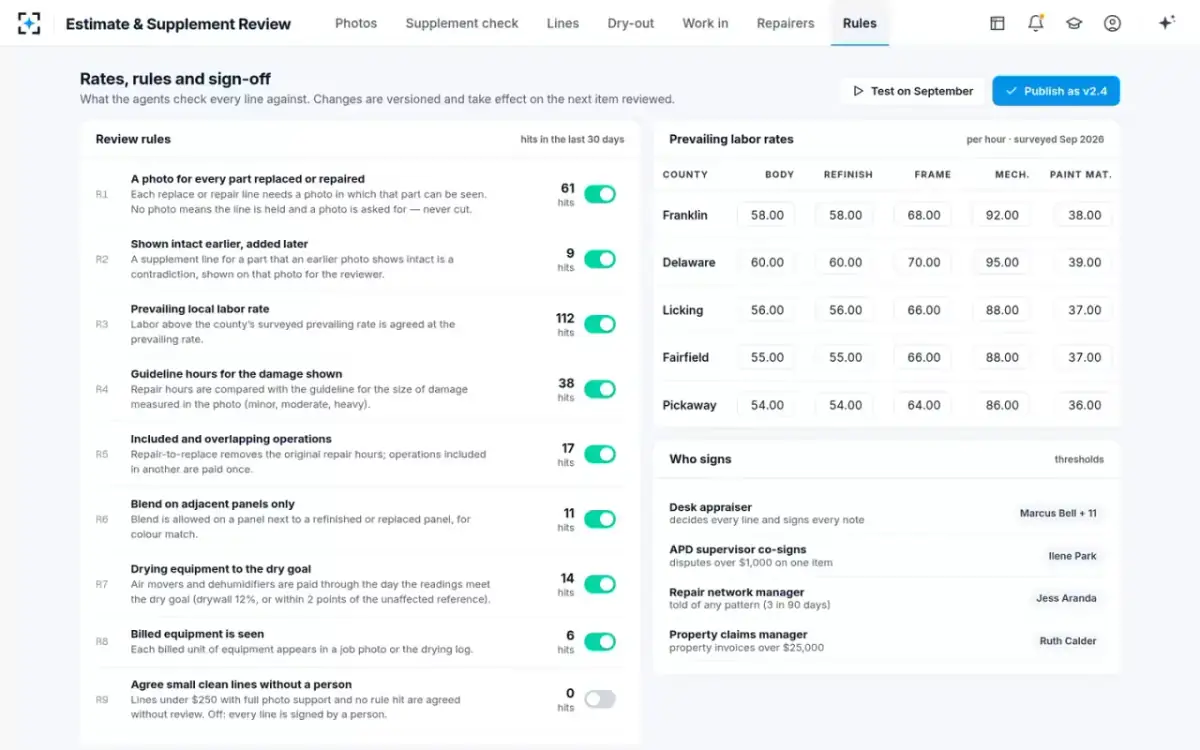
Take the sample supplement as it runs through the solution. Kestrel's supplement S1 on a 2022 Honda Accord billed body labor at $64.00 an hour on four lines. The Franklin County prevailing rate in the sample table, and Kestrel's own original estimate, is $58.00. The price checker flagged all four, the appraiser agreed each at $58.00, and the note to the shop carried the difference, $36.00, with the rate source printed in the margin beside them: the Franklin County rate survey of September 2026, body labor at $58.00 an hour.
The note to the shop cites the rate, its area and its date
Where the solution does not fit: it does not run labor rate surveys, file them or decide what a carrier's rate should be. It applies the rates a carrier gives it, shows which survey each came from, and makes sure no rate cut leaves the desk without its source. A carrier's California survey, its area definitions and its filing dates have to be loaded as they are; the review is only as good as the table. Rate disputes are also where shops most often invoke the policy's appraisal clause, and how to make a supplement decision hold up in appraisal covers what a file needs then.
Questions people ask
What is the average body shop labor rate in California?
No regulator publishes a statewide average, and under the standardized survey there is no single California rate: each shop's area has its own prevailing rate for each of eight labor types. Insurers' filed results, including every responding shop and the prevailing rate set for each area, are public on written request to the Department of Insurance's Custodian of Records under 10 CCR 2698.91(f).
Does an insurer have to do a labor rate survey in California?
No. Section 2698.91(j) says nothing requires an insurer to conduct one. An insurer that does survey shop rates and uses them to set a prevailing rate must report the results within 30 calendar days, and only a survey that meets 2695.81 earns the presumption that its labor rate was set in good faith.
Does the Department of Insurance approve labor rate surveys?
No. Filing is not approval, and an insurer may not say otherwise: section 2698.91(k) forbids representing that the Department approved a survey or found its data accurate and reliable. The Department can, however, demand every response, record and program behind a survey, even when a vendor ran it.
Can a shop refuse to take part in an insurer's survey?
Yes. The prescribed questionnaire in 10 CCR 2695.82 tells shops, in capitals, that they are not required to complete it, and gives a line to decline. A shop that declines, or does not meet the eight standards, is simply not counted, and an insurer may not tell a claimant the shop does poor work solely because of it.
Can my insurer use its direct-repair shops' rates to set the prevailing rate?
Only their posted, non-discounted rates. Section 2695.81(d)(6) bars any discounted rate negotiated with a direct-repair program from a standardized survey, and the insurer must tell the Department when a direct-repair shop's posted rate is among those used.
How does the survey treat refinish, frame and aluminum labor?
Each is a separate labor type with its own prevailing rate. The questionnaire asks every shop for its non-discounted rate for auto body and sheet metal, structural, frame, mechanical, refinish, aluminum, carbon fiber and fiberglass labor, and a shop counts toward a type only if it gives a rate for it.