Insurance claim estimating software is the category of tools adjusters, appraisers and shops use to write repair estimates from a database of parts, labor times and prices. Estimate review software is a different category: it checks an estimate, supplement or invoice that someone else wrote, line by line, before it is paid. Buyers searching for the first often need the second, because the costly work on a claims desk is not writing estimates but reading them: a shop's supplement after teardown, a contractor's estimate, a water dry-out invoice. The economics are simple to state. One review costs the reviewer's minutes times a loaded wage, times the number of items; the larger cost is the lines that go unread because there were not enough minutes, and a return formula has to count both.
Estimate & Supplement Review is Botminds' review software: seven agents read every estimate, supplement and dry-out invoice as it arrives, tie each line to the damage photos and the local prices, and draft the note back to the shop, while the desk appraiser decides every line and signs. This page prices the unit of work it changes. Wage data are from the Bureau of Labor Statistics; time figures are Botminds' estimates and design targets, labelled as such; worked numbers come from a fictional sample claim.
The inputs to the price of one estimate review
$78,240
median annual wage of insurance appraisers, auto damage, May 2025
70.0%
share of private employers’ compensation cost paid as wages, June 2026
the rest is benefits
$0.90/min
about this much: the loaded cost of an appraiser’s minute, our arithmetic
+56%
rise in the consumer price of vehicle repair, January 2020 to September 2026
Estimating software writes the estimate; review software checks it
The two are often bought by the same claims organisation and confused in the same search. Estimating systems hold the parts catalogues, guideline labor times and procedure notes that turn "replace rear bumper reinforcement" into hours and dollars, and regulators treat them as part of the insurer's method: California's auto rule forbids an insurer to deviate from the standards, costs or guidelines of "the third-party automobile collision repair estimating software used by the insurer to prepare the estimate" where the deviation would prevent a proper repair, and Montana bars an insurer from unilaterally disregarding an operation or cost that the estimating system both sides agreed to use identifies (Mont. Code Ann. 33-18-224).
Three kinds of software a claims desk buys for estimates, and what each one decides
| Category | What it does | Who uses it | What it cannot tell you |
|---|---|---|---|
| Estimating system | Writes an estimate from parts catalogues, guideline labor times and prices | Field and desk appraisers, shop estimators, contractors | Whether a line on someone else’s estimate is supported by the photos |
| Photo-based estimating | Drafts an estimate from photos, often with AI damage detection | Carriers for first notice and low-severity claims | Hidden damage, and much of what is subtle; a person stays accountable for the result |
| Estimate and supplement review | Checks each line of an incoming estimate, supplement or invoice against photos, rates, rules and coverage | Desk appraisers, property estimators, supervisors | How to write the repair plan; it reads plans, it does not make them |
"Estimating software for insurance adjusters" and "car estimate software for insurance companies" are, in most searches, the first row. The question this page answers belongs to the third: what does it cost to read what arrives, and what does it cost not to?
What does a desk appraiser earn, and what is a minute of review worth?
The median annual wage for insurance appraisers of auto damage was $78,240 in May 2025, according to the Bureau of Labor Statistics; for claims adjusters, examiners and investigators it was $78,000 (BLS Occupational Outlook Handbook). Wages are not the whole cost. In June 2026, wages and salaries were 70.0 percent of private employers' compensation costs, benefits the other 30.0 percent (BLS Employer Costs for Employee Compensation).
Dividing the median wage by 0.70 gives a loaded cost of about $111,771 a year. Spread over 2,080 paid hours that is $53.74 an hour, about 90 cents a minute, before desk space, systems and supervision. It is a floor: paid hours include leave and training, so the cost of an hour spent reviewing is higher. A carrier should use its own loaded rate, but the order of magnitude is the point. A review that takes eleven minutes costs about ten dollars of an appraiser's time.
How long does a desk appraiser spend on a supplement?
No public source we could find measures it. Our own estimate for one auto supplement reviewed by hand is about eleven minutes, split across five tasks; the solution's design target is three. The estimate is Botminds', built from the steps of the work, not measured at any carrier, and a desk should time its own.
Where an auto supplement’s minutes go, by hand and with the agents
- Read lines, match to original2
- Find a photo for each line3
- Rates, guideline hours, overlaps2.5
- Compare with first photos1.5
- Decide, write note, sign2
- Check the four findings2
- Decide and sign1
The shape matters more than the total. Most of the eleven minutes go to finding: the photo for each line, the rate and guideline for each operation, the earlier photo of the same part. Only two go to deciding. When an appraiser has 30 seconds for a supplement instead of eleven minutes, it is the finding that gets skipped, and lines are paid on trust. The design target keeps the decision with the appraiser and gives the finding to the agents.
The unit cost: minutes, loaded wage, volume
Price one review, then multiply. At about $0.90 a minute, eleven minutes is about $9.85 and three minutes about $2.69, a difference of about $7.16 a supplement (our arithmetic). A desk that reviews 10,000 supplements a year, a hypothetical figure for illustration, would spend 1,833 appraiser hours on them by hand and 500 at the target, a difference of about $71,600 a year at the loaded rate.
That number is real but modest, and a buyer who stops there will under-count. The volume of items is not fixed: a desk that cannot read every line samples, and the ones it does not read are paid as billed. The second term in the formula is the value of the lines that would otherwise go unread.
A return formula for estimate review that counts both directions
Review time released
(min by hand − min with tool) × $/min × items
Use your own loaded rate and a timed sample of your own reviews, not a vendor’s estimate.
Priced by claims operations
Lines corrected that hold
Σ amounts not agreed − amounts later restored
Count only what survives the shop’s reply, a complaint or appraisal; a cut that is reversed is not a saving.
Priced by the APD supervisor
Underpaid lines found
Σ amounts added on review
A review also finds lines the shop under-billed or the original missed. It is a cost here, and the right outcome.
Priced by claims and compliance
Cost to run
licence + setup + rate and rule upkeep
Include the time to load and maintain labor rates, guideline rules and note templates.
Priced by finance and IT
The bigger number is the lines nobody read
Each line is worth more than it was. The consumer price index for motor vehicle maintenance and repair rose from 300.112 in January 2020 to 468.491 in September 2026, an increase of 56% (BLS data via FRED; our arithmetic). The Insurance Institute for Highway Safety, which is wholly supported by auto insurers and insurance associations, reports that in one of its comparisons collision claims on otherwise identical 2017 to 2022 models with a bundle of driver assistance features cost about 10% more to settle, and notes that the sensors "are expensive and often require calibration after replacement."
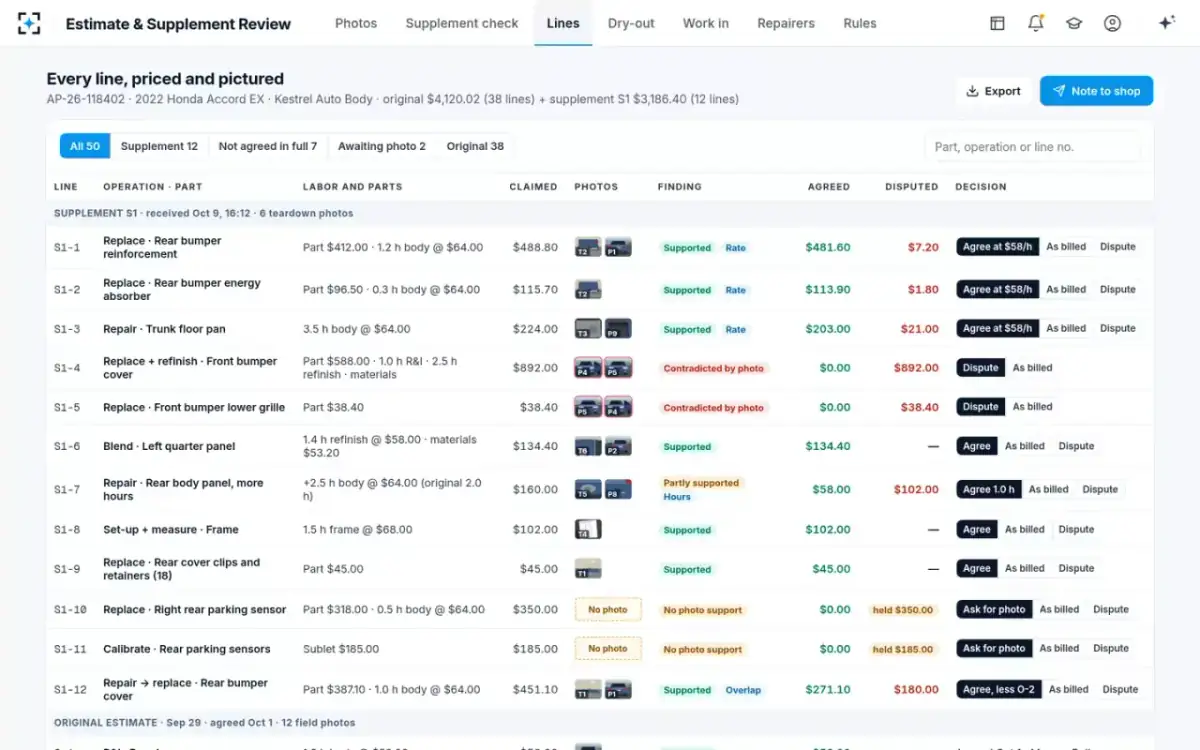
On one sample supplement, five lines carried 96% of the money in question
Car estimate software for insurance companies: the volume behind each line
Volume multiplies it. The National Highway Traffic Safety Administration counted about 22.9 million vehicles damaged in motor vehicle crashes in 2019, and property damage costs of $115.3 billion, 34 percent of the economic cost of crashes that year. Not every damaged car reaches an insurer's desk, and not every estimate has a supplement. But the arithmetic of the chart holds: one line read that would otherwise have been paid on trust, like the $892.00 bumper cover, is worth about ninety reviews.
The same arithmetic runs on one desk's morning. In the sample queue, 34 items arrived between Friday afternoon and Monday morning: 9 supplements, 14 auto estimates, 5 dry-out invoices and 6 contractor estimates, the 23 on the first screen totalling $127,070.80. Read properly at eleven minutes each, the 34 are 374 minutes, over six hours of one appraiser's day (our arithmetic, on Botminds' estimate). That is the gap that turns a review into a glance, and the gap the agents are designed to close.
How to measure ROI of estimate review
Measure it on your own closed files before buying, and count the lines that survive. Take three months of supplements and invoices your appraisers have already signed. Run them through the tool. For each line, compare its call with what was finally paid after the shop replied. Three numbers come out: lines where the tool and your appraisers agree, lines the tool would have questioned that were paid, and lines the tool would have paid that your appraisers cut. The second group, checked by a senior appraiser, is the second term of the formula; the third is the risk.
Two rules keep the measurement honest. A cut that was later reversed counts as zero, not as a saving, and a line the tool says should have been paid more counts against the saving. In Washington, offering substantially less than is ultimately recovered to push a claimant into appraisal is itself an unfair practice (WAC 284-30-330(7)), so a tool that cuts aggressively costs more than it saves. The full pilot design, week by week, is in how to test estimate review on last quarter's files.
Every line, priced and pictured: where the second term comes from
Where Estimate & Supplement Review fits, and where it does not
It fits after an estimate exists. It does not replace an estimating system, write first estimates or produce a price from photos. It reads what shops and contractors send: estimates, supplements, change orders, repair invoices and drying logs, with the photos, rates, guidelines and coverage summary behind them. On every line it sets out a finding with its evidence, and the desk appraiser decides. Rates and review rules are versioned settings, so a carrier can test a change on last month's files before it takes effect.
What arrives at the desk, already read
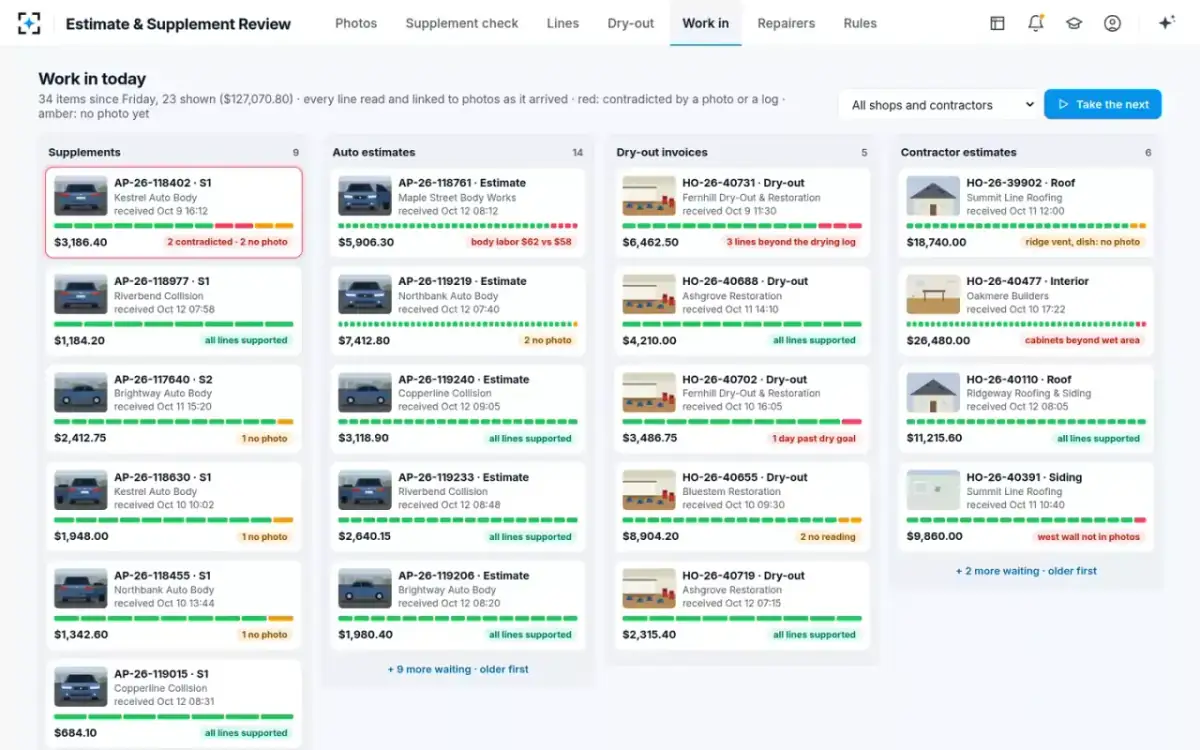
The unit economics also explain what the solution does not try to do. It does not agree lines without a person by default; the rule that would agree small, clean lines automatically is off unless a carrier switches it on. On the formula above, that choice gives up some of the first term to protect the second: every dollar not agreed has a signature and a photo behind it. What the agents do on each line, and why each stops where it does, is shown in the photo tagger, part by part.
Questions people ask
What is the best estimating software for insurance claims?
It depends on whether you need to write estimates or check them. Estimating systems write estimates from parts and labor databases, and California and Montana both treat the system an insurer uses as part of its method. Review software checks incoming estimates and supplements; judge it on a pilot with your own closed files, not on published percentages.
Can estimating software decide a claim on its own?
Not in Washington, where an investigation that relies solely on a database, including estimating software and benchmarks, is not reasonable under the amended WAC 284-30-330(4). Washington also makes insurers responsible for the accuracy of evaluations made on their behalf.
How many supplements can one desk appraiser review in a day?
There is no published standard. At our estimate of about eleven minutes for a careful review of one auto supplement, an appraiser with six hours of review time could do about 33; at a 30-second glance, many more, with most lines unread. Time your own desk before setting volume targets.
Does automated review reduce repair costs?
It changes which lines are paid, in both directions, and only a test on your own files can say by how much. Count only cuts that hold after the shop's reply and any appraisal, and subtract lines found underpaid; repair prices up 56% since January 2020 make each line worth more than it was.
Is the solution an estimating system?
No. Estimate & Supplement Review reads estimates others have written and checks every line against the photos, local rates, guideline rules and coverage. It drafts the note back to the shop; the desk appraiser decides each line and signs.