Property claims estimating software that reviews estimates, rather than writing them, should be tested on your own closed files before you buy it: replay three months of contractor estimates, supplements and water dry-out invoices your property estimators have already signed, compare every line the software would question with what was finally paid, then run it beside the desk on live work for two weeks. Pass it only if no line is ever cut, or recommended for a cut, without a photo, a log reading or a named rule behind it, and if every disagreement with your estimators can be explained. Vendor accuracy figures, including ours, cannot tell you how a tool behaves on your contractors, your price lists and your photos.
This guide sets out that pilot step by step. Estimate & Supplement Review is Botminds' software for reviewing estimates, supplements, repair invoices and drying logs line by line against the photos, the policy and local prices, with a named person deciding every line and signing the note back to the contractor or shop. Its review rules and rates are versioned settings that can be tested on past files before they take effect, which is the property a pilot depends on. Examples come from a fictional sample book of claims in Ohio; the rules cited are real and current as of October 2026.
Four property-claim clocks a review tool has to keep to
7days
Florida: send the policyholder any detailed estimate an adjuster generates
5business days
Washington: approve or answer a policyholder’s scope of mitigation
60days
Florida: pay or deny an initial, reopened or supplemental claim
18months
Florida: notice period for a supplemental claim, from the date of loss
How to evaluate estimate review software
Judge it on three questions: does it find the lines your best estimators would question, does it ever question a line without evidence, and can a person check each finding in seconds? Only a replay on files you know the answer to can settle the first two. The third you can see in a demonstration, but only on your own documents does it mean anything.
Regulators frame the stakes. California requires an insurer that settles on its own written scope or estimate to "take reasonable steps to verify that the repair or rebuilding costs utilized by the insurer or its claims agents are accurate and representative of costs in the local market area." Washington's amended rule is blunter: "Insurers are responsible for the accuracy of their evaluations including, but not limited to, evaluations made on their behalf, to determine the amounts owed under the applicable insurance policy." A review tool's findings become the insurer's evaluations the moment an estimator relies on them. Where a state has adopted the NAIC's model bulletin on insurers' use of AI, its expectations of pre-use diligence and of validating and testing what AI systems produce point the same way (NAIC model bulletin).
An estimate review pilot, week by week
Eight weeks is enough for a property desk with a steady flow of water and roof claims. The first two weeks are spent on settings, not software: the rates, price lists and review rules the tool will check against are the carrier's own, and a pilot that runs on generic settings tests the wrong thing.
An eight-week pilot of estimate review software on your own files
- Load rates, rules, note templates1–2
- Replay three months of closed files3–4
- Review every disagreement5
- Run beside the desk on live work6–7
- Decide8
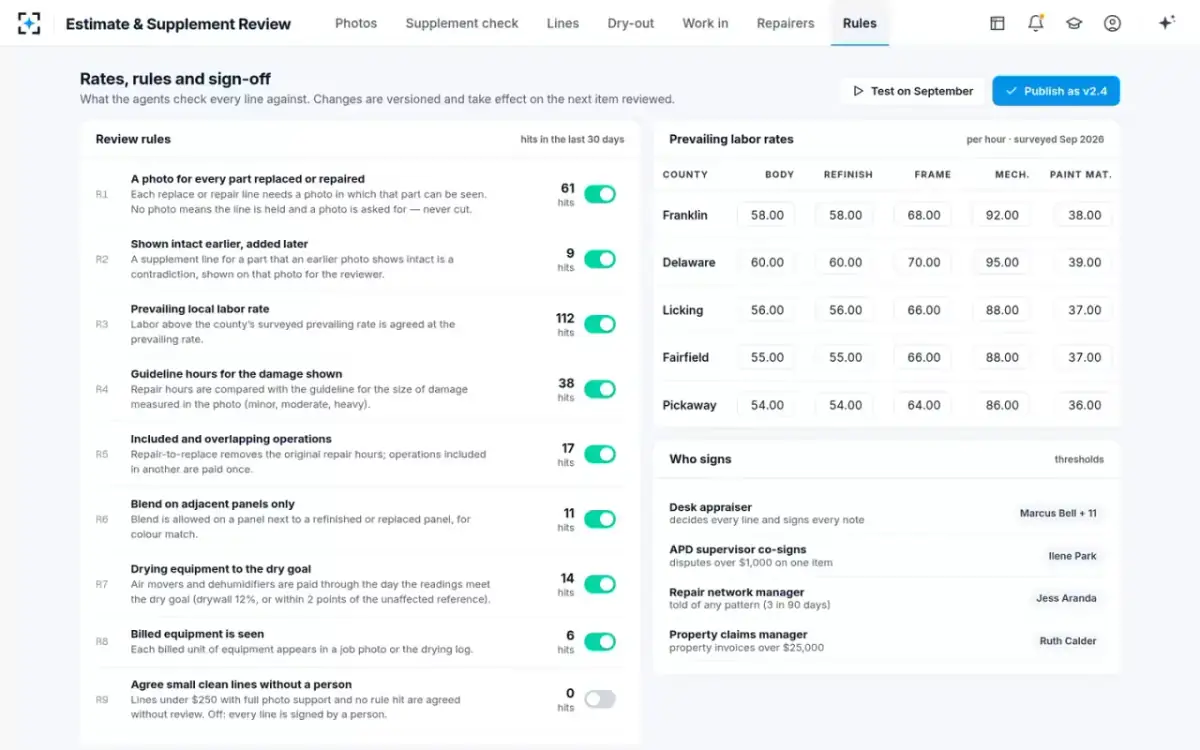
The replay comes first because it costs nobody's time on live claims and produces the numbers. The live weeks test what a replay cannot: whether findings arrive before the estimator needs them, whether the notes read well to contractors, and whether estimators trust the evidence enough to use it. A rule change found necessary in week five should be re-run on the replay set before week six; in the solution that is a button, "Test on September", on the rules screen.
Rules and rates are settings, testable on past files before they take effect
What data do you need to pilot estimate review?
Bring the files exactly as your desk received them, plus what your estimators decided. The tool needs the incoming documents; the pilot needs the decisions to compare against.
What to bring to a pilot, and why each item matters
| Bring | For property claims this means | Why it matters |
|---|---|---|
| The documents as received | Contractor estimates, supplements and change orders, mitigation and dry-out invoices | The tool must read what arrives, in the formats contractors actually send |
| The photos, with their dates | Inspection photos, contractor job photos, moisture-meter photos, each with date, time and author | A line can only be checked against a photo that shows the part, and only an earlier photo can contradict a later line |
| Drying logs | Daily readings by point, the dry standard and dry goal, equipment by day | Equipment-days are checked against the day each material reached its goal |
| Your price sources | Local price lists and labor rates, with their dates and where the data came from | Washington requires insurers to disclose, on request, when and where pricing data were collected and who supplied it |
| Coverage summaries | Coverages, deductibles, limits and exclusions for each claim | A covered-cost finding needs the policy behind it |
| What was signed and paid | The estimator’s line decisions, the note sent, and the final payment after any reply | The answer key: without it a replay measures nothing |
Choose the three months deliberately. A quarter that includes a storm or a freeze gives you volume; a quarter of ordinary pipe and appliance leaks gives you the everyday dry-out invoice, which is where equipment-days quietly add up. Include files that went to appraisal or produced a complaint: they are the ones where the reasoning was tested by someone else.
Replay against what your estimators signed
For every line in the replay set, record four things: what the contractor billed, what the tool found and recommended, what your estimator decided, and what was finally paid. The interesting lines are the ones where these disagree, and there are only four kinds.
Four outcomes of a replayed line, and what each tells you
| Outcome | What it looks like | What to do with it |
|---|---|---|
| Both agree | Tool and estimator both paid it, or both questioned it for the same reason | Count it. Check a sample anyway, to be sure the evidence was the same evidence |
| Tool questioned, estimator paid | For example, air movers billed after the drying log shows the wall dry | Have a senior estimator re-decide each one. Lines they would now question are the value the desk missed; lines they would still pay show where the rules are too strict |
| Estimator questioned, tool paid | A line your estimator cut for a reason the tool has no rule or evidence for | The risk side. Either a rule is missing, or the estimator’s cut lacked evidence; both are worth knowing |
| Tool would pay more | An underpriced line, or a line the original estimate missed | Count it against the saving. It is the correct outcome, and regulators look for it |
The second and third rows are where buying decisions are made. A tool that produces many "tool questioned, estimator paid" lines a senior estimator would also question is finding money; one whose third row is long is missing rules your estimators carry in their heads. Neither row, on its own, tells you whether the tool is safe. That is the job of the pass marks.
What pass marks should estimate review meet?
One mark is absolute: no line questioned or cut without evidence a person can open. The rest are thresholds a carrier should set for itself before the pilot starts, so the result cannot be argued after it.
Pass marks for a pilot of estimate review software
- No finding without evidence: 100%
Every questioned line links to a photo, a drying-log reading or a named rule with its source. A finding that says only "excessive" fails the pilot.
- Missing evidence is held, not cut
A line with no photo or no reading waits for one. Washington requires reasonable efforts to get more documentation before rejecting damage a photo does not show.
- Every disagreement explained
For each line in rows two and three of the replay, a senior estimator can say who was right and why.
- Both directions reported
Lines the tool would pay more are counted and reviewed, not left out of the summary.
- Notes that meet the written-reason rules
Each disapproved item itemized with its dollar amount and reason; Washington requires this for a rejected scope of mitigation.
- Findings in time for the clocks
Findings ready before the estimator’s deadline, such as five business days for a mitigation scope in Washington, or seven days for sending a detailed estimate in Florida.
- Price sources disclosable
For every rate or price the tool used, the date, where it came from and who supplied it, ready for a policyholder who asks.
Property files have their own evidence: dry-out invoices and contractor estimates
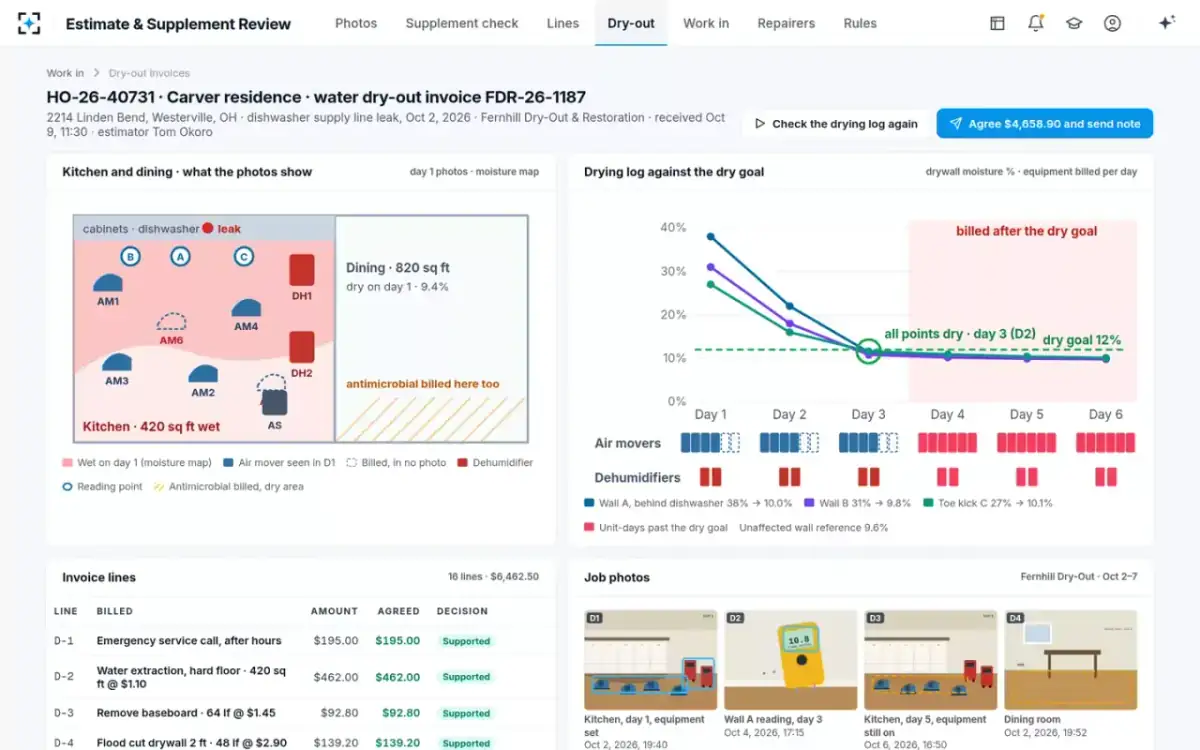
Auto supplements argue about parts and labor; property invoices argue about quantities and days. A dry-out invoice is a count of equipment-days, and the drying log shows the day each wall reached its dry goal. FEMA's flood claims manual, one of the few public government guides to paying for structural drying, treats a drying invoice as properly supported only with a drying log that records readings at least every 24 hours "until the drying goal is achieved", and treats a log that skips a day of monitoring as improper. A review tool for property claims has to read drying logs, not just invoices; how that works line by line is in water mitigation invoice review.
A dry-out invoice against its drying log and job photos
Contractor estimates: is each line inside the damaged area?
Contractor estimates for roofs, siding and interiors raise a different check: whether each line sits inside the damaged area the photos show. In the sample queue the review flagged a roof estimate whose ridge vent and dish had no photo, an interior estimate pricing cabinets beyond the wet area, and a siding estimate for a west wall that appears in no photo. Florida adds a document duty a pilot should test: when the insurer pays less than any of its own adjusters' detailed estimates, it "must provide a reasonable explanation in writing of the difference to the policyholder."
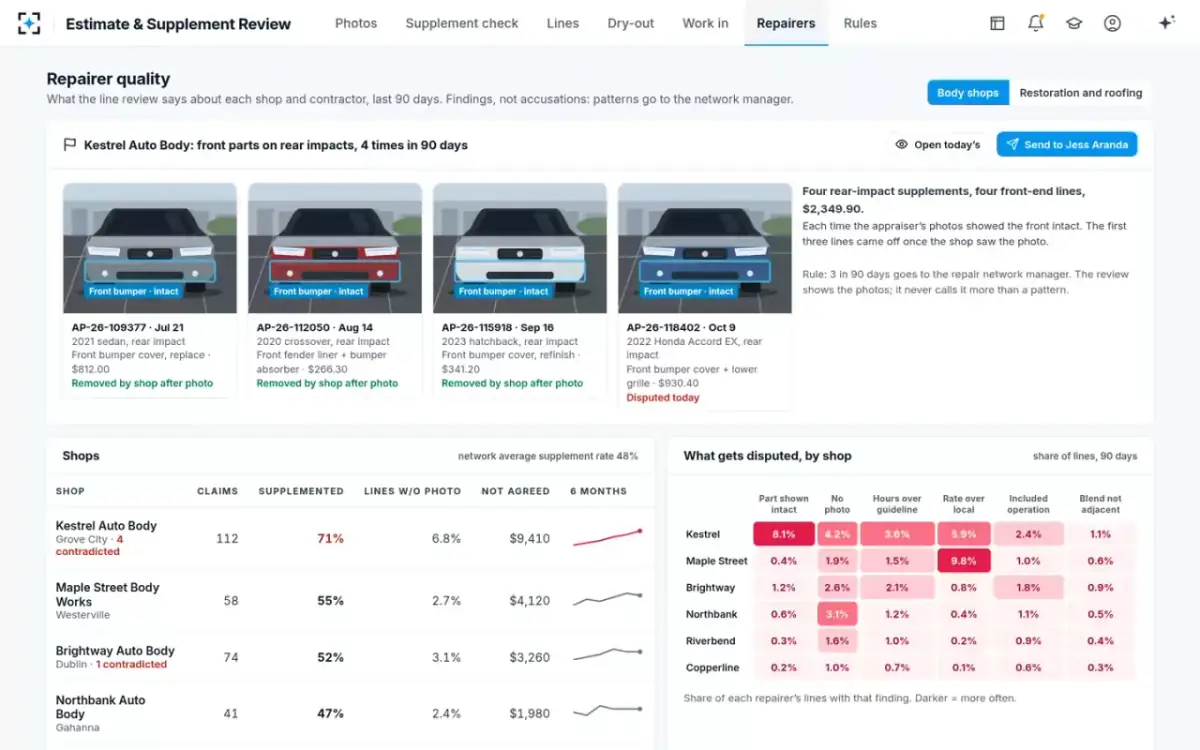
What contractors and shops send, sorted by what needs a decision
How long does it take to implement estimate review?
On the plan above, eight weeks from data to decision for a pilot, and most of that time is the carrier's: assembling three months of files, loading its rates and price lists, and writing the rules and note templates its estimators already follow. After a pilot, production use mainly means connecting the channels the desk already works through: where estimates, photos and logs arrive, and the portal or email the signed notes go out by. We give no general figure for the whole programme because it depends on how many lines of business and states are in scope, and a buyer should be wary of anyone who does.
Two choices shorten it. Start with one document type, often dry-out invoices or auto supplements, where the evidence is clearest and the rules fewest. And keep every line signed by a person during and after the pilot; Estimate & Supplement Review ships with the rule that would agree small clean lines without a person switched off, and a carrier that turns it on should do so only after a replay shows what it would have agreed. Whether a review tool belongs on auto or property first is a question of where the unread lines are; the cost of one review sets out how to price both.
Questions people ask
What are claims software programs for property damage?
Three kinds are common: estimating systems that write repair estimates from price databases, claims management systems that run the file, and review tools that check incoming contractor estimates, supplements and invoices line by line. California expects an insurer to verify that the repair costs it relies on are accurate and representative of the local market, whichever tool produced them.
Can review software check estimates written in any estimating system?
It should read the estimate as the desk receives it, whatever system or contractor wrote it, and a pilot should prove that with your own documents. Ask to see a finding on an estimate from each of your main contractors before you rely on the tool.
How many files does a pilot need?
Enough to see every common line type disagree at least a few times: three months of a steady desk's closed files usually covers water dry-outs, roof and interior estimates and their supplements. Include files that went to appraisal or produced a complaint, because their reasoning has already been tested.
Should the pilot let the software cut lines on its own?
No. Every decision should be a person's during the pilot, as it should be in production. A replay can show what an automatic rule would have agreed or cut, without letting it touch a live claim.
Does a supplemental property claim have a deadline?
In Florida, yes: notice of a supplemental claim must be given within 18 months after the date of loss, and the insurer must pay or deny an initial, reopened or supplemental claim within 60 days of notice unless factors beyond its control prevent it. Other states set their own terms.