Blend an adjacent panel when a panel next to it is being refinished or replaced and its new paint would not otherwise match the undamaged panel beside it; the blend carries color part-way into the adjacent panel so the eye does not see an edge. The test a reviewer applies is twofold: is the blended panel actually next to a refinished or replaced one, and does the evidence (the color, the photos, the paint maker's procedure) support it? Blend is one of a handful of thresholds where most supplement disputes sit. The others are overlap (hours paid twice when a repaired panel is replaced), included operations (steps already inside another line's labor time), guideline hours for the damage shown, and calibration after a sensor is replaced. Each has a source, and a review that cannot name it will not hold.
This guide sorts those thresholds by where their authority comes from. Estimate & Supplement Review is Botminds' software for checking estimates and supplements line by line against the photos, local rates and repair guidelines, with the desk appraiser deciding every line; its price checker applies blend, overlap and included-operation rules as versioned settings, each with the source it rests on. Examples come from a fictional sample supplement on a rear-ended 2022 Honda Accord in Ohio.
The threshold ladder: four kinds of rule behind a disputed supplement line
- 1
Law
Rules no estimate or review can trade away.
Repair to pre-loss condition; betterment only on wear parts; every reason for paying less, in writing; California’s survey method for a labor rate.
- 2
Maker’s and trade procedures
What the vehicle maker or accepted trade standards require for this repair.
OEM repair and refinish procedures; calibrating a sensor that was removed and replaced or reinstalled.
- 3
Estimating-system guidelines
The labor times, included and not-included operations and overlaps the agreed system publishes.
Repair hours removed when the panel is replaced; frame set-up as its own line; guideline hours for the damage shown.
- 4
The carrier’s own rules
Settings a carrier chooses and must be able to explain.
Blend only on panels adjacent to a refinished one; price lists no older than 90 days; a photo for every part.
When to blend adjacent panels
When an adjacent panel will be next to new paint and the two would not match without it. Factory paint varies, and paint on a car ages, so a newly painted panel can differ from the panel beside it even when the color code is the same. Blending tints part of the undamaged neighbour so the difference fades out across it. That is why a reviewer asks two questions of a blend line: which refinished or replaced panel is it next to, and is there evidence the match needs it?
No insurance regulation we found sets a rule for blending car panels. The duty that governs it is the general one. California requires an insurer's estimate to allow a repair "in accordance with accepted trade standards for good and workmanlike automotive repairs", and its repair rules define those standards to include procedures performed under the vehicle maker's service specifications or nationally distributed, generally accepted ones (16 CCR 3365). Washington makes it an unfair practice to fail to prepare or accept an estimate that will restore the vehicle to its condition before the loss (WAC 284-30-390(4)). A blend that a proper repair needs is part of that repair.
For buildings, regulators wrote the matching principle down. The NAIC's model property claims regulation says that when replaced items "do not match in quality, color or size, the insurer shall replace all items in the area so as to conform to a reasonably uniform appearance", and California's rule for residential and commercial property uses nearly the same words (10 CCR 2695.9(a)(2)). It is a useful way to think about a car's blend line too: the question is a uniform appearance, not a new panel.
A blend line that holds, and one that does not
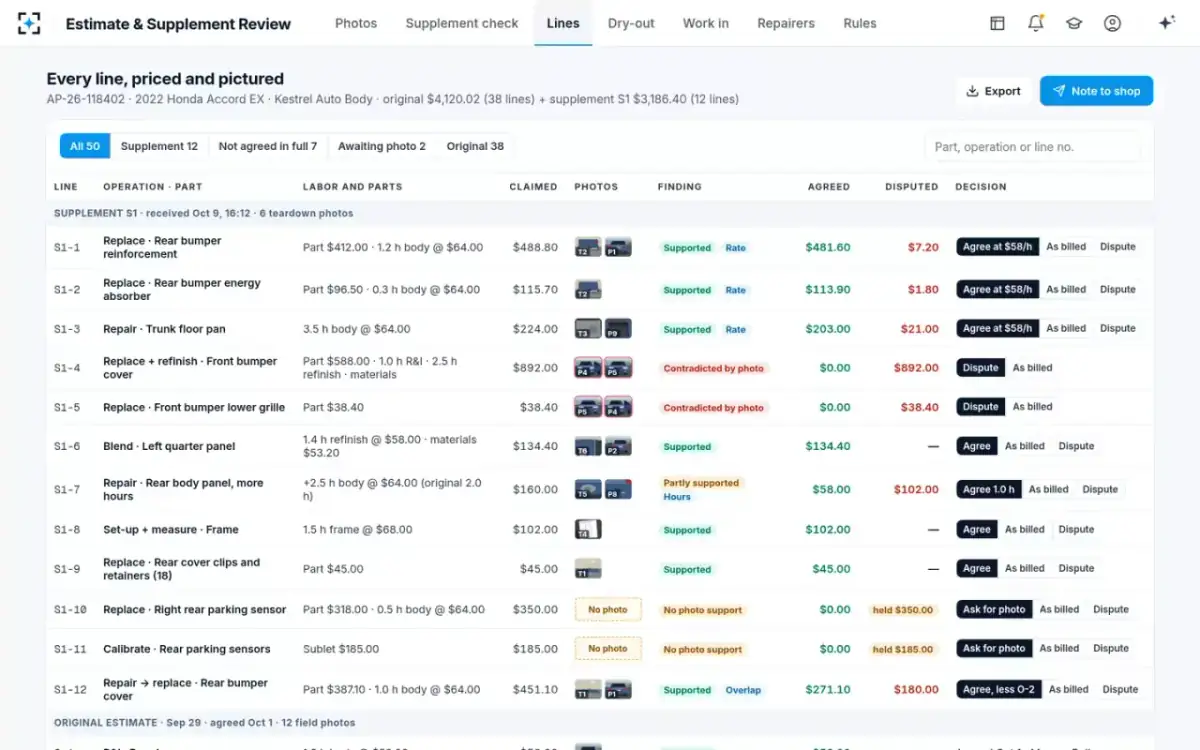
Blend that holds (sample line S1-6): Left quarter panel, beside the rear body panel and rear cover being repaired and replaced.
Blend a reviewer questions: A panel with no refinished or replaced panel next to it.
Blend that holds (sample line S1-6): Teardown photo T6 and field photo P2 linked to the line.
Blend a reviewer questions: No photo of the panel, or a photo showing it far from the repair.
Blend that holds (sample line S1-6): 1.4 h refinish at $58.00 plus $53.20 materials: $134.40.
Blend a reviewer questions: Full refinish hours billed on a panel described as a blend.
Blend that holds (sample line S1-6): Agreed as billed.
Blend a reviewer questions: Shown to the appraiser with the rule and the photos; never cut without them.
Does insurance pay for blending paint?
Where blending is needed for a proper repair, it is part of the cost of restoring the car, and the rules quoted above require the insurer's estimate to cover such a repair. Disputes are about need and amount, not principle. In the sample, the left quarter panel blend was agreed in full. In the sample shop data, a blend on a panel not adjacent to the repair was the least common finding at the shop with the most disputes.
At one sample shop, blend was the least-disputed finding; intact parts and rates led
What is overlap on an estimate?
Overlap is labor two operations share, so paying both at full time pays some of it twice. The case reviewers meet most is a panel the original estimate repaired and the supplement replaces: once the panel is replaced, the hours to repair it are no longer needed, and they come off. In the sample supplement, line S1-12 replaces the rear bumper cover the original estimate repaired in 3.0 body hours; the price checker took the original $174.00 repair off the supplement, and only the replacement was paid.
Where operations share labor, the reference is the estimating system's own procedures rather than the reviewer's judgment, which is why overlap belongs to the third tier of the ladder. The law gives those publications force in two directions. California bars an insurer from deviating from its estimating software's standards and guidelines where that would prevent a proper repair (10 CCR 2695.8(f)), and Montana bars it from unilaterally disregarding an operation or cost identified by the estimating system the insurer and shop agreed to use (Mont. Code Ann. 33-18-224). An overlap deduction the system publishes is defensible; one invented at the desk is not.
Repair to replace labor hours: what comes off
When a supplement changes a line from repair to replace, the reviewer removes the original repair hours on that part and pays the replacement time and the part. The sample's arithmetic shows the whole move on one line: the cover billed at $451.10 (part $387.10 plus 1.0 body hour at $64.00) was agreed at $271.10, which is the part, the hour at the prevailing $58.00, less the $174.00 original repair.
Overlap, hours and rate, flagged on the lines they apply to
Included operations and not-included operations
An included operation is a step already inside another line's labor time, so billing it separately pays it twice; a not-included operation is a step the labor time leaves out, so it must be written as its own line. Estimating systems say which is which in their procedure pages. In the sample, frame set-up and measuring (S1-8, 1.5 frame hours) is a not-included operation billed correctly as its own line, supported by the frame measurement printout photographed at teardown. Across the sample shop's lines over 90 days, 2.4% billed an operation that another line already included.
Reviewers should hold this threshold carefully, because it cuts both ways. A desk that removes not-included operations it does not recognise is disregarding operations the estimating system identifies, which Montana prohibits; a desk that pays included operations twice is paying for nothing. The defensible move is to cite the system's own procedure for the operation in question, and the line it is included in.
Guideline hours and the damage shown
Repair hours on a damaged panel are partly judgment, and the threshold is the guideline for the size of damage the photos show. In the sample, the rear body panel line asked 2.5 more hours on top of the original 2.0; the photos showed a moderate dent the same size in the field and teardown photos, and the carrier's guideline for that panel and damage size was 3.0 hours in all, so 1.0 more hour was agreed and 1.5 were not. The line was marked "partly supported", and the note to the shop said why.
Hours are the threshold where photos matter most, because damage size is the input. A guideline applied to a size nobody measured is a house rule pretending to be a measurement. How the photo tagger and evidence linker supply that measurement is described in AI vehicle damage detection, part by part.
Sensor calibration, betterment and other thresholds with a source in law or procedure
Some thresholds are not the reviewer's to set. When a sensor is replaced, calibration usually follows: the Insurance Institute for Highway Safety, which is funded by auto insurers and insurance associations, reports that "Automakers stipulate systems be calibrated anytime a sensor is removed and replaced or reinstalled." In the sample, the right rear parking sensor and its $185.00 calibration sublet were held together, because no photo showed the sensor clearly; once a photo confirms the sensor, the calibration follows it.
Betterment and depreciation: where the law sets the threshold
| State | Betterment or depreciation is allowed only… | And is limited to… |
|---|---|---|
| California · 10 CCR 2695.8(i)–(j) | On parts normally subject to repair and replacement during the vehicle’s useful life, such as tires and batteries; labor on a first-party partial loss is not depreciated unless the policy clearly allows it | A measurable difference in market value from condition and age, itemized in dollars and explained in writing |
| New York · 11 NYCRR 216.7(b)(11) | On parts normally subject to repair and replacement during the vehicle’s useful life | The lesser of the expired share of the part’s normal life, or the increase in the car’s resale value |
| Washington · WAC 284-30-390(7) | On parts normally subject to repair and replacement during the vehicle’s useful life | The lesser of the increase in actual cash value from the new part, or the value of the part’s expired life |
Other thresholds are the carrier's own and should be called that. The sample carrier refuses to price parts from a list older than 90 days; that is its rule, not a law. The age limits we found in regulation apply to other things: total-loss comparables (90 days in California and Washington) and the data in California's standardized labor rate survey (16 months, explained in how the prevailing rate is set).
A reviewer should be able to state each threshold and its source
The test for a disputed line is whether the person who signed it can say, in one sentence, which threshold the line crossed and where that threshold comes from. If the answer is "our rule", the note should say so, and the rule should be one the carrier can explain to a regulator.
For each threshold, what a review note should name
- Blend
The refinished or replaced panel the blend is next to, the photo, and the refinish procedure relied on.
- Overlap
The two lines that share the labor and the hours removed; for repair to replace, the original repair line.
- Included operation
The line whose labor time already includes it, and the estimating system’s procedure that says so.
- Guideline hours
The damage size the photo shows and the guideline for that size.
- Calibration and procedures
The part replaced or removed and reinstalled, and the maker’s procedure.
- Labor rate and betterment
The rate source with its date and area; for betterment, the wear part, the value and the rule.
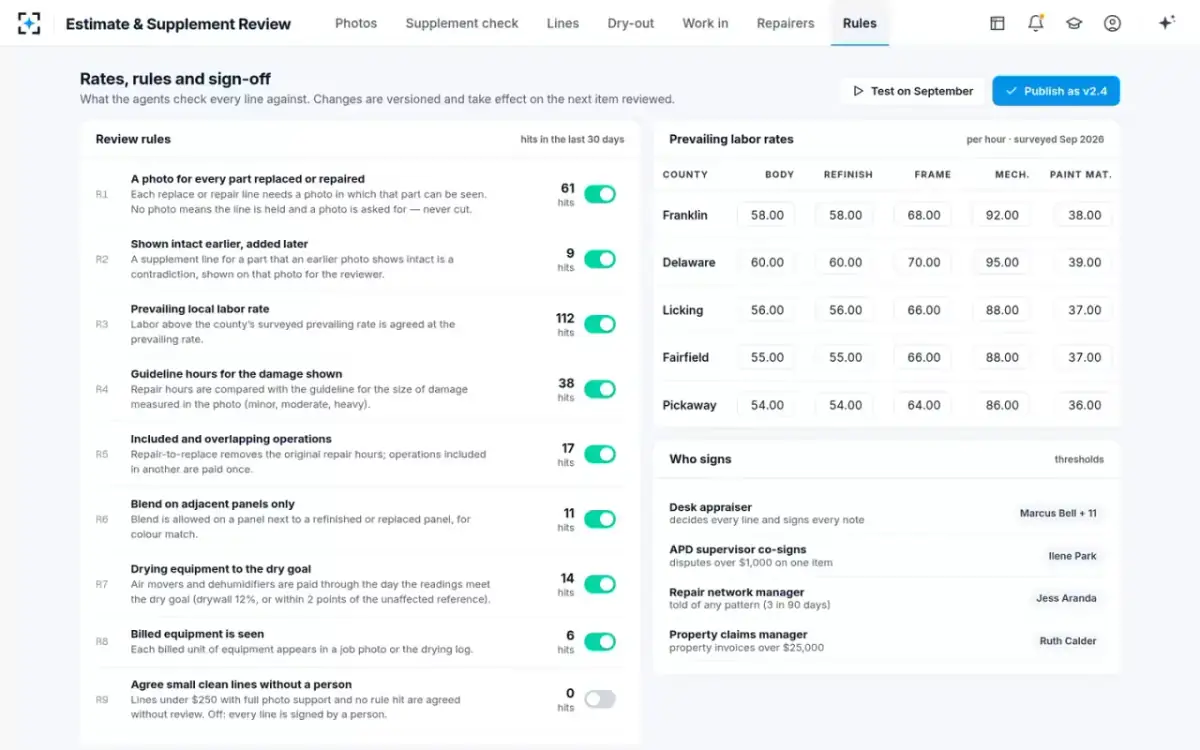
Each threshold is a setting, with the number of times it applied
Questions people ask
What is blend within a panel?
A blend confined to part of the same panel being repaired, rather than carried into the neighbouring panel, used when only part of the panel is refinished. It is reviewed the same way: by the photo of the repair area and the refinish procedure relied on.
Who decides whether a panel needs blending?
The repairer proposes it and the insurer's appraiser agrees or questions it, on the evidence of the car. California requires the insurer's estimate to allow a repair to accepted trade standards, and in Washington a claimant who disagrees after a virtual inspection can require an in-person one within five business days.
What is a P-page on an estimate?
The procedure explanation pages an estimating system publishes, setting out what each labor time includes and excludes and which overlaps it deducts. They are the reference for included and not-included operations, and Montana bars an insurer from unilaterally disregarding an operation the agreed system identifies.
Can an insurer refuse to pay for sensor calibration?
It can question whether the sensor was replaced or removed, but if it was, calibration follows the maker's procedure; IIHS reports that automakers stipulate calibration whenever a sensor is removed and replaced or reinstalled. In the sample, the calibration was held only until a photo confirmed the sensor.
Is a price list older than 90 days against the rules?
Not by any regulation we found for repair parts; it is a carrier's own rule, and the sample carrier applies it. The 90-day limits in California and Washington rules apply to comparable vehicles in total-loss valuations.