An appraisal clause in auto insurance is the policy provision that lets either the insurer or the policyholder, when they cannot agree on the amount of a loss, demand that each side appoint an appraiser, with an umpire to settle what the two cannot agree; the amount agreed by any two of the three is binding. It covers the size of the loss, such as the cost to repair or the car's value, not whether the loss is covered. Since 1 January 2026 every Washington auto policy with first-party physical damage cover that is issued or renewed must contain one, in wording set by statute. For a desk appraiser, the practical consequence is that any amount cut from a supplement may one day be re-appraised line by line by someone else, and a decision survives that only if each amount not agreed carries its photo, its rule and its reason.
That is the standard Estimate & Supplement Review is built to: Botminds' software for checking estimates, supplements and repair invoices line by line against the photos, the policy and local prices, with the desk appraiser deciding every line and signing. The example on this page is a fictional sample claim, a rear-ended 2022 Honda Accord in Ohio with fictional shop, carrier and people. The laws quoted are real and current as of October 2026; this is not legal advice.
Washington’s standard auto appraisal clause in four numbers
10days
for each side to choose a competent and disinterested appraiser after a written demand
30days
for the appraisers to complete their appraisals, unless one gives a reason for more
15days
to agree an umpire before either appraiser can ask the commissioner to name one
2of 3
agreements needed for a binding amount: both appraisers, or one with the umpire
What is an appraisal clause in insurance?
It is a dispute-resolution term in the policy for disagreements about amount. Washington's statute gives the clearest modern text, which every covered policy must now contain or match with language the insurer certifies is at least as favorable to the insured: "If . . . (the insurance company) . . . and . . . (the policyholder) . . . are unable to agree as to the amount of loss, either party may make a written demand for an appraisal, and within 10 days each party shall select a competent and disinterested appraiser and notify the other party of its selection."
The appraisers then each value the loss, "make separate findings regarding the amount of loss for each element of loss, and exchange their completed appraisals." Where they disagree, an umpire decides between them. "Competent" means subject-matter expertise, training and experience; "disinterested" means no direct financial interest in the outcome. The words "each element of loss" are the ones that matter for supplement review: an appraisal is itemized, so the insurer's side has to defend each disputed line, not a total.
Is an appraisal clause required in auto insurance?
In Washington, yes, for policies with first-party physical damage cover issued or renewed from 1 January 2026; elsewhere it depends on the policy. Washington's law passed the Senate 46 to 2 and the House 96 to 1 and was signed on 20 May 2025. Texas considered the same idea in 2023: the House Insurance Committee's analysis of HB 1437 noted that "Under current law, insurance companies are not required to include an appraisal process in their policies", but the bill stalled in the Senate in May 2023 and did not become law (bill history).
Where a policy has the clause, regulators already assume it. California's total-loss rule lists invoking "the appraisal provision of the insurance policy" among an insurer's options when an insured reports, within 35 days, that a comparable car cannot be bought for the settlement, and Washington's amended rules for total losses require an insurer to tell its appraiser the valuation methods the rule sets, and to disregard any non-compliant valuation when applying an award. Check the policy before assuming either side can demand appraisal.
Who can be an umpire under Washington's clause?
Anyone the two appraisers agree on, provided the person is competent and disinterested. If they cannot agree within 15 days, either appraiser can ask the Insurance Commissioner, who names a registered umpire. Washington's rule for that register, WAC 284-20-310, took effect on 31 January 2026, and sets a high bar.
To be a registered umpire for Washington auto appraisals
| Requirement | What the rule asks for |
|---|---|
| Experience | At least five years as an appraiser of auto claims or a collision repair specialist |
| Umpire record | At least five appointments as umpire on an appraisal panel |
| Education | An associate degree or equivalent in auto repair, or a professional auto repair certification from the Inter-Industry Conference on Auto Collision Repair, a vehicle manufacturer or the National Institute for Automotive Service Excellence, or an equivalent |
| Appraisal credential | An appraisal certification or designation from one of four named appraiser bodies, or an equivalent |
| Before each panel | A signed attestation that the umpire is competent and disinterested as the statute defines them |
What happens when you disagree with the insurance estimate?
There is a ladder, and appraisal is near the top of it. Most disputes about a repair estimate or supplement end lower down, once the insurer has given its reasons and the shop or owner has answered with evidence. The steps below apply to a first-party auto claim in the states named; a third-party claimant has no contract with the other driver's insurer and normally no appraisal right under it.
The ladder for a disputed repair estimate, from a written reason to the courts
- 1
Ask for every reason, in writing
Washington requires all of the reasons for paying less than the shop’s estimate, with the cited policy provision explained; California requires each adjustment and its cost to be identified.
- 2
Put a higher estimate in front of the insurer
In California and Ohio the insurer must then pay the difference or name a shop that will do the repair for its figure; California also allows a reasonable adjustment of the shop’s estimate, itemized.
- 3
Ask for an in-person inspection
In Washington, after a disputed virtual inspection, the insurer must inspect in person within five business days or another agreed time.
- 4
Invoke the appraisal clause
For disputes about the amount of loss, not coverage. In Washington, every policy with first-party physical damage cover issued or renewed from 1 January 2026 must have one.
- 5
Complain to the regulator, or go to court
Appraisal settles an amount; it does not decide whether a practice was unfair or whether a loss is covered.
California's rule sets out the insurer's three options once the claimant produces a higher written estimate: pay the difference; name at least one shop that will do the repair for the insurer's amount; or reasonably adjust the shop's estimate and give a copy to the claimant and the shop. An adjusted estimate "shall identify the specific adjustment made to each item and the cost associated with each adjustment made to the claimant's shop's estimate." New York adds a formal notice: if negotiation does not reach an agreed price, the insurer must send the prescribed Notice of Rights letter (11 NYCRR 216.7(b)(14)).
What does the insurer have to tell me if it pays less than my shop's estimate?
Every reason, in writing, tied to the policy. Washington's amended rule is now the most demanding. If an insurer pays less than the estimate from the claimant's chosen shop, it must "promptly and fully disclose all of the reasons it paid less than the claimant's estimate, including a reasonable explanation of the cited policy provision to reject the claimant's repair estimate or invoice, and must thoroughly document the circumstances in its claim file." It must also document in writing any repair costs in its estimate that the policy does not cover, citing the policy language, and on request explain how labor and material costs and repair processes were determined.
The national template points the same way. The NAIC's model unfair claims law treats as unfair "Failing in the case of claims denials or offers of compromise settlement to promptly provide a reasonable and accurate explanation of the basis for such actions" when done flagrantly or as a general business practice; state versions differ. Washington has gone further: its amended rule deletes the words "with such frequency as to indicate a general business practice" from its purpose section, so a violation no longer has to be shown to be a general business practice.
Four appraisal practices Washington treats as unfair
Washington's claims rule, as amended in 2026, lists four ways an insurer can mishandle appraisal, each an unfair claims settlement practice in its own right (WAC 284-30-330, as amended by WSR 26-17-089):
- Lowballing into appraisal. Compelling a first-party claimant to go to litigation, arbitration or appraisal by offering substantially less than is ultimately recovered.
- Out-of-area appraisers. Delaying appraisal or adding to its cost by using appraisers from outside the loss area, unless the loss is unusual or competent local appraisers are lacking.
- Skipping settlement. Failing to make a good-faith effort to settle before exercising a contract right to appraisal.
- Leaning on the appraiser. Requiring an appraiser acting under the clause to adjust their valuation at any time during the appraisal; the insurer may still apply the policy's conditions to a finished award.
The first of these turns the appraisal award into a measure of the original decision. If the award comes in well above the insurer's offer, the question becomes whether the offer was substantially less than the amount owed. That is a question about the supplement review that produced the offer, which is why the file behind each cut line matters more than the total.
The defensible file: the tests every cut line must pass
A cut line survives appraisal, a complaint or an examiner when someone who was not there can see why it was cut. The NAIC's model regulation states the general standard, that each claim file must contain "Detailed documentation" sufficient "to permit reconstruction of the insurer’s activities relative to each claim", and Washington adds that the insurer is responsible for the documentation that supports how its repair estimate meets the policy language. Translated to a supplement line:
Six tests for every amount not agreed on a supplement
- The evidence is on the line
A dated photo, measurement or log entry that shows the part or the work, kept unaltered. Washington lets insureds request photographs, estimates and reports from their claim file.
- The rule or price source is named
The labor rate survey, guideline time or price list, with its date. In Washington the data source must be disclosed on request.
- The policy reason is stated
Where coverage is the reason, the provision is cited. Washington requires the policy language for costs not covered.
- The dollars are itemized
Each adjustment and its cost, line by line, so an appraiser can find each element of loss.
- What would change it is said
A missing photo or measurement is asked for, not held against the line. In Washington, more documentation must be sought before damage a photo does not show is rejected.
- Who decided, and when, is recorded
The appraiser’s decision and any co-signature, with dates, so the insurer’s activities can be reconstructed.
One cut line, two ways
The sample supplement shows the difference. Kestrel Auto Body's supplement S1 added a front bumper cover, $892.00, to a car hit from behind. The line was not agreed. What matters for appraisal is how.
The same disputed line, as a phone call and as a defensible decision
Cut by phone: "That wasn’t in the original damage."
Cut on the record, as in the sample note: Rear impact; photos P4 and P5 of 26 September show the front bumper cover intact, gaps even, paint unbroken; none of the six teardown photos shows the front.
Cut by phone: In the appraiser’s memory, or a photo nobody attached.
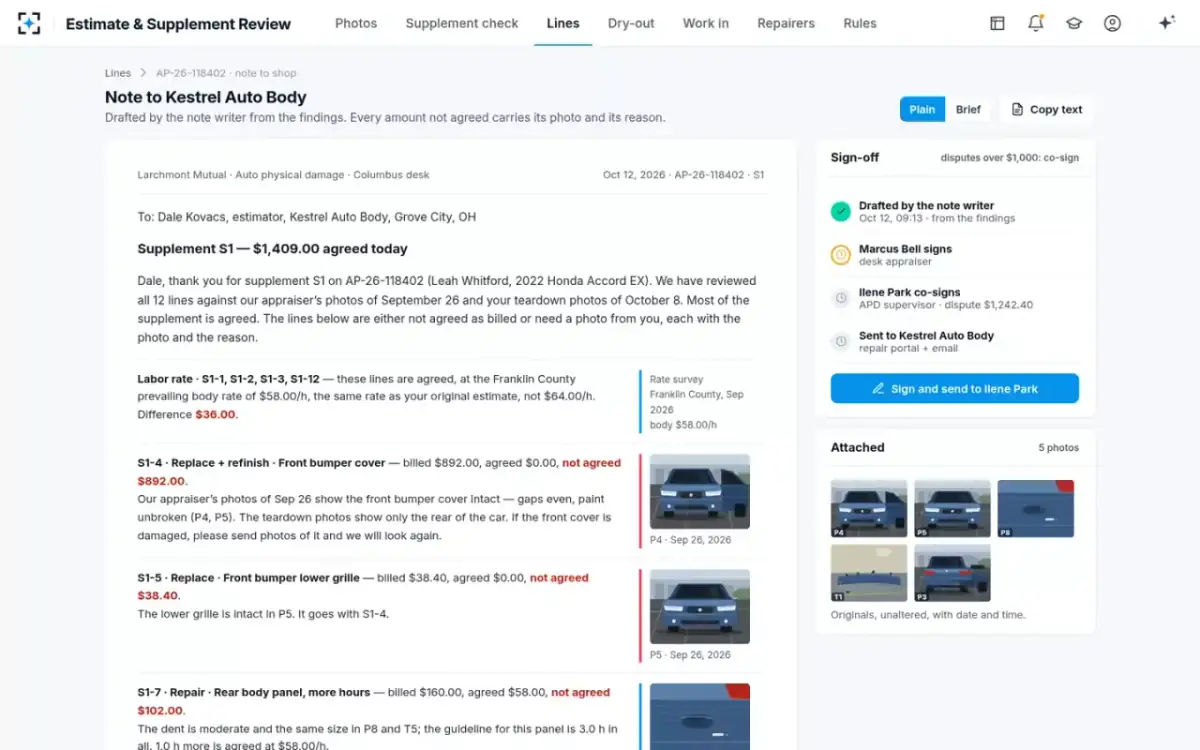
Cut on the record, as in the sample note: P4 and P5 attached to the note, originals with date and author.
Cut by phone: A lower total.
Cut on the record, as in the sample note: S1-4 billed $892.00, agreed $0.00; S1-5 grille $38.40 goes with it.
Cut by phone: Another call.
Cut on the record, as in the sample note: “If the front cover is damaged, please send photos of it and we will look again.”
Cut by phone: Unclear.
Cut on the record, as in the sample note: Desk appraiser signed 09:26; supervisor co-signed 09:31; sent 12 October through the repair portal.
Cut by phone: The insurer’s appraiser starts from nothing.
Cut on the record, as in the sample note: The element of loss is already isolated, evidenced and explained.
The disputed line, shown on the earlier photo of the same part
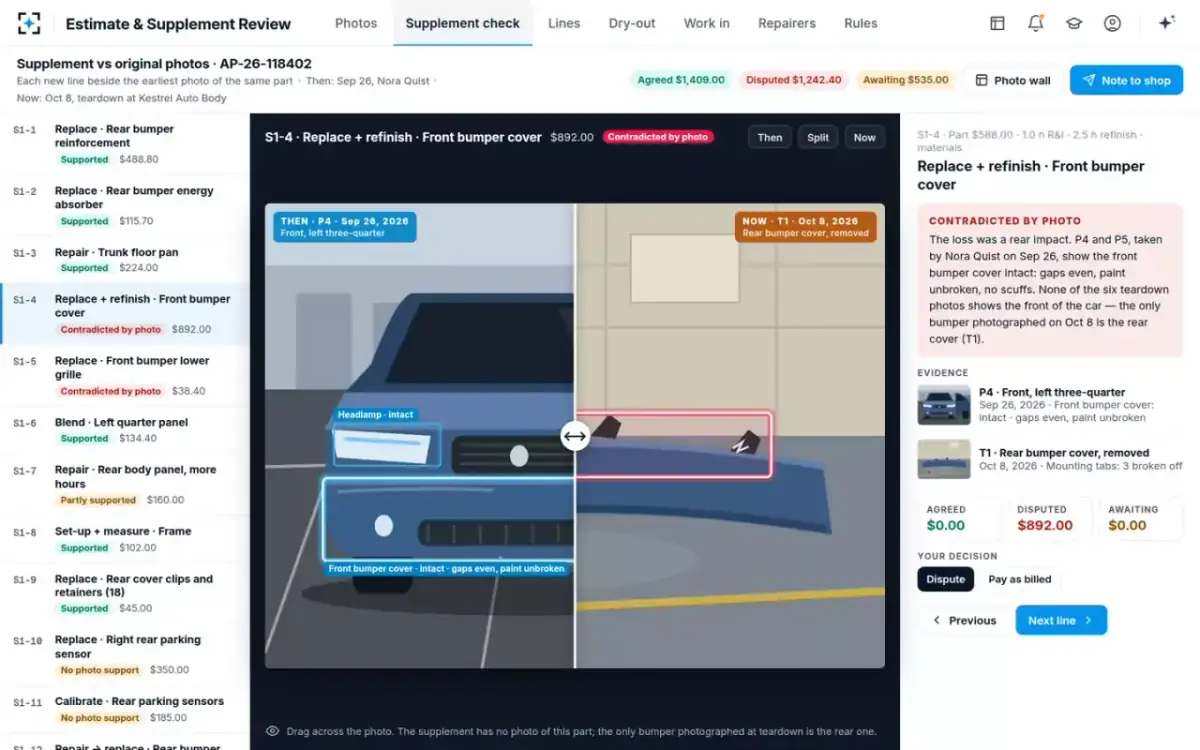
Under the solution, the note writer drafts that note from the findings and the desk appraiser signs it: every amount not agreed is listed with its photo in the margin and its reason, and the note says what the shop can send to change the answer. A line with no photo is held, never cut, so the file never contains a rejection that rests on an absence of evidence.
Every amount not agreed, with its photo and its reason
Can I dispute a supplement denial?
Yes. The first step is to ask for the reason for each line in writing and answer it with evidence: a photo of the part, a measurement, the repair procedure. In the sample file, the front bumper line came with an explicit route back: send photos of the front cover. Where the dispute is about amount, a first-party claimant can then invoke the appraisal clause if the policy has one, and in Washington every new or renewed policy with first-party physical damage cover now does.
Disputes about labor rates, hours and blend are the commonest amounts at issue on supplements, and they are only as strong as their sources; how the prevailing labor rate is set and the thresholds behind blend and overlap lines cover the two most frequent. What Estimate & Supplement Review does not do is take part in an appraisal: it does not appoint appraisers, argue values or predict awards. It makes sure that what the insurer's appraiser receives is a set of decisions that were already evidenced when they were made.
Questions people ask
How long does an auto insurance appraisal take?
Under Washington's standard clause, each side has 10 days to choose an appraiser after a written demand, and the appraisers have 30 calendar days from selection to complete their appraisals, unless one gives a reason for more before day 25. If they disagree and cannot agree an umpire within 15 days, either can ask the commissioner to name one. Policies elsewhere set their own timetables.
Who pays for appraisal in auto insurance?
Under Washington's clause, each party pays its own appraiser and the two share the umpire's cost equally. Other policies vary. Texas's 2023 bill would have made the insurer refund the policyholder's appraiser fees when the award beat its last offer by more than 10 percent, and the policyholder pay the insurer's when the award came in more than 10 percent below it, but the bill did not become law.
Is an appraisal award binding?
The amount agreed by any two of the three, the two appraisers or one appraiser and the umpire, is binding under Washington's clause. Appraisal settles the amount of loss; whether a loss is covered at all is not an appraisal question.
Can the insurer tell its appraiser to lower the number?
Not in Washington, where it is an unfair claims practice to require an appraiser functioning under the appraisal clause to adjust their actual cash value or valuation of loss at any time during the appraisal; the insurer may still apply the policy's conditions to a completed award.
Can the body shop invoke the appraisal clause?
The clause is between the insurer and the policyholder; Washington's text gives the right to "either party" to the policy. A shop can supply the estimate, photos and procedures the owner's appraiser relies on, and in Washington the owner can ask to be copied on all communications between the insurer and the shop about estimates.