AI vehicle damage detection is software that finds damaged areas and parts in photos of a car and marks each one, usually with a box or an outline and a label such as dent, scratch or broken lamp. It works well on damage that looks the same on every car, like shattered glass or a flat tyre, and markedly worse on dents, scratches and cracks, which are exactly the lines a body shop supplement and an appraiser argue about. For estimate and supplement review, the useful detector therefore does not price anything. It looks at every photo of the claim, names each part in frame, and says whether that part is damaged, intact or not clear, so a supplement line can be put next to the earliest photo of the same part and a person can decide.
That is how the photo tagger in Estimate & Supplement Review is designed. The solution is Botminds' software for reviewing estimates, supplements and repair invoices line by line against the damage photos, the policy and local prices, with a desk appraiser deciding every line and signing the note. The examples below come from a fictional sample claim, a rear-ended 2022 Honda Accord in Ohio; the research and rules are real.
What one public benchmark shows about AI car damage detection
4,000
car damage photos in the CarDD dataset, with over 9,000 labelled damaged areas
90AP
detection score for shattered glass and for flat tyres, from the best model tested
42AP
for dents and for scratches, from the same model
29.6AP
for cracks, the hardest of the six damage types
How does AI detect car damage from photos?
Most systems use object detection or segmentation models: neural networks trained on thousands of labelled photos to draw a box or an outline around each region that matches a learned class. The largest public dataset for the task that its authors know of, CarDD, published in IEEE Transactions on Intelligent Transportation Systems in 2023, contains 4,000 high-resolution photos with over 9,000 labelled instances of six damage types: dent, scratch, crack, glass shatter, lamp broken and tire flat. A model trained on it outputs, for each photo, a set of regions with a damage type and a confidence.
Two things in that output matter for claims. First, a damage type is not a part. "Dent, here" has to be tied to "rear body panel" or "trunk lid" before it can be compared with an estimate line, which names parts. Second, a detector trained on damage learns nothing about intact parts; an empty result on a photo means "nothing found", not "this part is undamaged". A claims tagger has to add both: a list of the parts visible in each photo, and an explicit verdict on each of them.
How accurate is AI car damage detection?
It depends almost entirely on the type of damage. On the CarDD benchmark, the authors' best model scored around 90 on a 0 to 100 detection scale for shattered glass and flat tyres, 70 for broken lamps, and about 42 for dents and scratches; cracks scored under 30. The authors explain why: "the difference between car damage types like dent and scratch is subtle", and the damaged areas vary widely in shape and size. In their dataset 38.6% of damaged areas are small, under 128 by 128 pixels.
AI damage detection is strong on obvious damage, weak on the dents and cracks supplements argue about
Read that chart as a buyer. The damage a field appraiser can see from three metres, shattered glass, a broken lamp, is where models are strongest, and it rarely needs a supplement. The damage that drives supplements is the bent reinforcement behind a bumper, a buckled floor pan, a crease in a quarter panel: dents and cracks, often small, often on teardown photos taken in a shop under poor light. A system that turns photos straight into prices inherits the weak end of this chart on the lines that matter most. That is the case for a detector that reports what it can and cannot see, and leaves the decision to a person.
Damaged, intact or not clear: why the useful answer is per part, per photo
The photo tagger in the solution gives every part in every photo one of three verdicts, with a box drawn around the part on the photo and the photo's date, time and who took it. Damaged and intact are both findings. Not clear is a finding too: the part is in the photo, but the light, angle or focus does not let anyone say. On the sample supplement, the tagger boxed 28 parts across six teardown photos and twelve field photos: 13 damaged, 13 intact and 2 not clear.
One field photo, two readers: the appraiser and the photo tagger
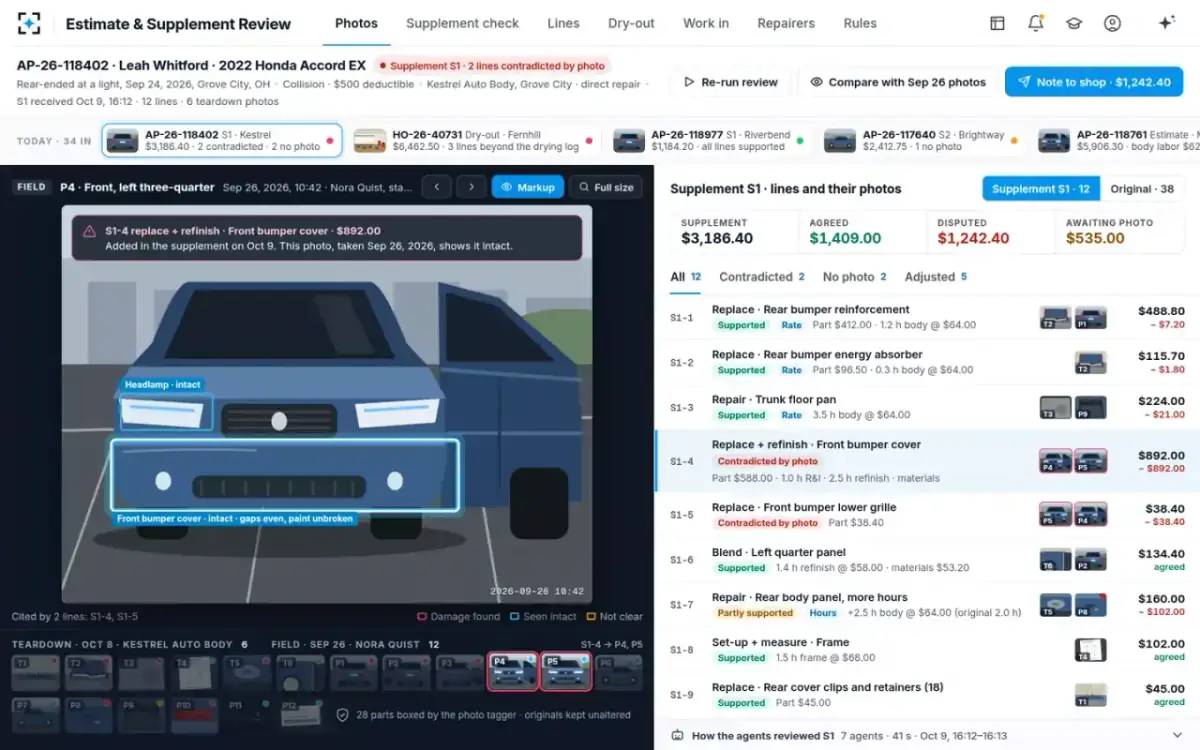
The appraiser, reading photo P4: Front of the car, left three-quarter view, taken at the first inspection.
The photo tagger, on the same photo: View: front, left three-quarter. Parts boxed: front bumper cover, left headlamp.
The appraiser, reading photo P4: Looks fine.
The photo tagger, on the same photo: Intact: gaps even, paint unbroken. Box drawn on the cover.
The appraiser, reading photo P4: Not noted.
The photo tagger, on the same photo: Intact. Box drawn on the lamp.
The appraiser, reading photo P4: In the file, if anyone looks.
The photo tagger, on the same photo: Sat 26 Sep 2026, 10:42, Nora Quist, staff appraiser. Original kept unaltered.
The appraiser, reading photo P4: Nothing, unless someone remembers the photo when the supplement arrives.
The photo tagger, on the same photo: Supplement line S1-4, a new front bumper cover, is put beside this photo and marked for a person: contradicted by photo.
Recording intact parts is what makes the comparison possible. When Kestrel Auto Body's supplement arrived on 9 October with a $892.00 line to replace and refinish the front bumper cover on a car hit from behind, the evidence linker found the earliest photo of the same part, photo P4 of 26 September, where the tagger had marked the cover intact. The line went to the desk appraiser shown on that photo, with the verdict and the date. The tagger did not reject it, price it, or call it anything but a contradiction.
A supplement line shown on the earlier photo of the same part
What does "not clear" mean on a damage photo?
It means the part is present but the photo cannot support a verdict either way, and it should trigger a request for a better photo, not a cut. Washington's amended claims rule makes this a duty. If an insurer "is unable to document damages in a submitted photograph by the claimant, the claimant's chosen repair facility, or both, the insurer must make reasonable efforts to request additional documentation prior to rejecting the coverage of the submitted damage" (WAC 284-30-390(1)(a)(ii), as amended, in force since 18 October 2026).
Three verdicts, three next steps for a supplement line
| Verdict on the part | What it means | What happens to the line | Who decides |
|---|---|---|---|
| Damaged | A photo shows damage on the part the line names. | Linked to that photo as support; rate and hours still checked. | The desk appraiser agrees it, usually as billed or at the prevailing rate. |
| Intact on an earlier photo | The earliest photo of the part shows it undamaged. | Marked as contradicted and shown on that photo, with its date. | The desk appraiser, who may dispute it, ask for more photos, or pay it. |
| Not clear, or not in any photo | No photo lets anyone see the part well enough. | Held, not cut; the shop is asked for a close photo. | Nobody yet. The line waits for evidence. |
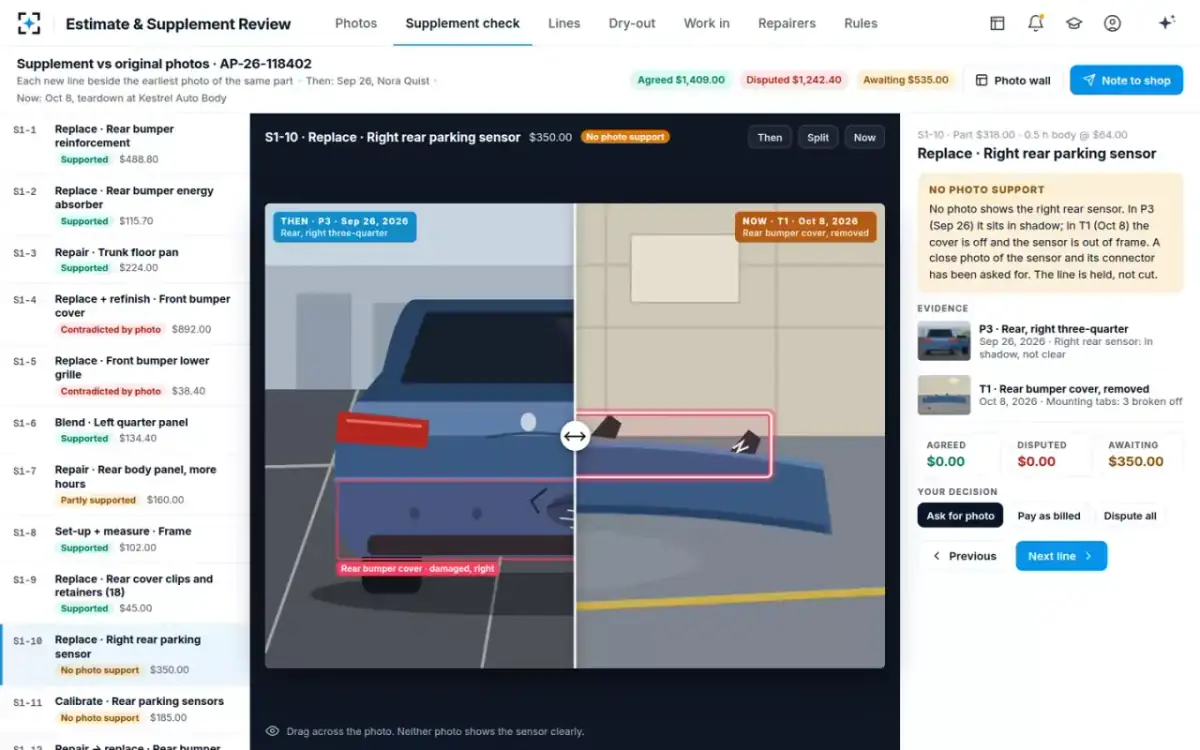
On the sample supplement, two lines fell into the third row: a right rear parking sensor at $350.00 and its calibration at $185.00. In field photo P3 the sensor sits in shadow; in teardown photo T1 the bumper cover is off and the sensor is out of frame. The tagger marked the sensor not clear on P3, the evidence linker found no other photo, and the $535.00 was held while the shop was asked for a close photo of the sensor and its connector.
Not clear means held: the sensor line waits for a photo
Can AI tell old damage from new damage?
Not from a single photo with any reliability, and no public benchmark we found measures it. What a system can do is compare dated photos: the field photos taken soon after the loss, any photos on file from earlier claims, and the teardown photos. A part that was intact in the first photos and appears damaged in a supplement is either damage found at teardown or damage that happened later; a person has to decide which, and the photo dates are the evidence.
The rules expect that separation to be made and written down. Massachusetts requires its licensed appraisers to "specify all damage attributable to the accident, theft, or other incident in question and shall also specify any unrelated damage". California's auto rule keeps the insurer's right to deduct for prior or unrelated damage, and requires the adjustments it governs to be "discernable, measurable, itemized, and specified as to dollar amount", with the basis explained to the claimant in writing (10 CCR 2695.8(i)). In both cases a photo with a date on it is what makes the call defensible; a model's opinion about the age of a dent is not.
Where the photo tagger sits among the agents
In the solution the photo tagger is one of seven agents, and the narrowest. It looks and reports; it never prices, never judges coverage and never alters a photo. Its verdicts are inputs to the evidence linker, which ties each line to the photos that support or contradict it, and everything ends with a person.
From a photo to a signed decision on one supplement line
Agent
Photo taggerNames the view and the parts in frame on every photo, boxes each part, and marks it damaged, intact or not clear, with the photo’s date, time and author.
Never: Alters or crops the original, guesses, or judges coverage.
Agent
Estimate readerReads the supplement line by line and matches each line to the original estimate as new, changed or repeated.
Never: Changes a line or an amount.
Agent
Evidence linkerPuts each line beside the earliest photo of the same part; links support, flags contradictions, holds lines with no photo.
Never: Calls anything fraud, or cuts a line for want of a photo.
A person decides
Desk appraiserSees the line on the photo, slides between the earliest photo and the teardown photo, agrees, disputes or asks for a photo, and signs the note.
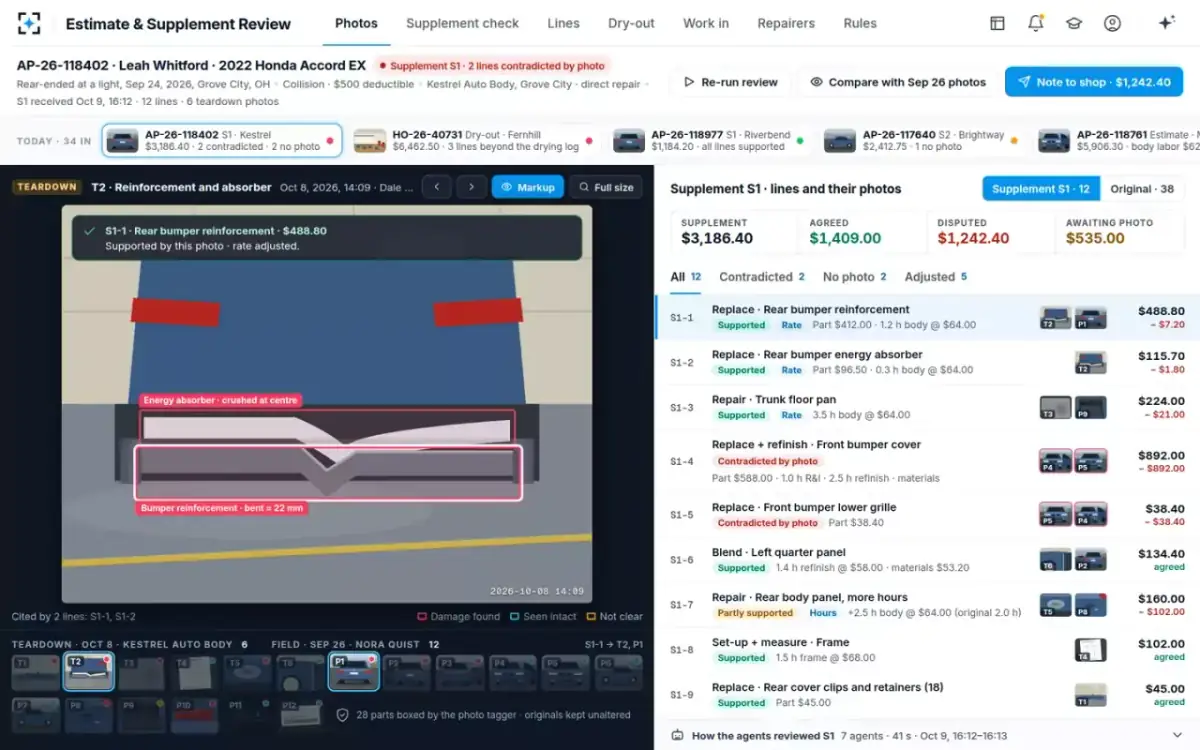
On the teardown photos the same tagger does the opposite job: it confirms the damage the supplement claims. On photo T2 it boxed the rear bumper reinforcement, bent about 22 mm, and the energy absorber, crushed at the centre. Those lines were supported by the photo, and only their labor rate was adjusted.
On teardown photos, the tagger confirms the hidden damage
The rules an AI damage detector has to work inside
None of the states reviewed here bans photo-based damage assessment, but several decide where it stops. Massachusetts requires its licensed appraisers to personally inspect the damaged vehicle, rely primarily on that inspection and photograph each damaged area. California lets an insurer ask for photos in place of an inspection, but only within three business days and with notice that it may still inspect. Washington, since 18 October 2026, bars making photo-only evaluation a condition of coverage, requires an in-person inspection on request after a disputed virtual one, and treats an investigation that relies solely on a database, including estimating software, as unreasonable.
The federal labor statistics agency already counts this shift in its projections. There were 13,500 jobs for insurance appraisers of auto damage in 2025, projected by the Bureau of Labor Statistics to fall 9% by 2035, and the agency cites software that evaluates photos among the reasons (BLS Occupational Outlook Handbook). What the state rules add is that the person who remains is accountable for what the software produced; the detail of who answers for an AI estimate is in whether an AI car repair estimate can be the insurer's estimate.
What to ask before buying AI vehicle damage detection
Ask what the system outputs, how it was measured on photos like yours, and what it does when it cannot see. A price with a confidence score answers none of those. The checklist below is what we would want answered for any AI damage assessment tool, including ours.
Questions for any AI vehicle damage detection tool
- Does it output a verdict per part, per photo?
Damaged, intact or not clear, tied to a named part, not just "damage found". Without intact verdicts, a supplement cannot be checked against earlier photos.
- What is its accuracy by damage type, on your photos?
Published benchmarks show a spread from about 90 for shattered glass to under 30 for cracks. Ask for results by type on a sample of your own closed claims, including teardown photos.
- How often does it say "not clear", and what happens then?
A system that never abstains is guessing on bad photos. In Washington, missing documentation must lead to a request before damage is rejected.
- Are originals kept unaltered, with date, time and author?
A cropped or enhanced photo is weaker evidence in a dispute or an appraisal.
- Does it price, and can a person see why?
If it produces amounts, Washington treats a database-only investigation as unreasonable and requires the data source on request.
- Can the reviewer see the box on the photo next to the line?
The finding is only useful if a person can check it in seconds and the shop can be shown the same picture.
A test on your own files answers most of these in a few weeks; how to pilot estimate review on last quarter's files sets out the steps. Where the solution does not fit: it does not write first estimates from photos, and it is not a mobile inspection app. It reads the photos a desk already receives, field, teardown and job photos, and uses them to check the lines someone else wrote.
Questions people ask
What are AI damage assessment tools?
They are systems that read photos or video of a damaged vehicle or property and identify damaged areas, sometimes going on to estimate repair costs. The detection step is mature for obvious damage; on the CarDD benchmark, the best model tested scored about 90 for shattered glass but about 42 for dents. Tools differ most in what they do after detection: price, flag for review, or record a verdict per part.
Is AI vehicle damage detection the same as AI visual inspection for defect detection?
The techniques are related: both train detection or segmentation models on labelled images to find anomalies. A factory inspection compares near-identical parts under controlled light; a claim compares one car's photos taken by different people, days apart, in yards and shops. That is why a claims tool needs photo dates, authors and an explicit "not clear" verdict.
Can an insurer reject damage because it is not in the photos?
In Washington, not without trying to get more documentation first: since 18 October 2026 an insurer unable to document damage in a submitted photo must make reasonable efforts to request more before rejecting it. The sample claim's design goes further, holding any line with no photo rather than cutting it.
Does the photo tagger decide what gets paid?
No. It records what each photo shows, part by part. The evidence linker ties those verdicts to supplement lines, and the desk appraiser decides every line and signs every note; a supervisor co-signs large disputes.
How many photos does a supplement review need?
One clear photo of each part a line adds or changes, plus the earlier photos of the same part. On the sample supplement, 18 photos covered 12 lines; two lines had no usable photo and waited for one.