Claim cycle time is the time an insurance claim takes to move through its life cycle, most often measured as the number of days from first notice of loss to closing or final payment. For claims still open, it is usually reported as days open, the claim's age. Both measures are easy to compute and both mislead in the same way: they count time a claim has existed, not time it has spent waiting. A claim that is moving steadily and one that has sat untouched for two weeks can have the same age. The measure that separates them is quiet days, the days since the last activity that actually moved the file, read by the party the file is waiting on.
Claims Cycle Time Monitoring, Botminds' solution for open property and auto claims, is built on that measure: it reads every open file each morning, counts quiet days, names who each file is waiting on and predicts which files will cross 14 quiet days. This guide defines claim cycle time and the claim life cycle in property and casualty insurance, shows why days open hides the problem, and sets out how to compute quiet days from data regulators already require. Worked examples use a fictional sample team.
One file, two measures of cycle time
Days open: Today minus the date the claim was reported.
Quiet days: Today minus the date of the last activity that moved the file.
Days open: 21 days: reported 21 September.
Quiet days: 12 days: nothing has moved it since a supplement arrived on 30 September.
Days open: A young claim, comfortably inside any normal range.
Quiet days: A stalled claim, two days from a 14-day threshold.
Days open: Not shown.
Quiet days: The insurer’s own supplement desk, found by following the body shop’s wait.
Days open: Nothing; it only grows until the claim closes.
Quiet days: A document received, a payment or reserve change, a decision, a two-way conversation.
What is claim cycle time in insurance?
In insurance, claim cycle time is the elapsed time between two points in a claim's life, and the useful definition depends on which two. The most common is first notice of loss to closing. Others measure first notice to first payment, first notice to first contact with the claimant, inspection to estimate, or proof of loss to decision. An open claim has no end point yet, so its cycle time is reported as its age, which is the number that most dashboards show.
No regulator publishes a standard definition of claim cycle time that we could find, so every insurer's figure rests on its own choice of start and end. What regulators do fix are the milestones in between: how fast a claim must be acknowledged, investigated, decided and paid. Those milestones are the skeleton of the claim life cycle, and the time between them is where cycle time is gained or lost.
The claim life cycle in P&C insurance, stage by stage
A first-party property or auto claim passes through six stages, and state rules set a clock on four of them. The table uses California and Florida as examples; other states' numbers are compared in prompt payment laws by state.
The life cycle of a property or auto claim, with the clock on each stage
| Stage | What happens | An example clock | What it usually waits on |
|---|---|---|---|
| First notice | The claim is reported and acknowledged; forms and instructions are sent. | California: 15 calendar days to acknowledge. Florida: 7 calendar days. | Nothing; the insurer acts. |
| Investigation | Coverage is checked; the loss is inspected or photographed; statements are taken. | Washington: complete within 30 calendar days of notice, since 18 Oct 2026. Florida: any physical inspection within 30 days of proof of loss. | Inspectors, independent adjusters, the insured. |
| Estimate and supplements | Damage is priced; supplements follow teardown or demolition. | Varies by state and line. | Shops, contractors, the insurer’s desk appraisers. |
| Decision | The claim is accepted or denied, in whole or part. | California: 40 calendar days after proof of claim, with notice every 30 days while undecided. | Documents from the insured; reports from vendors. |
| Payment | Payees confirmed; lienholders and mortgagees included; money sent. | California: 30 calendar days after acceptance. Florida: pay or deny within 60 days of notice. | Lienholders, mortgage servicers, payoff letters. |
| Close | Remaining items settled; rentals and storage ended; the file closed. | None. | Final invoices, salvage, subrogation. |
The fourth column is the important one. Within each stage, most elapsed time is spent waiting on someone: a shop, a contractor, a lender, the insured, or the insurer's own desks. A cycle-time measure that cannot say whose wait it is cannot say what to do about it.
Why days open hides the stuck file
Days open grows by one every day for every open claim, whatever is happening on it, so it ranks files by age rather than by need. Averages make it worse. An average cycle time computed on closed claims leaves out the claims that have not closed, which are by definition the slowest, and an average age of open claims is pulled up by a few very old files that may be moving properly through litigation or appraisal.
Catastrophes show the scale of the tail. Fourteen months after Hurricane Milton struck Florida in October 2024, insurers reported 385,146 claims, of which 92.0% were closed and 30,975 were still open on 9 December 2025: 16,572 with some payment made and 14,403 without any. An average computed only on closed Milton claims describes the 92% and says nothing about the 30,975.
Hurricane Milton claims still open without any payment, 14 months on
Those numbers are status counts, not durations: Florida's regulator publishes how many claims are open and closed, not how long each has waited or on whom. That is the general state of public data on claim timing. For why Milton claims closed without payment, a different question, see why a claim is closed without payment.
Quiet days: the cycle time that predicts
Quiet days are the days since the last activity that moved a file, and they predict delay because a claim that has stopped moving keeps accumulating cost and customer contact without getting closer to a decision. The definition rests on what counts as moving. In the sample's default settings, four kinds of event reset the clock: a document arrives, a payment is issued or a reserve changes, an approval or coverage decision is made, or a two-way conversation takes place. Notes, routing between desks, one-way voicemails and unanswered emails, and pushed diary dates are recorded but do not.
Quiet days become actionable when they are read by waiting party. A file quiet for ten days waiting on an insured who usually answers in five is a reminder; one quiet for ten days waiting on a desk that usually takes ten is about to stall. In the sample, the predictor estimates each crossing of 14 quiet days from how the waiting party behaved on closed files and what is already booked, such as an inspection or a parts date.
One sample team’s cycle time, read as quiet days
318
open property and auto files
39
past 14 quiet days
12
past 30 quiet days
$2,864
a day in rental, storage and hotel on files quiet 7+ days
Insurance claim time frame: what the rules fix and what they leave open
The rules fix the milestones, not the total. A state can say a claim must be acknowledged in 15 days, decided 21 or 40 days after proof of loss and paid within days of acceptance, but most say nothing about how long the stages before proof of loss may take, and an investigation that cannot reasonably be finished in time may run on with written explanations. Florida comes closest to a total, requiring residential property claims to be paid or denied within 60 days of notice, a clock that applies to initial, reopened and supplemental claims alike.
That gap is where quiet days live. Between milestones, nothing in the rules forces a file to move, except the duty to explain the delay in writing. California's continuing-notice rule anticipates exactly the waiting file: when a decision depends on a future event, the insurer must explain the situation to the claimant and estimate when it can decide (10 CCR 2695.7(c)(1)). A team that knows its quiet days knows which files owe that letter.
Some states also bound the claim from the policyholder's side, which matters for measuring cycle time on reopened files. Florida bars a new or reopened residential property claim unless notice is given within one year of the date of loss, and a supplemental claim unless notice is given within 18 months (Fla. Stat. §627.70132). A supplemental claim inside that window restarts the insurer's 60-day pay-or-deny clock for that portion. A team that counts a reopened file as a new claim will report a short cycle time for a loss that may be well over a year old.
Average time for the insurance claim process: why no reliable national figure exists
Because no regulator collects claim durations in a public national series. Insurers report losses, expenses and claim counts to regulators, and Florida publishes open and closed counts after each hurricane, but none of the government sources we checked publishes how long property or auto claims take from notice to close. Figures quoted elsewhere come from industry surveys or vendors, whose methods and samples are not public, and we do not repeat them.
Each insurer can compute its own, though, because the dates are required. The NAIC's model regulation asks insurers to note on each relevant document the date it was received, processed or mailed (Model 902 §4). California requires those dates on every material document and the dates of payment, acceptance, denial or closing on every claim, kept for the current year and four preceding years (10 CCR 2695.3). The useful benchmark for a team is its own history, broken down by line, stage and waiting party.
How to measure claim cycle time from your own claim data
Measure four things, each with a clear start and end, and report the open-file measures daily and the closed-file measures monthly.
Four claim cycle time measures and how to compute each
| Measure | Formula | Use it for |
|---|---|---|
| Notice to close | Close date minus notice date, closed claims only, as a median and 90th percentile by line | Monthly trend; comparing lines and teams |
| Age of open claims | Today minus notice date, open claims | Inventory and reserve reviews |
| Quiet days | Today minus the date of the last activity that moved the file, open claims | Daily work: which files need someone today |
| Wait time by party | Days each file spent waiting on each party, from the activity log, closed claims | Fixing the slowest waits, including the insurer’s own desks |
How Claims Cycle Time Monitoring measures it
The solution computes quiet days on every open file each morning from the claim system, the documents on each file, shop and contractor status, vendor bills and customer contacts, read-only. Its weekly trend tracks files past 30 quiet days for each team and adjuster, with days to close on auto and rental days per claim beside it so one measure cannot be improved at the expense of another. Its design target is 40% fewer files past 30 quiet days three weeks after go-live, a target to be measured against a carrier's own baseline.
Cycle time as files past 30 quiet days, week by week
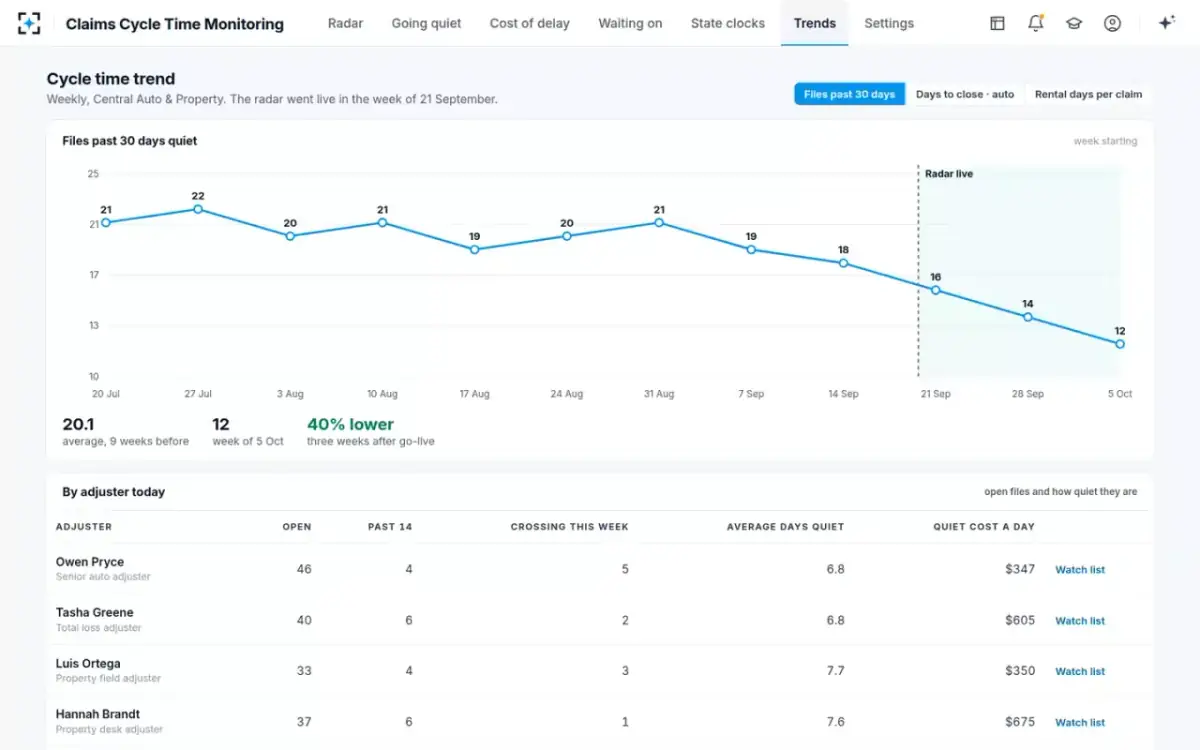
Looking ahead is the other half. The radar's time scrubber moves every file forward three or seven days: files with something booked move toward the centre, the rest drift outward, and the files that will cross 14 quiet days with nothing booked are flagged for their owners before they do. The KPIs built on these measures are set out in claims management KPIs that lead the money.
Questions people ask
How is claim cycle time calculated?
As the days between two dates in a claim's life, most often first notice and closing. For open claims, compute both age (today minus notice) and quiet days (today minus the last activity that moved the file); use medians and percentiles rather than averages.
What is the life cycle of a claim in insurance?
First notice, investigation, estimate and supplements, decision, payment and close. State rules set clocks on acknowledgement, investigation, decision and payment; the time between those milestones is mostly spent waiting on shops, contractors, lenders, the insured or the insurer's own desks.
What is a good claim cycle time?
There is no public benchmark from a regulator, so judge cycle time against your own history by line and stage. For open files, a practical standard is that none passes a quiet threshold, such as the sample's 14 days, without someone knowing why and what will move it.
Does a reopened claim start a new cycle?
For measurement, treat it as part of the original claim and report reopen rates separately, so closing early is not mistaken for speed. Florida's 60-day pay-or-deny rule applies to reopened and supplemental residential property claims as well as initial ones.
Why do some insurance claims stay open for months?
Because they wait: on repairs and parts, on contractors' reports, on lenders, on the insured, on disputes, or on the insurer's own queues. Fourteen months after Hurricane Milton, Florida insurers reported 30,975 claims still open, 14,403 of them with no payment made.