A claim closed without payment is a claim the insurer has finished handling without paying anything on it. It is not always a denial: after a hurricane, the largest single reason is that the damage came to less than the policy's hurricane deductible, and many others are claims withdrawn, duplicated, opened in error or closed because the policyholder could not be reached. Florida's Office of Insurance Regulation publishes the reasons for every recent storm, so a policyholder can find their branch and a carrier can see what its closing letters must explain. Botminds' Catastrophe Claims Management is catastrophe claims software that sorts a storm's claims for the carrier's adjusters; it never closes a claim itself, and every closing below the deductible goes out with a plain letter an adjuster signs.
The numbers here come from insurers' reports to Florida's regulator, which notes they are unaudited and change as claims are handled. Where the guide shows how a carrier can do this well, the examples come from a fictional sample event, Hurricane Delphine and the fictional carrier Corvane Mutual, as it runs through the solution; those figures are sample data, not a customer result.
Fourteen months after Hurricane Milton, a third of Florida claims had closed with nothing paid
385,146
claims reported to Florida insurers after Milton
219,994
closed with a payment
134,177
closed without payment
What does claim closed without payment mean?
It means the file is closed and the amount paid on it is zero. Florida's regulator counts every catastrophe claim in one of four states: open with a payment, open without a payment, closed with a payment, and closed without payment. The last is a status, not a reason, and the reason is what decides whether anything more can happen. A claim closed because the damage was below the deductible was paid correctly at zero. A claim closed because the insurer could not reach the policyholder may never have been looked at.
The regulator draws the same distinction. When it expanded storm reporting in April 2025 it said the top reasons are generally that the damage was below the deductible or that the loss was flood, which the policy did not cover, and that "Other reasons for claims categorized as closed include claims withdrawn by policyholders, claims opened in error, no cooperation from the policyholder and more." Each of those is a different branch, with a different next step.
Closed vs open claims: what the status tells you, and what it does not
An open claim is still being worked; a closed claim is not, whatever was paid. The status alone says nothing about whether the outcome was right. Milton's data shows why both words need a second one: 16,572 claims were open with a payment fourteen months on, for example a home where an advance or first payment has gone out and the rest is still being settled, while 134,177 were closed with nothing paid.
Open and closed claims, read the way the regulator reports them
Open: Money has gone out and more may follow: an advance, a first payment, a supplement in progress.
Closed: The insurer considers the claim settled. A later supplement or reopening starts from here.
Open: Nothing paid yet. The clock to pay or deny is running; in Florida, 60 days from notice for residential claims.
Closed: Finished with nothing paid. The reason decides whether that was correct, and whether it can be reopened.
Open: 16,572 with payment · 14,403 without
Closed: 219,994 with payment · 134,177 without
For a carrier, an open claim without a payment is the riskiest line on the board: in Florida the insurer must pay or deny a residential claim "Within 60 days after an insurer receives notice", with interest running from the date of notice on a late payment. For a policyholder, a closed claim without a payment is the line to read twice.
The reasons, ranked: what Florida's Milton data shows
Below the deductible comes first, by a wide margin, followed by a category the regulator labels administrative. Then come claims the policyholder withdrew, claims closed because the insurer could not reach or get cooperation from the policyholder, flood denials and duplicates. Fraud is a rounding error: 187 claims across every line.
Why Milton claims closed without payment, by the reason insurers reported
Two things in this ranking matter more than the order. First, "administrative reasons" is the second-largest category and tells a policyholder nothing. Hurricane Helene's table, reported in more detail, shows what such a bucket can hide: 6,401 claims closed because the "Claim System Not Capturing Specific Data Points", 938 for no coverage such as a wind exclusion, 757 for no contact, and 634 opened in error. Second, the small categories add up. Withdrawn, no contact, duplicates and inquiries together account for more than 44,000 Milton closings, and each of them can be a claim that was never adjusted.
Why was my hurricane claim closed without payment? A decision tree
Start from the closing letter and find the first question you can answer yes to. The branches below follow the regulator's categories in the order they are most common; each ends in what the closing usually means and what can still be done.
Six questions that find your branch
1
Ask
Was the damage worth less than your hurricane deductible?
If yes
Closed below deductible
The most common reason after Milton. In Florida the loss can still count towards the same calendar year’s hurricane deductible, so keep the letter and the receipts.
2
Ask
Was the damage caused by flood or storm surge, not wind?
If yes
Closed as flood, not covered
Most homeowners policies exclude flood. The water damage belongs on a flood policy, if there is one; the wind damage stays on this claim.
3
Ask
Did you, or someone for you, withdraw the claim or report it only to ask a question?
If yes
Withdrawn or inquiry only
A withdrawn claim can be reopened inside the statutory window if the damage was disclosed.
4
Ask
Did the insurer try to reach you and fail?
If yes
Closed for no contact or cooperation
Common where power, phones and addresses were lost. Calling back with a working number is usually the whole fix.
5
Ask
Is there another claim number for the same damage?
If yes
Duplicate or opened in error
Your claim lives under the other number. Ask which one, and check that it is open.
6
Ask
Is the date of loss on the letter wrong?
If yes
Incorrect date of loss
A storm claim’s date of loss is set by the event. A wrong date can attach the claim to the wrong storm or deductible.
If none of the six fits, the closing is one of the unexplained ones, and the first step is to ask for the reason in writing. Florida requires the insurer to "provide a reasonable explanation in writing to the policyholder of the basis in the insurance policy, in relation to the facts or applicable law, for the payment, denial, or partial denial of a claim." A closing letter that does not name a reason has not yet done that.
What does below deductible mean on a hurricane claim?
It means the insurer valued the covered damage at less than the deductible that applies to hurricane losses, so nothing is owed on this claim. In Florida that deductible is often a percentage of the dwelling limit rather than a flat amount: before issuing a homeowners policy the insurer must offer hurricane deductibles of $500, 2 percent, 5 percent and 10 percent of the dwelling limit, and show the dollar amount on the declarations page. On a home insured for $418,000, a 2% hurricane deductible is $8,360. A torn soffit, a fence and a few shingles can fall well under that.
What surprises policyholders is that a below-deductible claim can still matter later. Florida applies the hurricane deductible "on an annual basis to all covered hurricane losses that occur during the calendar year" with the same insurer, and lets insurers require policyholders to report below-deductible hurricane losses, or keep receipts for them, so they can be applied to later hurricane claims that year. Helene's Florida losses fell between 24 and 30 September 2024 and Milton followed in October: a homeowner with a closed-below-deductible Helene claim had a reason to keep that letter for Milton.
The pay-or-deny calendar, with closings below the deductible counted apart
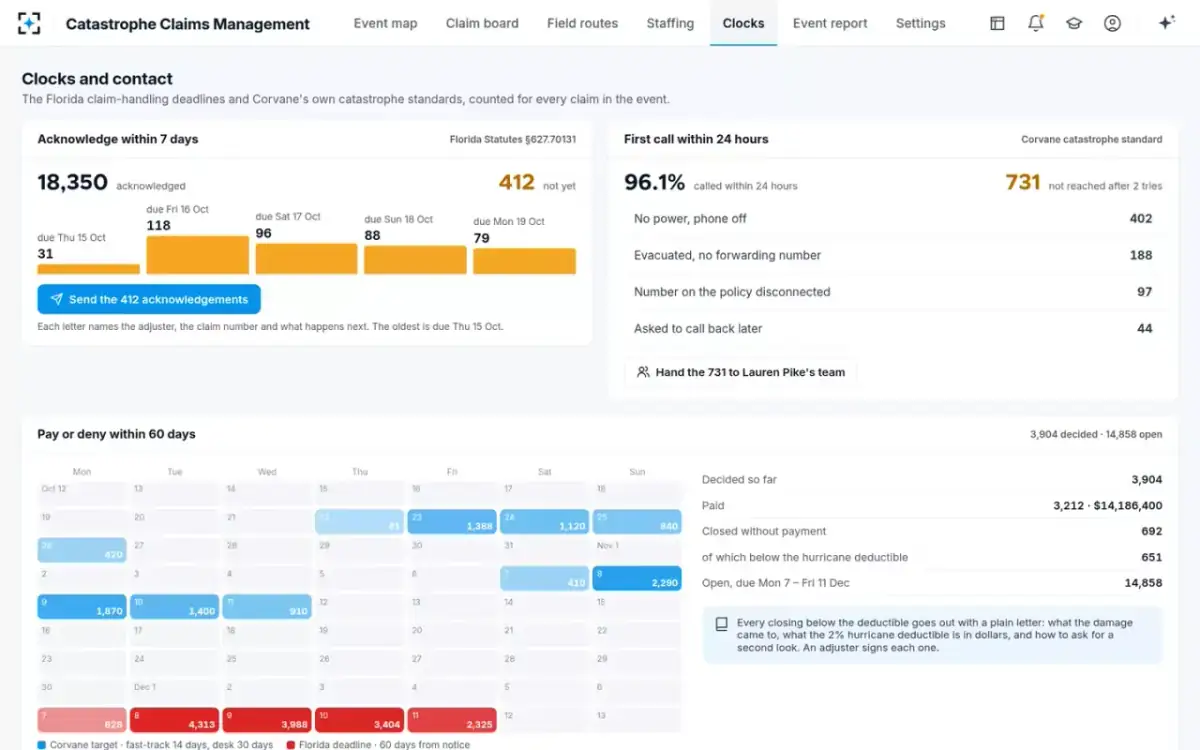
Is a hurricane deductible the same as a wind and hail deductible?
No. A hurricane deductible applies to damage from a hurricane during the period the law or the policy defines; a wind or hail deductible applies to wind or hail damage whenever the policy says it does. In Florida the hurricane period is fixed by statute, starting when the National Hurricane Center issues a hurricane warning for any part of the state and ending 72 hours after the last hurricane watch or warning ends (Fla. Stat. §627.4025). A tree that falls in a thunderstorm a week later is not a hurricane loss, even on the same roof.
That is why a claim's link to the right storm matters as much as its damage. A claim attached to the wrong event, or given the wrong date of loss, can be measured against the wrong deductible. How carriers tie each notice to its storm is covered in what a catastrophe code is; the 74 Milton claims closed for an incorrect date of loss are the visible tip of that problem.
The flood branch: covered damage on one policy, excluded on the other
A flood denial on a homeowners claim usually means the water damage is someone else's to pay, not that nothing is owed. The regulator says plainly that "Most residential homeowners insurance policies exclude flood damages." Flood is insured separately, most often through the National Flood Insurance Program, with its own adjuster, deductible and deadlines. A house can have a homeowners claim closed as flood and an open flood claim at the same time, and the wind damage on the roof still belongs to the first. The two-claim house is the subject of hurricane insurance vs flood insurance.
Can a closed insurance claim be reopened?
Yes, within limits the state sets. Florida defines a reopened claim as one the insurer has closed "but that has been reopened upon an insured’s request for additional costs for loss or damage previously disclosed to the insurer." A new or reopened property claim is barred unless notice is given within one year after the date of loss; a supplemental claim, for additional damage from the same peril, has 18 months. Once reopened, the claim runs on the same 60-day pay-or-deny clock as a new one, because that rule covers an "initial, reopened, or supplemental" claim.
Some closings do not need reopening so much as correcting. A duplicate closed in favour of another claim number needs that number. A claim closed for no contact needs a working phone. Where the policyholder and insurer disagree about the amount, Florida's mediation programme is available for residential claims, and the insurer must tell the policyholder about it at the time a first-party claim is filed; a claim becomes eligible once the insurer has acted under the 60-day pay-or-deny rule or elected to reinspect.
What to ask for when a storm claim closes with nothing paid
- The reason, in the regulator’s words
Below deductible, flood, withdrawn, no contact, duplicate, wrong date: each has a different next step.
- The figures behind a below-deductible closing
What the covered damage came to, and the hurricane deductible in dollars, not only as a percentage.
- The adjuster’s estimate
In Florida the insurer must send a copy of any detailed estimate its adjuster generates within 7 days.
- The policy wording relied on
For a flood or no-coverage closing, the exclusion or condition, quoted.
- Whether another claim number exists
For a duplicate or opened-in-error closing, the number the damage now sits under.
- The date of loss and the storm it is tied to
It decides which deductible applies and when the reopening window ends.
- How to ask for a second look
Reopening, a supplement, or mediation, and the deadline for each.
What a closing letter should say, and how Catastrophe Claims Management writes it
A good closing letter answers the checklist before anyone asks. In the sample event the solution keeps the reason each claim went where it went, so the reason exists before the claim closes. On the claim board, 1,222 claims carry the routing reason "Below the hurricane deductible · explained by phone": the damage on the notice and imagery fell under the deductible, and the contact team said so on the first call. The routing agent recommended the lane; it did not close those claims, and cannot. In the solution's settings, whether agents may close a claim is fixed at "Never · an adjuster decides", including below the hurricane deductible.
Every claim in Catastrophe Claims Management carries the reason it went where it went
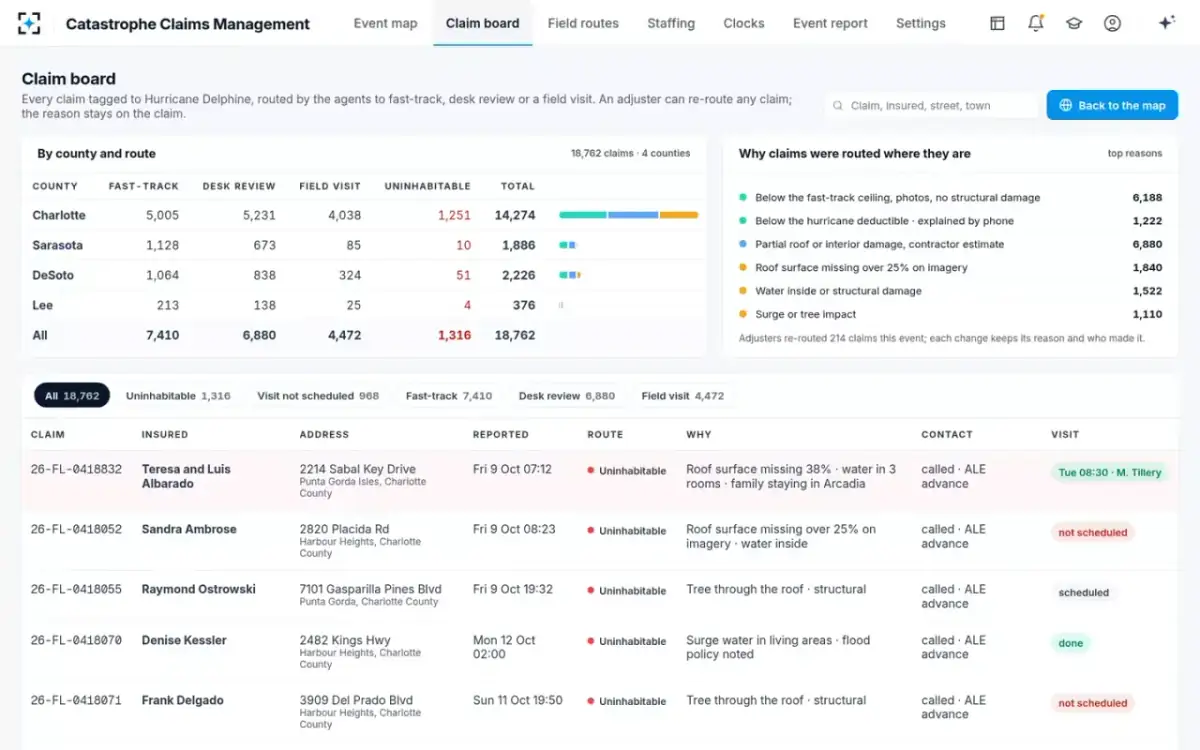
When an adjuster does close a claim below the deductible, the letter states what the damage came to, the 2% hurricane deductible in dollars, and how to ask for a second look, and the adjuster signs it. In the sample event's first days that was 651 of 692 closings without payment. The same approach answers the regulator's categories in advance: a policyholder the contact team could not reach carries the reason, such as no power, evacuated or a disconnected number, so a later closing for no contact can say what was tried. The agents keep the reasons; people make the decisions. The way that sorting works across a whole storm is set out in a catastrophe claim, hour by hour, and the solution itself is on Catastrophe Claims Management.
Questions people ask
What does a closed insurance claim mean?
It means the insurer has finished handling the claim. It may have closed with a payment, in which case the insurer considers it settled, or without one. Florida's regulator reports both, and after Milton 219,994 claims had closed with a payment and 134,177 without, as of 9 December 2025.
Is a claim closed without payment the same as a denial?
Not always. A flood exclusion or a no-coverage finding is a denial; a claim below the deductible, withdrawn, duplicated or opened in error is closed without being denied. The letter should say which, and Florida requires a written explanation of the policy basis for a payment, denial or partial denial.
Why would an insurer close a claim for lack of communication?
Because it could not reach the policyholder or get information it asked for. After a storm that is often a phone without power or a family that has evacuated. Milton had 15,440 such closings across all lines; giving the insurer a working number is usually the first step back.
How long do I have to reopen a hurricane claim in Florida?
Notice of a new or reopened claim must be given within one year after the date of loss, and notice of a supplemental claim within 18 months. For a hurricane, Florida treats the date of loss as the date the hurricane made landfall.
What is the Hurricane Helene proof of loss deadline?
For flood claims under the National Flood Insurance Program, FEMA extended the usual 60-day proof of loss deadline to 180 calendar days from the date of loss for Helene, in bulletin W-24018. Homeowners policies follow their own policy terms and Florida's notice rules, not FEMA's.
Does a claim below the deductible still count?
In Florida it can: the hurricane deductible applies once per calendar year across hurricane losses with the same insurer, and insurers may ask policyholders to report below-deductible hurricane losses so they can be applied to a later hurricane claim that year.