Hurricane insurance vs flood insurance is mostly a question of which policy pays for which damage, because in the United States there is usually no single policy for a hurricane. Damage from the wind, and from rain that gets in through an opening the wind made, is usually covered by the homeowners policy, subject to its hurricane or windstorm deductible. Damage from rising water, including storm surge, is flood, which most homeowners policies exclude and a separate flood policy covers, most often through the National Flood Insurance Program. After a hurricane one house can need both claims at once. Botminds' Catastrophe Claims Management is catastrophe claims software for the carrier on the wind side: it notes on the first call whether a separate flood policy exists, routes the wind claim, and leaves every coverage decision to an adjuster.
Where this guide shows the carrier side, the examples come from a fictional event, Hurricane Delphine, and a fictional carrier, Corvane Mutual, as they run through the solution; their figures are sample data, not a customer result. This is general information about how the two kinds of cover work, not advice on a particular claim; the policy wording decides.
One house after a hurricane: the wind claim and the flood claim, side by side
Wind claim (homeowners): The homeowners insurer.
Flood claim (NFIP): The National Flood Insurance Program, through a private Write Your Own insurer or FEMA’s NFIP Direct.
Wind claim (homeowners): Wind damage, and rain that enters through an opening the wind made first.
Flood claim (NFIP): Direct physical loss by or from flood, including storm surge; nothing else.
Wind claim (homeowners): In Florida, a hurricane deductible the insurer must offer at $500, 2%, 5% or 10% of the dwelling limit, applied once per calendar year.
Flood claim (NFIP): Separate building and contents deductibles for each flood loss.
Wind claim (homeowners): Florida: acknowledge within 7 days; pay or deny within 60 days of notice.
Flood claim (NFIP): Proof of loss within 60 days of the loss unless FEMA extends it; adjuster’s preliminary report within 15 days of assignment.
Wind claim (homeowners): Set by the carrier’s own practice, such as a living-expense advance for an uninhabitable home.
Flood claim (NFIP): Advance payments when FEMA authorizes them, before or after inspection.
Hurricane insurance vs flood insurance: the short answer
"Hurricane insurance" is a name for the wind cover in a property policy, with its own deductible; flood insurance is a separate policy for water. Florida's statute defines the first precisely: "“Hurricane coverage” is coverage for loss or damage caused by the peril of windstorm during a hurricane." The flood programme defines the second just as narrowly. FEMA's claims manual says "The SFIP is a single-peril policy and will only pay for direct physical loss by or from flood to the insured building and personal property."
Two policies, each covering one peril, leave a seam exactly where hurricanes do their damage: a roof torn by wind over a ground floor filled by surge. Florida's regulator noted that "Homeowners in high-risk flood zones (FEMA-designated Special Flood Hazard Areas) are required to purchase NFIP coverage if they have a federally backed mortgage." Outside those zones, and for owners without such a mortgage, flood cover is a choice, and many houses on a hurricane's path have wind cover only.
Wind vs flood damage: where the line falls
The line is the source of the water. Water that rises from outside, from the sea, a river or runoff covering the ground, is flood. The Standard Flood Insurance Policy defines flood as "A general and temporary condition of partial or complete inundation of two or more acres of normally dry land area or of two or more properties (one of which is your property)" from overflow of inland or tidal waters, unusual and rapid accumulation or runoff of surface waters, or mudflow. Water that comes down, through a roof the wind opened, is not flood; the flood policy expressly does not insure loss caused by "Rain, snow, sleet, hail, or water spray".
On one house the two can be inches apart. FEMA tells flood adjusters to document wind damage separately, including wall framing damaged by wind below the waterline and anything damaged above it by rain or wind, and to photograph the difference between the two kinds of debris: "noting the difference between wind-driven debris and flood-borne debris, and the directional orientation of wind damage versus the direction of flood’s velocity flow or wave action". The adjuster's waterline is the line between two claims.
What is wind-driven rain coverage?
It is cover for rain damage inside the house that happens because the wind broke in first. Florida writes it into the definition of hurricane coverage, which "includes ensuing damage to the interior of a building, or to property inside a building, caused by rain, snow, sleet, hail, sand, or dust if the direct force of the windstorm first damages the building, causing an opening through which rain, snow, sleet, hail, sand, or dust enters and causes damage." The order matters: wind first, opening second, rain third.
The sample event's Albarado claim is a wind claim of exactly this kind. The family reported at 07:12 the morning after landfall: the back half of the roof gone, and water through the ceiling in the kitchen and both bedrooms. Imagery later showed 38% of the roof surface missing. That water came through the roof, so it belongs to the homeowners claim; the screen also notes that the family holds a separate flood policy, so if water had risen from outside, a second claim would have been due.
Does homeowners insurance cover storm surge?
Usually not. Storm surge is the sea pushed ashore by the storm, which is an overflow of tidal waters and therefore flood under the flood policy's own definition; Florida's regulator notes that most residential homeowners policies exclude flood. Surge damage is a flood claim, if the house has a flood policy, and wind damage to the same house is a homeowners claim.
Hurricane Helene in Florida: flood was one of the biggest reasons storm claims paid nothing
50,138
claims closed without payment, all lines
15,251
closed because the damage was below the deductible
10,097
closed because the loss was flood, which the policy did not cover
20%
of closed-without-payment claims were flood denials, by the regulator’s count
The regulator adds a reason the flood denials look larger than they are. It says "a consumer seeking coverage through the NFIP often has to produce a denial letter from a traditional property insurance carrier, even if fully aware that their property insurance does not cover flood damage, before they are eligible for coverage through the NFIP." Some of those closings are paperwork that a flood claim needed, not a policyholder who expected to be paid. Either way, each one is a homeowners claim that was opened, handled and closed for a loss that belonged elsewhere.
Can I file a homeowners and a flood claim for the same storm?
Yes, and where both wind and water did damage, that is how the loss is meant to be paid. FEMA's manual tells flood adjusters what to do when they find another peril: "the adjuster must separate the activity to be performed on the loss assignment into two parts: one for flood, and a second for the other peril." The flood adjuster asks about other insurance; the homeowners adjuster does the same in reverse. Neither policy pays for the other's peril.
When wind and water both contributed to the same damage, the question becomes one of concurrent causation, and it is where disputes concentrate. Florida's regulator has reminded insurers of "the need to properly evaluate claim determinations when damage is caused by the peril of water and the peril of wind, commonly referred to as concurrent causation", and says such claims must be well documented. Documentation is the practical answer for both sides: dated photos of the roof, the waterline and the debris, taken before repairs.
One house, two claims, two insurers, two deductibles and two sets of deadlines: the kindest thing a claims team can do is separate them on the first call.
Two claims, two clocks
The two claims also run on different calendars, and a family handling both is tracking two sets of dates. On the wind side in Florida, the insurer must acknowledge a claim communication within seven days and pay or deny a residential claim "Within 60 days after an insurer receives notice". On the flood side the obligations fall partly on the policyholder: the flood policy says "Within 60 days after the loss, send us a proof of loss", a sworn statement of the amount claimed, unless FEMA extends the deadline, as it did to 180 days for Hurricane Helene in bulletin W-24018.
The first 60 days of the same storm, on each claim
- Acknowledge7 days
- Investigate; pay or denyby day 60
- Preliminary report15 days
- Closing or interim reportwithin 45 more
- Proof of loss due, unless FEMA extends60 days
Flood insurance advance payment, and early money on the wind side
The flood programme can pay before the claim is finished, when FEMA authorizes it. Before an inspection, a first option allows a payment on notice of loss up to $5,000; with more documentation, "the NFIP insurer may offer payment, when authorized by FEMA, up to $20,000 on building and contents losses combined (less deductibles)". After an inspection, an advance of up to 25% of the reserve on each coverage, or up to 50% on the building with a signed repair contract, can follow. Advances come off the final payment.
On the wind side, early money depends on the carrier's practice and the policy. In the sample event, every family whose home is uninhabitable gets a person's call within 24 hours and an offer of a living-expense advance, $2,500 in the sample playbook, approved by an adjuster. The Albarados were acknowledged 53 minutes after they called, and the advance was approved that afternoon. A family with a flood claim as well would be waiting on a second adjuster and a second set of options.
How a FEMA flood insurance claim runs
It runs through a private Write Your Own insurer or FEMA's NFIP Direct, with an adjuster assigned to the flood loss. The adjuster sends a preliminary report within 15 days of the assignment and a closing report within 45 days after that, or interim reports every 30 days while the claim stays open. The policyholder owes a signed proof of loss within 60 days unless FEMA extends it, and FEMA can let the insurer accept the adjuster's report instead; for Helene it went further and let insurers pay on the adjuster's report without the policyholder's signature, as a conditional waiver.
One more rule matters before the storm, not after it. A new flood policy usually takes effect 30 days after the application and premium are received; the regulation's own example is that a policy "applied for with the payment of the premium on May 1 will become effective at 12:01 a.m. on May 31." Buying flood cover when a hurricane is already forecast is, for most new policies, too late for that storm.
Wind and water, marked on the Catastrophe Claims Management claim board
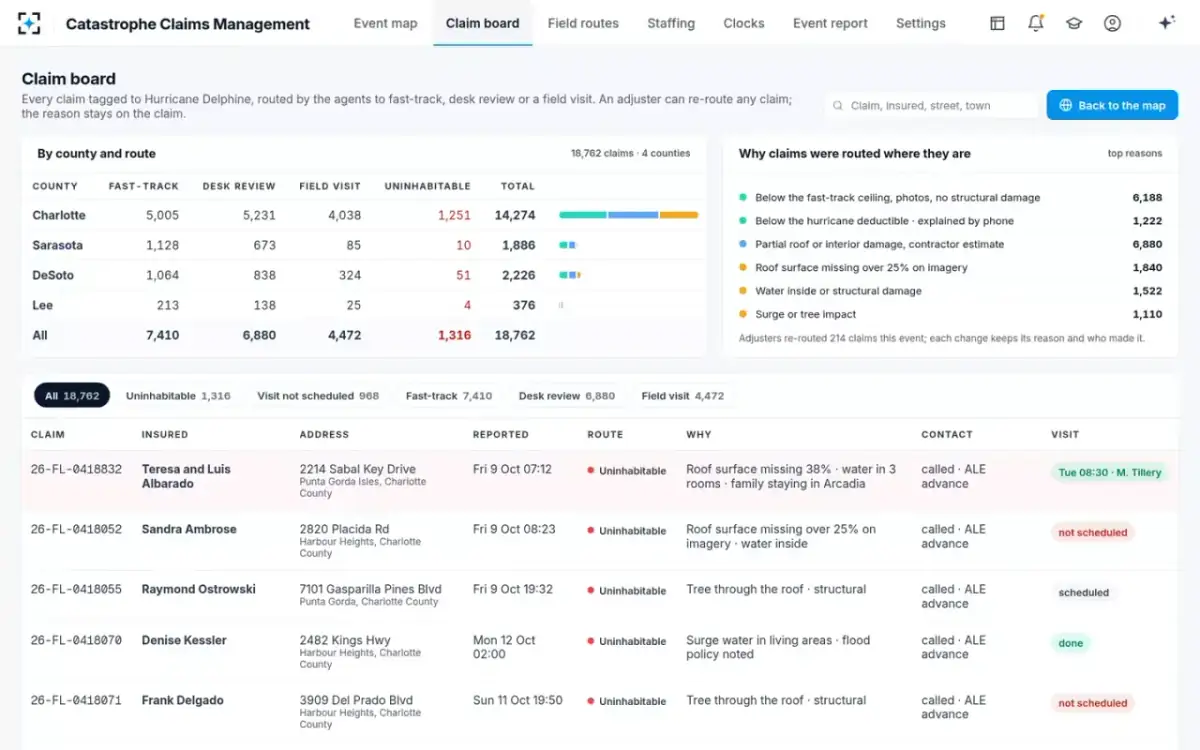
Separating wind from water early, as Catastrophe Claims Management does on the first call
A carrier on the wind side can save a family weeks by asking about flood on the first call and noting the answer on the claim. In the sample event the first-notice call is transcribed and tagged, and the claim screen shows the flood policy as separate and noted. On the claim board, one uninhabitable claim reads "Surge water in living areas · flood policy noted": the wind adjuster arrives knowing there is a flood claim and a flood adjuster, and that the two inspections should document the same rooms from both sides.
One claim: the call, the roof and the flood policy on one screen
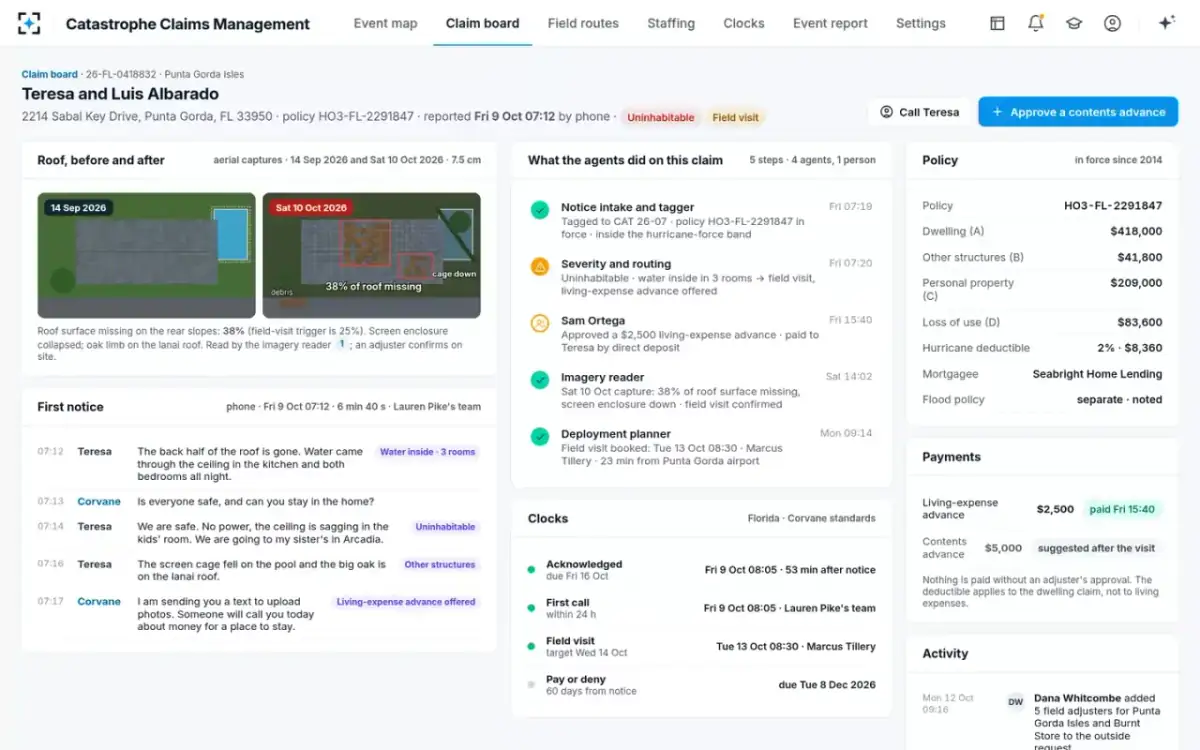
The agents' limits keep the coverage call with people. The routing agent can send a surge claim to a field visit, and the imagery reader can see water lines, but no agent decides whether damage is wind or flood, denies a claim, or closes one. That is an adjuster's call, made on site with the evidence FEMA's manual describes. The routing and the reasons that come before it are explained in claim closed without payment, and the storm's code, which decides the hurricane deductible, in what a catastrophe code is.
For a house with wind and water damage: what to gather for both claims
- Both policy numbers and both insurers
The homeowners insurer and the flood insurer, which may be a different company.
- Dated photos before any clean-up
The roof, the ceilings, the outside and inside waterlines, and the debris.
- The date of loss for each claim
For a hurricane in Florida, the homeowners claim’s date of loss is the landfall date.
- The flood proof-of-loss deadline
60 days from the loss unless FEMA has extended it for the event.
- Each adjuster’s name and licence number
Florida requires the homeowners adjuster to provide them at inspection.
- What each claim was paid for
Ask each insurer to say which damage it paid and which it treated as the other’s.
The full catastrophe event, wind side, is on Catastrophe Claims Management.
Questions people ask
Is flood insurance the same as hurricane insurance?
No. Hurricane cover is wind cover within a property policy, including rain that enters through an opening the wind made. Flood insurance is a separate policy for rising water, including storm surge, and the NFIP's policy covers only direct physical loss by or from flood.
Does homeowners insurance cover water damage from a hurricane?
It depends on where the water came from. Rain that enters through wind damage is generally part of hurricane cover; Florida's definition includes it. Water that rises from outside, such as surge or overflowing rivers, is flood and is excluded by most homeowners policies.
How long do I have to file a FEMA flood insurance claim?
The policy asks for prompt notice and a signed proof of loss within 60 days after the loss, unless FEMA extends the deadline for an event. For Hurricane Helene FEMA extended it to 180 days from the date of loss.
Can I buy flood insurance right before a hurricane?
You can buy it, but a new NFIP policy generally takes effect 30 days after the application and premium are received, so it usually will not cover a storm already on the way. Some exceptions apply, such as coverage bought at a loan closing.
Do I need two adjusters for wind and flood damage?
Usually, one for each policy, though a private insurer can write both a homeowners policy and, under the NFIP's Write Your Own arrangement, a flood policy. FEMA requires flood adjusters to split the inspection into flood and the other peril and to document both.