CAT adjuster deployment is the work of getting catastrophe adjusters, the carrier's own and those from contracted independent firms, to the claims that need a person on site, in the right order and fast enough to meet the carrier's own standards and the state's deadlines. It starts with where adjusters stage and ends with each adjuster's route for the next day. It is hard because every input moves at once: new notices arrive overnight, roads open and close, imagery changes a claim's severity, and the request for more adjusters has to go out days before they can arrive. Botminds' Catastrophe Claims Management splits the job. Its deployment planner matches field adjusters to zones by drive time, books visits uninhabitable homes first and sizes the gap; the catastrophe response manager assigns every zone and signs every request to an outside firm.
The worked example is a fictional event, Hurricane Delphine, run by a fictional carrier, Corvane Mutual, through the solution on its fourth morning. Every person, firm and number from that event is sample data, not a customer result; the rules quoted come from Florida law and federal sources, linked where they appear.
Fourteen deployment tasks in Catastrophe Claims Management: what agents do, what is shared, what stays with people
Agents, every run
- Rebuild the storm footprintFrom each advisory’s wind field, and list the policies in force inside it.
- Tag each notice to the eventOnly if the loss date and address fall inside the footprint; merge exact duplicates.
- Read the post-storm imageryRoof surface missing, structures down, water lines, for every reported or exposed address.
- Count tomorrow’s claimsScore every unreported policy, and turn the expected claims into expected visits.
- Compute drive timeFrom each adjuster’s staging point to each zone, around roads the county reports closed.
- Size each zone’s shortfallVisits needed over the visit target, against the adjusters inside the drive limit.
- Order the day’s visitsUninhabitable homes first, then by notice time; one route per adjuster.
- Draft the outside request and the reportFrom the same numbers as the map, with the method shown.
Shared
- Choose the zonesAgents suggest the short zones each morning; the manager draws her own.
- Route each claimThe agent recommends fast-track, desk or field with a reason; any adjuster can re-route it.
People only
- Assign a zoneNothing is booked until the catastrophe manager assigns.
- Sign the request to outside firmsThe manager signs; spend over $2 million needs the director.
- Approve outreachNo text or call to an unreported policyholder without the director.
- PayAdvances and payments are adjusters’ decisions, within authority.
What is CAT deployment?
CAT deployment is short for catastrophe deployment: sending adjusters into a declared disaster area and assigning them claims there for the length of the event. A carrier deploys its own catastrophe staff first and adds independent adjusters through contracted firms as the volume grows. In Florida the surge has a legal channel: in a catastrophe the Department of Financial Services may issue emergency adjuster licences to people certified as qualified by an insurer or a contracted adjusting firm, and the state's rule treats the words emergency and catastrophe as "synonymous" for that purpose. The licence covers only losses from the emergency it was issued for.
Deployment is not a single decision but a loop that runs every day of the event. Each morning the team decides where to send the adjusters it has, how many more to ask for, and which homes each adjuster will see. The answers change with every overnight batch of notices. That loop is the subject of this guide; the team that runs it is covered in the national catastrophe response team.
How are CAT adjusters assigned today?
Mostly by county, by roster and by phone. Adjusters stage where there is power and a hotel room, which after a hurricane is rarely where the damage is worst. The catastrophe manager learns who can reach which area by calling field leads, and the independent adjuster coordinator keeps half the roster in spreadsheets the outside firms send. Claims are handed out in the order they were reported. On the sample event's fourth morning, most of the 182 field adjusters were staged in Venice, North Port and Fort Myers; the shortage was in Punta Gorda Isles and Burnt Store.
Assigning by notice order has a cost the queue does not show. The families whose homes are uninhabitable are often the last to report and the hardest to reach, so a first-come, first-served queue serves the least damaged homes first. Assigning by county has a second cost: a county line says nothing about whether an adjuster can reach a street in 20 minutes or 90 once bridges and roads are closed.
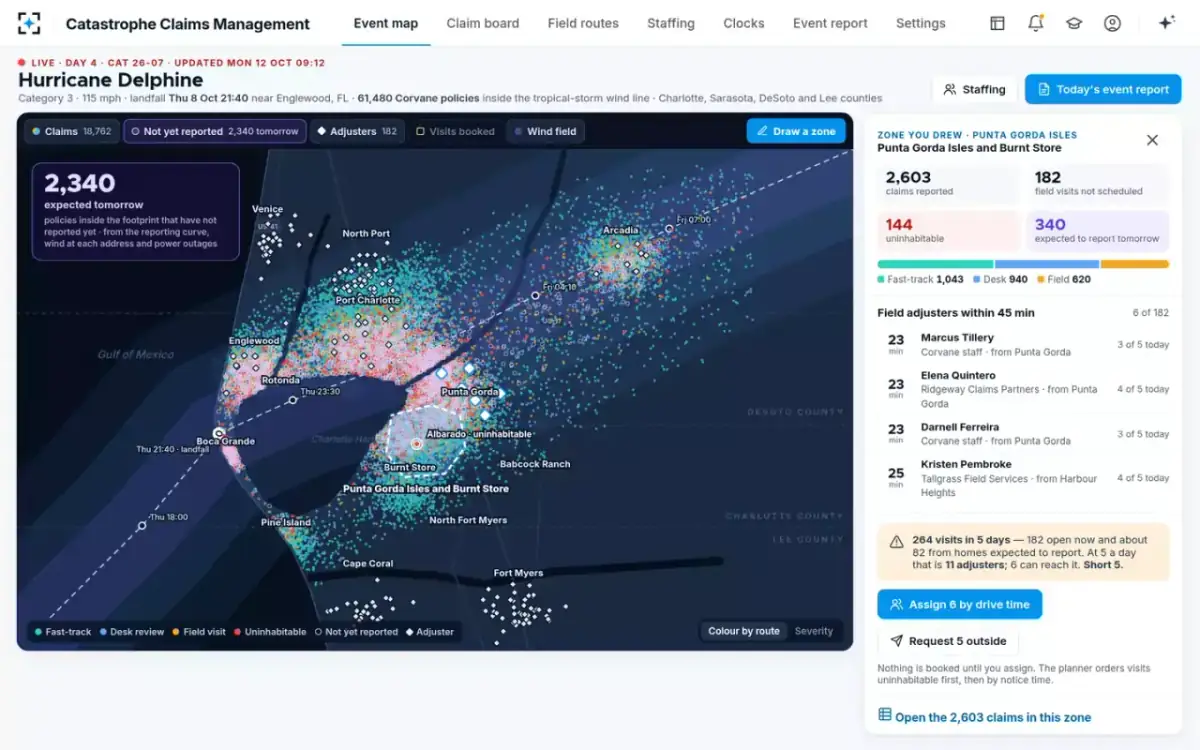
A zone drawn in Catastrophe Claims Management, and the adjusters who can reach it
The fourteen tasks, and why most of them belong to agents
Eight of the fourteen tasks are counting that has to be redone every time an input changes, which is several times a day in a catastrophe. A footprint changes with each advisory. A notice has to be tested against the footprint's dates and boundaries before it can be tagged. Drive times change when a county closes a road. Tomorrow's expected claims change with every policyholder who calls. None of these needs judgement; each needs to be current, and a person redoing them by hand is always working from the last version.
Four tasks stay with people because they commit the carrier: booking adjusters into a zone, signing a request that will cost money, contacting policyholders who have not called, and paying. Two are shared. The agents suggest the short zones each morning, and the manager can draw her own. The routing agent recommends a lane for every claim with its reason, and any adjuster can change it; in the sample event adjusters had re-routed 214 claims by day four, each change kept with who made it and why.
From a short zone to a booked day: who does each step
Agent
Deployment plannerFlags Punta Gorda Isles and Burnt Store as short: 182 visits not scheduled, 340 homes expected to report, 6 adjusters within 45 minutes.
A person decides
Catastrophe response managerDraws the zone around the two neighbourhoods; the panel recomputes 2,603 claims and 144 uninhabitable homes.
Agent
Deployment plannerWorks out 264 visits in 5 days, 11 adjusters at 5 a day, 6 available, short 5.
Never: Offering an adjuster outside the 45-minute limit.
A person decides
Catastrophe response managerPresses “Assign 6 by drive time”. Only now are visits booked.
Agent
Deployment plannerBuilds Tuesday’s routes, uninhabitable homes first, around closed roads; adds the 5 to the drafted outside request.
A person decides
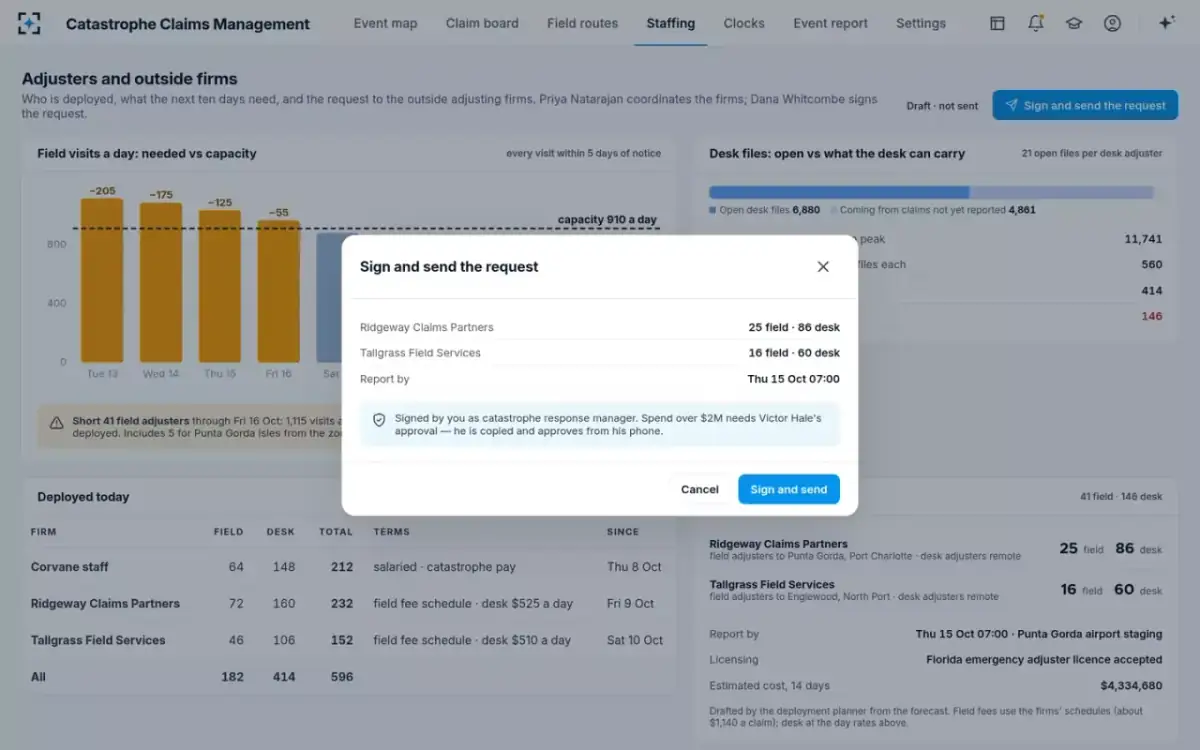
Manager, then directorShe signs the request; at over $2 million the director approves it from his phone.
How far do CAT adjusters drive? Drive time, not distance
As far as the carrier's playbook allows, and the useful limit is minutes, not miles. In the sample the longest drive the planner may offer is 45 minutes from where an adjuster is staged, adjustable in steps of five. A drive-time limit catches what a radius misses: after a hurricane a zone eight miles away across a closed bridge can be further than one 20 miles down an open highway. The planner computes drive times from each adjuster's staging point and routes around roads the county reports closed.
The cost of a long drive is easy to put in visits. A field adjuster in the sample does five hurricane inspections a day, roof and interior. If the extra driving on a far-staged day costs one inspection, it costs a fifth of that adjuster's output. Over a zone that needs 264 visits in five days, staging an adjuster an hour further away is the difference between filling the gap and adding to it.
Punta Gorda Isles over five days: what six nearby adjusters cover, and what the request must
264 visits needed
- 6 within 45 min · 150 visits · 57%
- 5 requested · 114 visits · 43%
Where the 264 come from
- Open now · 182 · 69%
- From homes expected tomorrow · about 82 · 31%
How many inspections a day can a field adjuster do?
There is no published standard; it is a setting each carrier chooses, and it should be written down. The sample playbook sets five hurricane inspections a day with roof and interior, and the deployment planner uses that figure for every capacity sum on the event: 182 field adjusters at five a day is 910 visits, against 1,115 a day needed at the peak. Change the setting and every shortfall on the map changes with it, which is why the solution versions the change and replays it on the claims so far.
The number interacts with the law. In Florida, if a residential claim investigation involves a physical inspection, "An insurer must conduct any such physical inspection within 30 days after its receipt of the proof-of-loss statements." A carrier that raises inspections per day to clear a backlog is trading inspection quality against that clock; one that lowers them needs more adjusters to meet it. The sample carrier's own target is tighter than the statute: a field visit within five days of first notice.
The zone’s arithmetic on the fourth morning
264
visits needed in 5 days: 182 open now, about 82 from homes expected to report
11
adjusters needed at 5 visits a day
6
can reach the zone within 45 minutes
5
added to the outside request with one click
Which homes do adjusters visit first after a hurricane?
In the sample playbook, uninhabitable homes first, then in the order the claims were reported. An uninhabitable home is one the family cannot live in: roof gone, water inside, structure damaged. Those families are paying for somewhere else to stay, and the solution's rule is that each one gets a person's call within 24 hours and an offer of a living-expense advance, $2,500 in the sample, and is never fast-tracked. The visit is what lets the rest of the claim move.
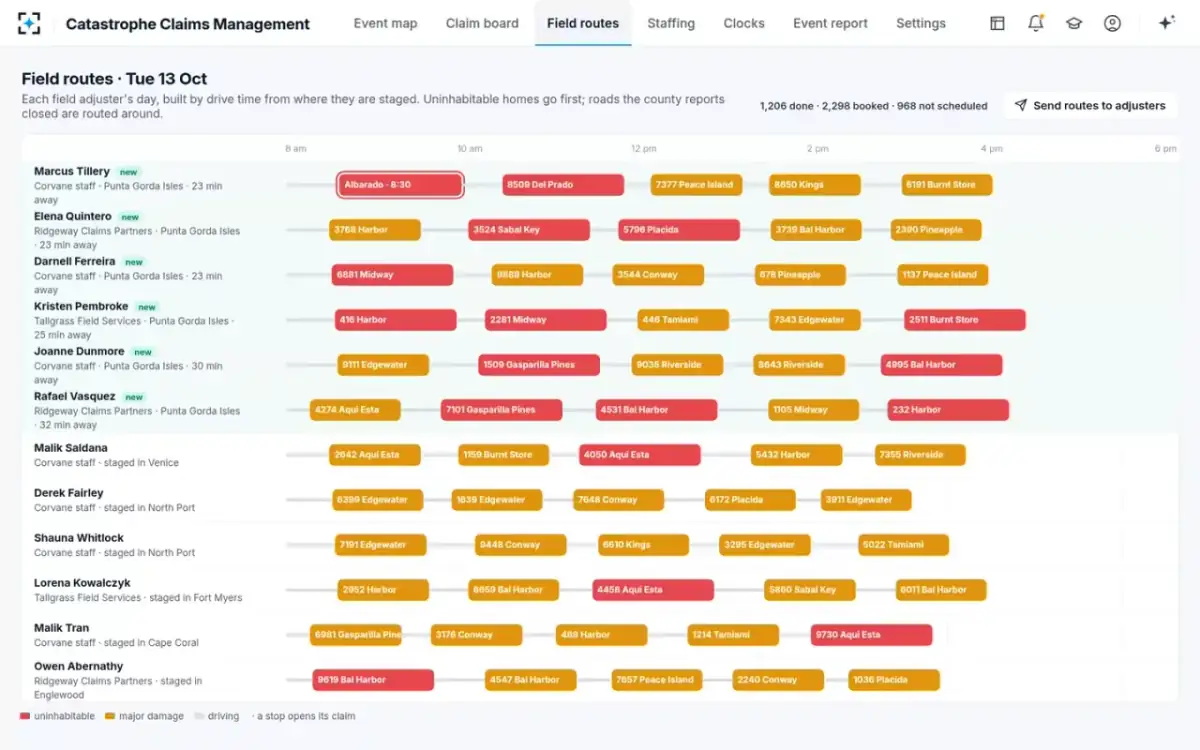
The deployment planner applies the order when it builds routes. Marcus Tillery, a staff adjuster 23 minutes away, starts Tuesday at 8:30 at the Albarado home, where Saturday's imagery shows 38% of the roof surface missing and the family is staying with a relative inland. His day opens with two uninhabitable homes before three with major damage, and the other five routes in the zone are built the same way.
Tuesday’s routes, built by drive time, uninhabitable homes first
Can AI schedule field adjusters?
It can build the schedule; it should not commit anyone to it. In the solution the deployment planner does the parts that are calculation: matching adjusters to zones by drive time and capacity, ordering visits, building routes and forecasting the gap. Its limits are written into its role: it offers only adjusters within the drive-time limit, and nothing is booked or requested without the catastrophe manager. The same applies to every agent in the event. The routing agent recommends but never denies or closes a claim; the imagery reader routes a claim but never settles one.
The reason for the line is accountability, not caution for its own sake. A booked visit commits an adjuster's day and tells a family when someone will come; a request to an outside firm commits money; a text to a policyholder who has not reported is outreach a regulator may later read. Each of those has a named person in the solution, and each decision is kept with who made it and when. What imagery can and cannot tell the planner about severity is set out in drone inspections for insurance claims.
Who decides which claims get a field visit?
The carrier's written triggers decide, applied by the routing agent and overridable by any adjuster. In the sample settings any one of four conditions sends a field adjuster: the home is uninhabitable, more than 25% of the roof surface is missing on imagery, water is inside, or there is structural damage. A fifth, a prior open claim, can be switched on. Claims below the $7,500 fast-track ceiling with photos and no structural damage go to the desk to settle from photos. On day four the split was 7,410 fast-track, 6,880 desk review and 4,472 field visit.
Writing the triggers down is what makes the routing auditable. A claim routed to the field shows "Roof surface missing over 25% on imagery" or "Water inside or structural damage"; a claim kept at the desk shows why. The National Flood Insurance Program applies a similar test to its own remote adjusting: "If the cause of loss is in question, requires neighborhood canvassing, or there is damage from other perils, remote adjusting is improper." Any trigger list that cannot say which claims must be seen in person is not finished.
The paperwork that travels with every deployed adjuster
Deployment creates obligations that follow the adjuster to each door. In Florida, when an investigation involves a physical inspection, the licensed adjuster must give the policyholder a document with their name and state adjuster licence number, and every later communication about the claim must carry them too. The insurer must keep a log of every adjuster who communicates with the policyholder and provide the list on request. An emergency adjuster's licence is valid for six months unless a shorter period is set, and the appointing insurer or firm is bound by the adjuster's acts.
For flood claims, the federal programme sets its own reporting clock on each assignment: a preliminary report within 15 calendar days of the assignment, a closing report 45 days after that, or interim reports every 30 days while the claim stays open. A deployment plan that does not track these per adjuster leaves the coordinator to discover late reports when the invoices arrive. How the cost of each deployed adjuster adds up is the subject of insurance claims temporary staffing.
The request goes when the manager signs it
Questions to settle before the next deployment
- What is our drive-time limit, and from where is it measured?
From each adjuster’s actual staging point, re-measured when roads close.
- How many inspections a day do we plan per field adjuster?
Written down, by peril, so every capacity sum uses the same number.
- What sends a claim to the field?
A short list of triggers, each visible on the claim, each overridable with a reason.
- In what order are visits booked?
Uninhabitable first is the default worth defending; notice order alone serves the least damaged first.
- Who may book, request, contact and pay?
Named roles, with a spend threshold for the director.
- How do we size tomorrow, not yesterday?
Expected claims from unreported policies, counted into visits by zone.
A carrier can answer these on paper before the season. The difference the agents make is that the answers are applied to every claim and every adjuster, every morning, and the result is waiting when the manager sits down. The full event is on Catastrophe Claims Management.
Questions people ask
What does CAT mean for an adjuster?
CAT is short for catastrophe. A CAT adjuster works claims from a declared catastrophe, usually travelling to the area for the length of the event, as a carrier's own catastrophe staff or through an independent adjusting firm.
How are CAT adjusters assigned to claims?
By the carrier or the adjusting firm, usually from a roster and a staging location. In the sample event the deployment planner proposes adjusters within 45 minutes of a zone and builds their routes, but visits are booked only when the catastrophe manager assigns the zone.
Do CAT adjusters need a licence in each state?
Generally yes, but states can issue emergency licences in a catastrophe. Florida may license adjusters certified as qualified by an insurer or a contracted adjusting firm; the licence lasts six months unless a shorter period is set and covers only losses from that emergency.
Why do adjusters stage so far from the worst damage?
Because they need power, fuel and a place to sleep, which are scarce where damage is worst. That is why a drive-time limit, measured from the staging point and updated for closed roads, is a better test of who can reach a zone than a county line.
Can a carrier book visits automatically from a forecast?
It can plan them; in the solution it does not book them. Expected claims are counted into the visits a zone will need, but nothing is booked until the catastrophe manager assigns the zone, and no policyholder who has not reported is contacted without the director's approval.