Insurance claims temporary staffing is the short-term hiring of adjusters and examiners to handle a surge of claims, and after a hurricane, hail storm or wildfire it mostly means field and desk adjusters supplied by independent adjusting firms under contract to the carrier. Field work is usually paid by a fee schedule per claim, set by the size of the loss; desk work is often paid by the day. The quoted rate is only part of the cost. A catastrophe also pays for every claim sent to a field adjuster that the desk could have settled, and for every day a request goes out late because it was sized on the claims already reported. Botminds' Catastrophe Claims Management does not supply adjusters. It routes each claim to the right lane, forecasts the claims not yet reported, and drafts the request to the outside firms for the catastrophe manager to sign, so the carrier buys the staffing it needs sooner.
The worked example is a fictional event, Hurricane Delphine, a fictional carrier, Corvane Mutual, and two fictional firms, Ridgeway Claims Partners and Tallgrass Field Services; their rates and counts are sample data, not market prices or a customer result. Public prices and rules come from FEMA, the GAO, the BLS and Florida law, linked where they appear.
What a catastrophe staffing decision costs, term by term
Field adjusting
field claims × fee per claim
Fee bands by size of loss, from the firm’s schedule
Firm’s contract
Desk adjusting
desk adjusters × days × day rate
Sized from open desk files at the peak, not today’s
Firm’s contract
Misrouting
claims sent to the field the desk could settle × (field fee − desk cost)
Plus the visit a severe claim did not get that day
Routing rules
Late request
days the request is late × visits short a day
Visits that miss the carrier’s target and the statutory clocks
The day the count is ready
What is insurance claims temporary staffing?
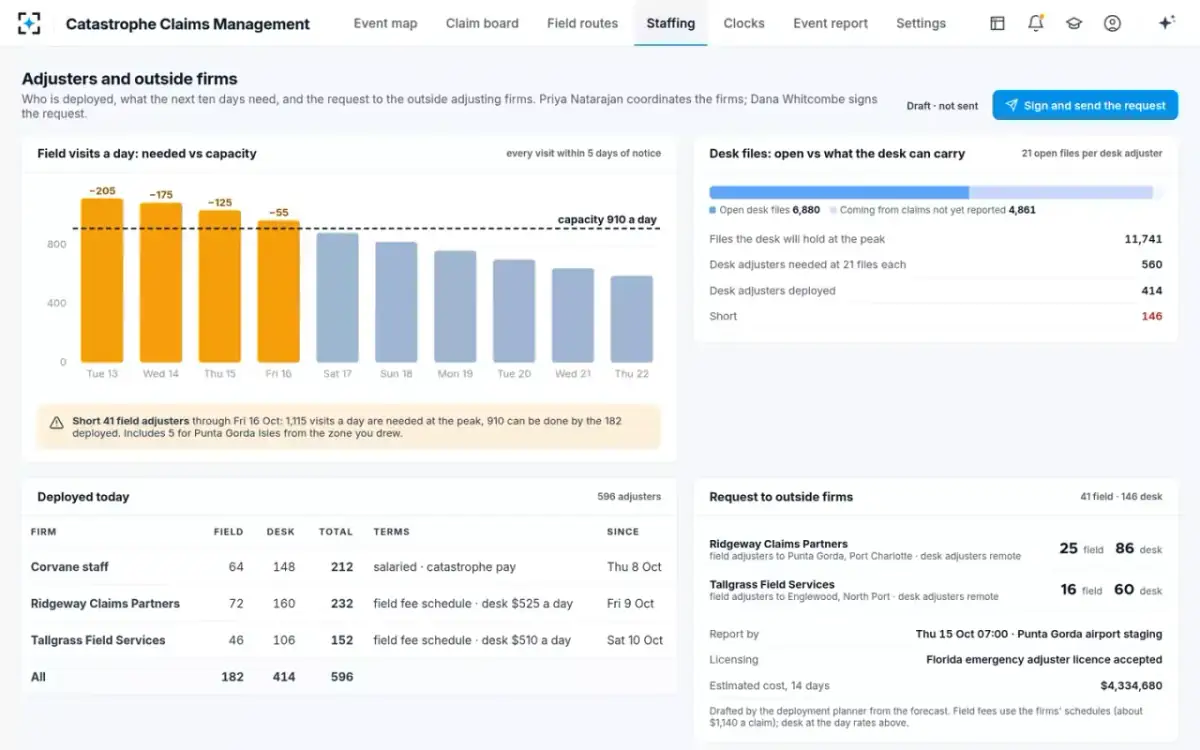
It is capacity bought for the length of an event. Three kinds of supplier fill it: independent adjusting firms, which supply licensed field and desk adjusters and are the main source in a catastrophe; staffing agencies, which place adjusters, examiners and support staff on temporary contracts; and individual independent adjusters contracted directly. In the sample event, two outside firms supplied 384 of the 596 adjusters working on day four, and the carrier's own staff supplied 212.
The workforce they draw on is large but not growing. The Bureau of Labor Statistics counts 376,100 jobs for claims adjusters, examiners and investigators in 2025, within 389,700 for the wider occupation, and projects the wider group to shrink by 6% from 2025 to 2035. It also notes that "Future increases in the number of natural disasters could result in some demand for claims adjusters in the field." A carrier that plans its catastrophe staffing on outside firms is planning on a pool that every other carrier hit by the same storm is drawing from at the same time.
Three ways to staff a catastrophe, compared on the same terms
Every carrier mixes the three; the question is the mix. A carrier's own catastrophe staff are the fastest to deploy and the most consistent, but they are a fixed cost all year. Outside firms scale with the event but arrive on their own timetable and work to their own schedules. Agents do not adjust claims at all; they change how many adjusters the event needs, and when the request goes out, by doing the sorting that otherwise falls to the people the carrier is paying for.
Own staff, outside firms and agents: what each buys and what it cannot
| Own catastrophe staff | Outside firms (temporary staffing) | Agents doing the sorting | |
|---|---|---|---|
| How it is paid | Salary and catastrophe pay, all year | Fee per field claim; day rate for desk | Software cost, independent of the event’s size |
| When it arrives | Day 0, staged before landfall | Days after the request; in the sample, the day-4 request reports on day 7 | Every morning, before the manager is at her desk |
| What it does | Inspects, estimates, settles | Inspects, estimates, settles | Routes claims, forecasts unreported ones, plans by drive time, drafts requests and reports |
| What it cannot do | Scale to a large event | Size its own request, or sort the carrier’s claims | Inspect, estimate, pay, or commit anyone without a person |
| Where the carrier’s risk sits | Idle capacity in quiet years | Late arrival, uneven quality, invoices to check | Wrong routing rules or a wrong forecast, both visible and overridable |
How do independent adjusters get paid?
Field adjusters are most often paid per claim, on a fee schedule that rises with the size of the loss; desk adjusters are often paid a day rate. Private fee schedules are contracts between carriers and firms and are not published. The one complete, public schedule in US property claims is FEMA's for the National Flood Insurance Program, and it shows the structure: a fixed fee for each band of gross loss up to $50,000, then a percentage with a minimum above it, plus flat fees for claims withdrawn, assigned in error or closed without payment.
FEMA's schedule also shows how the federal programme pays the companies that adjust for it. In a 2007 report the Government Accountability Office described it: FEMA pays private insurers "according to (1) an adjustment fee schedule used by the insurance industry for other types of insurance claims and (2) an allowance of 3.3 percent of each claim settlement amount to pay for their processing expenses." The figures are old; the shape, a fee for the adjusting and an allowance for handling, is the shape most carriers' own budgets take.
What does a CAT adjuster cost an insurer? The one public price list
There is no published market rate for private catastrophe adjusting, so the useful public benchmark is FEMA's. For flood claims with dates of loss on or after 1 October 2023, the NFIP pays the adjusting firm by the gross loss, the agreed cost to repair or replace before depreciation, deductible and salvage are applied.
FEMA’s flood adjuster fee schedule: the only complete public price list
| Gross loss | Fee to the adjuster |
|---|---|
| $0.01 – $1,000 | $680 |
| $1,000.01 – $5,000 | $1,035 |
| $5,000.01 – $10,000 | $1,340 |
| $10,000.01 – $15,000 | $1,520 |
| $15,000.01 – $25,000 | $1,650 |
| $25,000.01 – $35,000 | $1,910 |
| $35,000.01 – $50,000 | $2,235 |
| $50,000.01 – $150,000 | 4.5%, not less than $2,350 |
| $150,000.01 – $250,000 | 4.3%, not less than $6,750 |
| $250,000.01 – $350,000 | 4.0%, not less than $10,750 |
| $350,000.01 – $550,000 | 3.5%, not less than $14,000 |
| $550,000.01 – $1,000,000 | 3.2%, not less than $19,250 |
| Over $1,000,000 | 2.8%, not less than $32,000 |
| Closed without payment, after an inspection | $510 flat |
| Withdrawn before inspection, or assigned in error | $125 flat |
Two features of the schedule matter for a catastrophe budget. The fee is per claim, not per hour, so a field adjuster sent to a claim the desk could have settled still costs a full field fee. And a claim closed without payment after an inspection still costs $510, so every visit to a home whose damage was clearly below the deductible is a cost with nothing paid at the end of it.
Price the sorting, not just the headcount
The two terms an invoice does not show are often larger than the difference between two firms' rates. Misrouting is the first. A claim routed to the field that the desk could have settled pays a field fee instead of a share of a desk adjuster's day, and it takes a visit from a family that needed one. A claim kept at the desk that needed a visit comes back later as a supplement and a second assignment. Routing every claim on day one, with written triggers, is the cheapest saving in the event.
The late request is the second. A request sized from the claims already reported asks for the adjusters that yesterday needed. In the sample event the desk had 6,880 open files on day four and 414 desk adjusters at 21 files each: on yesterday's count the desk was covered, with room to spare. Adding the 4,861 desk files expected from policies that had not yet reported raises the peak to 11,741 files and the need to 560 adjusters. A request sized on the reported count would have asked for no desk adjusters at all.
The same desk on day four, counted two ways
328
desk adjusters needed for the 6,880 files already open, at 21 each
560
needed at the peak once 4,861 expected files are added
414
desk adjusters already deployed
146
short, and on the request only because the forecast is in it
A worked request: 41 field and 146 desk adjusters for 14 days
On the morning of day four the deployment planner drafted the request from the forecast: 25 field and 86 desk adjusters from Ridgeway, 16 field and 60 desk from Tallgrass, reporting Thursday at 07:00 at the Punta Gorda airport staging area, with Florida emergency adjuster licences accepted. The staffing screen estimates it at $4,334,680 over 14 days, using the firms' field schedules, about $1,140 a claim in this sample, and their desk day rates of $525 and $510.
Where the $4.3 million request goes
Three things in the arithmetic are worth a buyer's attention. Field adjusting is three quarters of the cost, so the visits-a-day figure and the share of claims routed to the field drive the budget more than any desk rate. The request is sized on visits within the carrier's five-day target, so loosening the target to seven days would shrink it, at the price of families waiting longer. And the request is for 14 days; the planner re-plans it every morning, so the cost is a commitment the manager can revisit, not a fixed purchase.
The roster by firm in Catastrophe Claims Management, and the request built from the forecast
What a claims adjuster staffing agency cannot fix
A staffing firm can supply adjusters; it cannot decide how many the carrier needs or which claims they should see. That decision rests on the carrier's own data, the policies in the footprint, the notices, the imagery and the roster, and most carriers assemble it by hand. The request to the independent adjusting firms goes late, by email, from a gut estimate, and the firm fills what was asked. A faster firm does not make a late request early.
The carrier also keeps the accountability. In Florida the insurer or firm that certifies an emergency adjuster takes on the adjuster's conduct: "The appointing entity is bound by the acts of the emergency adjuster applicant as in the case of any regular (non-temporary or non-catastrophic) adjuster", and it has "an affirmative duty" to provide continuing and significant supervision after licensure. The emergency licence is valid for six months unless a shorter period is set. The insurer must also keep a log of each adjuster who communicates with the policyholder, under Fla. Stat. §627.70131(4)(a), and every adjuster who inspects must give the policyholder their name and licence number. A carrier that cannot list which firm's adjuster called which family on which day has a compliance gap, not just a staffing one.
Penalties scale with the event too. Florida's regulator may fine an insurer up to $25,000 per non-willful violation, to an aggregate of $100,000, for violations tied to a claim from a declared emergency, twice the ordinary non-willful cap, according to its April 2026 compliance report. Late acknowledgements on a surge of claims are counted claim by claim.
How to choose: questions for staffing firms, and for software
The questions split into what the firm supplies and what the carrier must know before it asks. Put the first set to any claims adjuster staffing agency or adjusting firm; put the second to your own team, or to any software that claims to help.
Questions before the next catastrophe season
- What is the fee schedule, by band, and what counts as gross loss?
Compare it with FEMA’s public schedule as a reference, including the flat fees for claims closed without payment.
- What are the desk day rates, and the minimum term?
A 14-day minimum on a request sized for 10 is a cost of the request, not of the firm.
- How fast can each firm report, and where?
Name the staging point and the hour; the sample request asked for Thursday 07:00, three days after signing.
- Who licenses and supervises the adjusters?
In Florida the appointing entity is bound by an emergency adjuster’s acts; know which entity that is.
- Can we see every adjuster on every claim?
Name, licence number and each contact, for the statutory log.
- How do we size the request?
From open claims plus expected ones, by lane, against the visit target; if it is a gut estimate, it is late.
- What share of claims go to the field, and why?
Written triggers on every claim, with re-routes kept, so misrouting can be counted.
- Who signs, and who approves the spend?
A named manager, and a threshold above which the director approves.
Where Catastrophe Claims Management fits beside staffing firms, and where it does not
The solution sits beside the staffing contracts, not in place of them. It does not supply, license or pay adjusters, and it does not negotiate with firms. What it does is the counting a request depends on. The severity and routing agent sends each claim to fast-track, desk review or a field visit by the carrier's written triggers. The volume forecaster scores every policy in the footprint that has not reported. The deployment planner turns both into visits and desk files against capacity, and drafts the request to the outside firms, and the independent adjuster coordinator works from one roster by firm instead of the spreadsheets the firms send.
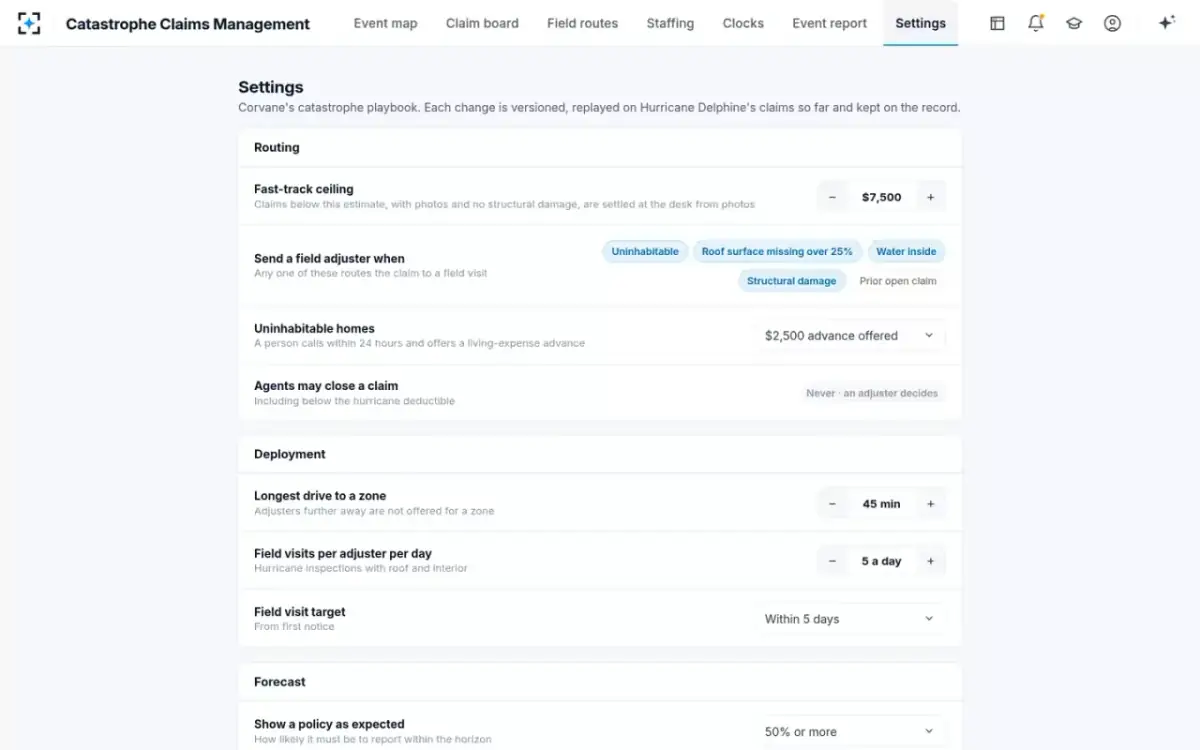
Every commitment stays with people. Nothing is requested until the catastrophe manager signs, and in the sample a request over $2 million goes to the director of claims operations, who approves it from his phone. The settings that drive the cost, the fast-track ceiling, the field triggers, visits a day and the visit target, are versioned, and each change is replayed on the event's claims so far, so the effect of a setting on next week's request can be seen before it is adopted.
The playbook that sets the cost: ceilings, triggers, visits a day
The fairest test is a past event. Run the claims, policies and rosters from one of the carrier's own storms through the solution, and compare the requests it would have drafted, and the day it would have drafted them, with the requests that actually went out. The daily mechanics of placing the adjusters once they arrive are in CAT adjuster deployment; how the forecast that sized the desk request is built is in catastrophe modeling software vs catastrophe claims management; and the event itself is on Catastrophe Claims Management.
Questions people ask
Is a claims adjuster staffing agency the same as an independent adjusting firm?
Not quite. An independent adjusting firm supplies licensed adjusters who handle claims on the carrier's behalf, often under a fee schedule; a staffing agency places workers on temporary contracts and may supply adjusters, examiners or support staff. In Florida a licensed independent adjusting firm contracted with an insurer can certify emergency adjusters in a catastrophe.
What do catastrophe insurance adjuster companies charge?
Private rates are contractual and unpublished. The public reference is FEMA's flood schedule: $680 for a loss up to $1,000, rising through fixed bands to $2,235 at $50,000, then a percentage with a minimum, such as 4.3% but not less than $6,750 between $150,000 and $250,000.
Who is responsible when a temporary adjuster makes a mistake?
The carrier remains responsible to the policyholder and the regulator for how its claims are handled. In Florida the insurer or firm that appoints an emergency adjuster is bound by that adjuster's acts and must supervise them after licensure.
How fast can outside adjusters arrive after a hurricane?
It depends on the contract and the competition for adjusters after the same storm. In the sample event the two outside firms were working on days one and two, and the day-four request was due at the staging airport on day seven.
Can software replace temporary claims staff?
It cannot inspect a roof or settle a claim. It can reduce how many adjusters an event needs by routing claims correctly on day one, and get the request out sooner by counting the claims not yet reported; in the solution, people still assign, sign and pay.