A catastrophe code in insurance, often called a CAT code, is the identifier an insurer puts on every claim that comes from one catastrophic event, such as a named hurricane, a hail outbreak or a wildfire, so that all of that event's claims can be handled, counted, reported and reinsured together. Carriers assign their own codes; federal and state bodies publish event identifiers of their own, such as FEMA's Event Designation Numbers for flood claims; and a commercial industry service assigns serial numbers many insurers also quote. Getting the code right on each claim is harder than it sounds, because notices arrive by phone, web, app and agent with addresses and dates people give from memory. Botminds' Catastrophe Claims Management tags each first notice to its event only if the loss date and address fall inside the storm's footprint, merges exact duplicates and flags near-duplicates for a person.
The tagging examples come from a fictional event, Hurricane Delphine, coded CAT 26-07 by a fictional carrier, Corvane Mutual, as it runs through the solution; their figures are sample data, not a customer result. Rules and real-storm data come from FEMA, Florida and Texas, linked where they appear.
A first notice on its way to a catastrophe code in Catastrophe Claims Management
Agent
Event footprint readerRebuilds the footprint from the latest official advisory, dates it and keeps every version; lists the policies in force inside it.
Never: Dropping a policy from the footprint without the reason.
Agent
Notice intake and taggerReads the notice from phone, web, app or agent; tests the loss date against the event window and the address against the footprint.
Agent
Notice intake and taggerTags the claim CAT 26-07 when both tests pass; merges an exact duplicate into the existing claim.
Never: Merging two notices that describe different damage; it flags them for a person.
A person decides
AdjusterDecides the flagged cases: an address just outside the footprint, a date before landfall, two notices that may be one claim.
Agent
Event report writerCounts the event’s claims for the daily report from the same tags, so the regulator’s data call and the leadership report agree.
What is a catastrophe code in insurance?
It is the event label on a claim. Without it, a hurricane is several thousand unrelated property claims; with it, the carrier can see the event as a whole. The code is what lets a catastrophe manager count the event's claims by route and county each morning, what an insurer reports against when a regulator calls for catastrophe data, and what a reinsurance recovery is built from. It is also what switches on the rules that apply only to catastrophe losses: a hurricane deductible, extended deadlines in some states, emergency adjuster licences.
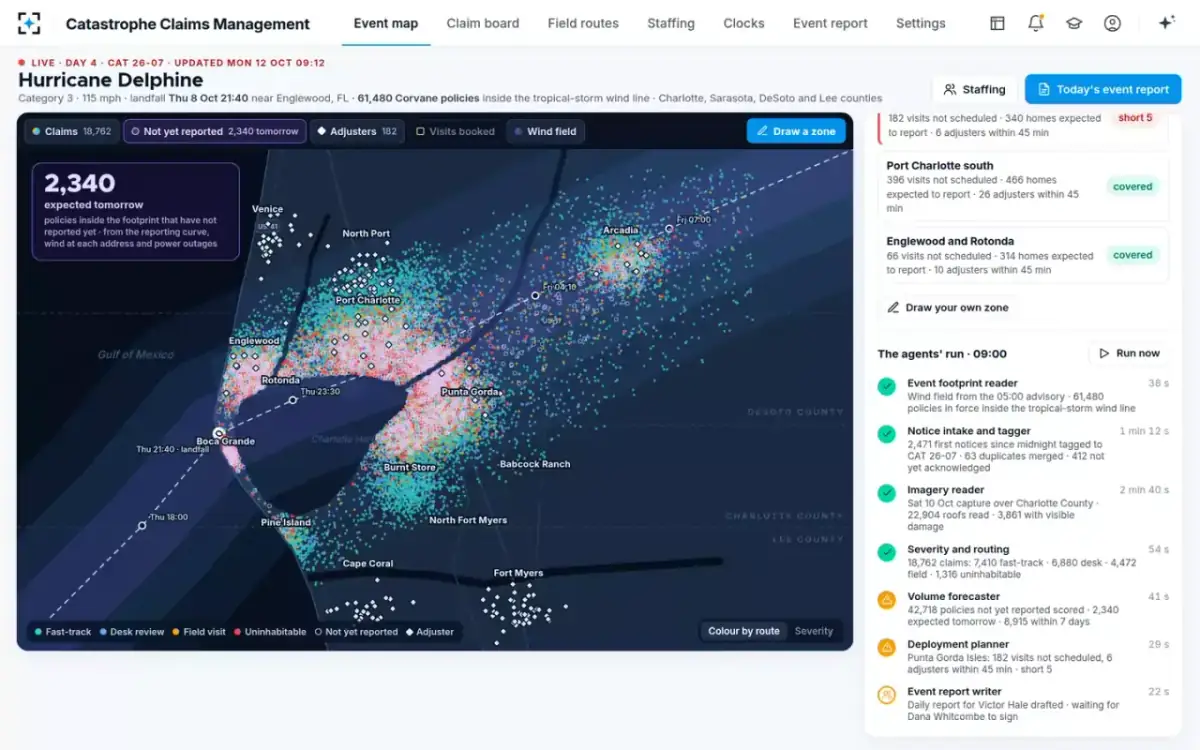
In the sample event the carrier's code for the hurricane is CAT 26-07. Overnight before the fourth morning the notice intake and tagger tagged 2,471 first notices since midnight to CAT 26-07 and merged 63 duplicates. Every one of those tags rested on two tests, a date and a place, and the rest of this guide is about why both matter.
Who assigns catastrophe codes?
Several bodies do, for different purposes, and a claim can carry more than one. The carrier's own code drives handling. Regulators and federal programmes publish their own event identifiers so that claims can be counted and special rules applied. The codes many people mean when they search for catastrophe codes come from a commercial service, Property Claim Services; their definitions belong to the company that owns it, not to a regulator, so this guide does not rely on them.
Four kinds of catastrophe code, and what each is for
| Code | Who assigns it | What it is used for |
|---|---|---|
| Carrier catastrophe code (e.g. CAT 26-07) | The insurer, when it declares an event | Handling, routing, staffing, reserves and the insurer’s own reports |
| FEMA Event Designation Number (e.g. FL0124) | FEMA, for National Flood Insurance Program claims | Applying event-wide rules, such as an extended proof-of-loss deadline, to flood claims in set states and dates |
| State catastrophe data call | A state regulator, under its own authority (Florida: s. 624.307) | Insurer reporting of claims and losses for the event, at dates the regulator sets |
| Industry catastrophe serial number | A commercial data service | Market-wide event tracking, under the service’s own rules |
FEMA's identifiers show what a public catastrophe code looks like in practice. When it extended the proof-of-loss deadline for Hurricane Helene flood claims, it wrote that the bulletin "applies to all NFIP claims associated with the following Event Designation Numbers (EDN)", and listed one per state, each with its own window of loss dates. A claim's eligibility for the longer deadline depends on carrying the right one.
Hurricane Helene’s flood event numbers: one storm, seven codes, seven windows
| State | Event Designation Number | Dates of loss |
|---|---|---|
| Florida | FL0124 | 24 – 30 September 2024 |
| Georgia | GA0124 | 24 – 30 September 2024 |
| North Carolina | NC0124 | 25 – 30 September 2024 |
| South Carolina | SC0124 | 25 September – 7 October 2024 |
| Tennessee | TN0124 | 25 – 30 September 2024 |
| Kentucky | KY0124 | 26 – 29 September 2024 |
| Virginia | VA0124 | 26 – 29 September 2024 |
How do insurers know a claim belongs to a hurricane?
By two tests: the date of loss falls inside the event's window, and the property sits inside the event's footprint. Both sound simple and neither is. A policyholder reporting from a relative's house days later may give the date they found the damage, not the date it happened. An address can sit on the edge of a wind field that moved with every advisory. And a storm's window is not one day: FEMA's Helene windows run from four to thirteen days depending on the state.
Florida settles the date question for property claims by statute. For hurricanes, tornadoes, windstorms, severe rain or other weather events, "the date of loss is the date that the hurricane made landfall or the tornado, windstorm, severe rain, or other weather-related event is verified by the National Oceanic and Atmospheric Administration." That fixes the date from which a policyholder's one-year notice window runs. It does not tell the carrier whether a particular roof was damaged by that storm or by the thunderstorm a week later; the footprint and the evidence on the claim have to do that.
Why does a catastrophe code matter for my deductible?
Because the code decides whether the hurricane deductible applies. In Florida a hurricane deductible applies to loss caused by a hurricane, and the statute defines how long a hurricane lasts for that purpose. It begins when a hurricane warning is issued for any part of the state and ends "72 hours following the termination of the last hurricane watch or hurricane warning issued for any part of Florida by the National Hurricane Center of the National Weather Service." A loss inside that window and caused by the hurricane is measured against the hurricane deductible, often a percentage of the dwelling limit; a loss outside it is measured against the ordinary deductible.
The code also carries the deductible across storms. Florida applies the hurricane deductible once per calendar year across hurricane losses with the same insurer, so a claim tagged to the wrong event, or a below-deductible loss never tagged at all, can change what a policyholder pays on the next storm that season. Why so many storm claims close below the deductible, and what the closing letter should say, is covered in claim closed without payment.
It changes who may adjust the claim, too. Florida's emergency adjuster licences are tied to an event: "Licensure as an emergency adjuster shall be used only for adjustment of losses directly resulting from the emergency regarding which the license was issued." A claim tagged to the event can go to an adjuster holding that emergency licence; a claim that belongs to a different loss cannot.
The Texas "catastrophe area" is something else
People searching the Texas Insurance Code for a catastrophe area find a term about where wind insurance is sold, not about how claims are coded. Under the windstorm insurance chapter, the commissioner may designate part of the seacoast territory as a catastrophe area after notice and a hearing, if "windstorm and hail insurance is not reasonably available to a substantial number of the owners of insurable property located in that territory because the territory is subject to unusually frequent and severe damage resulting from windstorms or hailstorms." The designation decides where the state's windstorm insurance association writes cover; it is not a code on a claim.
Texas does tie claim deadlines to a catastrophe, in a different chapter. Its prompt-payment law says: "In the event of a weather-related catastrophe or major natural disaster, as defined by the commissioner, the claim-handling deadlines imposed under this subchapter are extended for an additional 15 days." Whether a Texas claim belongs to such an event therefore moves its acknowledgement, investigation and decision dates. The tag is a deadline, not just a label.
Duplicate claims after a storm
Duplicates are the most common tagging error a regulator can see. A family calls the claims line, an agent files the same loss for them, and a relative uses the app: three notices, one roof. Florida's Milton table counts 5,487 claims closed without payment as a duplicate or opened in error. Merging too eagerly has its own cost: two notices from one address can be two losses, a dwelling and a detached structure, or a roof now and water damage found a week later.
Hurricane Helene: the tagging and data errors behind claims closed without payment
The largest bar is the one to read twice. More than six thousand Helene claims were closed without payment for a reason the regulator's table labels "Claim System Not Capturing Specific Data Points". Whatever lies behind that line, it says that a material share of one storm's closings could not be explained in the regulator's own categories from the data the claim systems held. A tag that is right but carries no reason is only half the job.
A notice tagged to the wrong storm is measured against the wrong deductible, run on the wrong deadlines and counted in the wrong recovery.
Where tagging fails silently
In four places, none of which produces an error message. A notice from just outside the footprint is left untagged and handled as an ordinary claim, without catastrophe staffing or the hurricane deductible review it may need. A notice with the wrong date is tagged to the right storm in the wrong window, or to no storm at all; Milton's table counts 74 claims closed for an incorrect date of loss. A duplicate stays open and doubles the event's count for a week. And when two storms hit in one season, as Helene and Milton did in Florida in 2024, a claim from the second can be tagged to the first.
Each failure is cheap to catch at intake and expensive later. Catching it needs the footprint for each advisory, kept and dated, the notice's address and date tested against it, and a person to decide the borderline cases. The tests are mechanical; the borderline cases are not.
Tagging, overnight: 2,471 notices, 63 duplicates merged
How Catastrophe Claims Management tags a notice, and what it leaves to people
The notice intake and tagger reads first notices from phone, web, app and agents, tags each to the event and tracks its acknowledgement. Its limits are part of its role: it tags a notice only if the loss date and address fall inside the footprint, flags rather than merges two notices with different damage, and never closes a notice. The footprint reader that it tests against uses the latest official advisory, keeps every footprint with its date, and never drops a policy from the footprint without a reason. When an advisory moves the wind field, the old footprint is still there to show why a claim was tagged the way it was.
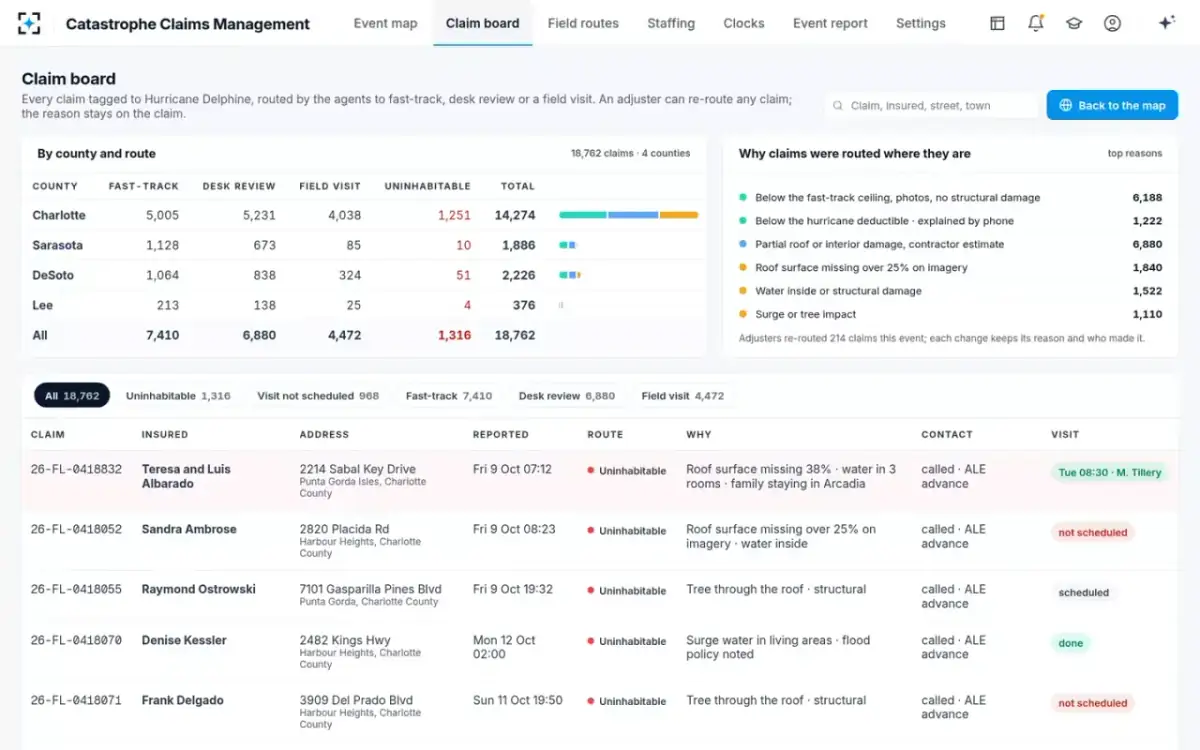
Every tag feeds the same numbers. The claim board counts the event by county and route from the tags; the clocks screen counts acknowledgements due; the daily report is drafted from the same counts, so a regulator's data call and the leadership report do not disagree. In the sample event, 412 tagged notices still needed the seven-day acknowledgement on day four, the oldest 31 due on Thursday. How the tagged claims are then routed is shown in a catastrophe claim, hour by hour.
The claim board, built from the tags
A tagging check for any catastrophe event
- Keep every footprint, dated
One per advisory, so a tag can be explained after the wind field moves.
- Test date and place on every notice
Date of loss in the event window; address inside the footprint.
- Decide the edges by hand
Addresses just outside, dates just before or after, go to a person with the reason.
- Merge duplicates only when the damage matches
Same address is not the same loss.
- Watch for a second storm
When two events overlap in a season, test each notice against both windows.
- Count from the tags, once
The regulator’s data call, the leadership report and the claim board should be one number.
Tagging is the least visible part of a catastrophe response and the one every other number depends on. The full event, tags to payments, is on Catastrophe Claims Management.
Questions people ask
What is a CAT code in insurance?
The same thing as a catastrophe code: the identifier that ties a claim to one catastrophic event. Insurers assign their own, and public bodies publish event identifiers such as FEMA's Event Designation Numbers, for example FL0124 for Hurricane Helene flood claims in Florida.
What are PCS catastrophe codes?
Serial numbers for catastrophe events issued by Property Claim Services, a commercial industry data service, and used across the market. Their criteria are set by the service's owner, not by a regulator, so a carrier should check them against its own event code and the public identifiers.
What was Hurricane Helene's date of loss?
For NFIP flood claims FEMA set windows by state, such as 24 to 30 September 2024 for Florida and 25 September to 7 October 2024 for South Carolina. For Florida homeowners claims, state law sets the date of loss for a hurricane as the date it made landfall.
Can a claim be moved from one catastrophe code to another?
Yes, and it should be when the date or place shows it belongs to a different event. The change can alter the deductible and the deadlines, so it should be made by a person and kept with its reason.
Do catastrophe codes change claim deadlines?
In some states. Texas extends its prompt-payment deadlines by 15 days for a weather-related catastrophe or major natural disaster as the commissioner defines it; Florida's regulator can grant extra time by order after a declared emergency, but no more than 30 additional days to pay or deny.