A national catastrophe response team is the group an insurer, or an independent adjusting firm working for one, moves into a disaster to take in, sort, inspect and pay the surge of claims a hurricane, hail storm or wildfire leaves behind: a catastrophe response manager, field and desk adjusters, outside adjusters from contracted firms, and the call and support staff who reach policyholders. The work is hard because the volume arrives before the people do, and because the families with the worst damage are often the last to report: no power, no phone, staying with relatives. Botminds' Catastrophe Claims Management is catastrophe claims software for those first days. Seven agents keep the event on one live map, route every claim to fast-track, desk review or a field visit, forecast the policies that have not reported yet and plan adjusters by drive time, while the catastrophe manager makes every assignment and signs every request.
The examples below follow one fictional event as it runs through the solution: Hurricane Delphine, a Category 3 storm that comes ashore near Englewood, Florida, on a Thursday night, and a fictional carrier, Corvane Mutual. Every person, firm and figure from that event is sample data, not a customer result. The figures on real storms come from Florida's Office of Insurance Regulation and federal agencies, linked where they appear.
The size of the job a catastrophe team is built for
789,066
claims reported to Florida insurers after Hurricane Ian, as of 4 March 2025
385,146
claims after Hurricane Milton, as of 9 December 2025
46
separate data calls Florida’s regulator ran on insurers for Hurricane Michael
What does a national catastrophe response team do?
It turns a disaster into a queue that can be worked, then works it under a regulator's clock. In practice that is five jobs running at once: knowing which policies sit inside the storm's footprint, taking in and acknowledging every notice, deciding which claims need a person on the roof, putting enough adjusters within reach of those roofs, and paying advances and claims as fast as the evidence allows. The Bureau of Labor Statistics describes the swing the team absorbs: claims examiners are called in "when, for example, a natural disaster occurs and the volume of claims increases."
"National" usually means the team is not tied to a region. A carrier keeps a standing group of experienced catastrophe adjusters and managers who travel to whichever state is hit, and tops it up with independent adjusters from contracted firms when the event outgrows them. Florida writes that surge into law: in a catastrophe the state may license adjusters who are not licensed there, if an authorized insurer or "a licensed independent adjusting firm contracted with an authorized insurer" certifies them as qualified. The team's size changes daily. Its structure does not.
What the team does not do well by hand is see the whole event at once. The catastrophe manager in our sample, Dana Whitcombe, ran previous storms the way most do: claim-system reports for the counts, outside-firm rosters kept in spreadsheets, and phone calls with field leads to learn who could reach where. Each of those is a day old by the time it is read. The ten days that follow show what that costs.
Who is on a catastrophe response team? The seats, and what each one carries
Six seats carry most of an event, and the work moves between them many times a day. A notice comes in through the contact team, is sorted by a desk lead, may need a field adjuster the manager has to place, and may end in a request to an outside firm that the coordinator sizes and the director approves. Every handoff is a place where a claim can wait.
Six seats on one catastrophe event, before and with agents doing the sorting
Today
Runs the event from claim-system reports, rosters the firms email in, and phone calls with field leads. Learns an area is short when complaints start.
With agents
Starts the day with short zones measured by drive time, draws a zone, assigns the adjusters who can reach it and signs the outside request.
Still theirs: Every assignment, every request to an outside firm, the daily report
Today
Gets yesterday’s count and a staffing ask built from a gut estimate.
With agents
Reads a signed 09:00 report with tomorrow’s expected claims beside today’s, and approves large spend from a phone.
Still theirs: Spend over the threshold, any outreach to people who have not reported
Today
Keeps half the roster in spreadsheets the firms send, and sizes requests from the manager’s estimate.
With agents
Works one roster by firm, with field and desk need against capacity for ten days and the request already sized.
Still theirs: Firm relationships, onboarding, licences
Today
Works the queue in notice order, so a lost roof waits behind a fence panel.
With agents
Opens each claim with its imagery, first-notice call, clocks and policy on one screen, uninhabitable homes first.
Still theirs: Advances within authority, every payment
Today
Stage where there is power and a hotel room, and get routes by phone.
With agents
Get a day built by drive time from where they are staged, uninhabitable homes first, closed roads routed around.
Still theirs: Confirming damage on site, the estimate
Today
Cannot see who the event has not heard from, or why.
With agents
Gets the unreached policyholders with the reason (no power, evacuated, number disconnected) and the acknowledgements due by day.
Still theirs: Every call, every call-back
The seats differ in what they decide, not in how hard they work. The manager decides where people go. The director decides what the event may spend and who may be contacted before they call. The desk lead decides advances and payments within authority: in our sample Sam Ortega approves advances up to $10,000. None of these decisions is mechanical, and none moves to software in the solution. What moves is the counting that sits under each of them.
The first ten days, drawn to scale
The pattern of an event is a race between three curves: notices arriving, adjusters arriving, and statutory deadlines arriving. Florida, where the sample storm lands, gives residential insurers seven calendar days to "review and acknowledge receipt" of a claim communication, and fourteen days to send the Homeowner Claims Bill of Rights after the first communication about a claim. So the first wave of notices, filed on the night of landfall, falls due on day seven, while the second and third outside firms are still arriving.
Ten days after landfall, by who is working the event
- Stagingday 0
- Field and desk at work64 field · 148 desk
- Called in1 d
- At work72 field · 160 desk
- Called in2 d
- At work46 field · 106 desk
- Not yet asked4 d
- Signed and travelling3 d
- At work41 field · 146 desk
- Acknowledgement window7 calendar days
- Past due if missed
Read down the chart and the problem is plain. The carrier's own staff and two outside firms are on the ground by day two, but the request that fills the gap is not signed until day four and does not report until day seven. That request was sized on day four from the claims already reported. The claims that would arrive on days five, six and seven were not in it, because nobody had counted them.
The regulator's own reporting shows the same rhythm. After Hurricane Michael made landfall on 10 October 2018, Florida's Office of Insurance Regulation ran "Daily data calls beginning October 12, 2018 through November 9, 2018", then weekly from mid-November, and less often after that: 46 in all. A team that cannot produce its own counts daily from day two will be producing them for the regulator anyway.
Desk adjuster vs field adjuster in a catastrophe
A field adjuster goes to the property; a desk adjuster settles claims from photos, estimates and calls without a visit. In a catastrophe the split decides the event, because field capacity is the scarcest thing a team has. The BLS describes the field side simply: "They work outside when examining damaged property." A field adjuster's day is bounded by daylight, drive time and the number of roofs and interiors that can be inspected properly. In the sample the carrier's playbook sets five hurricane inspections a day per field adjuster, roof and interior.
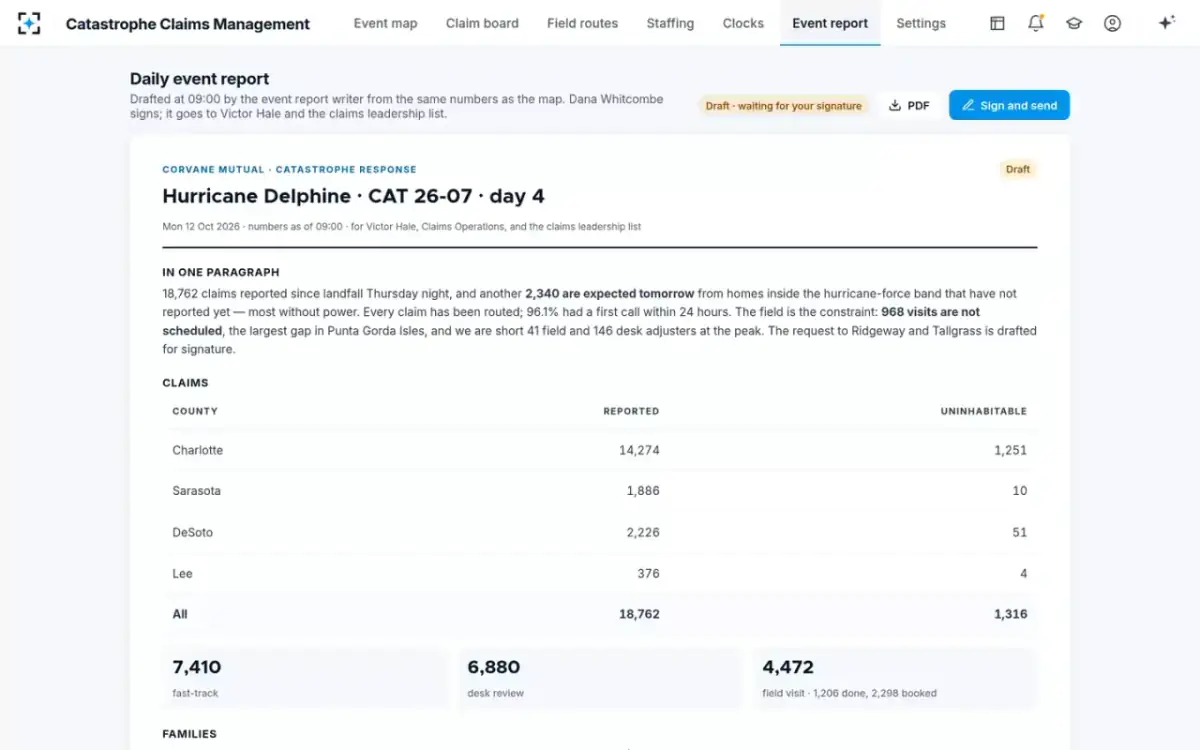
That makes routing the first lever. In the sample event the severity and routing agent sends each claim to one of three lanes from the notice, the photos and the imagery: 7,410 to fast-track (below a $7,500 ceiling, with photos and no structural damage), 6,880 to desk review and 4,472 to a field visit. Any one trigger sends a field adjuster: the home is uninhabitable, more than 25% of the roof surface is missing on imagery, water is inside, or there is structural damage. Each claim carries its reason, and adjusters have re-routed 214 of them, each change kept with who made it.
A claim routed to the wrong lane costs twice. Sent to the field when the desk could settle it, it takes one of the day's five visits from a family whose roof is gone. Kept at the desk when it needed a visit, it comes back a week later as a supplement or a complaint. The split is a staffing decision as much as a claims one.
Why catastrophe staffing chases yesterday's claims
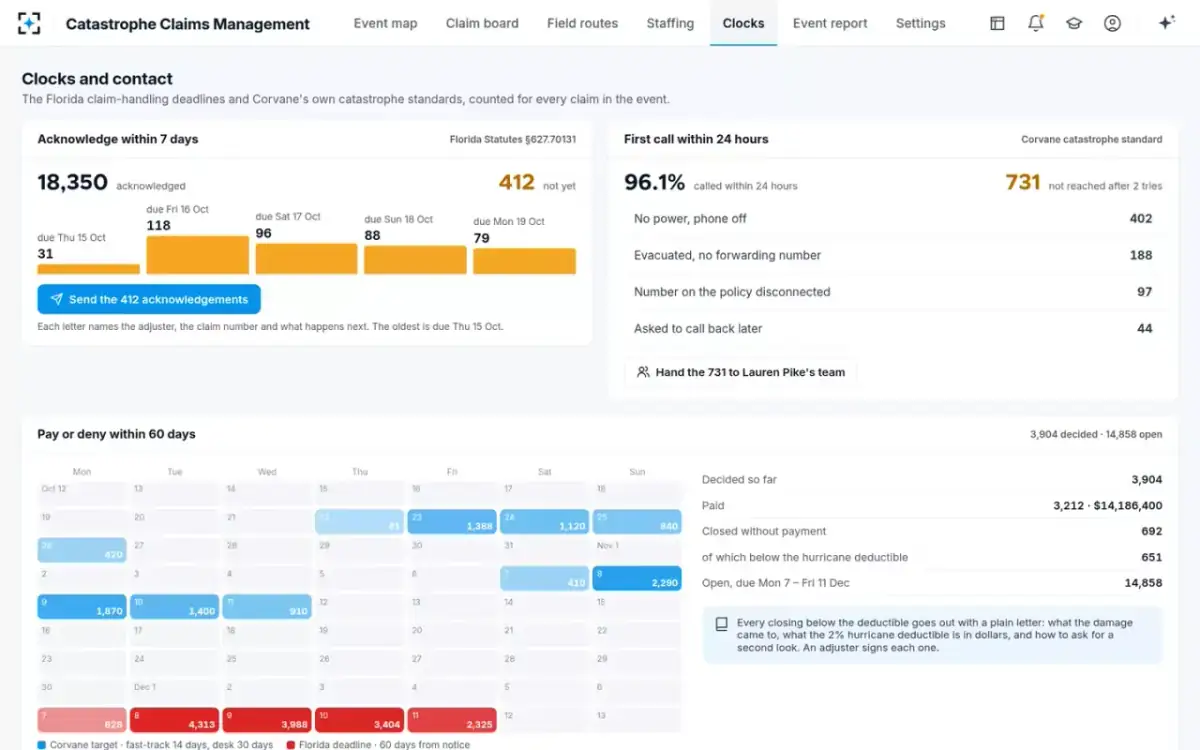
Because the count a team staffs from is the count of claims already reported, and the hardest-hit policyholders report last. On day four of the sample event Corvane had 18,762 claims from 61,480 policies inside the storm's tropical-storm wind line. That left 42,718 policies that had not called. The contact team's own list explains why many of them had not: of 731 policyholders not reached after two tries, 402 had no power and the phone off, and 188 had evacuated with no forwarding number.
A staffing request built from 18,762 claims undercounts tomorrow. The solution's volume forecaster scores every policy that has not reported, from the wind at its address, the reporting curve of the carrier's last two Gulf hurricanes, power outage reports by ZIP code, and whether a neighbour on the same street has reported. On day four it expects 2,340 claims the next day and 8,915 within a week. The forecast changes the request: the staffing screen counts 1,115 field visits a day needed at the peak against 910 the 182 deployed field adjusters can do at five a day, so the event is short 41 field adjusters through Friday, and short 146 desk adjusters once expected claims are added to the 6,880 open desk files.
Field visits needed against capacity, and the request already sized
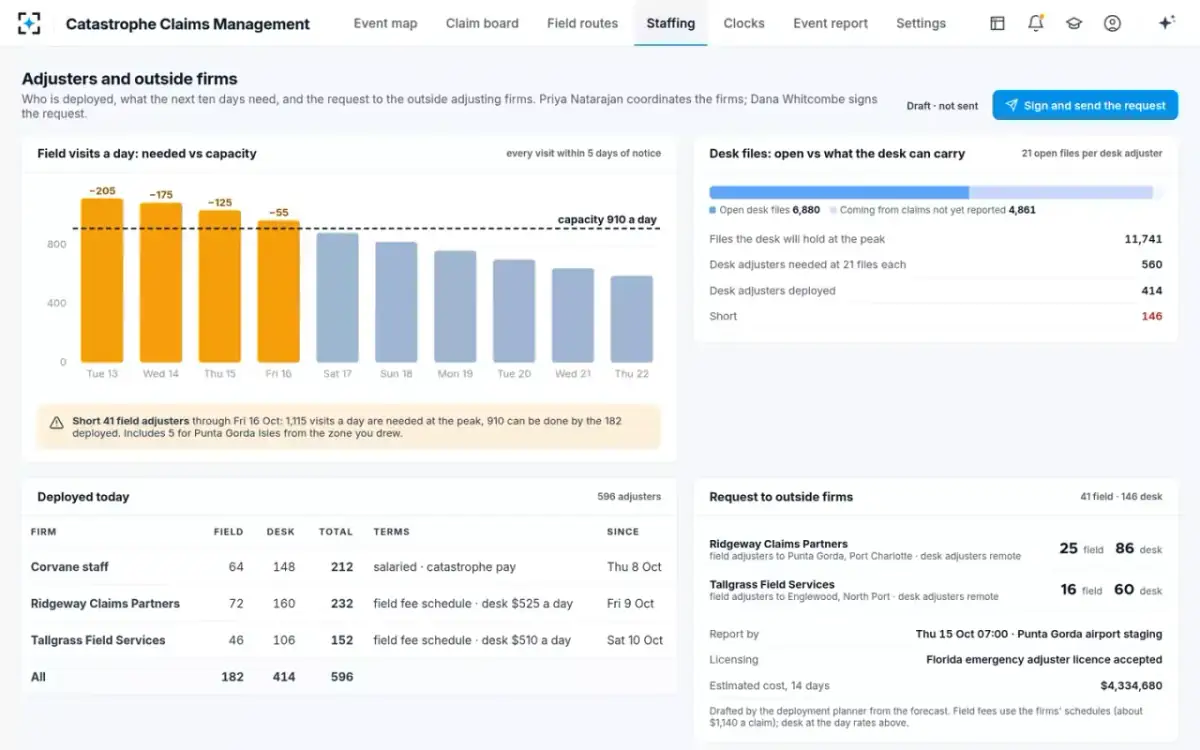
The difference is not that the forecast is perfect. It is that the request now carries a number for tomorrow, with the method shown, instead of a gut estimate the director has to take on trust. A request that is two days late is a request for the wrong two days.
What is CAT deployment, and when does it start?
CAT deployment is the movement of adjusters into a catastrophe area and their assignment to the claims there; it starts before landfall and is re-planned every day after. Before landfall the team works from the National Hurricane Center's forecasts, which are issued "every six hours at 0300, 0900, 1500, and 2100 UTC" with the storm's position, intensity and wind radii. That is when staging is chosen and firms are put on notice. After landfall the deployment becomes a daily allocation problem: which adjusters, from which staging point, to which neighbourhood, in what order.
The order matters most. The sample carrier's rule is uninhabitable homes first, then by notice time, and the deployment planner applies it when it books visits. On day four the manager draws a zone around Punta Gorda Isles and Burnt Store: 2,603 claims, 182 field visits not scheduled, 144 uninhabitable homes and 340 policies expected to report the next day. At five visits a day over five days the zone needs 11 adjusters, and only six can reach it within the 45-minute drive limit. The planner offers those six, books their Tuesday routes when she assigns them, and adds the missing five to the outside request. How the planner and the manager split that work is the subject of CAT adjuster deployment, task by task.
How many adjusters after a hurricane? Arithmetic, not a ratio
There is no published ratio of adjusters to claims that a team can rely on, and the federal data does not supply one. What the BLS publishes is the size and direction of the whole workforce: 389,700 jobs for claims adjusters, appraisers, examiners and investigators in 2025, a median pay of $78,020, and a projected decline of 6% from 2025 to 2035, with the note that "The number of natural disasters, such as floods and fires, influences demand for claims adjusters in property and casualty insurance." The catastrophe count has to be built from the event itself.
The arithmetic is short. Field adjusters needed equals the visits a day the event requires, divided by the visits one adjuster can do in a day. Visits required equals today's open field claims plus the field share of tomorrow's expected claims, spread over the carrier's visit target. Desk adjusters needed equals the open desk files at the peak divided by the files one desk adjuster can carry. In the sample that is 1,115 visits at peak over five a day, and 11,741 desk files over 21 each. The inputs are the carrier's own playbook settings; what is hard is keeping them current every morning, which is the part the agents do.
The regulator's clock runs on the team from day one
A catastrophe does not pause claim-handling law; in Florida it raises the price of breaking it. The Office of Insurance Regulation can fine an insurer for non-willful violations "up to $25,000 per violation, up to an aggregate amount of $100,000" when the claim arises from an emergency the Governor has declared, against $12,500 and $50,000 for other non-willful violations. In the first quarter of 2026 it fined 42 insurers across all lines. The team's deadlines are counted per claim, so they multiply with the volume.
The federal flood programme sets its own clock on the adjusters themselves. For flood claims under the National Flood Insurance Program, "The NFIP Preliminary Report is due within 15 calendar days of receipt of the loss assignment." A team that works wind and flood on the same street works two sets of deadlines on the same family, which is why a catastrophe claim is triage under a clock from the first morning.
Every Florida clock counted for the whole event
Where Catastrophe Claims Management changes the team's ten days
The solution does not add a seat to the team; it takes the counting out of the seats that exist. Before the manager is at her desk on day four, the agents have rebuilt the footprint from the 05:00 advisory, tagged 2,471 overnight notices to the event and merged 63 duplicates, read 22,904 roofs from Saturday's aerial capture, routed every claim, scored 42,718 unreported policies, planned deployment and drafted the daily report. The run is listed step by step with what each agent found and how long it took.
Where a catastrophe manager’s day goes, by hand and with Catastrophe Claims Management (hours)
The hours go back to the decisions the seats exist for. The manager signs the outside request on the morning it is drafted rather than late in the day; because it is over $2 million, the director approves it from his phone. The desk lead opens uninhabitable homes first. The contact lead gets 731 names with the reason each was not reached. The agents may recommend a route, offer adjusters within the drive limit and draft a request or a report; they may not close, deny or pay a claim, book a visit before the manager assigns a zone, or contact a policyholder who has not reported without the director's approval.
The daily event report, drafted from the same numbers as the map
A first-week checklist for any catastrophe response team
- Fix the footprint before the first notice
List the policies in force inside the forecast wind field from the advisory, and re-run it every six hours until landfall.
- Tag every notice to the event on arrival
Loss date and address inside the footprint; merge exact duplicates, flag near-duplicates for a person.
- Route on day one, with a reason on every claim
Fast-track, desk or field from written triggers, so a re-route is a decision someone can see.
- Count the policies that have not called
Size tomorrow’s staffing from expected claims as well as reported ones.
- Place adjusters by drive time, not by county
Staging follows power and hotel rooms; the damage may be 45 minutes away.
- Put every statutory clock on one screen
Acknowledgements, forms, first calls and pay-or-deny dates, counted per claim and due per day.
- Find the families you have not reached
Keep the reason: no power, evacuated, disconnected. Each needs a different next try.
A team can run most of this checklist by hand on a small event. On a large one the counting outgrows the people, which is when the staffing decision becomes a cost decision as well. How to compare outside firms, carrier staff and agents on that cost is set out in insurance claims temporary staffing against staff and agents, and the whole event can be seen screen by screen on Catastrophe Claims Management.
Questions people ask
What does a catastrophe adjuster do?
A catastrophe adjuster inspects and settles claims in a disaster area, usually travelling from elsewhere for the length of the event. Field catastrophe adjusters inspect roofs and interiors and write estimates; desk catastrophe adjusters settle claims from photos and calls. Under Florida law a licensed adjuster who inspects a home must give the policyholder their name and state adjuster licence number.
How long do CAT adjusters deploy?
As long as the event needs them, which is set by the carrier or the adjusting firm, not by law. In Florida an emergency adjuster licence issued for a catastrophe is valid for six months unless a shorter period is set, and can be extended while catastrophe conditions still exist. The sample event's outside request is sized for 14 days, then re-planned.
Is a national catastrophe response team the insurer's own staff or outside firms?
Usually both. Carriers keep a core of their own catastrophe adjusters and managers and contract independent adjusting firms for the surge. In the sample event the carrier's staff were 64 of 182 field adjusters and 148 of 414 desk adjusters on day four; the rest came from two outside firms.
What are the catastrophe response strategies that matter most in the first week?
Routing every claim on day one, forecasting the claims not yet reported, placing adjusters by drive time and keeping every deadline on one screen. Each attacks the same failure: staffing sized on yesterday's count while the hardest-hit families wait in the same line as minor damage.
Does a catastrophe change the claim deadlines in Florida?
Not automatically. Florida's Office of Insurance Regulation can order extra time when a declared emergency makes insurers reasonably unable to comply, but it may not extend the pay-or-deny period by more than 30 additional days. Fines for violations tied to a declared emergency are double the ordinary non-willful cap per violation.
How is a catastrophe team different from a regular claims department?
It works one event instead of a steady flow, so its volume is set by the storm and its staffing changes daily. A regular desk can work in notice order; a catastrophe team has to sort by severity first, because one day's field capacity, 910 visits in the sample event, is a fixed budget.