A catastrophe claim is an insurance claim that comes from a catastrophic event, a hurricane, hail outbreak, wildfire or flood, that the insurer has declared a catastrophe, so the claim is tied to that event and handled with all its others under catastrophe procedures. The difference from an ordinary claim is not the damage on one roof; it is that tens of thousands of claims arrive at once, under the same deadlines, while the people who can inspect them are scarce. Handling them is triage under a clock: deciding which claims need a person on site and in what order, reaching families who cannot be reached, and keeping every statutory deadline. Botminds' Catastrophe Claims Management is catastrophe claims software built for that triage. Seven agents keep the event on one live map and do the counting, routing, forecasting and drafting; the catastrophe manager, the adjusters and the director decide every assignment, request and payment.
This page follows one morning in the solution on a fictional event. Hurricane Delphine made landfall near Englewood, Florida, as a Category 3 on Thursday night, 8 October; it is Monday 12 October, day four. The carrier, Corvane Mutual, its people, the adjusting firms and the policyholders are all invented, and every figure from the event is sample data, not a customer result.
Day four of Hurricane Delphine in Catastrophe Claims Management, by the hour
Midnight – 09:00
Notice intake and tagger
2,471 first notices by phone, web, app and agent tagged to CAT 26-07; 63 duplicates merged; 412 still to acknowledge.
05:00
Event footprint reader
Rebuilds the wind field from the morning advisory; 61,480 policies in force inside the tropical-storm wind line.
By 09:00
Five more agents
Imagery read for 22,904 roofs; 18,762 claims routed; 42,718 unreported policies scored; deployment planned; daily report drafted.
09:12
Dana Whitcombe, catastrophe response manager
Opens the event map: 2,340 claims expected tomorrow; Punta Gorda Isles and Burnt Store short 5.
09:14
Dana, then the deployment planner
Draws the zone, assigns the 6 adjusters within 45 minutes; the Albarado visit is booked for Tuesday 08:30.
09:16
Dana
Adds the 5 missing field adjusters to the outside request drafted from the forecast.
Later that morning
Dana, then Victor Hale
She signs the request for 41 field and 146 desk adjusters; it is over $2 million, so the director approves it from his phone.
Later that morning
The clocks screen, for Lauren Pike’s team
731 policyholders not reached after two tries are ready to hand over with one click; the 412 acknowledgement letters are drafted to send with another.
What is a catastrophe claim?
It is a claim tied to an event the insurer treats as a catastrophe, usually because of how many claims the event produces at once. Florida's rule for emergency adjusters gives a regulator's version of the test: "an emergency or catastrophe exists when, due to a specific, infrequent, and sudden natural or manmade disaster or phenomenon, that has occurred or is imminent, there are losses or anticipated losses to insured Florida property, and the losses are, or likely will be so numerous and severe that resolution of claims related to such covered property losses may not occur expeditiously without the licensing of emergency adjusters." In other words, a catastrophe is an event the normal claims workforce cannot handle on time.
Once an insurer declares one, each claim from the event carries its catastrophe code, and the code switches on the event's rules: the hurricane deductible, emergency adjuster licences, the regulator's data calls and the carrier's own catastrophe standards, such as a first call within 24 hours. How a notice is tested against the event before it gets its code is covered in what a catastrophe code is.
What makes a catastrophe claim different from an ordinary claim
Volume, simultaneity and scarcity. An ordinary property claim is handled in the order it arrives by an adjuster with a normal caseload. A catastrophe claim arrives with thousands of others in the same week, from the same streets, to the same staff. Florida's figures for recent hurricanes show the scale: Hurricane Ian produced 789,066 claims across all lines and Milton 385,146, by insurers' reports to the state.
Where a catastrophe event stands on its fourth morning
18,762
claims reported since landfall Thursday night
2,340
more expected tomorrow from policies that have not reported
96.1%
of policyholders called within 24 hours of their first notice
24h
target for every claim to be contacted and sorted
Scarcity changes the order of work. When field adjusters can make about 910 visits a day across the event and 1,115 are needed at the peak, as in the sample, first come first served sends adjusters to the minor claims that reported first and leaves the families whose homes are uninhabitable, often the last to call, waiting behind them. A catastrophe claim is sorted by severity before it is worked.
Before 09:00: the overnight run
The work of the morning starts before anyone arrives. Between midnight and nine, the notice intake and tagger reads 2,471 first notices and tags each to CAT 26-07, testing its loss date and address against the footprint, and merges 63 duplicates. At 05:00 the footprint reader rebuilds the wind field from the morning advisory. By 09:00 the imagery reader has read 22,904 roofs from Saturday's capture, the severity and routing agent has routed all 18,762 claims, the volume forecaster has scored 42,718 policies that have not reported, the deployment planner has found the short zones and the report writer has drafted the day's report.
Each step is listed with what it found and how long it took, and the whole run takes minutes. None of it is a decision. A route can be changed by any adjuster; a forecast is shown, never acted on; a drafted report or request goes nowhere until it is signed. The run's job is to put the event, as it stands at nine, in front of the people who decide.
09:12: the event on one map
Dana Whitcombe, the catastrophe response manager, opens the event map at 09:12. It shows the storm track with its timestamps, the wind field, the 18,762 claims coloured by route, the 182 field adjusters as diamonds and, as hollow rings, the policies inside the footprint that have not reported. The side panel already says where the field is short, by drive time rather than by county.
09:12: the whole event in Catastrophe Claims Management, and where the field is short
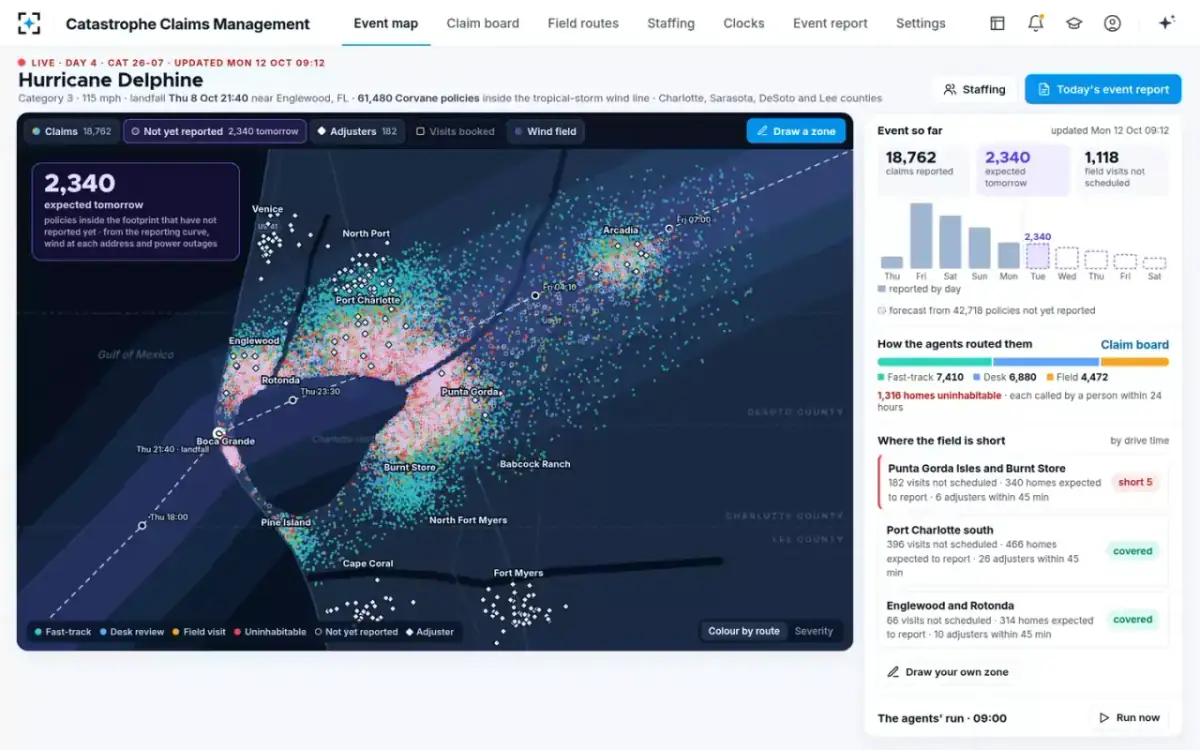
Most of what she would once have pieced together from reports and calls is on the screen: 7,410 claims on fast-track, 6,880 at desk review, 4,472 needing a field visit, and tomorrow's 2,340 expected claims drawn where they will come from. The densest cluster of expected claims is in Punta Gorda Isles, 340 of them, where the field is already short.
09:14: Punta Gorda Isles, where the field is short
She draws a zone around Punta Gorda Isles and Burnt Store, and the side panel recomputes for it: 2,603 claims, 182 field visits not scheduled, 144 uninhabitable homes and 340 policies expected to report tomorrow. That is 264 visits in five days; at five a day it needs 11 adjusters, and only six can reach the zone within 45 minutes. She presses "Assign 6 by drive time". The planner books Tuesday's routes, uninhabitable homes first, around the roads the county reports closed. At 09:14 the Albarado visit is booked: Tuesday 08:30, Marcus Tillery, 23 minutes away.
09:14: the zone, its arithmetic, and the six who can reach it
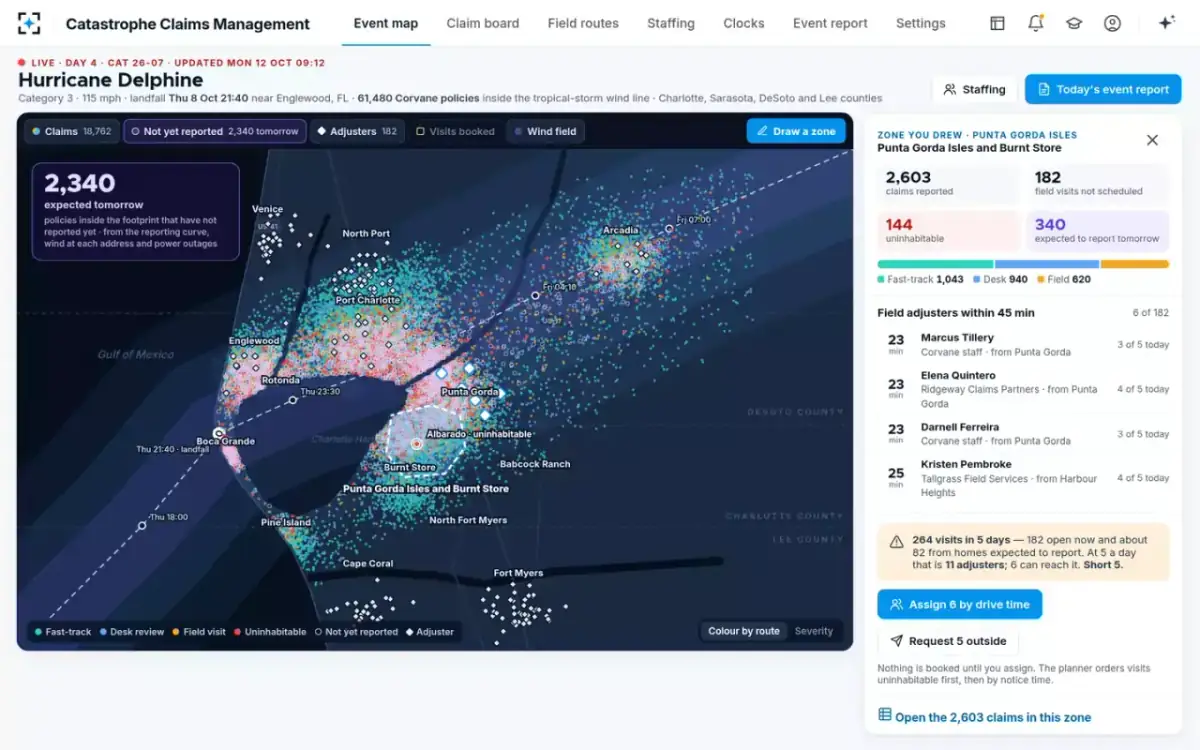
The task split behind those two minutes, what the planner does every hour and what stays with the manager, is set out in CAT adjuster deployment.
09:16: the shortfall goes into the outside request
Two minutes later she presses "Request 5 outside", and the five missing adjusters join the request already drafted from the forecast. It now asks two outside firms for 41 field and 146 desk adjusters, reporting Thursday at 07:00 at the Punta Gorda airport staging area, Florida emergency adjuster licences accepted, estimated at $4,334,680 over 14 days. It goes only when she signs it as catastrophe response manager; because it is over $2 million, the director of claims operations, Victor Hale, is copied and approves it from his phone. The screens give no time for the signature or the approval, and neither does this page.
One family's claim, from the first call to a booked visit
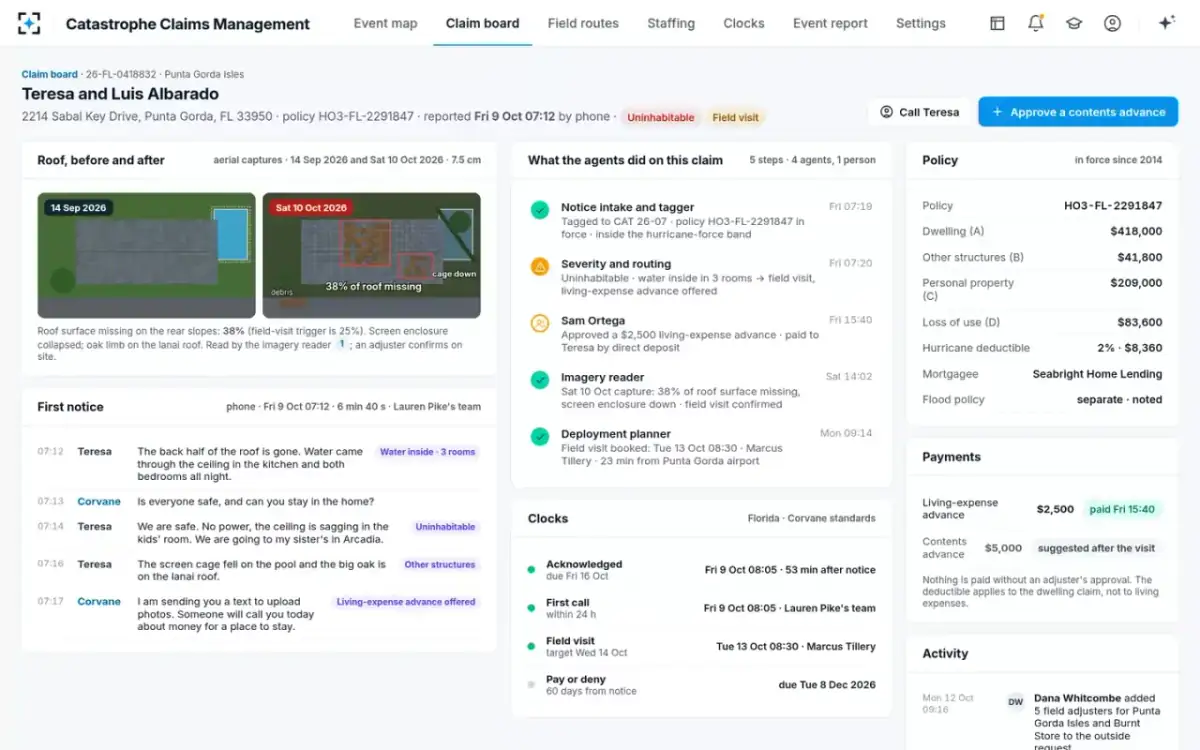
The Albarado claim shows what all of this is for. Teresa and Luis Albarado reported at 07:12 on Friday, the morning after landfall: the back half of the roof gone, water in three rooms, the family going to Teresa's sister in Arcadia. Drawn to scale, the claim's first four days show where the time went.
The Albarado claim from first call to the adjuster at the door, in hours
- To advance8.5 h
- Imagery read: 38% of roof missing22 h
- Waiting for a visit to be booked43 h
- Booked; waiting for the visit23 h
The family was acknowledged in 53 minutes and had $2,500 for somewhere to stay by the afternoon. The longest wait, 43 hours, sat between the imagery confirming the field visit on Saturday and the visit being booked on Monday morning, in a zone where 182 field visits were still unscheduled and only six adjusters were within reach. That is the gap the zone, the six assignments and the five-adjuster request close. The visit lands on Tuesday, a day inside the carrier's own five-day target for a field visit.
The claim: imagery, the call, the clocks, the policy and the payments
Before noon: the clocks, and the families not reached
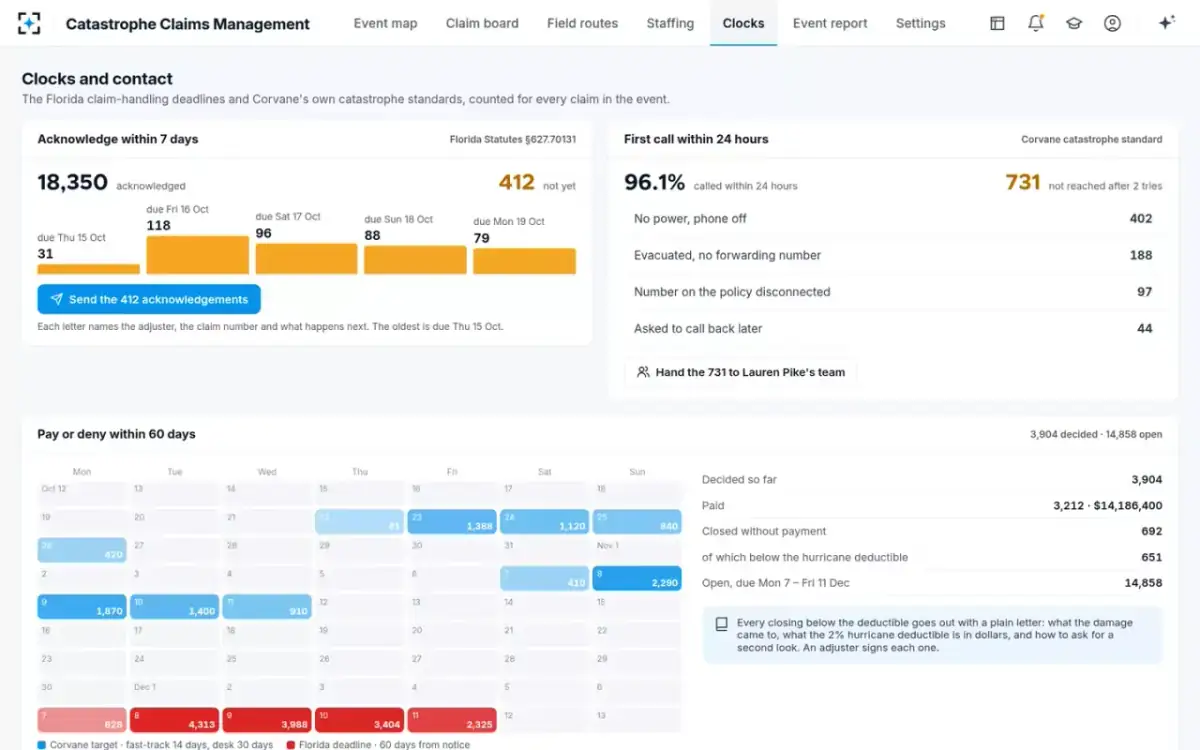
The last screen of the morning is the clocks. Florida gives residential insurers seven calendar days to acknowledge a claim communication, and 412 claims still need theirs: the oldest 31 are due Thursday 15 October, 118 on Friday. The letters are drafted, each naming the adjuster, the claim number and what happens next, and one click sends them. The same screen shows that 96.1% of policyholders were called within 24 hours, and lists the 731 who were not reached after two tries, with the reason: 402 with no power and the phone off, 188 evacuated with no forwarding number, 97 with a disconnected number, 44 who asked to be called later. One click hands them to Lauren Pike's contact team.
Every Florida deadline counted, and every family not yet reached
The daily report, drafted at nine from the same numbers as the map, waits for Dana's signature before it goes to the director. It leads with families and the field, and every figure in it traces to a screen.
How long does a hurricane claim take?
In Florida, the law sets the outer limit for a residential claim's first decision: the insurer must pay or deny within 60 days of notice, unless factors beyond its control prevent it. After a declared emergency the regulator can allow more time by order, but "The office may not extend the period for payment or denial of a claim for more than 30 additional days." In the sample event the first pay-or-deny dates fall on Monday 7 December, 60 days after the landfall-night notices.
The whole claim can take much longer, because supplements, reopenings and disputes follow the first decision. Florida's data shows the tail. Fourteen months after Milton, 92.0% of its claims were closed across all lines, and 30,975 were still open, according to insurers' reports to the Office of Insurance Regulation; for Ian, 95.7% were closed by March 2025. The last few percent can stay open for years: Ian's 4.3% still open in March 2025 was about 34,000 claims, some two and a half years after the storm.
How long after a hurricane can I make a claim?
In Florida, a new or reopened property claim must be reported within one year after the date of loss, and a supplemental claim within 18 months; for a hurricane, the date of loss is the date it made landfall, under Fla. Stat. §627.70132. Other states set their own limits, and policies have their own notice conditions. A claim reported late in a catastrophe is still tested against the event's footprint and dates before it is tagged, which is one reason to report with the date the damage happened, not the date it was found.
What a catastrophe claim needs in its first four days
- Tagged to the event on arrival
Loss date and address tested against the storm, duplicates merged only when the damage matches.
- Acknowledged within the state’s clock
Seven calendar days in Florida for residential claims.
- A person’s call within the carrier’s standard
And a note of why, if the family could not be reached.
- Routed by severity, with a reason
Fast-track, desk or field; uninhabitable homes never fast-tracked.
- Money for somewhere to stay, if the home is uninhabitable
Approved by an adjuster within authority.
- A visit booked inside the target
Uninhabitable homes first, by an adjuster who can reach the street.
The same claim can be followed through the rest of the event, and the team that carried it through ten days is described in the national catastrophe response team. Where a storm claim ends with nothing paid, the reasons are set out in claim closed without payment. The whole morning can be seen screen by screen on Catastrophe Claims Management.
Questions people ask
What does catastrophe claim mean on my insurance letter?
It means your claim has been tied to a declared catastrophe, such as a named hurricane, and is being handled with that event's other claims. It can affect which deductible applies, such as Florida's hurricane deductible, and which adjusters may be assigned.
How are catastrophe claims handled differently?
They are sorted by severity before they are worked, because field adjusters are scarce. Uninhabitable homes and severe damage go to field visits first; clear, smaller losses are often settled at a desk from photos.
What happens to my claim after a hurricane?
It is acknowledged, tied to the storm, routed to fast-track, desk review or a field visit, and then paid, partly paid or denied with a written explanation. In Florida the insurer must acknowledge within seven days and pay or deny a residential claim within 60 days of notice.
Why has no adjuster come to my house yet?
Often because adjusters are being sent to the most severe claims first, or because none can yet reach your area. If your home cannot be lived in, say so on the first call: in the sample carrier's playbook that sends the claim to a field visit and a living-expense advance.
Can my insurer pay me before the adjuster visits?
Many carriers can pay advances, for example for living expenses when a home is uninhabitable. For flood claims, when FEMA authorizes it, an NFIP insurer can pay an advance before the inspection: up to $5,000 on notice, or up to $20,000 with more documentation.