Claims management systems software is the system of record for claims: it takes first notice, links the policy, assigns the file, holds reserves, issues payments, schedules diary tasks, stores documents and correspondence, and reports on all of it. Cycle time monitoring is a different kind of software that sits on top: it reads the activity a claim system records and asks what has not happened yet, which files nobody is moving, and who each of them is waiting on. The two are layers, not rivals. A carrier that already runs a modern claim system does not need another one to find stalled files; it needs the record read for movement.
This guide is for buyers comparing the two. Claims Cycle Time Monitoring is Botminds' monitoring layer for open property and auto claims: six agents read every open file each morning, mark which entries moved it, name the waiting party, predict which files will cross 14 quiet days, price the daily rental, storage and hotel costs and draft a next step for a person to send. Examples come from a fictional sample team; none is a customer's result.
Who a sample team’s open files are waiting on: the field a claim system leaves blank
Open property and auto files placed on the radar, by waiting party
- The insured · 81 · 25.6%
- A body shop · 68 · 21.4%
- The insurer’s own desk · 65 · 20.5%
- An appraiser, adjuster or contractor · 68 · 21.4%
- A lienholder or yard · 35 · 11.1%
What does claims management systems software do?
It records the life of every claim and the money attached to it, in the form regulators and finance require. The NAIC's model claims regulation expects an insurer to be able to provide, for each claim, "the claim number, line of coverage, date of loss and date of payment of the claim, date of denial or date closed without payment", and states write the same expectation into their own rules. A claim system is where those dates live, along with notes, tasks, reserves, payments, documents and correspondence.
Modern claim systems also run workflow: assignment rules, authority limits, diary tasks, letter templates and dashboards over their own tables. Those features help a desk do the next known thing on a file. They are built around tasks and transactions, which is why they record a routed supplement, a voicemail and a customer's call faithfully, and cannot say that none of the three moved the claim.
Does the claim system already track diaries?
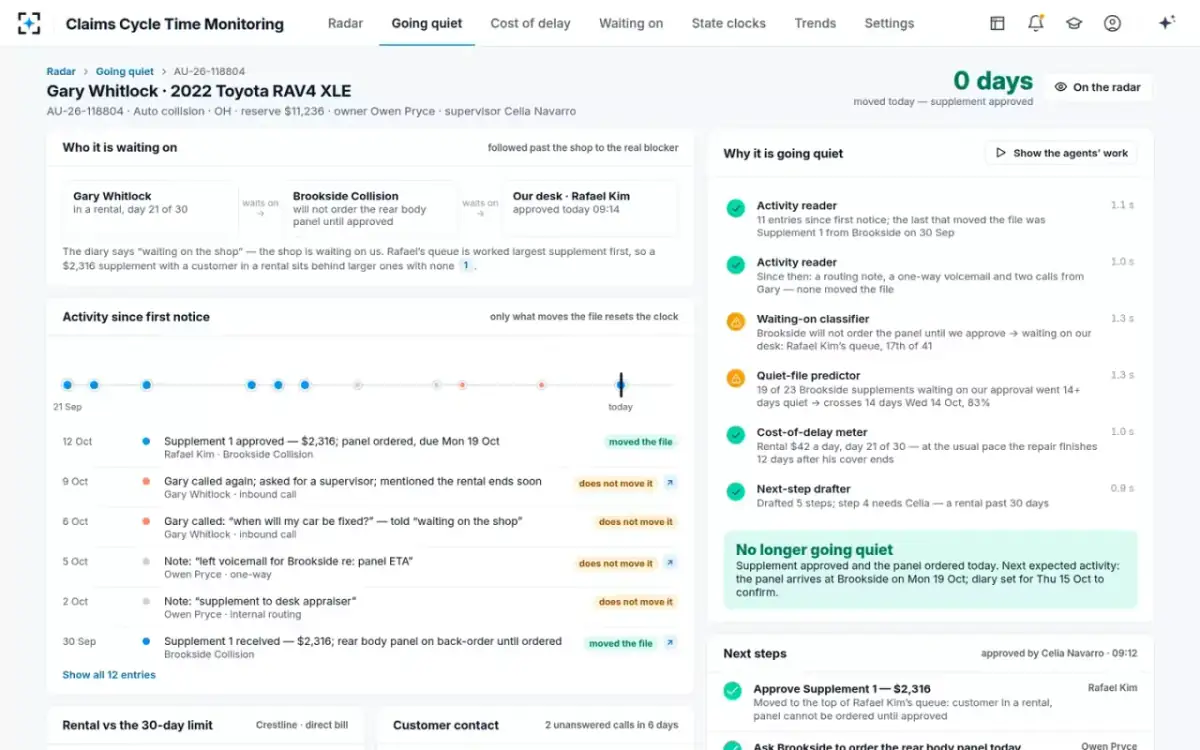
Yes, and that is the problem cycle time monitoring starts from. A diary is a reminder: a date on which someone should look at the file again. It moves whenever someone pushes it, adds a task or logs an entry, whether or not the claim changed. In the fictional sample, Gary Whitlock's auto claim had four entries in the 12 days after the body shop's supplement arrived: a routing note, a voicemail to the shop and two calls from the customer. The diary stayed current throughout; the claim did not move.
Cycle time monitoring keeps the diary and adds a second clock: days since the last activity that moved the file, where moving means a document received, a payment or reserve change, an approval or decision, or a two-way conversation. Notes, routing, one-way calls and pushed diaries are recorded and do not reset it. How that reading works, entry by entry, is shown in why a busy diary is not a moving file.
What does cycle time monitoring add to a claim system?
It adds judgment about movement, the identity of the party each file is waiting on, a prediction of the next stall, a daily price for the wait and a drafted next step. None of those is a record the claim system lacks; all of them are readings of records it already holds, joined with vendor bills and shop status the claim system usually does not hold.
Claims management systems software and cycle time monitoring, question by question
Claims management system: What happened on this claim, and what is due next?
Cycle time monitoring: What has not happened, and who is it waiting on?
Claims management system: A task or a transaction.
Cycle time monitoring: A file and its wait.
Claims management system: Recorded as a status or a note.
Cycle time monitoring: Followed past the shop to a supplement waiting in the insurer’s own queue.
Claims management system: Rental and storage paid as they are billed.
Cycle time monitoring: Priced per day on each quiet file, against the policy limit, before it is reached.
Claims management system: Diary dates set by people.
Cycle time monitoring: A predicted date the file crosses 14 quiet days, with the closed files behind it.
Claims management system: Yes: it is the record.
Cycle time monitoring: Read-only; approved steps land on the activity trail through people.
Waiting-on: the field no claim system fills in
The most useful single field a monitoring layer adds is who each file is waiting on, with how fast that party usually answers. Claim systems record parties, not waits. Measured across closed files, waits differ more than most desks assume, and the insurer's own queues appear on the same list as the shops and lenders. In the sample, the desk appraiser's supplement queue answered in a median of 9.8 days, and 41% of its 388 supplements since January stalled past 14 days, a higher stall rate than any body shop on the board.
Who files are waiting on, including the insurer’s own desks
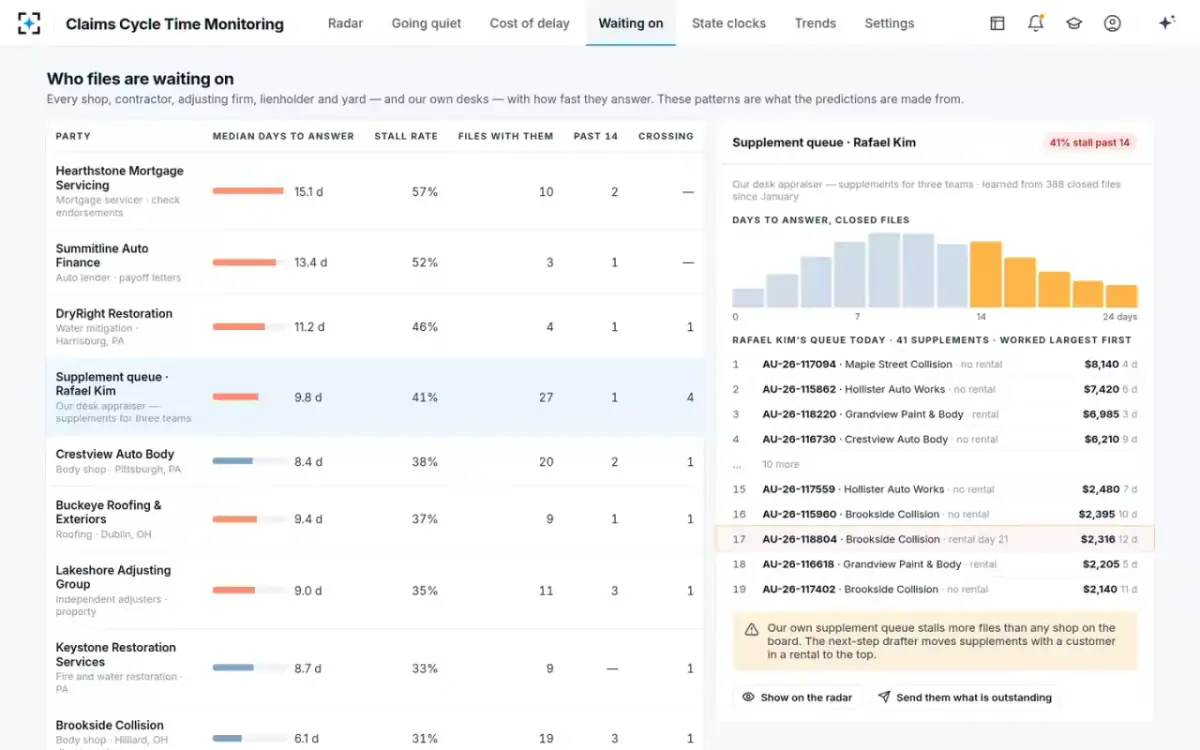
That reading changes the fix. A desk that believes its files are waiting on shops sends shops reminders; a desk that sees its own queue worked largest supplement first, with a $2,316 supplement and a customer in a rental 17th of 41, changes the order of the queue. The full chain is traced in when a pending claim is waiting on the insurer.
The same attribution applies to money. A claim system pays the rental company, the yard and the hotel as their bills arrive, and records each payment against the claim; it does not say which waiting party the money was spent waiting on. In the sample, the $2,864 a day running on files quiet for a week or more splits into $709 waiting on insureds, $565 on contractors, $524 on body shops, $407 on appraisers and adjusters, $299 on the insurer's own desk, $225 on lienholders and $135 on yards. That split is a reading across the claim system and three billing feeds, which is the kind of work a monitoring layer exists to do.
Best claims management software: the questions that decide cycle time
The best claims management software for cycle time is the one whose data can be read for movement, whichever vendor supplies it. When choosing or renewing a claim system, a few data questions matter more to cycle time than any feature list, because they decide whether a monitoring layer, built in or added, has anything reliable to read.
Data questions to ask of any claims management system
- Is every activity typed and timestamped?
A note, a call, a document, a payment and a decision must be distinguishable without reading free text.
- Are document dates recorded on receipt, processing and sending?
California already requires the three dates for every material document, so the data should exist.
- Can inbound and outbound contacts be told apart?
A customer’s second call is a warning; an adjuster’s voicemail is an attempt.
- Does vendor status flow in?
Shop parts dates, contractor reports and rental days billed, or the wait cannot be priced.
- Can the full file be produced for a claimant?
Washington now lets insureds request any portion of a first-party claim file at reasonable intervals.
- Is history kept long enough to learn from?
California requires open and closed claim data for the current year and four preceding years; predictions need closed files.
- Can another system read it without writing to it?
Read-only access keeps the record clean while a monitoring layer works.
Claims management software for adjusters: what the screen should show
An adjuster's screen should show the next step on each file, not just the file. Most claim systems give adjusters a work queue of tasks and diary dates; an adjuster carrying 46 open files, as the sample's senior auto adjuster does, needs to know which three need something today and what that something is. In the sample, the adjuster receives a drafted message, call script or diary date three days before a file is predicted to cross 14 quiet days, and sends it himself.
The desk appraiser's screen needs the same idea applied to a queue. A supplement queue worked largest first is rational for indemnity and wrong for cycle time when a small supplement holds a car in a rental. The sample's next-step drafter moves supplements with a rental running to the top of the appraiser's queue, with the file and the shop behind each, and the appraiser still approves each one.
Who uses each layer, and for what
| Role | In the claim system | In the monitoring layer |
|---|---|---|
| Adjuster | Notes, payments, reserves, letters, diary | One drafted next step per file about to go quiet |
| Desk appraiser | Estimates and supplements, approvals | Which supplements have a customer in a rental |
| Supervisor | Approvals past authority, file reviews | Morning list of quiet files with the plan that needs a decision |
| Operations manager | Inventory and performance reports | Files past 30 quiet days, days to close and rental days per claim, weekly; the rules |
| Customer experience lead | Complaint log | Alert at 30 quiet days or a second unanswered call |
When a monitoring layer is not worth adding
When the claim system already does the reading, or when there is little to read. A small book of quick, simple claims that close in days has few quiet files to find. A claim system whose activity is free text only, without types or reliable timestamps, has to be fixed before any monitoring can be trusted. And a team that cannot connect rental and storage bills will get the waiting party and the prediction but not the price. Ask a claim-system vendor whether its own product classifies activity as moving or not, follows chains past the first party and predicts stalls; if it does, on your files, you may not need a second layer.
The pressure to find stalled files without more reading is likely to grow. The Bureau of Labor Statistics projects employment of claims adjusters, appraisers, examiners and investigators to decline 6% from 2025 to 2035, so fewer people will carry the same open files. Meanwhile, Florida requires residential property insurers to keep dated records of every claim communication, information request, inspection and estimate (§627.70131(4)(b)): the material a monitoring layer reads is increasingly a legal requirement.
How Claims Cycle Time Monitoring sits on top of a claim system
It connects read-only to the claim system for notes, tasks, payments, reserves and diary dates, and to the documents on each file, shop and contractor status, the rental direct bill, storage and hotel bills and customer contacts. Every morning it rebuilds each file's picture: last moving activity, waiting party, predicted crossing, daily cost and the next step. Approved steps are carried out by people in their usual systems and written to the file's activity trail with who did them.
The same file once the supplement was approved: zero days quiet
The division of labour stays fixed whatever the configuration: the claim system remains the record, the agents read and draft, and the adjuster, desk appraiser and supervisor decide. How the layer is fitted in and switched on is set out in cycle-time alerts beside your claim system. For a related comparison on total loss files, see the two clocks of a total loss.
Questions people ask
What is the best claims management software?
The one whose data fits your lines, volumes and states, and can be read reliably by other tools: typed, timestamped activity, dated documents and vendor status. For cycle time specifically, judge any candidate on your own open files by whether it can show which are not moving and who they wait on.
What claims management software programs do adjusters use?
A claim system of record for notes, reserves, payments and diary; estimating software for repairs; portals for shops, contractors and independent adjusters; and the rental program's billing system. Adjusters switch between them, which is why waits that sit between systems go unseen.
What should claims software for adjusters do about stalled files?
Show the adjuster which of their files are about to stop moving, why, and the one step that would move each, before the threshold. In the sample, the adjuster receives that step three days before a predicted crossing of 14 quiet days and decides whether to send it.
Is claims monitoring part of a claims management system?
Sometimes in part: many claim systems include diary alerts and inventory dashboards. Monitoring for movement, reading each entry, following waits past the first party and pricing them, usually needs data from outside the claim system as well, such as rental and storage bills and shop status.
Does cycle time monitoring need a new claim system?
No. It reads the existing claim system and the systems around it, and writes back only steps a person has approved. What it does need is activity that is typed and timestamped, which most claim systems already record.