A total loss adjuster confirms that a damaged car is not worth repairing, builds and approves its actual cash value, sends the owner an itemized offer and approves the payment that splits between lender and owner. That is the visible half of the job. The other half is chasing: lenders for payoff letters, owners for signatures, the state for a salvage title, yards for invoices. On many desks that tail is shared with a title and payoff specialist, a salvage coordinator, a supervisor who holds the higher authority and a contact centre that fields "where is my money?".
The work is growing. Repair prices have risen 56% since January 2020 while used-car prices rose 36% (BLS repair index, used-car index, to September 2026), so more crashed cars cost more to fix than they are worth, and more of them run this whole chain. Botminds' Total Loss Claims Management exists for the part after the decision: specialist agents read, check, draft and chase, and each person on the desk receives one request at a time with its evidence, to approve or send back. This page walks the desk seat by seat: what each one decides, what clock it works against, and what its week looks like when the chasing leaves it.
Fewer people will carry each total loss: the adjuster workforce is projected to shrink
389,700
claims adjusters, appraisers, examiners and investigators in the US, 2025
−6%
projected change in those jobs, 2025 to 2035
21,600
openings a year projected even so, all to replace people who move to other jobs or leave the workforce
What does a total loss adjuster do?
The total loss adjuster owns the money decisions on a totaled car: the call that it is a total, the value, the offer and, within a dollar limit, the payment. The test is economic. As Texas’s Office of Public Insurance Counsel puts it to consumers, a total loss "means that your vehicle costs more to fix than to replace", and the salvage the insurer expects to sell is part of that sum: an owner who keeps the car has "the amount they would get for selling the car as salvage" taken off the payment. So the adjuster weighs the repair estimate, the pre-accident value and the expected salvage proceeds, and a borderline car can go either way on a few hundred dollars of any of them.
The value is where most of the craft sits. Model Regulation 902, the template most states adapted, builds a cash settlement from two or more comparable cars in the local market within the last 90 days, plus taxes and transfer fees, and requires every deduction to be "itemized and specified as to dollar amount". The way the value is explained is under scrutiny too: when the UK’s Financial Conduct Authority surveyed 12 motor insurers it found that "some firms reported average settlement values that were lower than the available guide prices", and that low first offers raised only when the owner pushed back "can be unfair". How that value is assembled, line by line, is its own subject, covered in how total loss value is calculated.
Then the adjuster becomes a coordinator. The owner has to accept and sign a power of attorney and odometer statement; the lender has to produce a payoff letter; the payment has to split correctly. The Bureau of Labor Statistics files all of this under one occupation, "claims adjusters, appraisers, examiners, and investigators", which is why public job data says little about how a total-loss desk divides the work.
Five seats on a total loss desk, and what each one decides
A total loss passes through five working seats, and each one owns a different kind of decision. No public benchmark describes how carriers split the work; some run title, payoff and salvage as three jobs, others as one specialist, and some hand parts of it to vendors. The split below is the one built into the solution, where title, payoff and salvage sit with one specialist.
What the seats have in common is that each answers to a clock it does not control. The adjuster works against the claim-handling deadlines in the state’s unfair-claims rules. The specialist works against a payoff letter’s good-through date and the state’s title office. The supervisor works against dispute and appraisal deadlines. Compliance works against a federal monthly report.
Five seats, five kinds of decision, five clocks
What the seat decides: Total or repair; the value; the offer; payments within the adjuster’s limit.
The clock it works against: Acknowledge a claim within 15 days, accept or deny within 21 days of proof of loss, pay within 30 days once liability is clear (NAIC Model 902).
What the seat decides: Payoff requests, title notices, the salvage-title filing, moves out of billing yards, sales at or near reserve.
The clock it works against: The payoff letter’s good-through date; in Texas, a title the owner never sends can be applied for in the insurer’s name only from day 30 after payment, after two written notices; in New York, 10 business days to forward the title to the DMV.
What the seat decides: Anything over the adjuster’s limit; borderline totals; payee and bank-detail changes; disputes and the appraisal clause.
The clock it works against: Dispute replies, appraiser deadlines, and the 35-day window in which an owner who cannot buy a comparable car can reopen the claim.
What the seat decides: Nothing about money. Explains the offer, the split and what is still needed.
The clock it works against: A written status letter at 45 days and every 45 days after (Model 902), and every call in between.
What the seat decides: Approves state rule changes and the federal total-loss report.
The clock it works against: A monthly report of total losses to the National Motor Vehicle Title Information System (28 CFR §25.55).
The adjuster’s day: from finding stuck cars to deciding requests
On a hand-run desk the adjuster’s day is reactive: the queue is a claims system, an inbox, voicemail and a valuation tool, and a stuck car announces itself when the yard’s bill arrives. With agents, the day starts from a short list of decisions, ordered by deadline, each prepared and cited.
Take a sample desk at a fictional Austin carrier, Pecan Valley Mutual. Keisha Monroe, a total loss adjuster, carries 46 open total losses; 11 are past their stage target and 16 sit in yards that bill storage, together $720 a day. Her Monday opens on ten requests. Each names the agent or person who raised it and the car it concerns, and none of them is "find out what is happening".
Total Loss Claims Management, the adjuster’s Monday
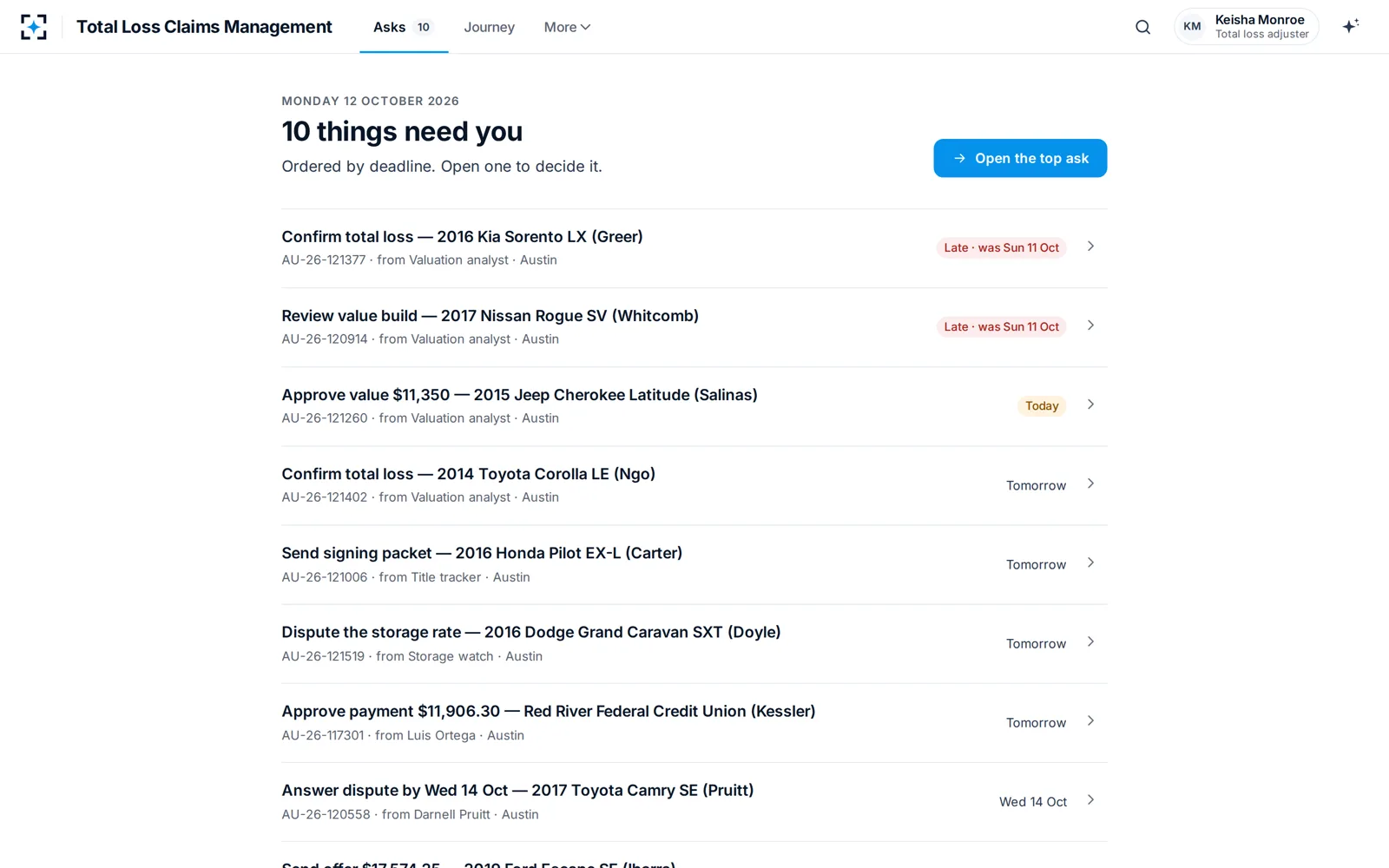
Every row starts with a verb and says who asked: the valuation analyst, the title tracker, storage watch, a colleague or the claimant himself.
Each request opens on the same five-row checklist with its evidence: the vehicle and its coverage, the value and who approved it, the deductions and the photos behind them, the payee and the lien. The adjuster approves it or sends it back with a reason. The value build she approves is the same page the owner sees, so explaining it later is reading it, not reconstructing it.
What does a total loss specialist do? The title and payoff seat that decides when a car can be sold
The specialist turns a paid claim into a sellable car: lien released, title in hand, salvage title filed, car sold. It is the slowest stretch of a total loss and the least visible. The state sets the pace. Texas lets an insurer that paid the claim but cannot get the title apply for one in its own name only "not earlier than the 30th day after the date of payment of the claim", and only with a statement that it sent "at least two written notices" asking for it. A specialist who sends the first notice late has moved the earliest filing date, and every day of that is a day the car sits in a yard.
The loan makes it harder. The Consumer Financial Protection Bureau found that 11.6% of vehicle loans in its 2018–2022 data rolled negative equity from an earlier car into the new loan, with an average loan-to-value of 119.3% at signing; even loans with no trade-in averaged 101.6%. A car financed above its value can be totaled for less than is owed, which means gap waivers, owner shortfalls and second conversations. The lender is paid first, and the owner gets "the difference" only "if you owe less than the car is worth", as Texas’s consumer counsel tells owners. Every payoff letter also expires, and a payment against an expired letter can leave the loan short by the interest accrued since.
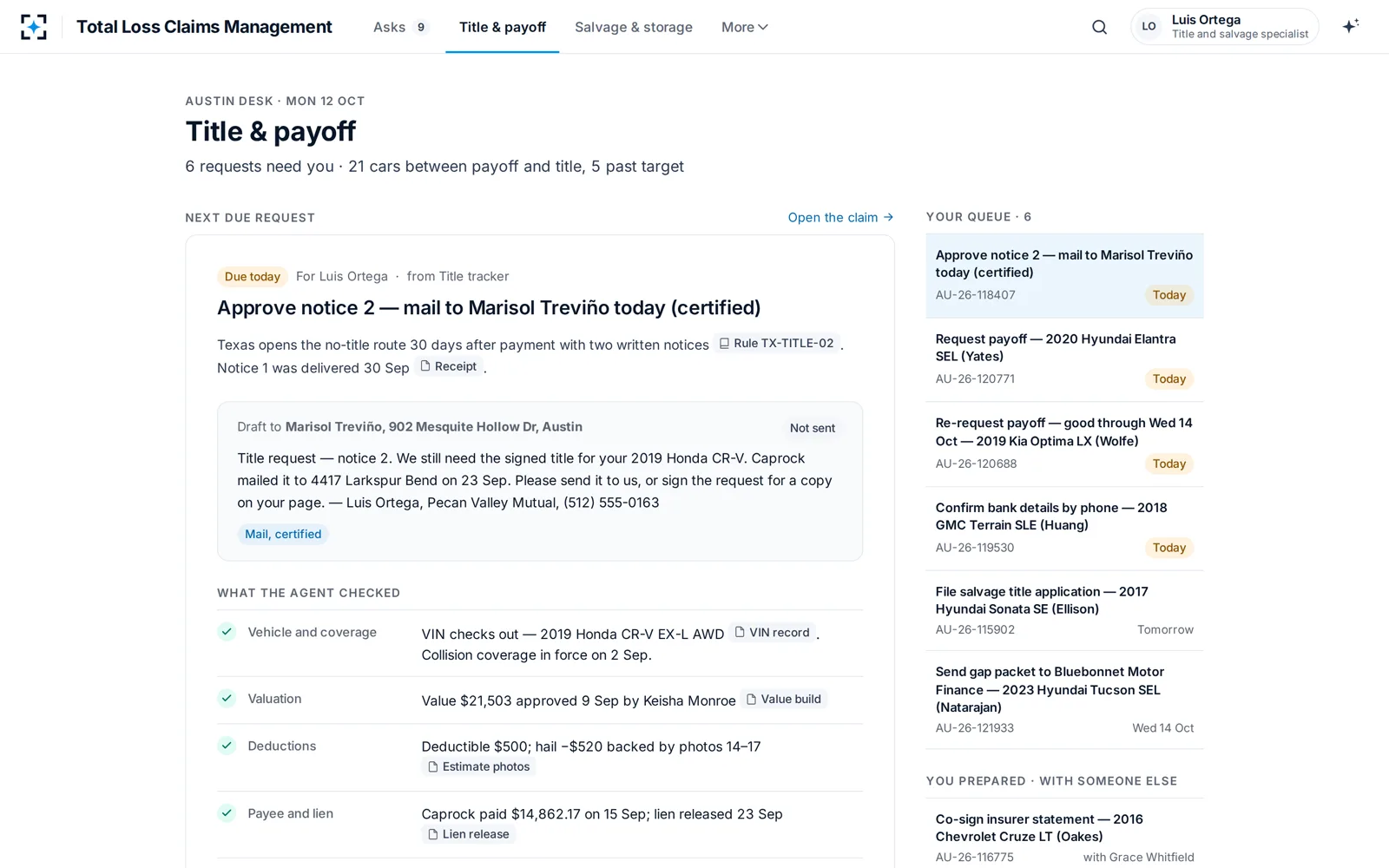
In the sample desk, Luis Ortega holds this seat. His screen opens on the next due request with the agent’s work already done: the title tracker has read the mail tracking, found that the lender mailed the CR-V’s title to the owner’s former address, and drafted the second written notice Texas requires before its no-title route opens. Nothing is sent until he approves it. The full story of that car, 28 days stuck at "Title received", is the subject of the CR-V case study.
The specialist’s Title & payoff screen
The supervisor and customer contact: the seats that answer "why"
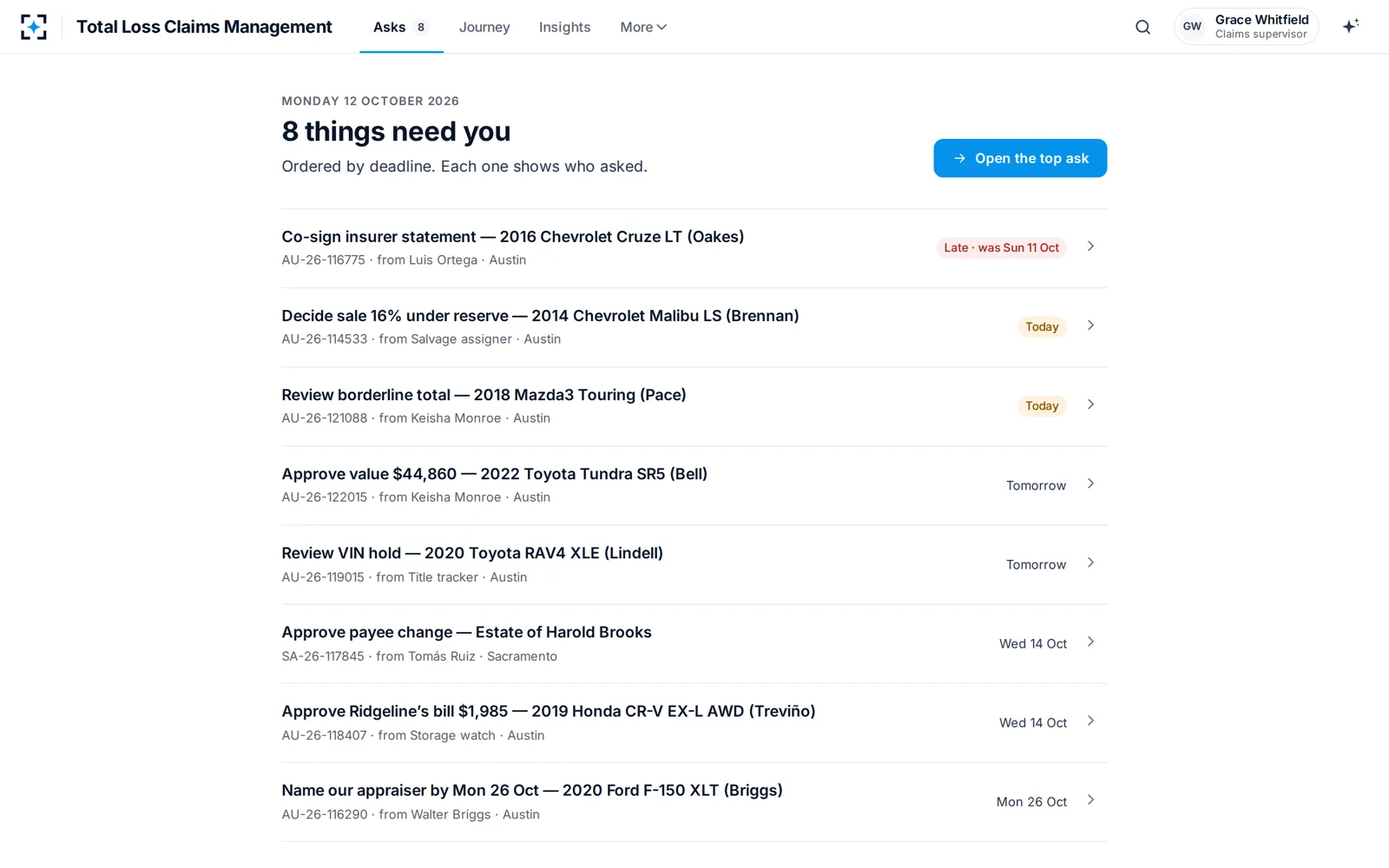
The supervisor holds the authority above the adjuster’s and the questions nobody else can close. In the sample desk, Grace Whitfield’s Monday holds eight requests: co-signing a Texas insurer statement under penalty of perjury, a salvage sale 16% under reserve, a borderline total, a $44,860 value over the adjuster’s $40,000 limit, a VIN hold, a payee change to an estate, a yard bill and naming the carrier’s appraiser for a disputed value.
A supervisor’s queue is the desk’s exceptions
Customer contact answers the owner’s two questions: when do I get paid, and why that number? Those are the questions that turn into complaints. Of the 2,167 complaints the Massachusetts Division of Insurance closed in 2025, auto claim delay was the largest single topic at 349, and auto total loss made the top ten on its own, with 127. A delay call and a value dispute are the same two questions asked too late. A contact agent who can read the owner the offer line by line, with each listing and adjustment and the lender’s share, can answer "why" on the first call. In the solution, that seat can read every claim in its region and cannot approve money. What owners see on their side is covered in the value explainer.
How each seat’s week changes when agents take the chasing
The change is the same on every seat: the hours that went into finding out move to deciding, and the decision arrives with its evidence. The words below are the sample desk’s own, as each person describes the job.
Each seat in Total Loss Claims Management, before and after
Today
“I find out a car is stuck when the yard sends the bill.”
With agents
Starts from requests ordered by deadline, and sees every car on one route with the stopped ones pulled aside: the reason, the days held, the storage.
Still theirs: total or repair, the value, the offer
Today
“Half my day is calling lenders about titles they already mailed.”
With agents
Works a queue where tracking and addresses are already read, and letters, notices and payoff re-requests are drafted for approval.
Still theirs: filings, moves, sales at reserve
Today
“When someone disputes, I need every adjustment on one page.”
With agents
Opens the value build with every listing, adjustment and exclusion and its reason: the same page the owner sees.
Still theirs: anything over a limit, payee changes, appraisal
Today
“People want to know when they get paid, and why that number.”
With agents
Reads the owner the letter line by line, sees signatures and the split, and asks the built-in assistant for a cited answer.
Still theirs: the conversation
The work that leaves the seats is the work a person should never have been doing by hand: rereading a tracking page, re-keying a payoff amount, counting yard days. The work that stays is the work someone has to answer for. The agents behind each seat, and the things each is forbidden to do, are described in the agents on a total loss desk.
Agents do the reading and chasing; each decision stays with a named seat
Agents do
- Read every incoming document and say what is missing
- Find comparable listings and adjust each one
- Draft the offer letter and the plain-words value
- Request and read payoff letters
- Re-request a payoff before it expires
- Read mail tracking and check addresses
- Draft title notices and the salvage-title application
- Collect salvage bids and propose the buyer
- Price every storage day, every morning
People decide
- Confirm the total lossAdjuster
- Approve the valueAdjuster
- Send the offerAdjuster
- Approve a payment someone else preparedAdjuster
- Approve a move out of a billing yardSpecialist
- File the salvage titleSpecialist
- Change a payee or bank detailsSupervisor
- Co-sign a no-title statementSupervisor
- Approve the monthly federal total-loss reportCompliance
Who approves what: the authority ladder on a total loss
Authority on a total-loss desk is a ladder of dollar limits plus a short list of decisions that always need a second person. Where both live in a policy manual, the solution turns them into a settings table it enforces on every request.
In the sample desk’s settings, an adjuster approves values and payments to $40,000, adds up to $750 above the value build and pays storage and tow bills to $1,500. The supervisor’s limits are $75,000, $3,000 and $5,000; the director has none. The specialist prepares payments but never approves his own, and may sell a salvage car at reserve or up to 10% under it. Anything above a limit goes to the next person up with its evidence, and raising a limit needs a second director-level approval.
Authority as a setting, per person
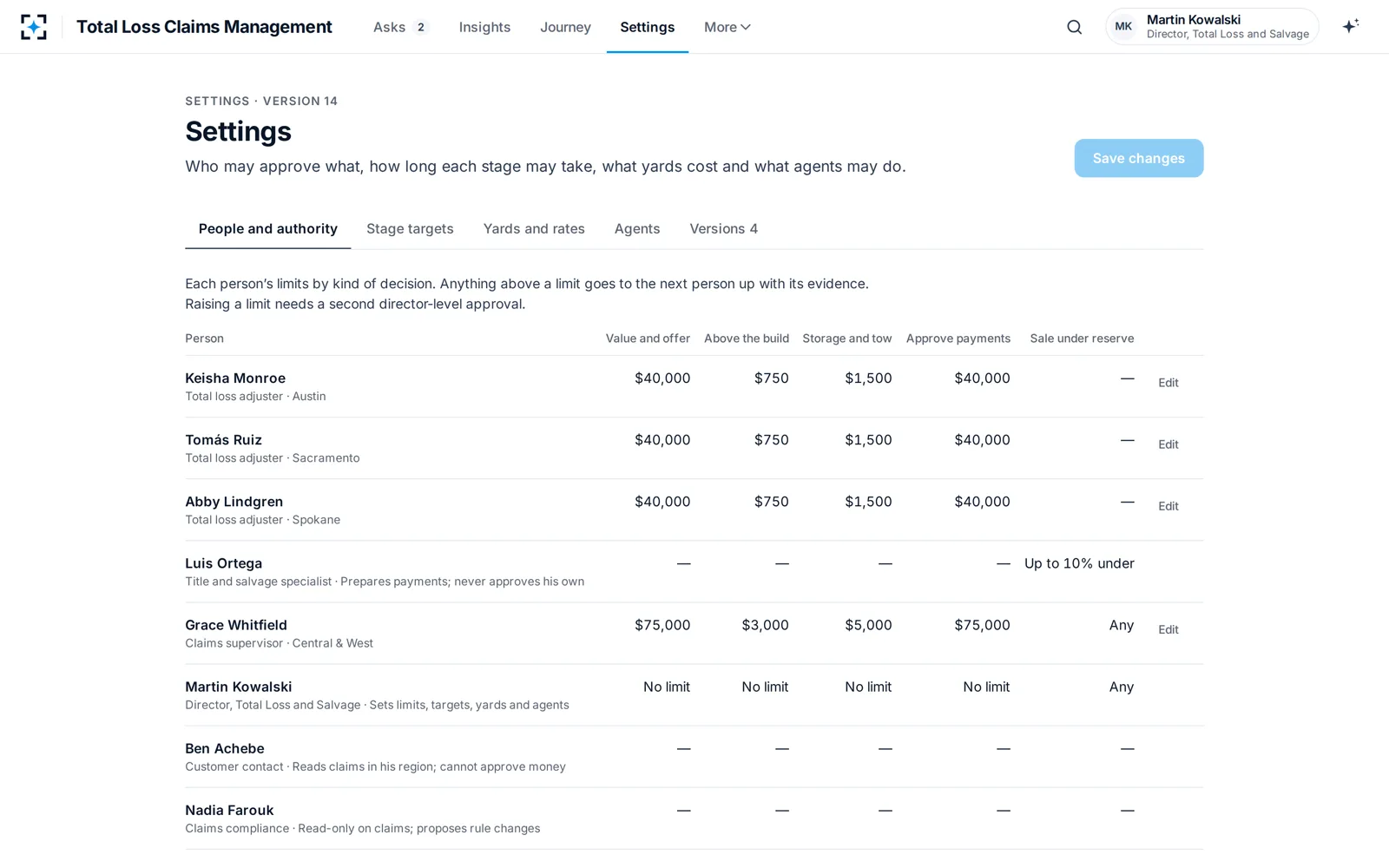
The rule that matters most is not a dollar figure. The person who prepared a payment can never approve it, a payee or bank-detail change always goes to the supervisor, and a payment on an expired payoff letter is refused outright. The flow below is a lien payment on the sample desk.
One lien payment, three hands
Agent
Lien payoff agentReads the payoff letter, the good-through date and the daily interest, and checks the bank details against those already on file for the lender.
Never: trusts bank details from an emailed PDF alone
A person decides
SpecialistPrepares the split: lender first, the remainder to the owner.
A person decides
AdjusterApproves within her limit; a larger payment goes to the supervisor.
Never: approves a payment she prepared
When the seat belongs to a vendor
Some of these seats are not staffed by the carrier at all. Salvage auctions offer payoff and title retrieval as a service to the insurers that consign cars to them, independent appraisers prepare valuations, and staffing firms supply desk adjusters when volume spikes. Each takes work off the desk; none takes the decision with it.
Outsourcing a seat does not outsource its obligations. The monthly report of total losses to the federal title register is placed on "any individual or entity acting as an insurance carrier", and state unfair-claims rules judge the carrier’s practice, whoever keyed it. When a vendor holds a seat, the questions are the same ones the authority ladder answers for staff.
Five things to settle before a vendor holds a seat on the desk
- Which decisions the vendor may make, and up to what amount
Preparing a payoff request is not approving a payment. Write the limit down per decision, not per contract.
- Who is the second person
If the vendor prepares payments or federal reports, someone at the carrier approves them, and never the preparer.
- Where the evidence lives
A payoff letter, a tracking scan or a title image the carrier cannot open is not evidence the carrier can show an examiner.
- How bank details are verified
Against the lender details the carrier holds, by call-back, never against a PDF that arrived by email.
- Who talks to the owner
Consent and opt-outs apply per channel whoever sends the message, and an owner who has a lawyer is contacted only through counsel.
Will AI replace total loss adjusters? What stays human, task by task
Agents replace tasks on a total loss desk, not the decisions, and the regulators and the industry’s own practice point the same way. The Bureau of Labor Statistics expects technology to "automate some of the tasks that these workers currently perform" and projects a 6% decline in these jobs by 2035, while still forecasting about 21,600 openings a year. Those openings exist only to replace people who move to other jobs or leave the workforce, so each departure takes a desk’s know-how with it: which lender answers by fax, which yard bills from the tow date, which state wants the title forwarded in ten business days. Writing those habits into rules an agent follows, with a person approving each decision, keeps them when the person leaves.
“Few companies are using AI/ML claims models for claims approvals (9) and none are using them for claims denials.”
NAIC, Private Passenger Auto AI/ML Survey, 2022
Among large auto insurers, 96 companies said they used AI in claims mostly "as an informational resource for adjusters". The NAIC’s model bulletin on AI, adopted in 29 jurisdictions as of 8 October 2026, says an insurer’s actions "must not violate" the unfair-claims rules "regardless of the methods the Insurer used". A decision still needs someone who can be asked why.
The solution builds that line into the work rather than the policy manual. Each agent task is set to watch, propose or act; money and customer-facing steps are locked to propose; and a task people override more than 5% of the time in 30 days drops back from act to propose by itself. With fewer experienced adjusters coming, the more useful question is which seat each newcomer learns first, and how fast. A pilot on a carrier’s own closed files, the subject of the 30-day pilot, is also a way to train the desk on the new rhythm before a live claim depends on it.
Questions people ask
What is the difference between a total loss adjuster and an auto damage appraiser?
The appraiser estimates the damage; on a total, the decisions that follow (the value, the offer, the payment) sit with the adjuster’s seat. BLS counts auto damage appraisers separately: 8,670 in May 2023, of whom 4,960 worked for insurance carriers, a small specialist group beside the 389,700 people in the wider adjuster occupation.
What does an insurance title processor do on a total loss?
The title processor gets the car’s ownership into the carrier’s name so it can be sold: payoff letters and lien releases from lenders, the signed title or a state substitute from the owner, the salvage-title application and the paperwork the auction needs. It is chasing work, and it is where a paid claim most often sits still.
How much does a total loss adjuster make?
Federal data does not separate total loss adjusters, so the nearest figures are for the wider group. BLS puts the 2025 median pay of claims adjusters, appraisers, examiners and investigators at $78,020 a year, and the mean wage of auto damage appraisers at $75,660 in May 2023. Pay on a total loss desk varies with the authority a seat carries more than with its title.
How many claims does a total loss adjuster handle?
There is no published benchmark for auto total losses; the caseload studies that exist cover workers’ compensation. A desk can measure its own as open totals per adjuster and, more usefully, stopped totals per adjuster. In the solution’s sample book one adjuster carries 46 open total losses, 11 of them past a stage target, and it is the 11 that set the size of her day.
Do agents need their own seat on the desk?
No. In the solution the agents sit beside the existing seats and raise requests to them. What changes is the authority table: it becomes a setting the director owns, and every request is checked against it.