Insurance claims automation software for total losses is best judged on your own closed files, not on a vendor's demonstration, because a total loss does not end when the owner is paid. The carrier still has to stand behind the value, pay off the lender before the payoff letter expires, collect the title, apply for the salvage title, report the car to the federal register and sell the wreck, while a yard bills storage every day. Since January 2020 the US price index for vehicle repair has risen 56%, against 36% for used cars and trucks (to September 2026), so more crashed cars cost more to fix than they are worth, and that tail is a growing part of an auto claims book. Botminds' Total Loss Claims Management carries each totaled car from the decision to a closed file: agents read, check, draft and chase, and named people approve every payment, letter, move and sale. To evaluate it you do not need a core-system replacement or a live integration. You need a sample of your own closed totals, your state rules, your letter templates and your yard rates. Replay the last 90 days, then run alongside your desk on live open files for a week, and decide against pass marks you set before you saw a result. Thirty days is the length of the plan we propose, not a measured go-live time.
A proposed 30-day pilot of Total Loss Claims Management, from baseline to a go or stop decision
How do you choose claims automation software for total losses?
Start from where your total losses lose days, then pick the kind of tool that reaches that stage. Most carriers have three options for the work after the decision, and they are often combined: build workflow into the core claim system, buy services from the auction or a payoff network, or add a specialist layer that reads, chases and proposes across all of them. Each is a reasonable choice for some desks.
Three ways to automate the total loss tail, and where each falls short
| Option | What you get | What it asks of you | Where it falls short on a total |
|---|---|---|---|
| Workflow in the core claim system | Tasks, diaries and reminders inside the system of record | Configuration and IT time for each rule, letter and state | It reminds a person to check; it does not read the payoff letter, the tracking scan or the yard invoice for them |
| Services from the auction or a payoff network | Payoff quotes, lien payoff and title retrieval for cars consigned to that auction | A contract, and your documents sent to the vendor | Covers the cars that go to that partner, and the evidence sits in its portal rather than your file |
| A specialist automation layer | Agents that read every document, build and check the value, chase payoffs and titles, price storage and propose each step | Exports to start; connections to lenders, states and auctions to go live | Newer, and only as good as the limits and evidence you can inspect; it must prove itself on your files |
Whichever you choose, five things decide whether it shortens the tail: whether it sees every car's stage and reason every day without someone looking; whether each number it produces opens to its source; whether a person with the right limit approves each payment, send, move and filing, and never the one who prepared it; whether state rules live as dated, sourced settings someone signs; and whether it can be tested on your past files before you sign. The pilot below is built to answer all five in a month.
Why pilot total loss automation on closed files first?
Because a closed file has an answer key and a live one does not. You already know what happened to every total you closed last quarter: the value you paid, the letter you sent, the day the payoff letter expired, the day the title arrived and what the yard charged. Replaying those files shows what the agents would have caught, drafted and proposed on the same documents, on the same dates, with nothing at risk.
A live-only pilot mixes two questions: does the software work, and was this a normal month? Published figures will not settle the second: no regulator publishes a national total-loss cycle time, and the rules give only outer limits. Texas, for one, gives an insurer 15 business days to accept or reject a claim once it has what it asked for, and five business days to pay after accepting, while a title it cannot get may be applied for in its own name only from the 30th day after payment. Your own 90 days are a better baseline than any published number, and the replay builds it as a by-product.
Be clear about what a replay cannot prove. It measures detection and drafting: did the agents find the expiring payoff, the title mailed to an old address, the letter missing a required line? It cannot measure the days a live desk would have saved, because nobody acted on the replay's proposals. That is what the live week is for.
What you need on day one: eight inputs, most already in your files
Everything the pilot needs exists today as documents and exports. The work in week one is finding the right version of each, and agreeing which region and which 90 days to replay. Choose a window with a mix of financed cars, at least one state beyond your largest, and some files that went badly. A sample of only clean files tells you little.
Eight inputs for a Total Loss Claims Management pilot
- Closed total-loss files, last 90 days
Appraisals and estimates, valuation reports, letters sent, payment lines and close dates, exported from your claim system.
- Open totals for the live week
The same region, read-only. Nothing is sent or paid by the pilot; your desk keeps working as it does today.
- Valuation vendor reports
The CCC, Mitchell or Audatex report on each file, with its comparables and adjustments, so the replay can check them line by line.
- Payoff letters and lender details on file
Good-through dates, per diem and the bank details you hold for each lender, to test expiry and mismatch checks.
- Title, lien-release and mail-tracking events
When the title was requested, released, mailed and received, and to which address.
- Tow and storage invoices, with yard rates
Every yard bill on the sample, so each storage day can be priced at the stage it was spent in.
- Salvage assignments, bids and sale results
From your auction partner: reserve, bids, pickup and sale dates, and whether the car moved before the title.
- Your rules, letter templates and limits
The state rules you apply, each letter template, dollar authority by person and the targets you hold each stage to.
Staff the pilot with the people who will own it: the director of total loss and salvage as day-to-day owner, the VP of auto claims as sponsor, a compliance lead who signs the rules, an IT lead for exports and access, and one working adjuster and one title specialist who will judge the agents' work. What each of those seats does differently afterwards is set out in the desk, seat by seat.
Week 1: baseline first, then turn rules, letters, yards and authority into settings
Measure the baseline before anything else, so the result cannot shape it. From the 90-day sample, write down days at each stage, storage paid per car, payments made on an expired payoff letter, letters that went out missing a line, and how a stopped car was first noticed. The full set of measures, and how to price a day, is on the cost of waiting page. Freeze those numbers in a signed note.
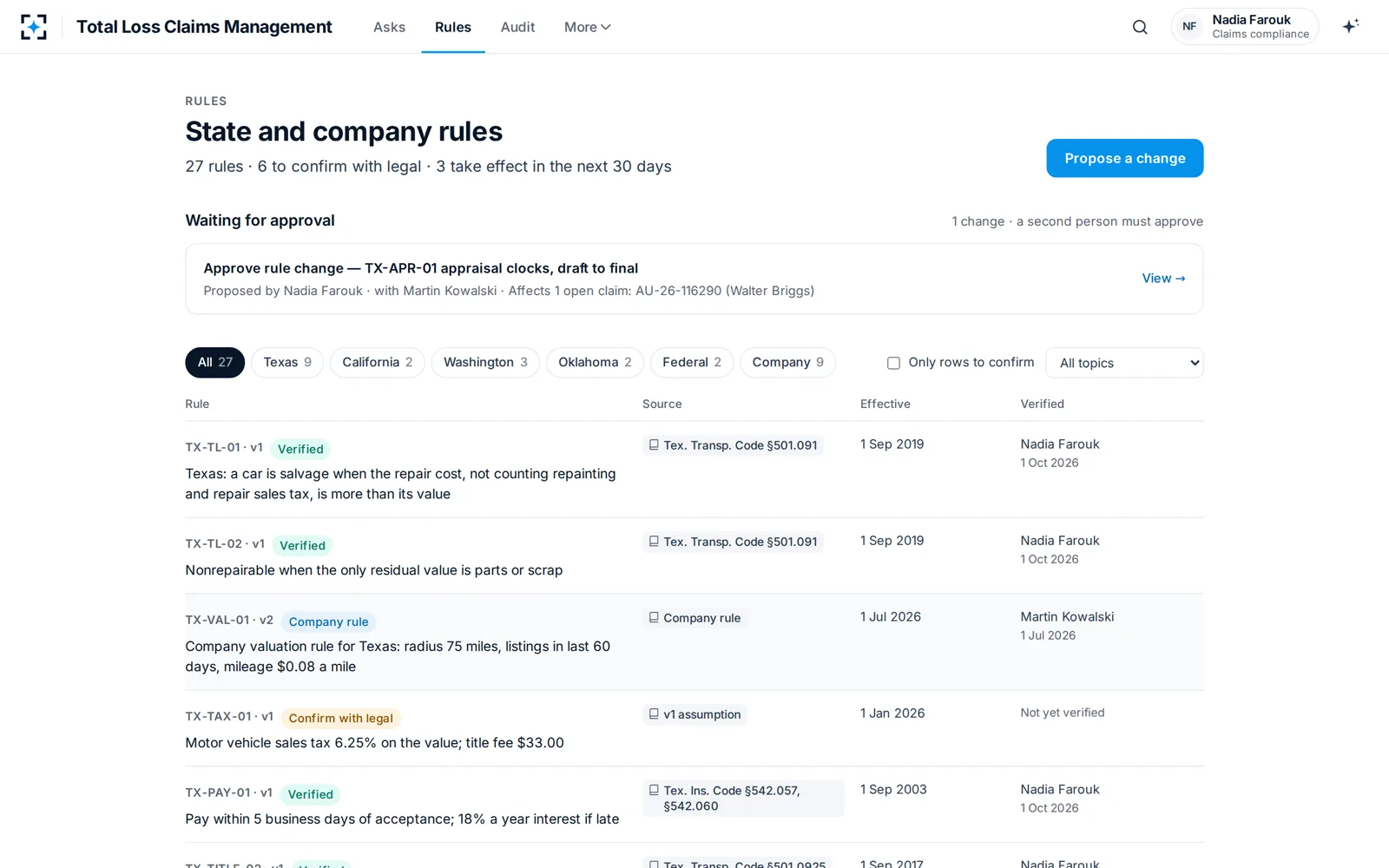
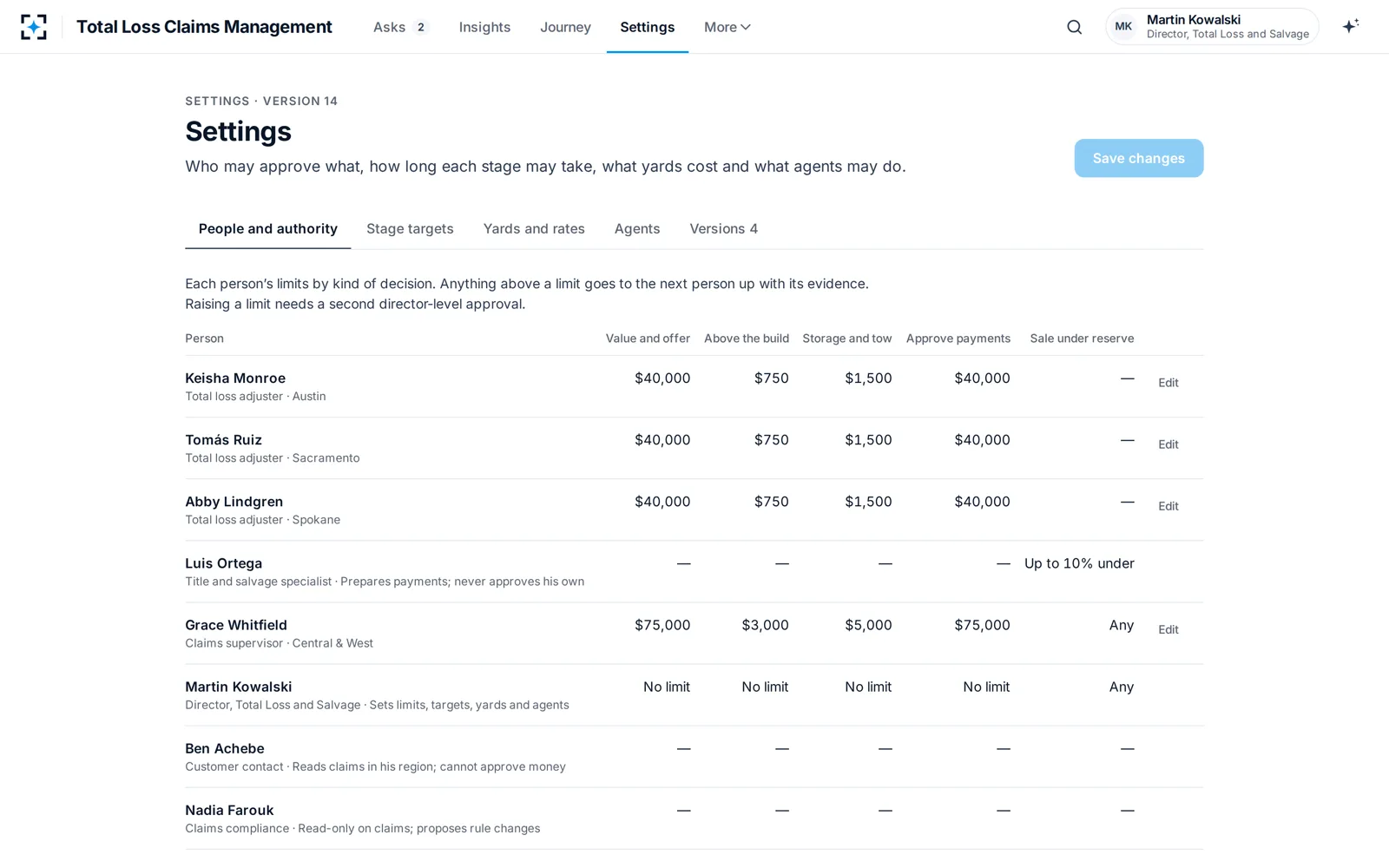
Then the configuration. Each state rule you apply becomes a dated row with its source, effective date and the person who verified it. Rows your legal team has not confirmed are shown as such, and in the solution's design an unconfirmed row blocks go-live. Letter templates, yards and their rates, stage targets and each person's dollar limits become versioned settings. How those rules differ from state to state, and which ones the solution carries, is on the rules by state page.
State rules become dated, sourced rows that a second person approves
Authority is set per person, and anything over a limit goes up with its evidence
Weeks 2–3: replay 90 days of closed total losses
Run every file on its own dates, in the order its documents arrived. On each file the agents do what they would have done live: read each document, build or check the value, draft the letter, follow the payoff and the title, price each storage day and propose the move that would have stopped it. Every finding names the page, listing, invoice or rule it rests on.
The replay, file by file, with your reviewers at the end
Agent
Value checkRebuilds the value from the file's listings and checks the vendor report: every adjustment evidenced, no branded-title comparable, no blanket condition markdown.
Never: takes a negotiation-type deduction
Agent
Letter checkDrafts the offer letter from your template and compares it with the one you sent, line by line, against the state's required lines.
Never: sends anything
Agent
Payoff and title watchTracks good-through dates and per diem, the lien release and where the title was mailed; notes each day it would have chased.
Never: pays or files
Agent
Storage watchPrices each storage day at the yard's invoiced rate, by stage, and dates the move that would have stopped the meter.
Never: moves a car
A person decides
Your adjuster and title specialistMark each finding right, wrong or not worth acting on, and note the time it would have saved them.
The valuation part deserves its own reviewer, because it is where litigation lives. In Drummond v. Progressive the Third Circuit described a projected sold adjustment that reduced base market value by 6.7% on average; a similar case in New York ended in a $48 million settlement fund, given final approval in March 2025. A replay will show how often your vendor reports carry an identical adjustment across every listing, or a deduction with no evidence behind it. How to measure a value's fairness file by file is the subject of defensible total loss valuations.
Week 3 ends with the scoring and the first decision. For each kind of finding, count how many the agents raised, how many your reviewers accepted and how many real problems in the file they missed. A pattern of misses, such as one lender's payoff format read badly, is fixed and that slice replayed before the live week. A known defect is not carried into it.
Week 4: run beside the desk on live open totals, with people approving everything
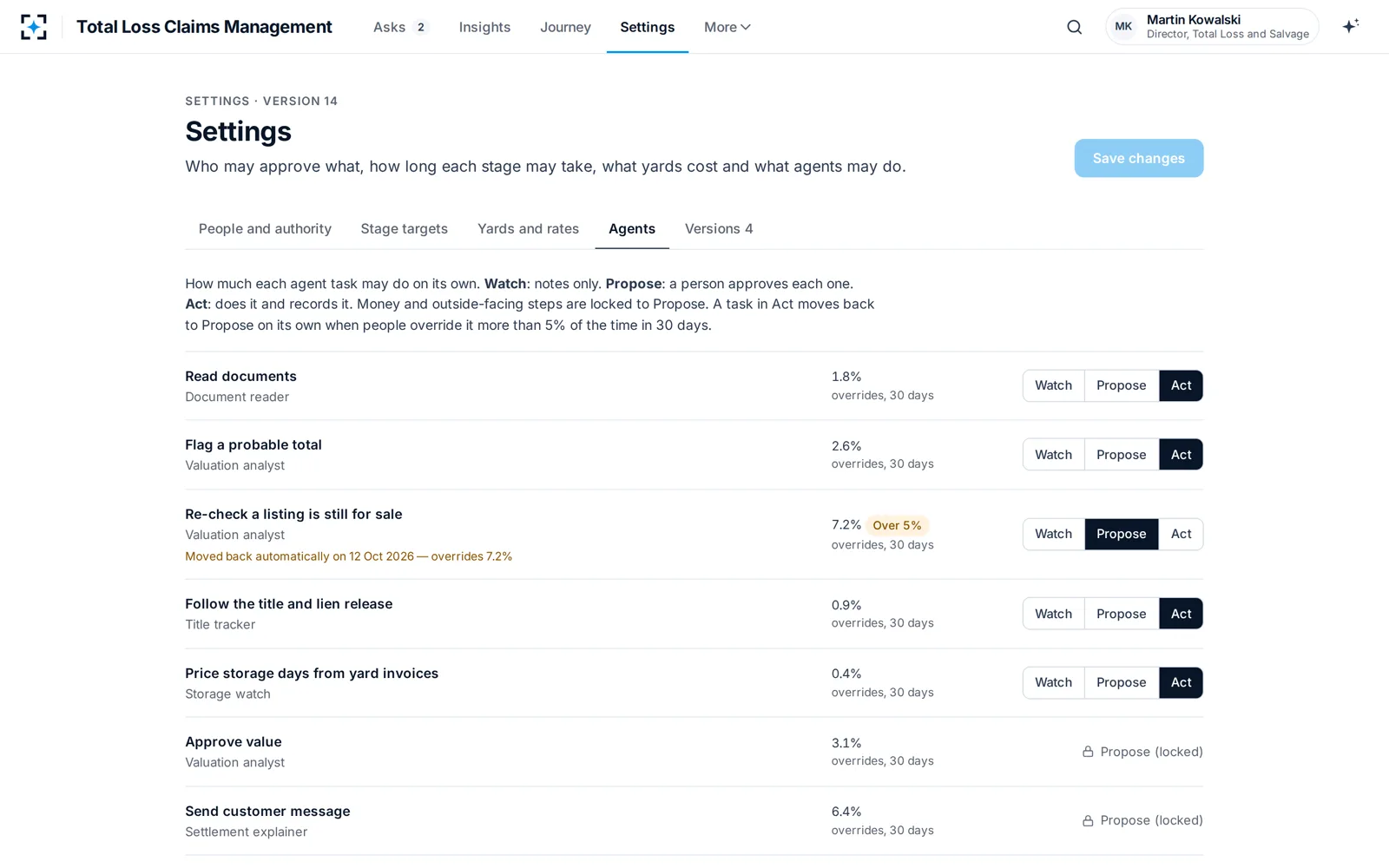
In the live week the agents work the open files in parallel with your desk, and every step stays at Propose. Nothing is paid, sent, moved or filed by the pilot. Your adjuster and specialist see the asks the agents raise, decide each one as if it were real and note whether they would have acted sooner than the desk did. That is the first honest measure of days: the gap between when the agents raised a stopped car and when your desk found it.
Each agent task has its own autonomy setting, and money and customer steps stay with people
Use the live week to test the controls as well as the speed. Seed one payoff letter whose bank details differ from those on file and confirm that payment is blocked until a call-back is recorded. Hand one file to someone whose limit it exceeds and confirm it goes up a level. Confirm that the person who prepared a payment cannot approve it. These are the failures an examiner will ask about, and they are cheap to test before a real dollar is at stake.
The pass marks: what has to hold before go-live
Write the pass marks down in week 1, and sign them, before anyone sees a replay result. A pass mark set afterwards measures the pilot's luck, not the software. Some are absolute, because a single miss is a regulatory or fraud problem; others are rates you choose from your baseline.
Four absolute pass marks we propose for the replay and the live week
0
payments proposed on an expired payoff letter
design target
100%
of value adjustments citing their evidence
design target
0
letters missing a required tax, fee or notice line
design target
0
branded-title listings used in a value
design rule
Add the rates you set yourself: the share of stopped cars found before the yard's statement arrived, the share of findings your reviewers accepted, and the time a financed car waits for its first payoff letter. The solution's design target for that last one is 80% within one business day, a target, not a result. Finally, an evidence test: pick five replayed files at random and ask compliance to reconstruct, from the history alone, who approved each step, on what evidence and under which rule version. If they cannot, it fails.
"Actions taken by Insurers in the state must not violate the UTPA or the UCSPA, regardless of the methods the Insurer used to determine or support its actions."
NAIC Model Bulletin on the Use of AI Systems by Insurers (2023)
That is the standard your examiner will apply, and 29 jurisdictions had adopted the bulletin as of 8 October 2026. It expects a written program for AI systems that covers claims. The pilot's evidence test is the first piece of that program for total losses.
Fitting around your vendors: CCC or Mitchell values, Copart or IAA sales, your claim system
Keep them. The solution works across the vendors a total loss already touches; it is not another one to replace them. The eight systems a single total moves through, and where the days go between them, are mapped in the two clocks of a total loss.
What you keep, and what the agents add around it
Stays with your vendor: The valuation report and its comparables.
What the agents add: A line-by-line check of each report, and a value build the owner can follow, with every listing and adjustment cited.
Stays with your vendor: Pickup, title processing, the sale and its proceeds.
What the agents add: Bids compared net of storage, a move proposed when the yard bills and the auction takes cars before title.
Stays with your vendor: Your lender network or your auction's payoff service.
What the agents add: Good-through and per diem watched, a re-request before expiry, bank details checked against those on file.
Stays with your vendor: The claim, the reserve and the official claim file.
What the agents add: Reads its exports; nothing in the pilot writes back.
Stays with your vendor: Your payment system pays.
What the agents add: A prepared split, lender first, approved by a second person. The product moves no money.
Stays with your vendor: Your monthly total-loss report to the federal register, as filed today.
What the agents add: The monthly file prepared, approved by someone other than its preparer.
Two sets of rules shape the plan. Title steps differ by state: Florida requires an insurer that pays a total to obtain the title, notify the federal register and forward the title to the state "within 72 hours after receiving such certificate of title", so ask your auction partner which of those steps it already performs before duplicating them. And the valuation vendor's comparables must meet rules you answer for: Model Regulation 902 builds a cash settlement on two or more comparable cars available in the local market within the last 90 days, and Washington's amended rule caps the search at "a reasonable distance of the principally garaged area not to exceed 150 miles". The agents check a vendor's work against those rules; they do not need to replace its database.
Be equally clear about the current release. Its connections to lenders, state title systems, the federal register, auctions, listing services, VIN decoding and payments are simulated. Connecting your own is project work after the pilot, sized by how many of those systems you want live first. The replay does not need any of them, which is why it fits in a month.
What questions should you ask a claims automation software vendor? Twelve
Ask them of us too. Each one has a short, checkable answer, and an evasive one tells you something.
Questions that separate a sales demonstration from software you can run
- Will you replay our closed files before we sign?
A vendor that only demonstrates on its own data has not shown it works on yours.
- What can the AI do without a person?
Ask for the list of steps it may complete alone, and how that is set and changed.
- Who can approve a payment someone else prepared?
Separation of duties should be enforced by the software, not by policy alone.
- Where does each number come from?
Every value, payoff and storage figure should open to the page or listing it came from.
- Does the value ever include a negotiation-type deduction?
This is the adjustment the class actions turn on.
- How are state rules kept, dated and approved?
Look for a source, an effective date and a second approver on every rule.
- What happens when a payoff letter's bank details change?
The right answer stops payment until a call-back to the number on file.
- Can the history be edited?
An examiner will want who, what, when, the inputs and the rule version, unchanged.
- What does the owner see?
The value in plain words, one named person, and a way to dispute a single line.
- Which connections are live today, and which are simulated?
Ask per system: lenders, title, auction, listings, payments, federal reporting.
- What do you need from IT for the pilot?
Exports and read access should be enough; a write-back integration should not be.
- What is the cost per claim, and what drives it?
Ask how model use is priced as volume grows, before you are committed.
After go-live: adding the next state
A new state is mostly rules and letters, not new software. Compliance proposes each rule as a row with its citation and effective date, a second person approves it, and its letters gain the state's required lines. Rules also change in states you already run. Washington's amended rule, effective 18 October 2026, allows a closed list of adjustments, widens the comparable search to 150 miles and requires taxes and fees whether or not the owner keeps the car. New York makes an owner who keeps a car with repairs over 75% of value surrender the title for a "REBUILT SALVAGE" brand. California bars condition deductions unless the car was below average and requires comparables that were for sale within 90 days of the final offer, each identified by VIN, stock number or plate.
Use the same method for each state you add: replay that state's recent closed files against its new rows before they go live. The federal duty does not change by state. Carriers report total losses to the National Motor Vehicle Title Information System every month; in the solution, that file is prepared by one person and approved by another.
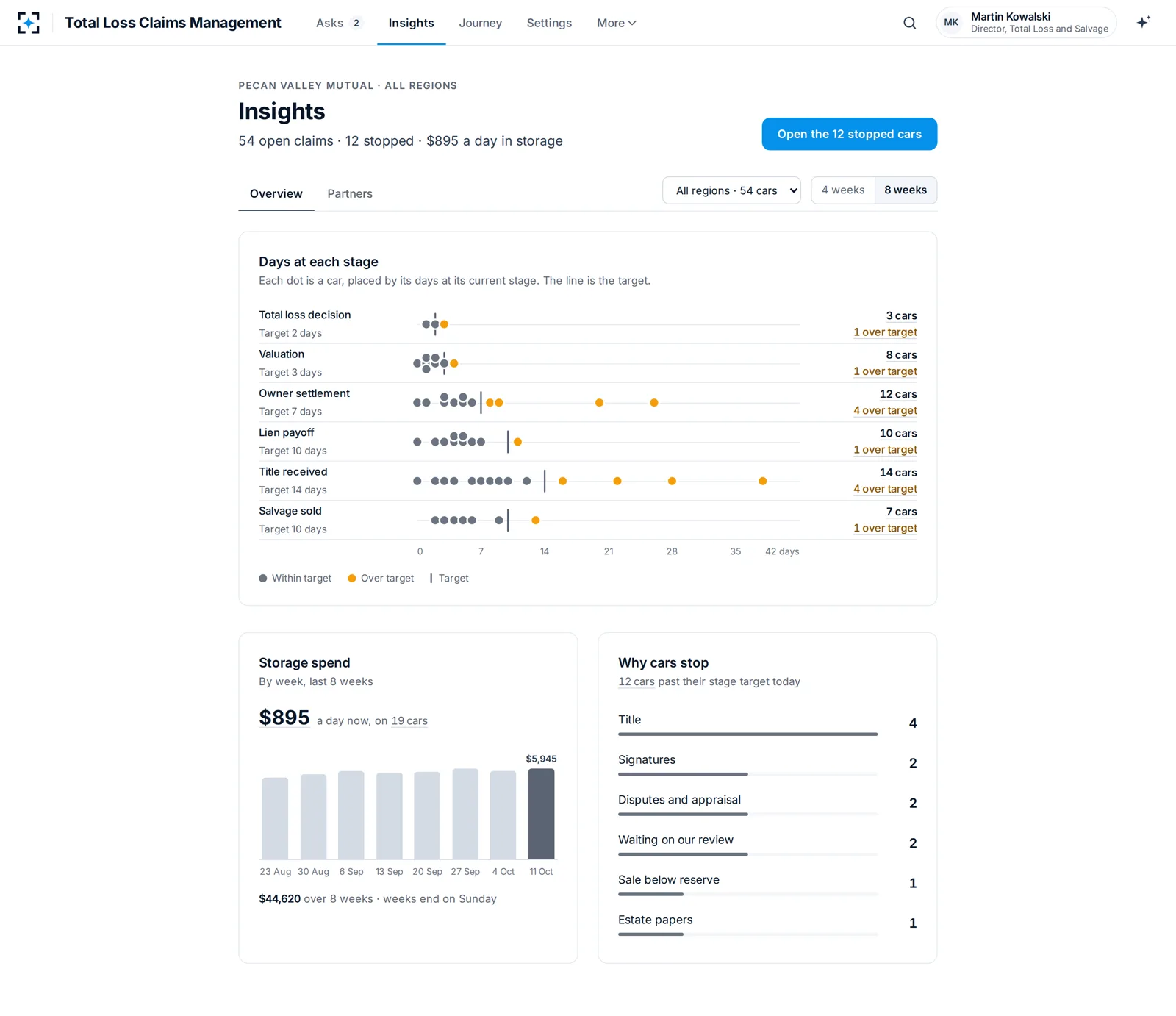
After go-live, the director watches days against target, storage spend and why cars stop
To begin, bring a sample of your own closed total losses to Total Loss Claims Management and we will replay them with you.
Questions people ask
How long does it take to implement total loss software?
The pilot we propose takes 30 days because it runs on exports and needs no live connection. Production takes longer, and how much longer depends on how many connections you want live first and how many states you write. We do not yet have a measured go-live time to quote.
Do we have to replace CCC, Mitchell, Copart or IAA?
No. Your valuation vendor still produces the report and your auction still sells the car. The agents check the report, watch the payoff and title, and price the storage while the car waits.
Is it worth piloting when only a fraction of claims are total losses?
Yes, because the work per total is large and the share is unlikely to shrink while repair prices outrun car values: the repair price index rose 44% from January 2022 to September 2026 while the index for used cars and trucks fell 12%. Each total also runs on its own clocks, from payment deadlines to title deadlines, and complaints follow when they slip: auto total loss was one of the Massachusetts Division of Insurance's ten most common complaint topics in 2025, with 127 complaints.
How much does claims automation software cost?
Ask for the cost per claim and what drives it, because model use grows with volume. For this solution the engineering target is a language-model cost of $1.00 or less per claim from the total-loss decision to a closed file, a target rather than a measured figure; add the subscription, set-up and the minutes people spend approving what the agents propose, which never fall to zero.
What if the replay misses things our desk caught?
That is what the week 3 decision is for. A miss on a closed file costs nothing and shows exactly where the gap is. Fix it, replay that slice and score it again before the live week.