An insurance claim under review is one the insurer has received and is still working on: it has not been accepted, denied or paid in full. The phrase is honest but empty, because it does not say what is being reviewed, who is reviewing it, what it is waiting for or when a decision is expected, and those are exactly the questions that make a policyholder call. State rules already ask for more. California requires an insurer that needs more time to say in writing what information it still needs and why it cannot decide yet, and to repeat that every 30 days; Pennsylvania requires a written explanation every 45 days stating when a decision may be expected. Botminds' Claim Status Self-Service is a claim status solution for policyholders that replaces a bare status with the claim's stage, the one item it is waiting on, who has it and the next date on the file, each drawn from the live claim file.
This guide covers property and auto claims; health and unemployment claims use the same words under different rules. Its examples come from a fictional sample claim, Alicia Brennan's kitchen water claim with an invented insurer, Halverton Mutual, as it runs through the solution; those details are sample data, not a customer's result. Rules are quoted as published on 27 October 2026.
Five weak status lines, and what each should say instead
The status the customer sees: Your claim is under review.
A complete status line: With Tomás Reyes, your adjuster: comparing your contractor’s estimate with our inspection. Answer by Wed 14 Oct, 5 p.m.; you’ll get a text.
The status the customer sees: In progress.
A complete status line: Waiting on you: your contractor’s estimate, asked for on 5 Oct. Upload it here.
The status the customer sees: Pending.
A complete status line: Waiting on your lender: it needs to sign the check before releasing the money. Here is its number.
The status the customer sees: Under investigation.
A complete status line: We need the cause-of-loss report from the plumber, requested on 7 Oct. We expect to decide within 10 days of receiving it.
The status the customer sees: Processing payment.
A complete status line: $13,785.92, by check to you and your lender, mailed Thursday 15 Oct. $2,214.60 follows when repairs are done.
What does it mean when your insurance claim is under review?
It means the insurer has the claim and has not finished deciding it. Behind those words the claim can be in very different places: waiting for an inspection, for the adjuster to write or compare an estimate, for a document from the policyholder, for a contractor's report, for a coverage question to be answered, or for a supervisor to approve an amount beyond the adjuster's authority. Each of those has a different owner and a different next step, and only one of them is something the policyholder can fix.
Some reviews the insurer will not describe in full, and the rules allow that. California's status-letter rule says that nothing in it "shall require an insurer to disclose any information that could reasonably be expected to alert a claimant to the fact that the claim is being investigated as a possible suspected fraudulent claim." That exception is narrow. It does not excuse an empty status on the ordinary claim, which is almost every claim.
What the rules already require an under-review letter to say
Several states, and the NAIC model many of them follow, require an insurer that cannot decide a claim within the first deadline to write to the claimant, explain why, and keep writing at fixed intervals. California's is the most specific: the written notice must "specify any additional information the insurer requires in order to make a determination and state any continuing reasons for the insurer's inability to make a determination." Then: "Thereafter, the written notice shall be provided every thirty (30) calendar days until a determination is made or notice of legal action is served."
How often an undecided claim must hear from the insurer, and what the letter must say
| Rulebook | How often | What the letter must say |
|---|---|---|
| California, 10 CCR 2695.7(c)(1) | Within the 40-day decision window, then every 30 calendar days | The information still required and the continuing reasons; if the decision waits on a future event, the situation and an estimate of when |
| Pennsylvania, 31 Pa. Code §146.6 | At 30 days from notification, then every 45 days | A reasonable written explanation for the delay, and when a decision may be expected |
| NAIC Model Regulation 902, §7B | At 45 days from notification, then every 45 days | The reasons additional time is needed for the investigation |
| Ohio, Adm. Code 3901-1-54 | At least every 45 days | The status of the investigation and the continued time it needs |
| Florida, Fla. Stat. §627.7142 | On written request, 30 days after a complete proof of loss | Covered in full, partially covered or denied, or a written statement that the claim is being investigated |
Pennsylvania's wording is the best single test of a status line. Its rule requires the insurer to give a reasonable written explanation for the delay and "state when a decision on the claim may be expected." A status that cannot say when, and why, fails that test on paper; a status page that cannot say it fails it every day.
Why is my insurance claim taking so long?
Usually because it is waiting on one specific thing, and the status does not say which. On the sample claim, seven days of "under review" were seven days waiting on the policyholder's own contractor estimate; two calls in that week did not tell her. Across the sample region's 2,192 open property claims on the same evening, 611 were waiting on the policyholder, 388 on a contractor, 941 on an adjuster, 155 on payments and 97 on someone else, such as a lender or a city permit office.
“I want to see, for every claim, who it’s waiting on — and for how long.”
Grace Oduya, the sample team's claims supervisor
A supervisor's question is the policyholder's question in another form. Once each claim names who it is waiting on, the slow claims sort themselves: the ones waiting on the customer need a reminder, the ones waiting on a contractor need a chase, and the ones waiting on the insurer's own adjusters need someone to look at their queue. The longer answer for a claim that has gone silent is in the guide to an insurance adjuster not responding.
The five parts of a status line that ends the call
A complete status says who has the claim, what they are doing or waiting for, when the next thing will happen, what the customer can do, and where that came from. Leave out any one and the call comes back.
A status line a customer will not need to call about
- Who has it
A named adjuster, the customer, a contractor, payments or a lender. “We” is not an owner.
- The one item
The estimate being compared, the document awaited, the decision pending; one item, not a list of everything outstanding.
- The date
A reply-by time, a payment date or an expected decision date that is on the file. Never a date nobody has committed to.
- The customer’s move
Upload, sign, call the lender, or nothing to do: said plainly.
- The source
The claim document, policy clause or approved rule behind the line, which the customer can open.
The sample carrier's approved message rules write that standard down. Rule G-1 answers status questions with the live stage and the waiting item, who has it and by when; rule G-12 governs the words of every answer: plain words, no status codes, name the person and the date, and never promise a date that is not on the file.
Under review, said completely: owner, item, date, next step
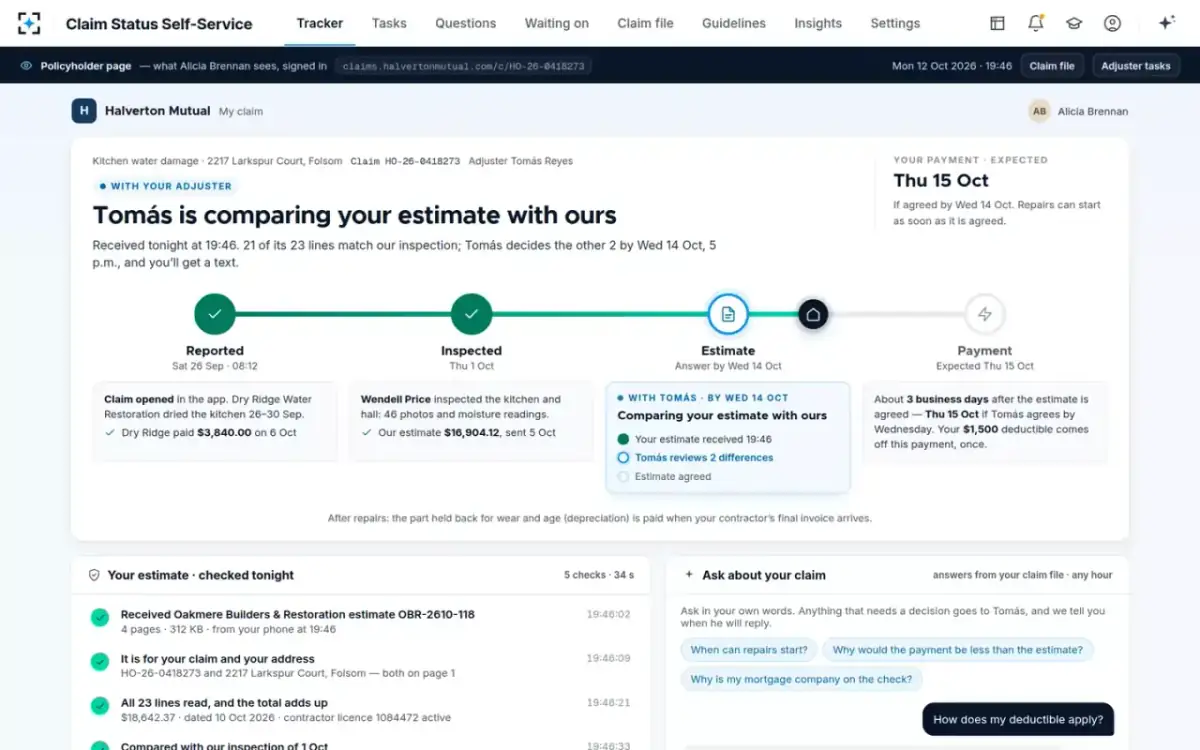
How long can a claim be under review?
Until the insurer decides, within outer limits that depend on the state. California requires acceptance or denial within 40 days of proof of claim unless the insurer writes to explain the delay, and then every 30 days; Florida requires a residential claim to be paid or denied within 60 days of notice; Pennsylvania asks for an investigation to be completed within 30 days of notification unless it reasonably cannot be. A review can lawfully last longer where it waits on a future event, such as a repair, an engineer's report or a lawsuit, but the policyholder must be told what it is waiting for.
One sample week: every undecided claim heard from the insurer on time
118
undecided claims sent their 30-day written status on time
3,358
customer questions answered or replied to within 15 days
209of 212
handed questions answered by the time promised; 3 still inside it
Under review is not the same as denied, or closed
A claim under review is open and undecided; a denied claim has a decision, which must come with reasons; a closed claim has no further handling, paid or not. The words matter because the remedies differ. A policyholder with a denial can ask for the policy provision relied on and dispute it; one whose claim was closed without payment can ask why and whether it can be reopened, which the guide to a claim closed without payment sets out. A policyholder whose claim is under review can ask what it is waiting on.
The NAIC model act treats the explanation as part of fair dealing: among the unfair practices it lists is failing to explain promptly, reasonably and accurately the basis for a denial or a compromise offer. A status line that explains itself every day makes that explanation the continuation of something the customer has already seen, not a surprise.
Asking for more than the status: the claim file
When a status is not enough, a policyholder can ask for the documents behind it, and in Washington the right is now explicit. The state's amended claims rule gives insureds the right, at reasonable intervals, to request and receive any portion of their first-party claim file, including reports, claim notes, estimates, photographs and communications, subject to redaction of privileged material, third-party financial information and records essential to a criminal investigation (WSR 26-17-089). Florida requires the adjuster's detailed estimate to be sent within 7 days of being generated.
A status page should not try to be the whole claim file, and the sample carrier's rules keep internal notes, reserves and fraud or subrogation activity off it. But it should make the file request easy, and route it to a person with the clock running, so that "under review" never becomes a wall.
The rules every status line follows, owned and approved
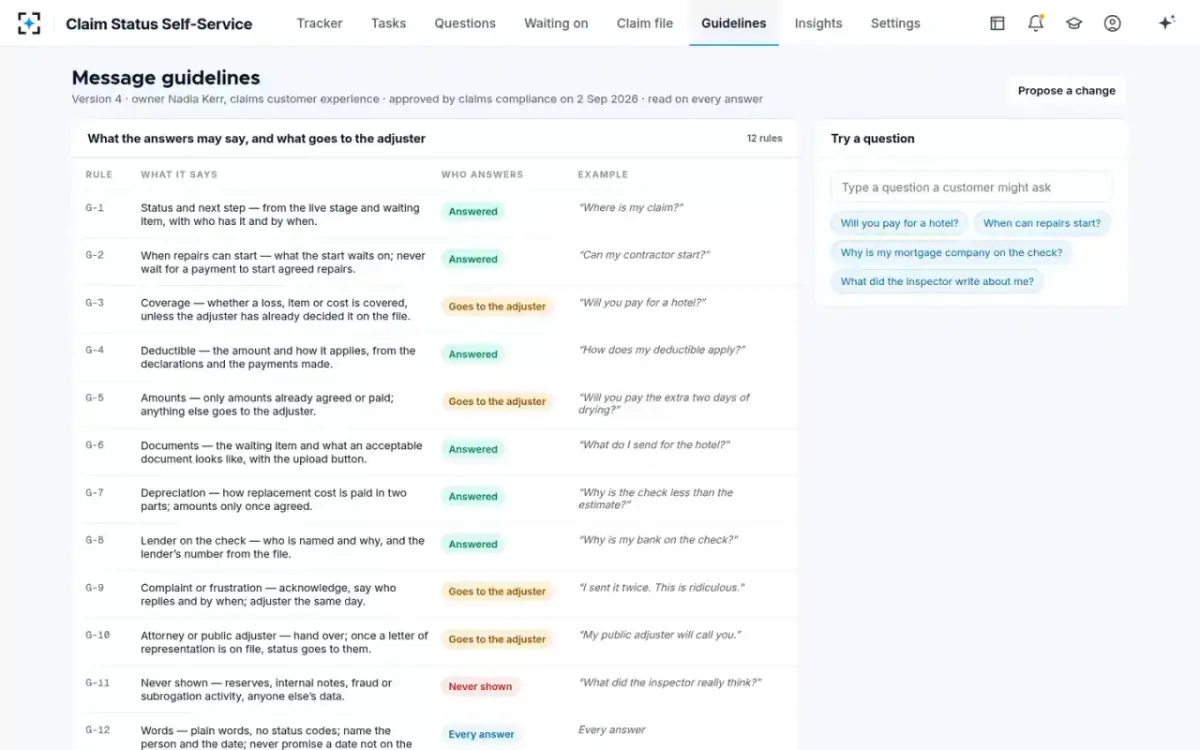
What Claim Status Self-Service writes instead of “under review”
It writes the stage, the one waiting item, its owner and the next date, every time the claim changes, from the claim system's own status and activity. The claim file reader keeps those current and turns status codes into plain words; the question answerer answers anything else from the file and the policy with a source on each detail; the contact logger counts the 15-day response clock and the 30-day written-status clock on every question and claim. Anything that needs a decision goes to the adjuster with a reply-by time the customer sees.
It never says a claim will be covered, quotes an amount nobody has agreed, or invents a date. When the honest answer is that a decision waits on something, it says what and, if the adjuster has given one, when. The four stages it writes those lines into are set out in the guide to the homeowners insurance claim process, and to see the sample claim screen by screen, start from Claim Status Self-Service.
Questions people ask
What does "your claim is currently in review" mean?
That the claim has been received and not yet decided. It does not say what is being reviewed or by whom, so ask in writing what the claim is waiting on and when a decision is expected; in Pennsylvania the insurer's delay letter must state when a decision may be expected.
How long can an insurance claim stay under review in California?
The insurer must accept or deny within 40 days of proof of claim, or tell you in writing within that time why it needs longer and what it still needs, then repeat that notice every 30 days until it decides or legal action is served.
Is "under review" a bad sign?
Not in itself; nearly every claim is under review for some of its life. It becomes a concern when it lasts beyond the state's decision window with no written explanation, or when nobody can say what the claim is waiting on.
Why is my insurance claim still open after I was paid?
Because part of it is not finished: depreciation held back until repairs are done, a supplement for hidden damage, a contents or living-expense claim, or a lender still to release funds. A good status page says which.
Can I ask for a copy of my claim file?
In Washington, yes: insureds may request any portion of the first-party claim file, including claim notes, with limited redactions. Elsewhere the right varies, but you can always ask for the estimate and the policy provisions a decision rests on.