An insurance check made out to your mortgage company as well as to you is normal on a home repair claim: the policy's mortgage clause makes the lender a payee on money for damage to the house, because the house secures its loan. Neither of you can cash the check alone. You endorse it, the lender endorses it, and the lender usually holds the money and releases it in draws as the repairs progress, under rules set by the lender or by whoever owns the loan. For the homeowner this is the most confusing moment of a claim, because the insurer has paid and the money still has not arrived. Botminds' Claim Status Self-Service is software that answers policyholders' status questions from the live claim file and hands anything that needs judgment to the adjuster; on the payment stage it names the lender, says why it is on the check and what the lender's step is.
The rules below come from the federal flood policy, the National Association of Insurance Commissioners, Fannie Mae's servicing rulebook and Florida law. Where the guide shows how a carrier can explain them, the example is a fictional sample claim as it runs through the solution: Halverton Mutual, an invented insurer, and its policyholder Alicia Brennan in Folsom, California, whose kitchen flooded when a supply line burst. Her figures are sample data, not a customer's result.
One sample week of customer questions: the lender comes up in the payment stage
97
questions about the lender on the check, out of 3,358 asked
684
asked when they would be paid
12days
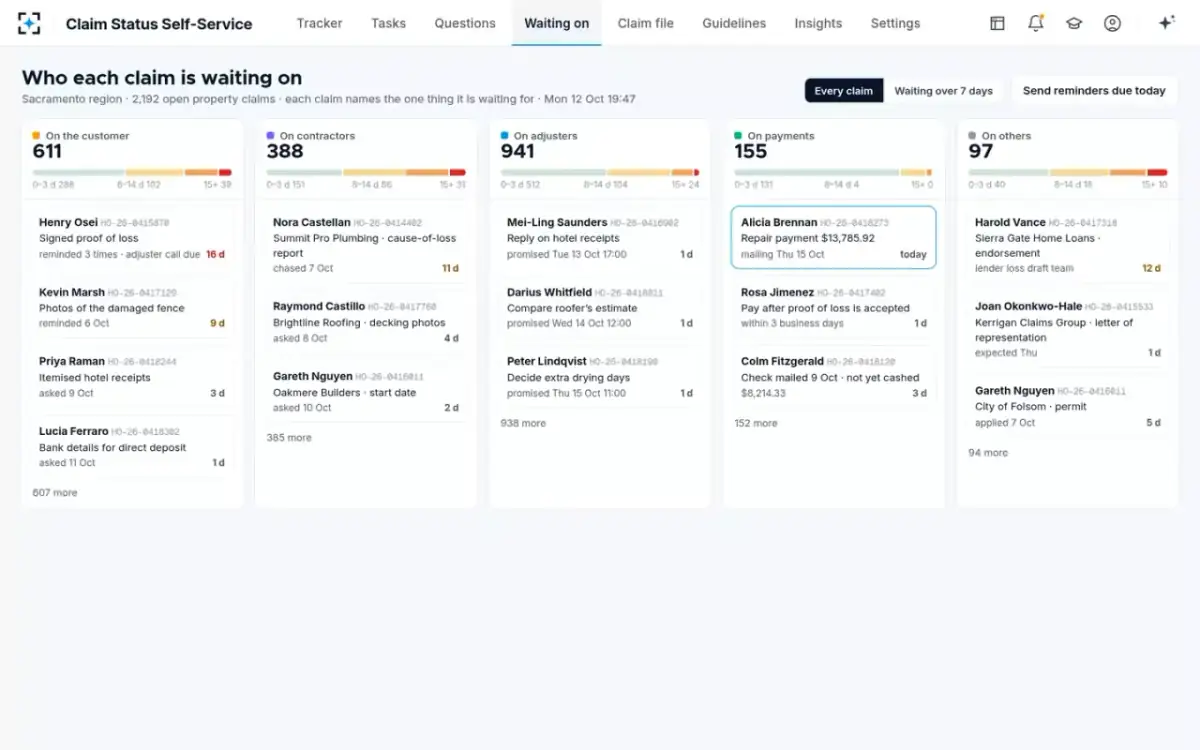
a sample claim had waited on a lender’s endorsement
Why is my mortgage company on my insurance check?
Because your policy says the lender gets paid on damage to the building, and because the lender asked to be named when the loan was made. The lender's interest is the house: if it is not repaired, the security behind the loan is worth less. The NAIC's consumer guide puts the consequence plainly: once the lender is on the policy, "the insurer is obligated to include them on the check it pays for major repairs."
The clearest public example of the clause itself is the federal flood policy, whose text is a regulation anyone can read. Its mortgage clause says: "Any loss payable under Coverage A—Building Property will be paid to any mortgagee of whom we have actual notice, as well as any other mortgagee or loss payee determined to exist at the time of loss, and you, as interests appear." Private homeowners forms use their own wording, but the structure is the same: building money goes to the owner and the mortgagee together, and a second mortgage or home-equity lender can be on the check as well.
The clause protects the lender in ways that surprise owners. Under the flood policy, a denial of the owner's claim does not defeat a valid claim by the mortgagee in some circumstances, and the mortgagee keeps its right to payment even after it has started foreclosure. That is why insurers do not leave the lender off a check to save the owner a trip: a payment that ignores a mortgagee the insurer knew about leaves the lender's claim on that money open.
Which payments name the lender, and which do not
The lender is named on payments for the structure; it is usually not named on money for belongings or for living somewhere else. That distinction is the single most useful thing a status answer can say, because owners often assume every check from the claim will be stuck at the bank. Fannie Mae's rulebook tells the servicers of the loans it owns to "Immediately issue the borrower a check for any amount of insurance loss proceeds designated for contents (for example, personal property) or living expenses." In other words, if that money reaches the servicer at all, it should come straight back out.
Who is on each kind of claim payment, and why
Usually names the owner only: Belongings (contents) and the extra cost of living elsewhere while the home is repaired.
Usually names the owner and the lender: Repairs to the house itself: dwelling coverage, often called Coverage A.
Usually names the owner only: The lender’s security is the house, not the furniture or the hotel bill.
Usually names the owner and the lender: The mortgage clause makes the lender a payee on building losses.
Usually names the owner only: Fannie Mae tells servicers to pass contents and living-expense money to the borrower immediately.
Usually names the owner and the lender: The lender deposits it and releases draws as repairs progress.
Usually names the owner only: Not yet paid; a hotel question is with the adjuster.
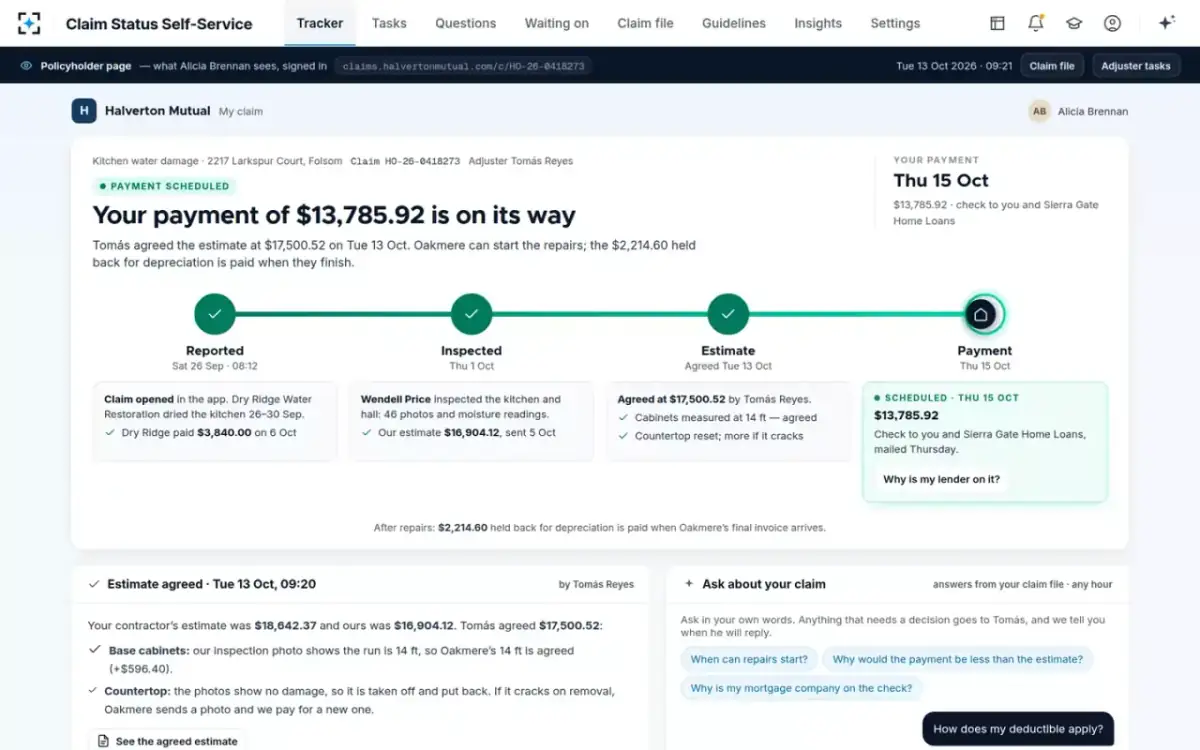
Usually names the owner and the lender: $13,785.92 by check to Alicia Brennan and her lender, mailed Thursday 15 October.
Two further cases catch owners out. A payment made to a contractor alone, as on the sample claim where $3,840.00 went to the drying company, never passes through the lender. And a payment that combines dwelling and contents money in one check can carry the lender's name on all of it, which is why a carrier that splits its payments by coverage saves its policyholders a trip to the bank.
How does a mortgage company endorse an insurance check?
You sign the back of the check and send it to the lender's insurance claims or loss draft department, which signs it too and deposits it. The department's address and its paperwork list are on the lender's own instructions, not the insurer's, and they vary. The NAIC's guidance to policyholders is direct about where the work sits: "You’ll need to work with your mortgage lender to get the claim money released for repairs."
One dwelling check, from the insurer to the last repair draw
Insurer
Issues the dwelling payment to the owner and every mortgagee it knows of, under the policy’s mortgage clause.
Contents and living-expense money is usually paid separately.
Owner
Endorses the check and sends it to the lender’s loss draft or insurance claims team, with whatever forms that team asks for.
Under Fannie Mae’s rules, a servicer releasing money in stages reviews the repair plans and bids.
Lender
Endorses, deposits the money and releases a first draw under its own rules or its investor’s.
On a current Fannie Mae loan the first draw can be the whole check up to $40,000.
Lender
Inspects the repairs and releases later draws as the work progresses.
Larger losses and loans behind on payments are released in smaller steps.
Insurer
Pays any depreciation it held back once repairs are proven, again as a dwelling payment.
Under a clause like the flood policy’s, that check names the lender too.
What lenders typically ask for before releasing money is a picture of the repair: the adjuster's estimate, the contractor's estimate or contract, and sometimes the contractor's licence and insurance. Some also want an inspection before the first draw. On the sample claim one homeowner put exactly that to the self-service assistant, "My lender wants an inspection before releasing the money", and the answer was the honest one: lenders set their own release rules, and here is your lender's number from the file.
How long can a mortgage company hold an insurance check?
There is no single national deadline; the release schedule depends on the lender's rules, the investor that owns the loan, and state law where it speaks. What is public is the rulebook the largest investors give their servicers. Fannie Mae's sets out how much a servicer may release, and when, depending on whether the loan is current.
How a Fannie Mae servicer releases a dwelling payment
| Loan status at the time of the loss | First release | The rest |
|---|---|---|
| Current, or less than 31 days late | Up to the greater of $40,000, 33% of the proceeds, or the amount by which the money exceeds what is owed on the loan | Released on periodic inspections of the repair work |
| 31 days or more late, proceeds of $5,000 or less | Can be paid in one payment | Nothing held back |
| 31 days or more late, proceeds above $5,000 | 25% of the proceeds, but no more than the greater of $10,000 or the amount by which the money exceeds what is owed | Increments of no more than 25% of the proceeds, each after an inspection of the repairs |
The draw schedule on one sample check
Read the first row against a real check and most of the anxiety goes. The sample claim's dwelling payment is $13,785.92. If that loan were a current Fannie Mae loan, the whole amount sits under the $40,000 threshold, so the servicer would be authorized to release all of it in the first draw. A $90,000 dwelling payment on the same current loan would release $40,000 first and the remaining $50,000 against inspections. If the loan were two months behind, the first release on that $90,000 would be $10,000 at most, and the rest would follow in steps of up to $22,500 (our arithmetic on the rule, assuming nothing is owed beyond the proceeds).
Fannie Mae's rule also explains why a lender asks the owner for a contractor's estimate, a signed contract or bids: when the money is released in more than one draw, the servicer must review and approve the final plans for repair, including the bids, and monitor and inspect the repairs as they are completed. That is the lender's job under its investor's rules, not a sign the insurer has done something wrong.
“Nobody told me the estimate was waiting on me. I thought you were writing it.”
Alicia Brennan, the sample claim's policyholder, before self-service
Her complaint was about an earlier stage, but it is the same failure: a claim that is waiting on someone, with nobody saying who. At the payment stage the someone is often the lender, and a homeowner who does not know that calls the insurer.
What the insurer can and cannot do once the check is mailed
The insurer cannot release a lender's hold, choose the draw schedule or make the lender endorse faster. It can do three things that matter: split payments by coverage so only dwelling money carries the lender's name, tell the owner exactly which lender and which department is on the check, and keep explaining the rest of the claim while the money sits at the bank. In Florida the law already assumes the lender's role. The Homeowner Claims Bill of Rights promises payment within 60 days "subject to any dual interest noted in the policy", which is the statute's way of saying the mortgagee may be on the check.
Florida also tells the policyholder, in capital letters, when a payment is not the last one. A payment that is not full and final must carry the statement "WE ARE CONTINUING TO EVALUATE YOUR CLAIM INVOLVING YOUR INSURED PROPERTY AND MAY ISSUE ADDITIONAL PAYMENTS." A partial dwelling payment with the lender on it is exactly the case that sentence is for: the owner needs to know both that more money may come and that this money will move through the lender first.
When the lender itself is the problem, the owner's remedies are outside the claim. The NAIC suggests the state agency that regulates banks and mortgage lenders or the attorney general's office, and the federal route is a complaint to the Consumer Financial Protection Bureau. A status answer can point there without taking sides.
What should a claim status page say about the lender?
It should say who is on the check and why, what the owner does next, who at the lender handles it and how to reach them, and what else on the claim is still moving. That is five lines, and every one of them is available in the claim file and the policy declarations. The sample claim's payment stage shows them.
The payment stage names the lender and offers the reason
The lender also needs to appear in the part of the system adjusters and supervisors read, because the wait often continues after the check is mailed. In the sample region the board of open claims has a column for claims waiting on someone outside the insurer and the policyholder: lenders, public adjusters and city permit offices. One claim there had waited 12 days on a lender's endorsement, with the lender's loss draft team named as the party holding it.
Claims waiting on the lender sit in their own column
Where Claim Status Self-Service fits, and where it does not
The solution explains the lender's place on the check; it does not deal with the lender. Its approved message guidelines, a set of twelve rules owned by the carrier's claims customer-experience lead and approved by claims compliance, include one for exactly this question: who is named on the check and why, with the lender's number from the file. The answer is drawn from the policy's mortgage clause and the payment, and it carries those two sources so the owner can open them.
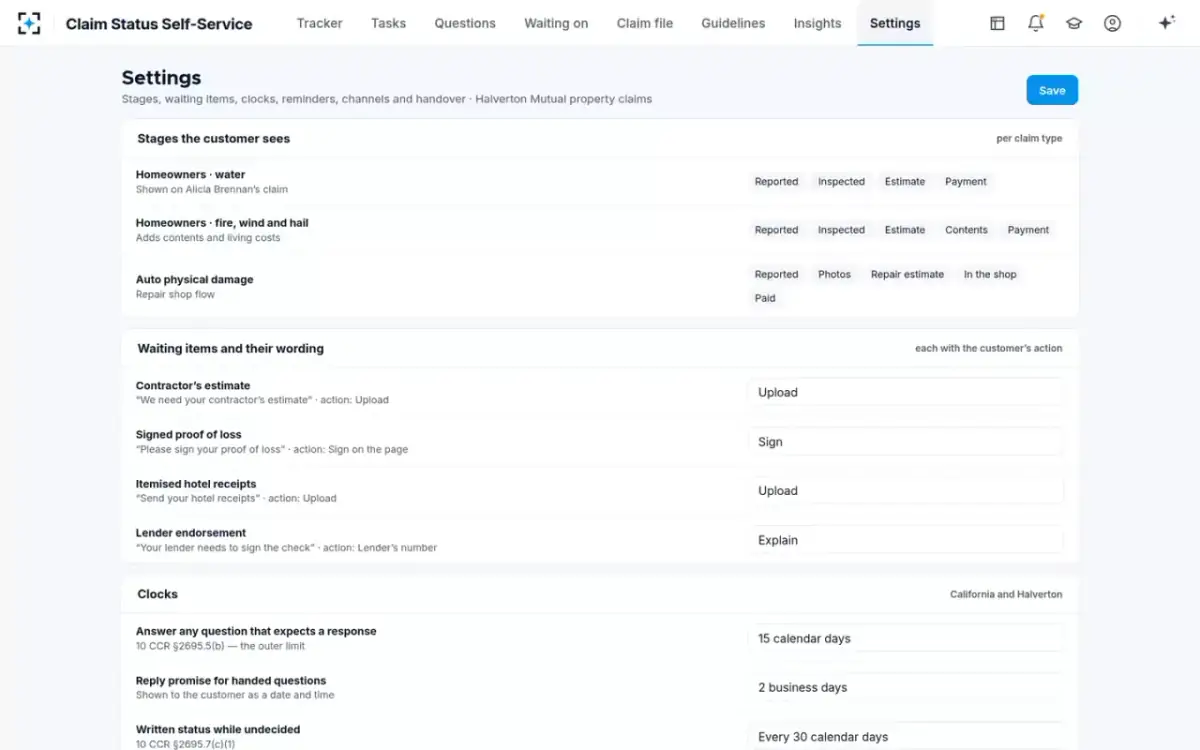
The waiting items a customer sees are settings, each with the action the customer can take. For the lender the sample carrier's wording is "Your lender needs to sign the check", and the action is the lender's number rather than an upload, because nothing the owner sends the insurer will move it.
The lender's step is a waiting item with its own wording
What the solution will not do is promise a release date, say what the lender will require, or comment on whether a hold is reasonable. Those are the lender's decisions, and any question about them that goes beyond the file, or turns into a complaint, is handed to the adjuster with the customer's words and a time for the reply. The same discipline applies to the amount on the check: the solution explains how it was reached, and the separate guide to the depreciation holdback and the deductible shows that arithmetic line by line.
What a homeowner needs to know when the lender is on the check
- Which coverage the check pays
Dwelling money carries the lender; contents and living-expense money usually should not.
- The lender’s department and number
The loss draft or insurance claims team, not the general customer line.
- What the lender will ask for
Say that each lender sets its own list, and which documents from the claim are usually requested: the adjuster’s estimate, the contractor’s estimate or contract.
- Whether more money is coming
A partial payment, or depreciation held back until repairs are done, means another check, usually with the same names.
- What the insurer is still doing
A supplement, a contents claim or a living-expense question keeps moving while the check is at the bank.
- Where to go if the lender stalls
The state banking regulator, the attorney general, or the CFPB.
The payment stage is the last of the four a homeowner can see, and the one where the insurer has least control. That is a reason to explain it better, not less. The homeowners insurance claim process in four stages sets the payment stage in the whole claim, and to see the sample claim screen by screen, start from Claim Status Self-Service.
Questions people ask
Can my mortgage company keep my insurance claim check?
A lender can apply dwelling money to the loan in some cases, for example where the property cannot legally be rebuilt, but its normal job is to release the money for repairs. Fannie Mae's rules tell servicers to use the proceeds to reduce the debt only when the property cannot be rebuilt, and otherwise to release it in draws. Check your mortgage and ask the lender which rule it is applying.
How do I cash an insurance check made out to me and my mortgage company?
You cannot cash it alone. Endorse it and send it to your lender's loss draft or insurance claims department with the documents it asks for; the lender endorses it, deposits it and releases the money to you or your contractor under its draw rules. On a current Fannie Mae loan, checks up to $40,000 can be released in one draw.
Why does my mortgage company need to sign my insurance check?
Because the policy names it as a payee on building losses, so the check is legally payable to both of you. The flood policy's clause says building losses are paid to any mortgagee of whom the insurer has actual notice, and to you, "as interests appear".
Will my contents or hotel money go to the lender too?
Usually not, because the lender's security is the house. If a combined check does reach the servicer of a Fannie Mae loan, its rules tell the servicer to pass contents and living-expense money to the borrower immediately. Ask your insurer to pay those coverages separately.
What if my mortgage is paid off but the old lender is still on the check?
The insurer pays the mortgagees its policy shows, so a lender that was never removed from the policy can still appear. Ask the old lender for a lien release or a letter confirming the loan is satisfied, and send it to the insurer with a request to reissue the check and update the policy.