An AI insurance chatbot is accurate enough when it answers the questions it should answer correctly and identically every time, cites the document behind each answer, and hands the rest to a person; and the only honest way to know is to test it on your own customers' questions against your own team's answers. No published study we could find measures the accuracy of insurance claim chatbots, so a buyer has to measure it. The good news is that the method exists: public auditors have measured phone answers for years by sampling real calls and scoring them. Botminds' Claim Status Self-Service is an AI claims assistant for property policyholders that answers status questions from the live claim file, the policy and approved message guidelines, with a source on each answer, and passes coverage and other judgment questions to the adjuster.
The examples below use a fictional sample: Halverton Mutual, an invented insurer, and a week of questions from its policyholders in one sample region, as they run through the solution. Those figures are sample data, not a customer's result. The test design is ours, built from the auditors' method and from the failures regulators and tribunals have described.
The human baseline is measurable: one federal audit of recorded calls
200
recorded IRS calls sampled and listened to by the inspector general
14
where the caller was given inaccurate information
26%
of calls where service fell short in some way (52 of 200)
How accurate are AI insurance chatbots?
As accurate as the information they are allowed to use and the rules that stop them guessing, which varies enormously between products. A chatbot that composes answers from general knowledge or public web pages can sound right and be wrong; the U.S. National Institute of Standards and Technology lists this as a named risk of generative AI in its generative AI profile, calling it confabulation: confidently stated but false content that can mislead users. A chatbot that may only answer from the customer's own claim file, the policy and a written set of approved answers has far less room to invent, and can show its working.
What no one should accept is a vendor's single accuracy number. Accuracy depends on the questions asked, and a figure measured on someone else's questions tells you little about yours. The tribunal ruling against Air Canada is the cautionary case: its chatbot gave a confident wrong answer about a refund rule while linking to the page that contradicted it, and the tribunal held the airline responsible for all the information on its website, chatbot included. The guide to AI chatbot disclosure laws covers the liability side; this page is about measuring the risk before it reaches a customer.
The baseline is your own team, and it can be measured
The right comparison for a claims assistant is the people who answer the same questions today, not an ideal. Those people are skilled and still inconsistent, because they are busy, because policies differ, and because a question like "why is my check smaller?" has three moving parts. The question is whether the assistant is at least as right, more consistent, and better at knowing when to stop.
Public auditors show how to measure the people. In a June 2026 report the Treasury Inspector General for Tax Administration listened to a statistically valid sample of 200 recorded calls from five IRS lines and found 52 where the service fell short, including "14 instances where taxpayers were provided with inaccurate information." Projected across the nearly 3.8 million calls recorded on those lines in three months, the inspector general estimated that about a million callers did not receive quality service. A carrier that records its claims calls can draw the same kind of sample, and the same sample, scored the same way, can be run against an assistant.
California's claims rules supply the standard an answer has to meet. A claim communication that calls for a response must receive a complete response based on the facts known at the time, within 15 calendar days. Complete and true is the bar for the team and for the assistant alike.
Why accurate means the same answer every time
A claims answer can be right in one telling and incomplete in another, and the policyholder hears both. Depreciation is the classic case: one adjuster explains it as money paid later, another as the age of the cabinets, a third does not mention it, and the policyholder concludes that nobody knows. Consistency is part of accuracy because a policyholder who gets two different true answers believes neither.
Consistency is also easier to test than truth. Ask the same question in eight different phrasings, from eight different sample claims, at different times of day, and compare the answers line by line. A team will vary with who picks up; an assistant built on fixed rules and the claim's own numbers should not vary at all, except in the numbers. In the sample carrier's set-up, one approved rule, G-7, governs every depreciation answer, and two policyholders asking about the smaller check got the same structure with their own amounts.
Every answer, its source and its outcome, in one list a reviewer can sample
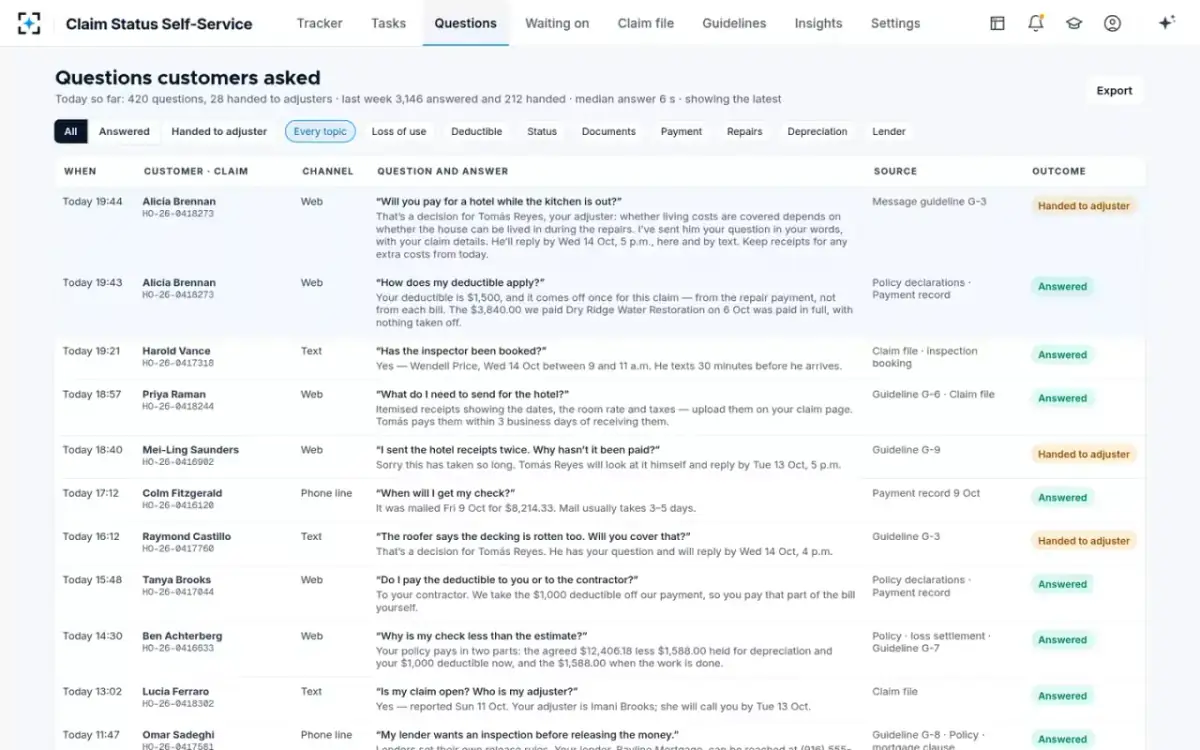
Insurance chatbot examples: three jobs, three tests
Insurance chatbots do three quite different jobs, and each needs its own accuracy test. Sales and quoting assistants answer questions about products and prices; their risk is a misdescribed coverage or a wrong quote. Policy service assistants handle changes, documents and billing; their risk is a wrong change made or promised. Claims assistants, the subject here, tell a policyholder where a claim stands and what happens next; their risk is a wrong promise about money or coverage at the moment the customer is most anxious.
For a claims assistant, three things make the test tractable. The questions are concentrated: in the sample week, eight topics covered every one of 3,358 questions. The answers come from the policyholder's own file, so each can be checked against a document. And the questions that must not be answered can be listed in advance.
What 3,358 policyholder questions were about, in one sample week
How to test an AI insurance chatbot on your own questions
Build the test from your own call and message logs, run it against the assistant and against a sample of your own staff, and score both the same way. It takes a few days, needs no special tooling, and tells you more than any demonstration.
A test protocol for a claims assistant
- Pull a month of real questions
From call notes, portal messages and texts. Group them by topic and keep the proportions.
- Write each topic eight ways
Different phrasings, a typo, a question inside a complaint, one in Spanish if you serve Spanish speakers.
- Attach each question to a real or realistic claim
Open claims in different stages, so the right answer depends on the file, not on a script.
- Write the expected answer and its source first
Before anyone answers. Include the questions that must be handed over, and to whom.
- Run the assistant and a sample of staff
Same questions, same claims. Record the staff answers the way a call review would.
- Score blind
A reviewer who does not know which answers came from the assistant scores every one on the rubric below.
- Repeat after every rule change
The same set, re-run, shows whether a change helped or broke something.
Scoring an answer: right, sourced, and handed over when it should be
Score every answer on four questions, not one. An answer can be correct and unsupported, or supported and incomplete, and a claims assistant fails in different ways from a person.
The test set, topic by topic: where the right answer comes from
| Topic | Where the right answer comes from | A passing answer |
|---|---|---|
| Where is my claim, and what’s next | The live stage and the one waiting item | Names the item, who has it and since when; never a stage the file does not show |
| When will I be paid | Agreed amounts and the payment schedule | Gives a date only if one is on the file; otherwise says what the date depends on |
| How does my deductible apply | Declarations page and payments made | States the amount, that it applies once, and which payment it came off |
| When can repairs start | Estimate status and the carrier’s rule on starting | Says whether agreed repairs can start without waiting for the payment |
| What documents do you need | Waiting items and what an acceptable document looks like | Names the document and how to send it, with the date it was asked for |
| Why is the payment less than the estimate | Agreed estimate, depreciation held, deductible | Separates the holdback from the deductible, in the same order every time |
| Will you pay for a hotel | Coverage decisions already on the file | Hands over to the adjuster unless the adjuster has already decided |
| Why is my lender on the check | Mortgage clause and payee | Names the lender and why, and gives the lender’s number |
How the same rubric catches different failures
Typical failures by a busy team: Right in substance, but a part is left out, often the depreciation or the deductible.
Typical failures by an assistant: Fluent and wrong, when it answers beyond its sources.
Typical failures by a busy team: Correct from memory, with no document to point to.
Typical failures by an assistant: A source attached that does not say what the sentence says.
Typical failures by a busy team: A coverage answer given on the phone to be helpful.
Typical failures by an assistant: A judgment question answered because it looked like a status question.
Typical failures by a busy team: An internal note read out.
Typical failures by an assistant: A reserve or another person’s detail surfaced from the file.
The handover column deserves the most weight in a claims test. In the sample week the assistant handed 212 of 3,358 questions to adjusters, 6.3 percent, and 81 of those were coverage questions. A test that rewards only "answered" will push any assistant towards answering those, which is the most expensive error it can make.
What a sample week looks like once it is live
Accuracy testing does not stop at launch; the weekly view is the ongoing test. The sample team's insight screen shows how many questions were answered and handed over, why they were handed over, the response clocks, and the status calls that still reached adjusters.
The weekly view: answered, handed over, and the clocks
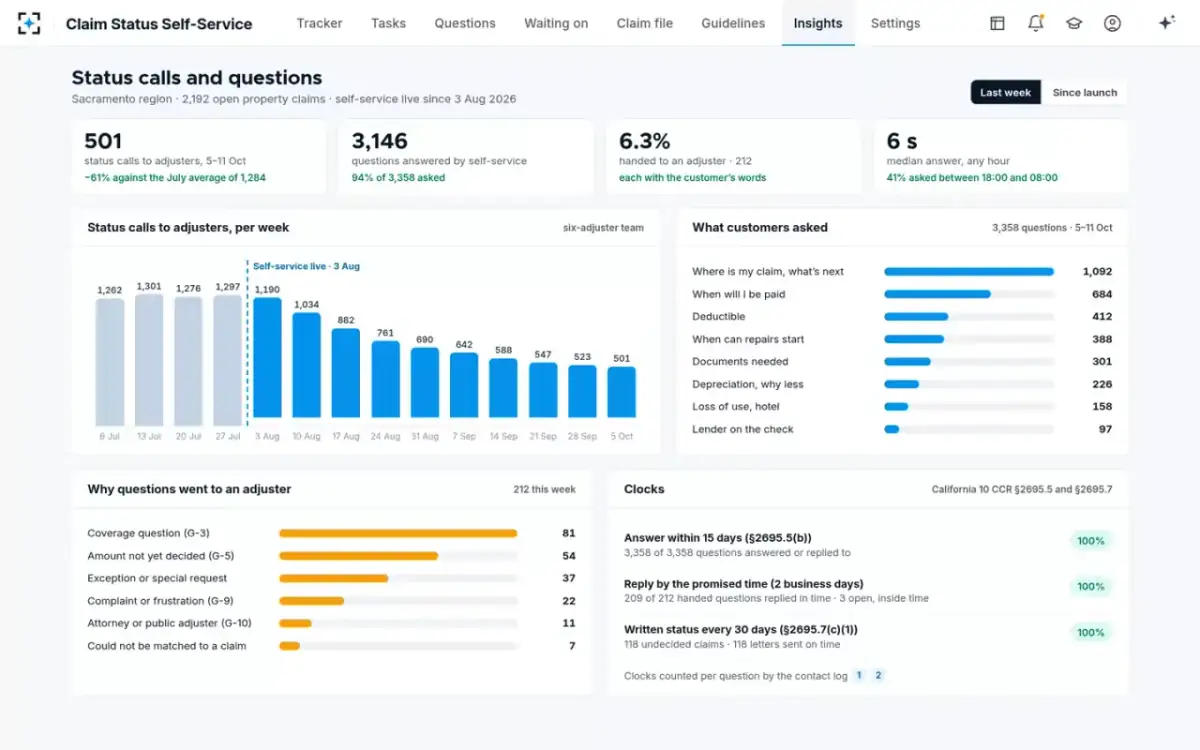
Two numbers on that screen matter more than the headline. The 41 percent of questions asked between 18:00 and 08:00 are questions that, before self-service, waited for the morning or became a call. And the reply clock for handed questions, 209 of 212 answered by the promised time, measures whether the handover is a real route to a person or a polite dead end.
What to look for when buying an AI insurance chatbot
Look for the things the test measures, and ask to see them working on your data, not described. A buyer comparing claims chatbots should be able to answer each question below from a trial on its own claims.
Buying questions for an AI insurance chatbot on the claims line
- What may it answer from?
Only your claim file, the policy and approved wording, or also general knowledge and web pages?
- Does each answer show its source, and can the customer open it?
A source per detail, not one link at the end.
- Who writes the rules on what it may not answer?
Your compliance team, in a versioned rule set, or the vendor’s prompt?
- What happens to a question it should not answer?
A task for a named adjuster with the customer’s words and a reply-by time, or a phone number?
- Will it run your test set before launch, and after every change?
And will it show you the failures, not just the score?
- Is every conversation kept on the claim?
With the channel, the sources and the outcome, unedited.
Where Claim Status Self-Service fits on the claims line
It fits the claims line for property claims: where is my claim, what is it waiting on, when will I be paid, why is the check smaller, why is my lender on it. It reads the claim system, policy administration, inspection estimates and claim payments, and answers on a policyholder page, by two-way text and on a phone status line, in English and Spanish. It checks documents the customer uploads and lines up a contractor's estimate with the inspection, but agrees nothing: every amount and every coverage decision stays with the adjuster.
It does not sell, quote or change policies, and it is not a general insurance chatbot for questions outside a claim. A carrier that wants those needs a different product and a different test. The economics of answering status questions this way, including what a status call costs, are set out in the guide to insurance virtual assistant cost; to see the sample week screen by screen, start from Claim Status Self-Service.
Questions people ask
How reliable are AI chatbots for insurance questions?
It depends on what they are allowed to answer from. NIST names confabulation, confidently stated false content, as a core risk of generative AI; an assistant restricted to the customer's claim file, the policy and approved wording, with a source on each answer and a rule for handing over, removes most of the room for it. Test it on your own questions to know.
How do you evaluate a claims chatbot?
Run a fixed set of real questions, written several ways and attached to real claims, through the chatbot and through a sample of your staff, and score every answer blind on four points: correct, sourced, handed over when it should be, and nothing shown that must not be. Repeat after every rule change.
Is a chatbot more accurate than a human agent?
Not automatically. Humans make measurable errors too: an inspector general's review of 200 recorded IRS calls found 14 with inaccurate information. The right question is whether the assistant is at least as correct, more consistent and better at handing over on your own test set.
What questions should a claims chatbot never answer?
Anything that needs a new decision: whether something is covered, an amount nobody has agreed, an exception, a complaint, or anything after an attorney or public adjuster is mentioned. It should also never show reserves, internal notes, fraud or subrogation activity, or another person's data.
Can an AI insurance chatbot answer in Spanish?
Some can. Claim Status Self-Service answers and texts in English and Spanish; test the Spanish answers with the same rubric, because a correct English answer and its translation are two answers to check.