Regulation 64 is New York's claims-handling regulation, 11 NYCRR Part 216, issued under Insurance Law §2601. It requires insurers licensed in New York to acknowledge a claim within 15 business days, set an investigation going within 15 business days, accept or reject the claim within 15 business days of receiving the proof of loss and everything they asked for, write to the claimant every 90 days while a claim stays undecided, and pay within 5 business days of an agreed settlement. Auto physical damage claims have faster rules of their own in section 216.7. Because the clock counts business days and New York's own legal holidays, the same dates can be on time in New York and late in California or Florida, which is why a multi-state claims audit has to count a New York day the New York way. Botminds' Claims Compliance Audit applies a New York business-day calendar to New York claims and cites the section behind every result.
The regulation is quoted from Cornell's Legal Information Institute copy of the official New York Codes, Rules and Regulations; the statute from the New York State Senate's site. Examples from the solution use a fictional sample insurer, and its figures are sample data.
Have as your basic goal the prompt and fair settlement of all claims.
11 NYCRR 216.0(e)(1), the first of Regulation 64's claim practice principles
What is New York Regulation 64?
New York Regulation 64 is the set of minimum claims-handling standards in 11 NYCRR Part 216, sections 216.0 to 216.13, that defines what counts as an unfair claims settlement practice under Insurance Law §2601. Its opening section describes them as minimum standards whose breach, without just cause and often enough to amount to a general business practice, is an unfair claims settlement practice, and it says other acts can qualify too (216.0(b)). It covers first- and third-party claims, with specific rules for auto physical damage and for third-party property damage under auto liability policies.
It applies to all insurers licensed in New York, with exclusions. It does not apply to workers' compensation, credit, title or ocean marine insurance, nor to inland marine unless section 3425 of the Insurance Law covers it; parts of it do not apply to life or to accident and health policies (216.2). And when a public adjuster represents the claimant, three provisions drop away: the written-provision rule for denials in 216.3(b), the 15-business-day reply rule in 216.4(b), and the start-of-investigation rule in 216.5(a) (216.2(d)). An audit that ignores that exception will report violations the regulation does not contain.
Section 216.0 also sets out claim practice principles that read like a job description, from assisting the claimant to clearly telling the claimant the insurer's position on any disputed matter. The sixth is a management duty: every insurer must give the regulation to each person who supervises, handles or settles claims and make sure they comply with it.
Regulation 64 New York insurance law: section 2601 behind it
Insurance Law §2601 is the statute Regulation 64 implements, and it sets the trigger and the penalty arithmetic. An insurer's acts are unfair claim settlement practices "if committed without just cause and performed with such frequency" as to indicate a general business practice (Ins. Law §2601(a)). The statute itself requires the insurer to advise the claimant "of acceptance or denial of the claim within thirty working days" after a properly executed proof of loss; the regulation tightens that to 15 business days once the requested items are also in.
Two more provisions shape an audit. Complaint counts are admissible, but no insurer is in violation "solely by reason of the numbers and types of such complaints" (§2601(b)). And after notice and an opportunity to be heard, "each instance of noncompliance with subsection (a) hereof may be treated as a separate violation" for the purpose of a monetary penalty (§2601(c)). The frequency test decides whether there is a violation; the instance count can decide its price. A New York audit therefore needs both the error rate and the list of confirmed instances.
11 NYCRR 216.4: acknowledge in 15 business days, answer the Department in 10
Section 216.4 sets the communication clocks. Every insurer must acknowledge a claim within 15 business days of notice, in writing or by a note in the claim file, and notice to an agent counts as notice to the insurer unless the agent tells the claimant it cannot accept notices of claim (216.4(a)). Every other pertinent communication needs an appropriate reply within 15 business days (216.4(b)). An inquiry from the Department of Financial Services about a claim must be answered with the available information within 10 business days (216.4(d)).
The same section requires each insurer to run an internal department for complaints filed with the Department, with a corporate officer responsible for it, and a central log of all complaint activity (216.4(c) and (e)). For a claims audit, the log is a second source of dates: a complaint about a late acknowledgment often records when the claimant first called.
Business days, not calendar days: one claim on three calendars
A business-day rule moves the deadline further out than its number suggests, and by a different amount every month. Take a claim reported on Monday 26 October 2026 and count the acknowledgment deadline in three states. California's 15 calendar days end on Tuesday 10 November (10 CCR 2695.5(e)). Florida's 7 calendar days end on Monday 2 November (§627.70131(1)(a)). New York's 15 business days skip three weekends, Election Day on 3 November and Veterans Day on 11 November, and end on Wednesday 18 November.
One acknowledgment, three state calendars: a claim reported on Monday 26 October 2026
- Calendar days7 d
- Calendar days15 d
- Business days and weekends21 d
- Election Day, Veterans Day+2
The two-day gap between a careless count and a correct one is where audits go wrong in both directions. A desk that counts weekdays only will flag a New York acknowledgment sent on 17 November as late, an exception that should never reach a reviewer. A desk that copies a federal holiday calendar will flag one sent on 18 November, which New York's own list of holidays allows. Neither error is visible in a spreadsheet unless the calendar is written into the rule and cited.
Which holidays stop a New York claims clock?
Regulation 64 defines a business day as "a day other than Saturday, Sunday or a New York State legal holiday" (216.1(d)). New York's General Construction Law lists the state's public holidays, and the list differs from the federal one in ways that matter for claims. It includes Lincoln's Birthday on 12 February and "each general election day," neither of them a federal holiday. Flag Day, the second Sunday in June, is on the list but always falls on a Sunday (GCL §24).
The weekend rule is narrower than many payroll calendars assume. The statute moves a holiday only when it falls on a Sunday: "if any of such days except Flag day is Sunday, the next day thereafter" is the holiday. A holiday that falls on a Saturday is not moved to the Friday under that rule. A team that imports an employer's holiday calendar, which may observe a Saturday holiday on the Friday before, can therefore skip a day New York's text does not skip. The safe course is to write the state's own list into the rule table, have compliance approve it, and show it on every result.
How New York and California count the same claims deadlines
New York, Regulation 64: Business days for nearly every first-party clock.
California, fair claims regulations: Calendar days, every day counted.
New York, Regulation 64: New York legal holidays excluded, including Lincoln’s Birthday and election days.
California, fair claims regulations: Counted, but a deadline that lands on a weekend or holiday moves to the next working day.
New York, Regulation 64: 15 business days after notice.
California, fair claims regulations: 15 calendar days after notice.
New York, Regulation 64: 15 business days after proof of loss and all requested items.
California, fair claims regulations: 40 calendar days after proof of claim, broadly defined.
New York, Regulation 64: Reasons within 15 business days, then a letter every 90 days.
California, fair claims regulations: Written notice within the 40 days, then every 30 calendar days.
New York, Regulation 64: 5 business days after the agreement is received.
California, fair claims regulations: 30 calendar days after acceptance.
11 NYCRR 216.6: decisions, 90-day letters and payment
Section 216.6 holds the decision and payment rules. Within 15 business days after the insurer receives a properly executed proof of loss and every item it asked for, it must tell the claimant in writing whether the claim is accepted or rejected; where it suspects arson, the period is 30 business days (216.6(c)). If it needs more time, it must say so within the same 15 business days, with its reasons, and then write again 90 days after that first letter and every 90 days after that, unless the matter is in litigation or arbitration.
The content rules are scattered through the section. An acceptance must state the amount offered. A rejection must tell the claimant of any policy provision limiting the right to sue (216.6(c)). A disclaimer for no policy in force or a breach must explain the specific reasons (216.6(d)). Any element of a claim that is not in dispute must be paid even while others are (216.6(e)), and an agreed settlement must be paid within five business days of receiving the agreement (216.6(f)). A notice rejecting any element of a personal property claim must carry a prescribed statement that begins "Should you wish to take this matter up with the New York State Department of Financial Services, you may file a complaint with the department" and gives the addresses (216.6(h)). Section 216.3 adds that no element may be denied on a specific policy provision unless the provision is referred to in writing (216.3(b)).
The 90-day letter is easy to miss because it is so much longer than other states' cadence. California expects a written update every 30 calendar days; the NAIC model every 45 days. A team running all states off one diary will either over-send in New York, which costs nothing, or under-send in California, which does. How the California denial letter itself must read is taken line by line in insurance claim denial letter requirements in California.
New York regulation 64 section 216.7: the auto rules on their own clocks
Section 216.7 runs auto physical damage claims on shorter clocks, mostly in business days, and it is the part of Regulation 64 people search for most by name. It also contains the only explicit tolerance in the regulation. Unless clear justification exists, no more than 20% of a representative sample of physical damage claims selected by the Department's examiners may take more than 30 calendar days from notice of loss to payment, and if an insurer breaches that standard, each claim over 30 days "may be treated as a separate violation" (216.7(d)(1)).
New York Regulation 64, section 216.7: the auto physical damage clocks
| Step | Clock | Section |
|---|---|---|
| Inspect the car before repair, and make a good-faith offer | 6 business days after notice of claim | 216.7(b)(1) |
| Ask the insured for an estimate instead of inspecting | 3 business days after notice | 216.7(b)(10) |
| Inspect after receiving that estimate, if the insurer elects to | 4 business days | 216.7(b)(10) |
| Reinspect for hidden or additional damage | 2 business days; 4 if the repair is sublet | 216.7(b)(9) |
| Pay once the insured accepts the offer | 5 business days, or 3 business days after a completed proof of loss | 216.7(b)(17) |
| Offer on an unrecovered theft total loss | By the 25th calendar day after notice, if the insured has supplied what was asked | 216.7(c)(7) |
| Explain any element unresolved after 30 calendar days | In writing at day 30, then every 30 calendar days | 216.7(d)(2) |
| Forward the title to the Department of Motor Vehicles | 10 business days after receiving it from the owner | 216.7(b) |
Section 216.7 is also the clearest example of why an audit cannot use one unit per state. Inside one section, inspection runs on business days, the theft offer on calendar days and the written explanation on 30-calendar-day cycles. A New York auto rule table needs a unit on every row.
11 NYCRR 216.11: files built so examiners can rebuild every event
Section 216.11 states the documentation standard in its strictest form: "Claim files must be so maintained that all events relating to a claim can be reconstructed by the Department of Financial Services examiners" (216.11). Every communication and transaction, written or oral, must be dated by the insurer, and the insurer must keep a note or a copy of every form mailed to a claimant.
For a business-day audit that requirement is decisive, because a business-day deadline depends on the exact date of the starting event. A notice of claim taken by phone on a Friday afternoon and logged on Monday shifts every downstream deadline by a business day. The audit can only test what the file dates, and section 216.11 makes the dating the insurer's job.
How Claims Compliance Audit counts a New York day
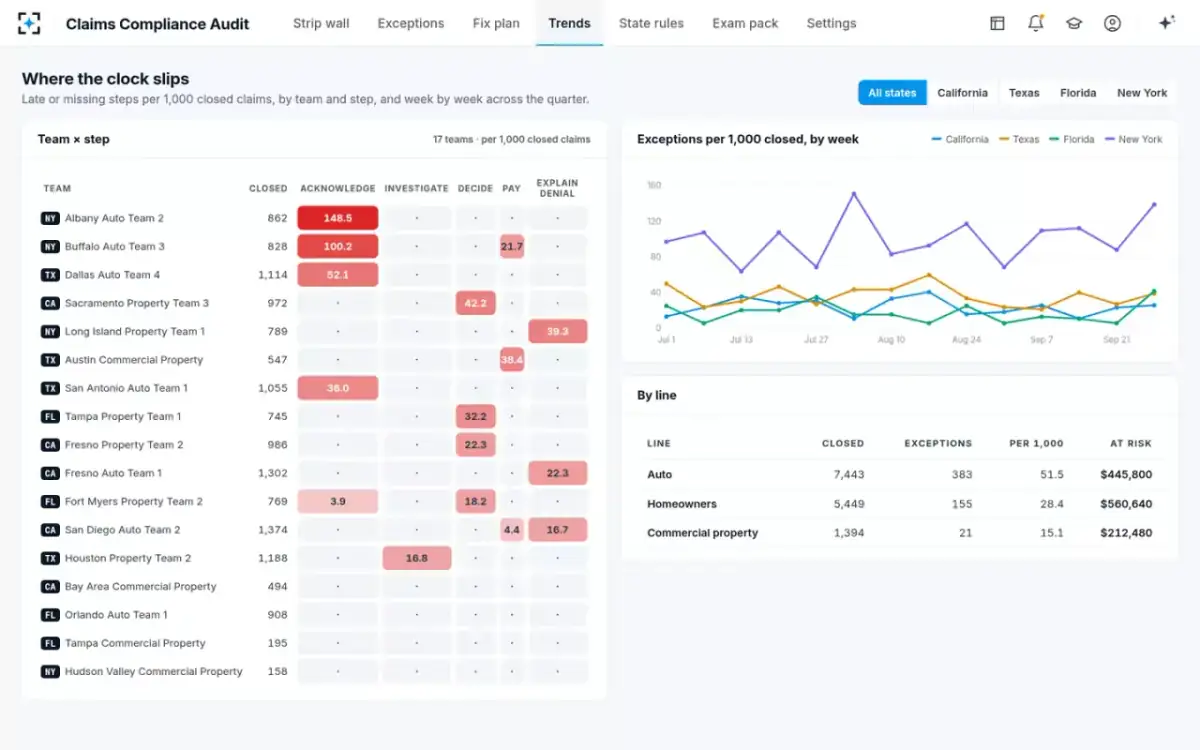
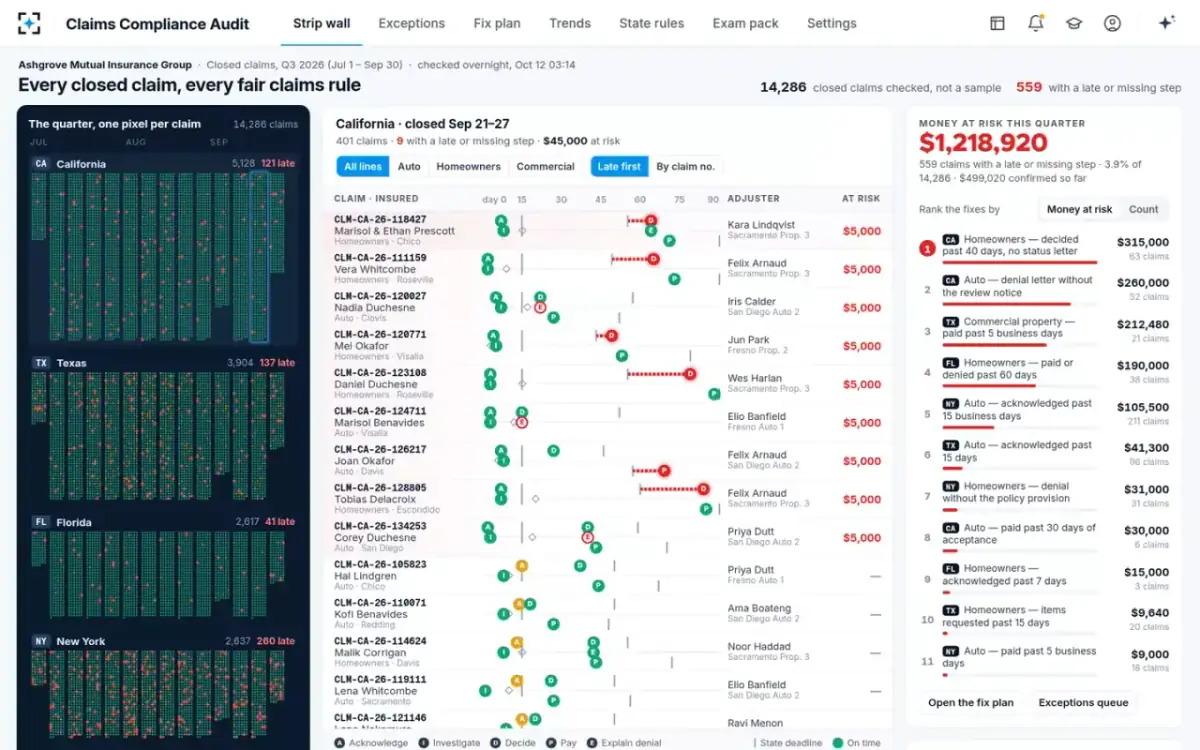
Claims Compliance Audit applies a New York calendar, approved by compliance and versioned, to every New York claim, and the version is named on each result. In the sample quarter, the New York rule set in force was version 4, whose change log records "Business-day counting for acknowledgments". New York produced 260 of the quarter's 559 claims with a late or missing step, from 2,637 New York claims closed.
New York in Claims Compliance Audit's sample quarter
260claims
with a late or missing step, of 2,637 New York claims closed
211claims
auto claims acknowledged after 15 business days, the largest pattern by count
148.5per 1,000
late acknowledgments at one Albany auto team, the highest rate of any team
5thby money
where that largest pattern ranks once each step is priced
The largest New York pattern shows why the calendar matters. Late auto acknowledgments were the most frequent pattern in the whole quarter, concentrated in two upstate auto teams. If the calendar had counted weekdays without New York's holidays, some of those 211 claims would have looked late when they were not; if it had counted calendar days, most would have looked late. Priced on the company's own schedule, the pattern carried $105,500 and ranked fifth by money, behind four patterns with fewer claims. The trends screen shows where it sits.
Where the clock slips: late steps per 1,000 closed claims, by team and step
The wall view puts the same New York claims beside the other states. Each claim is a strip of five steps placed on the day it happened, with the state's deadline marked, so a New York acknowledgment that looks late against a calendar count can be checked against its business-day tick.
Every closed claim of the quarter by state, with New York's late steps in red
How to scope a New York review so that the business-day pattern is sampled where it lives, rather than spread evenly across states, is covered in the closed claim file review process. Which state's rule governs a New York policyholder's claim in the first place is the subject of the unfair claims settlement practices act guide.
Questions people ask
Does Regulation 64 apply to health insurance claims?
Only in part. Several provisions, including the 15-business-day acknowledgment and investigation rules and the decision rule in 216.6(c), do not apply to accident and health policies where the claimant is not the policyholder, a certificate holder, or a relative or household member of one, and the actual-cash-value definition does not apply to them at all (216.2(b) and (c)).
How long does an insurer have to pay a claim in New York?
Five business days after it receives a settlement agreement, or after the claimant meets a condition the agreement sets, whichever is later (216.6(f)). For auto physical damage, payment is due five business days after the insured accepts the offer, or three business days after a completed proof of loss (216.7).
Does Regulation 64 count Saturdays?
No. A business day under Regulation 64 is any day other than Saturday, Sunday or a New York State legal holiday (216.1(d)). A few clocks in the auto section are stated in calendar days instead, such as the 25th calendar day for a theft total-loss offer and the 30-calendar-day explanation letters.
What happens if an insurer violates Regulation 64?
Under Insurance Law §2601, acts committed without just cause and often enough to indicate a general business practice are unfair claim settlement practices. After notice and a hearing, each instance of noncompliance may be treated as a separate violation for a monetary penalty. Complaint counts alone do not establish a violation.
Does a public adjuster change Regulation 64's deadlines?
Yes, for three provisions. When a public adjuster represents the claimant, the rule that denials cite policy provisions in writing (216.3(b)), the 15-business-day reply rule (216.4(b)) and the start-of-investigation rule (216.5(a)) do not apply (216.2(d)). An audit should record representation before testing those steps.
Is Regulation 64 the same as the New York total loss rules?
The total loss rules are part of it. Section 216.7 covers auto physical damage, including how total losses are valued and offered, the 25-calendar-day theft offer and the 35-day right of recourse. The NAIC's chart lists Part 216 as New York's adoption of its claims model regulation.