Insurance claim denial letter requirements in California come mainly from one regulation, 10 CCR 2695.7. A first-party claim denied in whole or in part must be denied in writing, with every basis then known and the facts and law behind each, a reference to and explanation of any policy provision the denial relies on, and a statement that the claimant may have the decision reviewed by the California Department of Insurance, with the address and telephone number of the unit that reviews claims practices. The denial must go out within 40 calendar days of proof of claim, or the insurer must explain in writing why it needs more time. That makes the denial letter the most testable document in a claim file: each element is either there or not. Botminds' Claims Compliance Audit reads every denial letter in every closed file for each required element and checks its date against the clock.
The rules are quoted from Cornell's copy of the California Code of Regulations. The annotated letter is a specimen written for this guide on a fictional sample claim from the solution; its names and amounts are sample data, not a real policyholder's.
The four California numbers every denial file is tested against
40days
to accept or deny, in whole or in part, after proof of claim
30days
between written notices while a decision is still pending
60days
notice before a time limit the insurer may rely on to deny expires
80days
in place of 40 where there is a documented basis to suspect fraud
What must a California insurance claim denial letter include?
A California denial letter for a first-party claim must include four things. It must be in writing. It must list all the bases for the denial known to the insurer at the time, with the factual and legal basis for each. Where the denial rests on a statute, a law, or a policy provision, condition or exclusion, it must refer to it and explain how it applies to the claim. And it must tell the claimant that a decision they believe is wrong can be reviewed by the California Department of Insurance, giving "the address and telephone number of the unit of the Department which reviews claims practices" (2695.7(b)(1) and (3)).
The requirements apply to a partial denial exactly as to a full one: the regulation speaks of claims denied "in whole or in part". Third-party claims have a shorter rule: an insurer that denies or rejects a third-party claim, in whole or in part, or disputes liability or damages, must do so in writing. And there is one carve-out. Nothing in the content rule requires an insurer to disclose information that could alert a claimant that the claim is being investigated as suspected fraud (2695.7(b)(2)).
A California denial letter, annotated line by line
The specimen below is a partial denial on a sample homeowners water claim in Claims Compliance Audit: $31,470 claimed, $18,640.22 accepted, $12,829.78 of mold remediation denied above a $5,000 limit. Each line of the letter is paired with the rule it has to satisfy. The letter passes every content test. It fails the first one, the date.
A partial denial letter in California, clause by clause, with the rule each line must meet
Claim CLM-CA-26-118427 · Policy HO3-CA-4471902 · Loss of 6 July 2026 · Letter dated 9 September 2026
2695.7(b), (c)(1)
The date is the first test. California’s 40 calendar days ran from proof of claim on 22 July to 31 August, so this letter is 9 days late, and no written notice of the need for more time went out within the 40 days.
We accept $18,640.22: $13,640.22 for the water damage repair to your kitchen and hall, and $5,000 toward mold remediation.
2695.7(b), (h)
A partial denial is still a denial, and the amounts accepted and denied must be clearly documented in the claim file. Payment of the accepted amount is due within 30 calendar days.
We are not paying the remaining $12,829.78 of the $17,829.78 mold remediation estimate, because your policy limits mold remediation to $5,000 for this loss.
2695.7(b)(1)
Every basis the insurer then knows must be listed, with the facts and the law behind each. A reason that is not in the letter is hard to add later.
Section I.C.8 of your policy reads: [the provision quoted in full]. The lab report of 4 August found elevated mold spore counts from the water loss, so this limit applies to the remediation.
2695.7(b)(1)
Where the denial rests on a provision, the letter must refer to it and explain how it applies to this claim. Quoting the words, then tying them to a fact, does both.
Other coverage under your policy may apply, including additional living expense if your home could not be lived in. Please call us if that applies.
2695.4(a)
California requires insurers to disclose all benefits, coverage and time limits that may apply to the claim presented.
If you believe we have wrongly denied or rejected all or part of your claim, you can ask the California Department of Insurance to review it: [the unit that reviews claims practices, its address and telephone number].
2695.7(b)(3)
The statement, the address and the telephone number are each required; a template that drops any of them fails every letter it produces.
The content rules are easy to meet once and easy to break at scale, because most denial letters come from templates. A template that loses one paragraph produces a defective letter on every claim it is used for, which is exactly how a single drafting change becomes a pattern an examiner reports as an error rate. The policy-wording side of a denial, how a coverage position is reached and written, is covered in the coverage denial letter guide.
When is a California denial due? Forty days from a proof of claim defined broadly
A California denial is due within 40 calendar days after the insurer receives proof of claim, and proof of claim arrives earlier than many teams assume. The regulation defines it as any evidence or documentation in the insurer's possession, whether submitted by the claimant or gathered in the investigation, that "reasonably supports the magnitude or the amount of the claimed loss" (2695.2(s)). A contractor's estimate in the file is enough. A sworn proof of loss is not required to start the clock.
If the insurer cannot decide within the 40 days, it must send written notice within that period saying what additional information it needs and why it cannot yet decide, and then repeat the notice every 30 calendar days until it decides or legal action is served (2695.7(c)(1)). Where a decision has to wait for a future event, the notice must say so and estimate when the decision can be made. Calendar days include weekends and holidays, but a deadline that lands on one moves to the next working day (2695.2(b)).
Two exceptions change the count. Where there is a reasonable basis, supported by specific information available for review by the Department, to believe the claim is fraudulent, the 40 days become 80, or are suspended by the Commissioner's order (2695.7(k)). And the 40-day clock does not apply to disability, disability income and mortgage guaranty claims under their own statutes, or to auto repair bills governed by Insurance Code section 560, although the content rules still do (2695.7(b)(4)).
What a California denial may not rest on
A California denial cannot rest on facts the file does not prove, and three rules say so directly. No insurer may deny a claim on information from a telephone call or interview unless the conversation is documented in the claim file (2695.7(l)). No insurer may deny because the claimant did not exhibit the property unless the file documents a reasonable demand and an unfounded refusal, or a breach of a policy provision requiring it (2695.4(c)). And no insurer may demand notice or proof of claim within a set time unless the policy specifies that time limit (2695.4(d)).
Other lines a denial must not cross concern pressure. An insurer may not tell a claimant their rights may be impaired if a form or release is not signed by a deadline, except to give notice of a statute of limitations or similar limit (2695.7(i)). It may not require a claimant to withdraw or refrain from a complaint to the Department as a condition of settling (2695.7(o)). For an auditor, each of these is a test of the file behind the letter rather than the letter itself: the denial is only as good as the documented facts it cites.
Notices that travel with a denial, or before it
A California denial file is often judged on notices sent outside the letter. The time-limit notice is the most consequential. Unless the claim has been settled by payment, the insurer must give written notice of any statute of limitation or other time limit it may rely on to deny the claim, at least 60 days before it expires, or immediately if the claim arrived within those 60 days; for an uninsured motorist claim the period is 30 days, and the notice is not required for a claimant represented by counsel (2695.7(f)).
The subrogation notice is the second. Every insurer must tell a first-party claimant in writing whether it intends to pursue subrogation; if it elects not to, or stops, it must say that any recovery is the claimant's responsibility, with exceptions where the deductible was waived or no deductible applies (2695.7(p)). The disclosure duty is the third: insurers must disclose all benefits, coverage and time limits that may apply to the claim presented (2695.4(a)). A partial denial that does not mention another coverage the facts point to can fail that duty even when the denial itself is right.
California fair claims settlement practices regulations: where the denial rules sit
The California fair claims settlement practices regulations are 10 CCR sections 2695.1 to 2695.14, adopted under Insurance Code section 790.03(h), which the regulations describe as enumerating sixteen claims settlement practices. They define minimum standards whose breach is an unfair practice when "knowingly committed on a single occasion" or frequent enough to be a general business practice (2695.1(a)). File documentation is in 2695.3, disclosure in 2695.4, communications in 2695.5, training in 2695.6, and the decision and denial rules in 2695.7, with auto and other line-specific rules after it.
The single-occasion trigger is what makes California denial testing worth doing on every file. In May 2026 the Department of Insurance said penalties under Insurance Code §790.035 "may reach $5,000 per violation, or $10,000 for willful violations" (CDI). Each defective letter is a potential violation in its own right, so the count of defective letters matters as much as their rate.
Insurance claim denial letter requirements by state
Denial letter requirements differ by state in what the letter must contain, not only in when it is due. California asks for the most in one place. New York prescribes the exact words of a regulator notice, but only for personal property denials. Texas asks for reasons in the notice. Florida asks for a reasonable explanation of the basis in the policy. The table sets five rulebooks side by side.
Claim denial letter requirements by state: what each rulebook asks the letter to say
| Rulebook | Reasons and basis | Policy provision | Regulator notice | Also required |
|---|---|---|---|---|
| California, 10 CCR 2695.7 | All bases known, with the facts and law for each | Referred to and its application explained | Department review statement with the unit’s address and telephone | Written denial for third-party claims; time-limit notice 60 days ahead |
| New York, 11 NYCRR Part 216 | Specific reasons when disclaiming for no policy or a breach | Referred to in writing before any element is denied | Prescribed Department statement on personal property denials | Any policy provision limiting the right to sue |
| Texas, Ins. Code §542.056 | The reasons for the rejection, in the written notice | Not stated in §542.056; chapter 541 makes failing to explain the basis an unfair practice | Not required by the statute | Written notice within 15 business days of the items requested |
| Florida, §627.70131(7)(a) | A reasonable written explanation of the basis in the policy, in relation to the facts or law | Implied by the explanation duty | Not required by the section | Explain any payment below the insurer’s own estimate |
| NAIC Model 902 §7 | Written denial, documented in the file | Referred to in the denial | If the claimant objects, a written notice that the department can review it | Days are calendar days |
New York's is prescribed word for word: a notice rejecting any element of a personal property claim must prominently tell the claimant that a complaint may be filed with the Department of Financial Services, with the Department's web and postal addresses (216.6(h)). A multi-state template that uses California's wording in New York, or New York's in California, fails both. How New York's other clocks count business days is set out in Regulation 64 New York.
What examiners find in California denial files
Examiners test denial files for content and timing together, and recent findings show both failing at scale. In May 2026 the California Department of Insurance announced an accusation against State Farm General Insurance Company after a market conduct examination of 2025 Los Angeles wildfire claims. The Department said its examiners reviewed a sample of 220 claims and found 398 violations in 114 of them, including failures to accept or deny within 40 days and to give written notice when more time was needed, and that on smoke damage claims the insurer "failed to provide required written denials for hygienist and environmental testing" (CDI). These are the Department's allegations, to be heard by an administrative law judge.
The examiners' handbook tells them what to look for in denied and closed-without-payment files: whether denials are based on policy provisions and law, whether the notices refer to specific provisions or exclusions, whether the claimant is given a reasonable basis, and, where required, whether the claimant is told how to have the denial reviewed by the insurance department (Handbook, claims standard 9, 2017 edition). Every one of those is a test a reader can run on the letter itself.
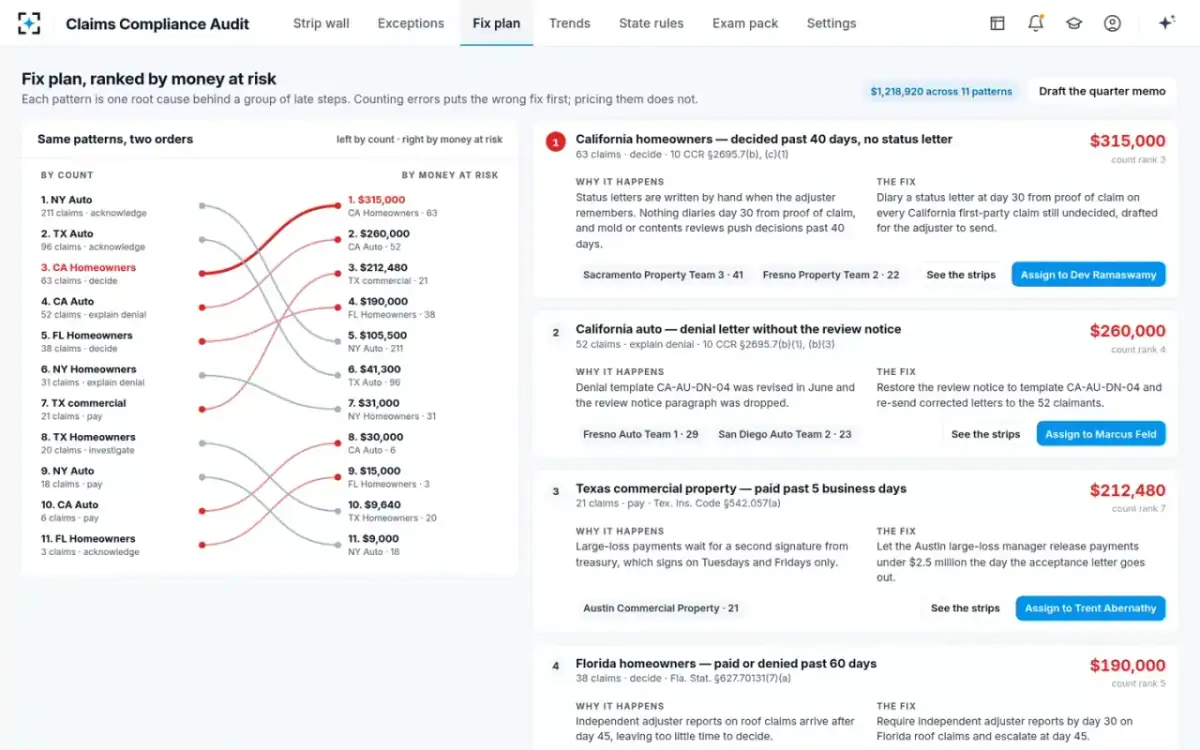
In the solution's sample quarter, the letter checker read 3,234 denial letters across four states and found 83 missing content the state requires. Fifty-two were California auto denials from one template, revised in June, that had lost the paragraph telling claimants about the Department's review. At the sample's $5,000 per act, that one edit put $260,000 at risk.
One template, one missing paragraph, 52 letters
A sample insurance denial letter, checked before it goes out
A denial letter is easiest to fix before it is sent, and the checks are short. The checklist below turns 2695.4 and 2695.7 into nine questions a reviewer, or a letter checker, can answer from the letter and the file in a few minutes. A letter that passes all nine can still be wrong on the merits; one that fails any of them is defective whatever the merits.
Nine checks for a California denial letter before signature
- Is it within 40 days of proof of claim?
Count from the first evidence that supports the amount, not from the sworn proof of loss. If not, was written notice of the need for more time sent within the 40 days, and every 30 days since?
- Does it say what is accepted and what is denied?
Amounts on both sides of a partial denial, matching the claim file.
- Is every basis listed?
All the reasons known now, each with its facts and the law or provision behind it.
- Is each provision referred to and applied?
Quote the wording, then tie it to a fact in the file.
- Does every fact relied on have a document?
No reliance on an undocumented call, and no failure-to-exhibit denial without the demand and refusal in the file.
- Are other possible benefits mentioned?
Coverage, benefits or time limits that may apply to the claim presented.
- Is the Department review statement there, complete?
The statement, the unit, its address and its telephone number.
- Is a time-limit notice due?
If a limitation period or other time limit could be relied on, written notice 60 days before it runs, unless counsel represents the claimant.
- Is the subrogation position stated?
Whether the insurer will pursue it, and if not, that recovery is the claimant’s responsibility.
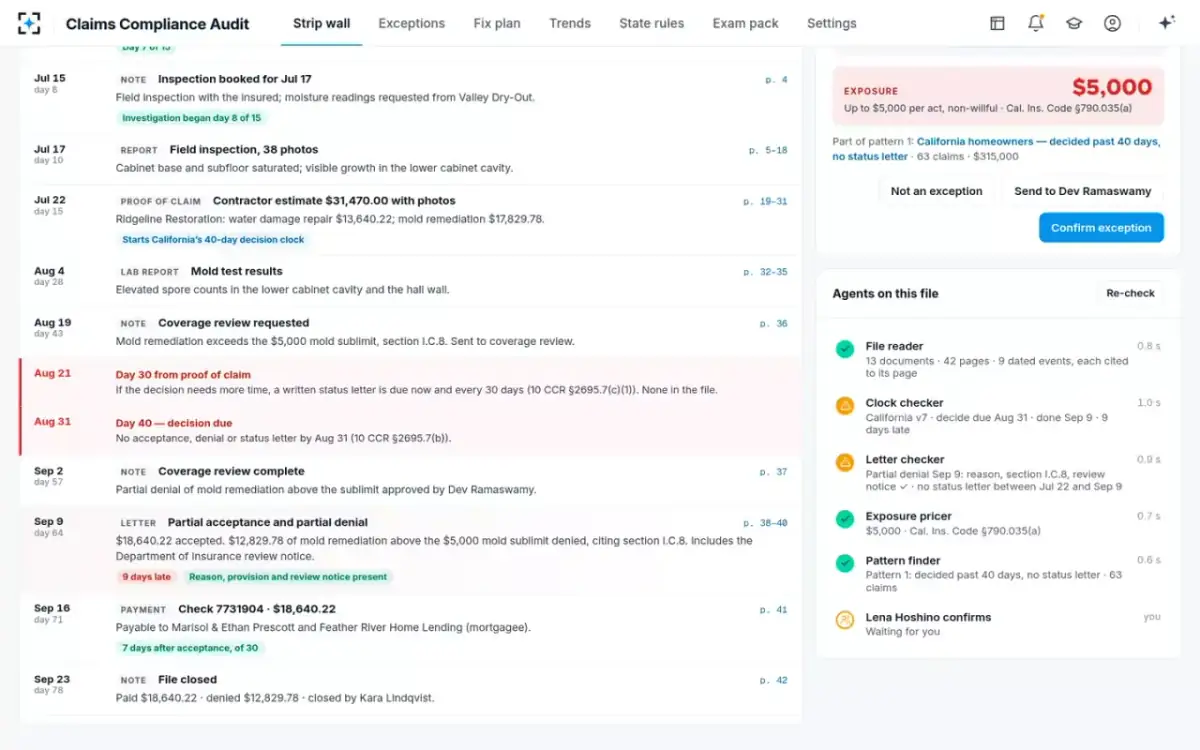
On the sample claim, the letter checker's result reads: partial denial on 9 September, reason, section I.C.8 and review notice present, no status letter between 22 July and 9 September. The letter passes; the timing does not. How a single exception like this is confirmed or overturned, and who may decide, is set out in the AI claims audit tool guide.
The letter checker's result on one California denial
Questions people ask
Does California require a denial letter for a partial denial?
Yes. The rule covers first-party claims denied or rejected "in whole or in part", so a letter that pays part of a claim and refuses the rest must meet every content requirement for the refused part. The amounts accepted and denied must also be clearly documented in the claim file.
Does a California denial letter have to cite the policy language?
Where the denial rests on a policy provision, condition or exclusion, the letter must refer to it and explain how it applies to the claim. Quoting the words and tying them to a fact in the file is the safest way to meet both parts. The NAIC model regulation makes a denial on an unreferenced provision improper.
How long does an insurer have to deny a claim in California?
Forty calendar days after receiving proof of claim, which can be any evidence that reasonably supports the amount claimed. If it needs more time, it must say so in writing within the 40 days and every 30 days after. Where there is a documented basis to suspect fraud, the period is 80 days.
Can a California insurer deny a claim based on a phone call?
Only if the call is documented in the claim file. The regulation forbids denying a claim on information obtained in a telephone conversation or personal interview unless the conversation is recorded in the file under the documentation rules.
What happens if a denial letter leaves out the Department of Insurance notice?
The letter fails 10 CCR 2695.7(b)(3), and in California a single knowing breach can be an unfair practice. The Department has described penalties of up to $5,000 per violation, or $10,000 if willful. A template missing the notice repeats the breach on every letter; the sample insurer's fix was a corrected template and corrected letters to all 52 claimants.
Is there an official sample insurance denial letter?
Neither 10 CCR 2695.7 nor the NAIC's model regulation prescribes a model letter; they set required content instead, so a defensible letter is built from those elements: the decision, every basis, each provision applied to the facts, other possible benefits and the Department review statement. The specimen earlier in this guide shows one way to lay them out, line by line.