A claim file audit checklist is the list of tests a reviewer runs on a closed insurance claim to show that each step met the rules of the state that governs it: acknowledged, investigated, decided, paid and, if denied, explained in writing, each on time. The test that matters for every step is the same. Is there a date, is there a document in the file that proves it, and which rule does it meet? A checklist that only asks whether a step happened will pass files an examiner fails. Botminds' Claims Compliance Audit runs this checklist on every closed claim, cites each date to its file page, and leaves each exception for a claims compliance reviewer to confirm.
The checklist below is built from the claims standards in the NAIC's Market Regulation Handbook, the manual state examiners work from, and from the claims rules of four large states. The examples come from the solution's fictional sample insurer, Ashgrove Mutual Insurance Group, and are sample data rather than a customer's results.
What an examiner expects a closed claim file to show
11standards
for claims in the examiners’ handbook, from first contact to litigated files
7of 11
are rated Essential; the other 4 are Recommended
3dates
California wants on every material document: received, processed and sent
5years
of claim files California expects kept: the current year and four before it
What goes on a claim file audit checklist?
A claim file audit checklist should carry one line for each step a state puts a clock or a content rule on, and for each line it should demand three things: the date the step happened, the page in the file that proves it, and the rule and version it is tested against. That turns "acknowledged: yes" into "acknowledged 14 July, page 3, day 7 of 15 under 10 CCR 2695.5(e)(1)". The first is an opinion. The second is evidence an examiner can check in a minute.
The order matters too. A good checklist decides which state's rule applies before testing a single date, records the event that starts each clock, and only then computes the deadline. Most errors in hand-run checklists come from the middle step: the wrong starting event, or a calendar count where the rule says business days. Which state's rule governs a claim, and why the answer is not always obvious, is set out in the unfair claims settlement practices act guide.
The eleven claims standards examiners test, turned into file checks
The handbook gives examiners eleven claims standards, and each translates into a check that can be run on a closed file. The standards are written in the handbook's general language; the right-hand line on each is the file evidence a compliance desk should look for. Seven are rated Essential: first contact, investigation, resolution, correspondence, documentation, handling to policy and law, and denied or closed-without-payment files.
The eleven handbook claims standards as a claim file audit checklist
- 1 · Initial contact within the required time
Date of notice and date of acknowledgment, each from a document; the state’s day count applied. Essential.
- 2 · Timely investigation
Date of the first investigative act against the state’s start-of-investigation rule. Essential.
- 3 · Timely resolution
Date of the starting event (proof of loss, proof of claim or all items), the decision and the payment. Essential.
- 4 · Timely response to correspondence
Every claimant communication that expects a reply, with the reply date. Essential.
- 5 · Adequate documentation
Each material document dated as received, processed and sent; enough in the file to support the outcome. Essential.
- 6 · Handled under the policy and the law
Deductible, payee, total-loss method, sales tax, salvage and fraud referral, where they apply. Essential.
- 7 · Appropriate claim forms
Forms in the file match the product and carry the state’s fraud warning. Recommended.
- 8 · Reserves follow procedure
Reserve set and changed as the company’s procedures say. Recommended.
- 9 · Denied and closed-without-payment files
Denial based on a cited provision, a reasonable basis given, the regulator’s review notice where required. Essential.
- 10 · Checks and drafts
Payee and amount correct; no “final” or release wording unless the claim is settled. Recommended.
- 11 · No compelled litigation
Litigated files reviewed for offers well below what was later recovered. Recommended.
Standard 9 deserves the most attention because its failures are visible on paper. The handbook tells examiners to check whether denial notices refer to specific policy provisions or exclusions and, where the state requires it, whether claimants are told how to have a denial reviewed by the insurance department. Both are tests of a letter's content, which a checklist that records only "denial letter sent: yes" cannot catch.
What is an adequately documented claim file?
An adequately documented claim file is one an examiner can rebuild from start to finish without asking anyone a question. The NAIC's model regulation asks for every relevant document in the file to carry its date of receipt, processing or mailing (Model 902 §4C). New York is blunter: "All communications and transactions, whether written or oral, emanating from or received by the insurer shall be dated by the insurer" (11 NYCRR 216.11), and the insurer must keep a note or a copy of every form mailed to a claimant.
Florida lists the records outright. A property insurer must keep a log of each adjuster who talks to the policyholder, and dated records of every claim-related communication, receipt of the proof-of-loss statement, every request for information, every inspection, every detailed estimate, the start and end of any tolling period, and the payment or denial (§627.70131(4)). That is a ready-made checklist for the documentation standard. California requires the same three dates on each document and keeps the files longer, for the current year and the four before it (2695.3).
For a reviewer the practical test is simple. Cover the adjuster's summary note and try to date each step from the underlying documents alone. Where you cannot, the file fails the documentation standard whether or not the step was on time, and the timeliness test for that step cannot be passed either.
Closed claim audit checklist: five steps, each with a date, a source and a rule
A closed claim audit checklist tests five steps, and every one of them has a different clock in each state. The table sets the four states in the sample side by side, with the event that starts each clock and the evidence the file must hold. Read it as the skeleton of a multi-state checklist; each row still needs the state's exceptions, such as fraud investigations, catastrophe extensions and tolling.
The five steps of a closed claim audit checklist in four states
| Step | California | New York | Texas | Florida | Evidence in the file |
|---|---|---|---|---|---|
| AcknowledgeStarts at: Notice of claim | California15 calendar days (2695.5(e)(1)) | New York15 business days (216.4(a)) | Texas15 days (§542.055(a)) | Florida7 calendar days after any claim communication (§627.70131(1)(a)) | Evidence in the fileThe letter, or a dated file note of an oral acknowledgment. |
| InvestigateStarts at: Notice of claim (Florida: proof-of-loss statements) | CaliforniaBegin within 15 calendar days (2695.5(e)(3)) | New YorkCommence within 15 business days (216.5(a)) | TexasCommence within 15 days, and request all items (§542.055(a)) | FloridaBegin within 7 days of proof-of-loss statements (§627.70131(3)(a)) | Evidence in the fileFirst investigative act with its date: inspection booked, statement taken, items requested. |
| DecideStarts at: Proof of claim or loss, or all requested items | California40 calendar days after proof of claim (2695.7(b)) | New York15 business days after proof of loss and requested items (216.6(c)) | Texas15 business days after all requested items (§542.056(a)) | FloridaPay or deny within 60 days of notice (§627.70131(7)(a)) | Evidence in the fileThe written decision, its date, and any written notice that more time was needed. |
| PayStarts at: Acceptance or agreement | California30 calendar days after acceptance (2695.7(h)) | New York5 business days after the agreement is received (216.6(f)) | Texas5 business days after notice of acceptance (§542.057(a)) | FloridaWithin the 60 days; interest runs from notice if later (§627.70131(7)(a)) | Evidence in the filePayment date from the payment record, payee, amount accepted. |
| Explain a denialStarts at: The decision | CaliforniaWritten; every basis; the provision applied; Department review notice (2695.7(b)(1), (3)) | New YorkProvision cited in writing (216.3(b)); Department statement on personal property denials (216.6(h)) | TexasReasons stated in the notice (§542.056(c)) | FloridaReasonable written explanation of the basis in the policy (§627.70131(7)(a)) | Evidence in the fileThe letter itself, read for each required element, not just its existence. |
The decision row is where checklists go wrong most often, because the four states start the clock from four different events. California's "proof of claim" can be a contractor's estimate already in the file. New York and Texas wait for the items the insurer asked for. Florida ignores proof of loss and counts from the notice. The same claim can be on time in one state's terms and late in another's; the New York day count is worked through in Regulation 64 New York.
Which steps fail most, and which cost most?
In the sample quarter, most late steps were acknowledgments, but most of the money sat in late decisions. A checklist that weights every line equally will send the desk's time to the step that fails most often. The split below takes the 559 claims with a late or missing step and divides them by step, once by count and once by the money each step put at risk under the sample company's exposure schedule.
Claims Compliance Audit's sample quarter: exceptions by step, counted and priced
By count · 559 claims
- Acknowledge · 55%
- Investigate · 4%
- Decide · 18%
- Pay · 8%
- Explain denial · 15%
By money · $1,218,920
- Acknowledge · 13%
- Investigate · 1%
- Decide · 41%
- Pay · 21%
- Explain denial · 24%
The denial row is the one to look at twice. Fifty-two of the sample's 83 denial-letter exceptions came from a single California auto template revised in June, in which the paragraph telling the claimant they could ask the Department of Insurance to review the denial had been dropped. One template edit produced a whole pattern. A checklist that samples files will find one or two of those letters; a checklist that reads every letter finds the template.
Your own claims manual belongs on the checklist
Examiners now test insurers against their own written standards as well as the statute, so a claim file audit checklist that tests only the law is incomplete. Florida requires each residential property insurer to keep a claims-handling manual covering every stage from acknowledgment to closing, and to attest every year that it complies and can be followed during catastrophes (§627.4108).
Florida's 2025 Hurricane Ian reports show what that means in practice. One insurer missed its own 72-hour inspection standard on 47.8% of sampled claims (Centauri Specialty). Another did not send its own acknowledgment letter within 24 hours on 16.2% (American Mobile). A third did not upload estimates, photos and sketches within its own five-day standard on 19.8% (Citizens). None of those deadlines is in the statute. Every one became a finding with an error rate.
The practical step is to add the manual's deadlines as rows, with their own version and effective date, and to test them exactly like the statutory ones. If the manual promises something the desk cannot deliver during a catastrophe, the checklist will show it before the examiner does, and the manual can be changed through its own approval process.
Claims file audit checklist template: the columns that make it defensible
A claims file audit checklist template is defensible when each row can be checked against the file without the person who filled it in. The columns below do that. They also make the checklist reusable: the same columns serve the quarterly test, the corrective-action log and the response to an examiner's data call.
A claims compliance audit checklist template, column by column
| Column | What goes in it | Why it is there |
|---|---|---|
| Claim and scope | Claim number, state, line, first or third party, closed date | Decides which rule applies and whether the claim is in the audit at all. |
| Rule and version | Citation and the version of the rule table in force on the step’s date | A 2022 Florida claim is tested against 2022 law, not today’s. |
| Starting event | Which event starts the clock, its date and its file page | Most wrong deadlines come from the wrong starting event. |
| Deadline | Computed due date, with calendar or business days and holidays | Lets anyone recompute it. |
| Done | The date the step happened and its file page | The evidence the examiner will ask for. |
| Result | On time, within margin, late, missing or not applicable; days late | Separates a late step from an undocumented one. |
| Letter content | Each required element present or absent, quoted | A timely letter can still fail. |
| Reviewer decision | Confirmed or overturned, by whom, when and why | Shows a person decided, and why an exception was dropped. |
| Corrective action | The pattern it belongs to and the fix, owner and due date | Turns the audit into a change in the claims operation. |
Two columns are often left out and are the ones examiners value most. The rule version proves the desk tested the law in force on the day, which matters whenever a state changes its rules, as Florida did when it cut its 14-day acknowledgment to 7 days in 2023 (noted in the 2025 Florida reports). The reviewer decision proves that a person, not a spreadsheet formula, decided each exception, and it keeps the reason when one is dropped.
From exception to finding: how to score the checklist
An exception on the checklist is not yet a violation, and the scoring should say so. Under the NAIC's model act a claims practice is improper when it is flagrant or frequent enough to be a general business practice, and the handbook's long-standing benchmark for claims is an error rate of 7%, which states are encouraged to use as the threshold for that presumption (2017 edition, chapter 14). California does not wait for frequency: its rules reach practices "knowingly committed on a single occasion" as well as general business practices (2695.1(a)).
So score twice. Report the error rate per standard and per state, which is the number an examiner will compute. And keep every confirmed exception as an individual item with its own evidence, because in California, and wherever a state counts each instance as a separate violation, the single file is what gets penalized. What a small sample can and cannot say about that error rate is the subject of the claims audit sample size calculator.
How Claims Compliance Audit runs the checklist on every closed file
Claims Compliance Audit runs the same checklist on every closed claim and shows each file as a strip of five steps against its state's deadlines. Take one sample file: a California homeowners water claim with notice on 7 July and proof of claim, a contractor's estimate, on 22 July. California's 40 days ran to 31 August; the partial denial went out on 9 September. The letter itself passed every content check, with the reason, the policy provision and the Department review notice, so only the decision is an exception, priced at $5,000 under the sample schedule.
One claim against its state's clock, with the file page by page
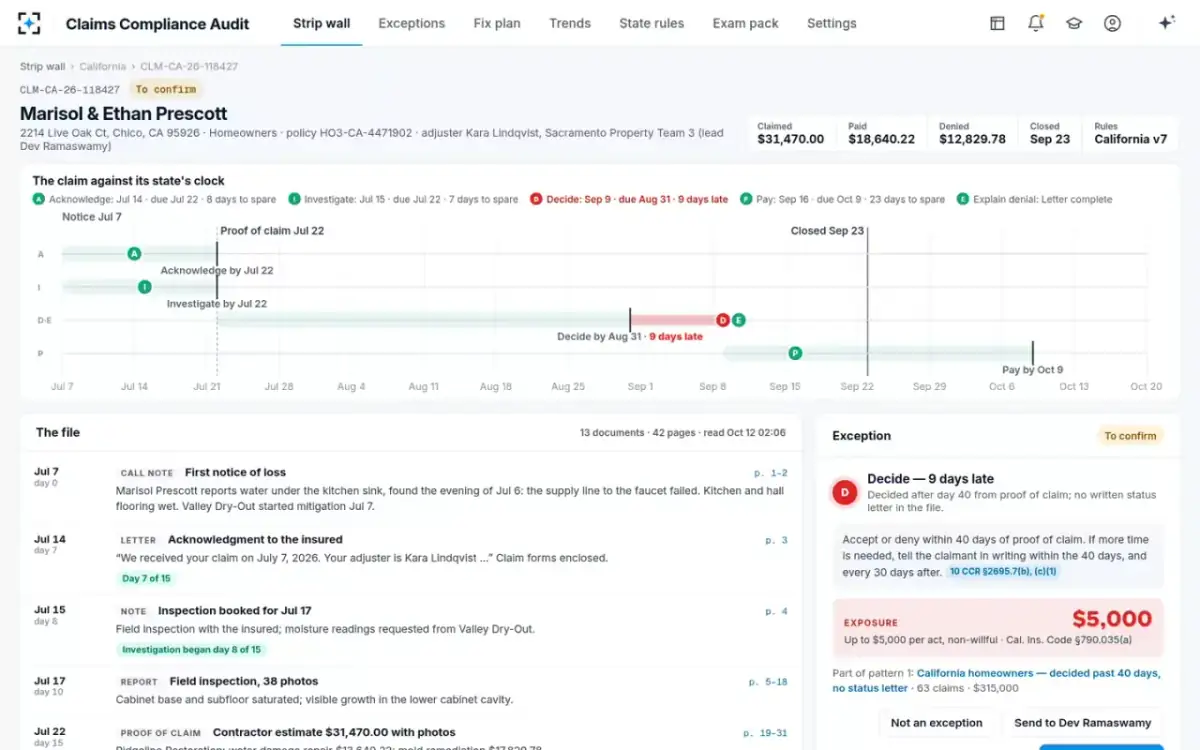
The checklist is the same one a careful analyst runs by hand. The difference is that it runs on 14,286 files instead of 60, and each line carries its page and rule version. Who confirms each exception, and what the agents may not decide, is covered in the AI claims audit tool guide.
Questions people ask
What is the difference between a claims audit checklist and a claim file audit checklist?
A claims audit checklist is a broad term; it can mean a review of adjuster invoices, leakage or reserves. A claim file audit checklist for compliance tests the file against the state's fair claims rules: dates, deadlines and letter content. For invoices from independent adjusters, see the claims audit checklist for IA bills.
What should a closed claim audit checklist include?
One line for each step the state regulates, usually acknowledgment, investigation, decision, payment and the denial letter, plus documentation. Each line needs the starting event, the computed deadline, the date the step happened, the file page and the rule version. Florida alone lists seven kinds of dated record it expects in a property claim file.
Is there a claims compliance audit checklist template from the NAIC?
The NAIC does not publish a company template, but its Market Regulation Handbook sets out the eleven claims standards examiners test, with the documents to review and the review procedures for each. Adapting those standards to each state's rules is the most defensible way to build a template.
How many claim files should a checklist review be run on?
Enough to support the conclusion you want to draw. Examiners using the handbook's acceptance table sample 76 to 108 claims from populations of 200 to 5,000 for each test (2017 edition). A desk that wants to find every late step rather than estimate a rate has to read every file, which is what the sample quarter in this guide did.
What makes a claims quality assurance audit checklist different?
It usually scores the claim against the company's own standards: coverage, amount, reserve and file notes. In Florida the two lists converge, because examiners test the insurer's claims-handling manual as well as the statute; one 2025 report found 47.8% of sampled claims missed the insurer's own 72-hour inspection standard.
How long should claim files be kept for an audit?
As long as the strictest state you write in requires. California expects claim files for the current year and the four before it; the NAIC model regulation asks that claim data be available for the current year and the two preceding years. Keep the audit's own evidence for at least as long as the files it tested.