A claims compliance analyst checks whether closed insurance claims were handled the way the state's fair claims rules require: acknowledged on time, investigated, accepted or denied within the deadline, paid, and, when denied, explained in writing with the right content. The hard part is not the rules. It is the dates. Nothing in a claim system records "acknowledged on day 7 of 15"; the analyst reads notes, letters, estimates and payments to rebuild each date, then applies a clock that counts calendar days in one state and business days in the next. Botminds' Claims Compliance Audit is built for this desk. Specialist agents read every closed file and date each step with the page it came from, and a person on the desk confirms or overturns every exception they find.
The examples below use a fictional sample insurer, Ashgrove Mutual Insurance Group, with third-quarter claims in California, Texas, Florida and New York. Its people, claims and figures are sample data from the solution, not a customer's results. The rules are quoted from the regulators' own texts, linked where they appear.
What the rules ask a claims desk to be able to prove
11standards
for claims in the NAIC examiners’ handbook, from first contact to litigation
7records
with dates that Florida requires a property insurer to keep on each claim
4years
of closed-claim data California expects to be retrievable, plus the current year
15business days
for New York’s acknowledgment, where most states count calendar days
What does a claims compliance analyst do?
A claims compliance analyst turns each closed claim into a list of dated steps and tests every step against the rule of the state that governs the claim. The work runs in the same order on every file: find the notice of claim, the acknowledgment, the start of the investigation, the proof of loss or proof of claim, the decision, the payment and any denial letter; put a date on each; work out each deadline from the right starting event; and record a pass, an exception or "not applicable" with the evidence.
The starting events are where the judgment lies. California's 40-day decision clock runs from "proof of claim", which its regulation defines broadly as any evidence in the insurer's possession that reasonably supports the size of the loss (10 CCR 2695.2(s); see California denial letter requirements). A contractor's estimate can start it before anyone has signed a sworn proof of loss. Texas starts its 15-business-day decision clock only when the insurer has received every item it asked for (§542.056(a)). An analyst who dates the wrong event produces a clean-looking result that is wrong.
The evidence the analyst relies on is itself a regulatory requirement. California requires three dates on every material document in the file: when it was received, when it was processed and when it was sent or mailed (2695.3(b)(2)). The NAIC's model regulation says the same in fewer words (Model 902 §4C). A file without those dates is an exception before any clock is tested.
Claims compliance analyst job description: the duties the rules write
Most of a claims compliance analyst's job description is written in the regulations rather than in an HR template. Each state names records that must exist, training that must happen and certifications someone must sign, and the analyst is the person who checks that they do. The table pairs six of those duties with the rule behind each and the test an analyst runs.
A claims compliance analyst job description, written from the rules
| Duty | Where a rule asks for it | What the analyst checks |
|---|---|---|
| Date every document as received, processed and sent | Where a rule asks for itCalifornia 10 CCR 2695.3(b)(2); NAIC Model 902 §4C | What the analyst checksEach step on the claim has a date and the page it came from. |
| Keep files an examiner can rebuild event by event | Where a rule asks for itNew York 11 NYCRR 216.11; California 2695.3(a) | What the analyst checksNo step depends on memory: a call, a promise or a request has a note. |
| Produce claim data by number, line, loss date and outcome dates | Where a rule asks for itCalifornia 2695.3(b)(1): current year and four before it; Model 902 §4A: two before it | What the analyst checksThe closed-claims list reconciles to the files behind it. |
| Make sure every handler knows the regulation | Where a rule asks for itNew York 216.0(e)(6); California 2695.6(b) annual certification | What the analyst checksTraining records match the handlers on the sampled files. |
| Run a claims-handling manual and attest to it every year | Where a rule asks for itFlorida §627.4108: attestation each year by 1 May | What the analyst checksThe manual’s own deadlines are tested, not just the statute’s. |
| Log every adjuster who talks to the policyholder | Where a rule asks for itFlorida §627.70131(4)(a) | What the analyst checksThe name and license number appear on later letters. |
Two of these duties fall on management, but they land on the analyst's desk as evidence. New York's Regulation 64 requires every insurer to give a copy of the regulation to each person who supervises, handles or settles claims, and says each insurer "shall satisfy itself that all such personnel are thoroughly conversant with, and are complying with, this regulation" (216.0(e)(6)). The analyst's sample is how the insurer satisfies itself. California goes further: an entity's annual certification that its claims manual contains the regulations is executed "under penalty of perjury" by a principal (2695.6(b)(2)).
Florida added a duty in 2023 that turns the company's own manual into a compliance standard. Every residential property insurer must keep a claims-handling manual covering acknowledgment, communication, reserving, investigation, estimates, payment or denial and closing, and attest each year by 1 May that it complies and that the insurer has the resources to follow it "including during natural disasters and catastrophic events" (§627.4108). Examiners then test the manual's deadlines alongside the statute's. In one 2025 Hurricane Ian examination, 47.8% of sampled claims missed the insurer's own 72-hour inspection standard (Florida OIR).
Four seats on the claims QA desk, and who sits in each
A claims compliance desk usually has four seats, whatever the titles: the analyst who dates and tests, the reviewer or auditor who decides whether an exception is real, the quality manager who turns exceptions into fixes, and the compliance officer who answers the regulator and signs. In a small insurer one person may hold two of them. What matters is that the person who finds an exception is not the only person who decides it, and that someone with authority signs what goes to the department.
The same quarter on the claims QA desk, seat by seat, before and after the agents
Today
Draws the quarterly sample, reads each file end to end and dates every step in a spreadsheet; most of the quarter goes here.
With agents
Starts from every closed claim already dated and cited to its page, and spends the time on the exceptions and the edge cases.
Still theirs: which event starts each clock, and when the file is ambiguous
Today
Reads the analyst’s write-up of a few dozen files and agrees or disagrees in a meeting.
With agents
Confirms or overturns each exception with a reason: the insured asked for more time, the wrong date was read, or the claim is out of scope.
Still theirs: the decision that an exception is a violation
Today
Gets a list of errors by count and fixes the most common one first.
With agents
Sees the same root causes ranked by money at risk beside the count, and assigns each fix to a team lead.
Still theirs: which fix is worth doing first
Today
Signs an exam response assembled by hand from a sample and a spreadsheet.
With agents
Approves each state’s rule version and the exposure schedule, and signs a pack in which every exception carries its file page.
Still theirs: the signature; nothing goes to a regulator without it
Claims compliance auditor, specialist or QA analyst: what differs?
The titles overlap, but two questions separate them. A claims quality assurance analyst usually asks whether the claim was handled to the company's own standard: right coverage, right amount, right reserve, good file notes. A claims compliance analyst, auditor or specialist asks whether it met the state's rules, the yardstick an examiner will use. The work converges because examiners now test both. Florida's 2025 reports cite insurers for missing deadlines in their own manuals beside the statutory ones.
Claims quality assurance and claims compliance: the same file, two questions
Claims quality assurance: Did we handle this claim well, to our standards?
Claims compliance testing: Did we meet each deadline and letter rule in the governing state?
Claims quality assurance: Claims manual, authority levels, payment accuracy, reserves.
Claims compliance testing: Statute and regulation for that state and line, plus the manual where a state tests it.
Claims quality assurance: Often by adjuster or team, a few files each per month.
Claims compliance testing: By state, line and step, sized to support a conclusion an examiner accepts.
Claims quality assurance: A coaching point or a leakage amount.
Claims compliance testing: An exception that may be a violation once someone confirms it.
Claims quality assurance: Claims leadership.
Claims compliance testing: Claims leadership, the compliance officer and, eventually, the examiner.
The claims compliance manager title usually sits over both: it owns the testing plan, the rule table for each state and the corrective-action log, and it is the person the compliance officer calls when a data call arrives. The official occupation data does not separate these seats. In the US occupational classification, compliance work sits under Compliance Officers (13-1041), and claims analysts and examiners under Claims Adjusters, Examiners, and Investigators (13-1031). A claims compliance analyst can sit in either, depending on whether the role reports to compliance or to claims.
Where a quarter of claims compliance testing goes
Most of a quarter goes to two jobs that add nothing to judgment: pulling files and dating steps, and answering an exam data call by hand. Botminds' estimate for one quarter's testing plus one data call, done by hand, is 32 working days, and almost two thirds of it sits in those two rows. With the agents reading and dating, the same work is estimated at 7 days, and most of what is left is review and sign-off, which stays with people.
Where the days go in Claims Compliance Audit's estimate, by hand and with the agents
By hand · 32 days
- Pull files, date steps · 31%
- Test each step · 13%
- Read letters · 9%
- Root causes · 9%
- Exam data call · 32%
- Review, sign · 6%
With the agents · 7 days
- Pull, date · 7%
- Test · 7%
- Letters · 14%
- Root causes · 14%
- Data call · 29%
- Review, sign · 29%
The split explains why sample sizes stay small. If dating one file takes most of an hour, a desk can afford a few dozen files a quarter, which is also why the sample rarely reaches the patterns examiners find. The arithmetic of what a small sample can and cannot detect is set out in the claims audit sample size calculator.
What examiners do with the analyst's work
Examiners run the same tests the analyst runs, on the insurer's data, and they arrive with a method. The NAIC's examiners' handbook tells them to check the company's standards, then test files: for the first claims standard it says plainly, "Perform a time study of acknowledgment times" (Handbook, 2017 edition, chapter 16). For timeliness of settlement its automation tip asks for a list of closed claims with reported and closed dates, computes the days between them and groups the results into ranges to look for patterns.
An analyst who has already run those time studies has three advantages. The insurer knows its own error rates before the examiner states them. It can fix a pattern and show the correction in the file. And it can explain an outlier before it becomes a criticism. Florida also bills the examined insurer for the reasonable cost of the examination, contracted examiners included (§624.3161(3) and (4)). Every file the analyst cleans up in advance is one the examiner does not have to write up.
The skills that matter: reading a date, a rule and a letter
The skills that separate a good claims compliance analyst are reading precision and rule literacy, not statistics. Four traps catch most new analysts, and each is written into a rule.
Which kind of day. New York counts 15 business days to acknowledge (216.4(a)); California counts 15 calendar days and, when the last day falls on a weekend or holiday, extends to the next working day (2695.2(b)). Texas's acknowledgment runs to "the 15th day" while its decision runs to "the 15th business day" (§§542.055, 542.056).
Which event starts the clock. Notice of claim, proof of loss, proof of claim, receipt of all requested items and notice of acceptance are different events, and the rules use all of them. Florida's 60-day pay-or-deny clock runs from notice of the claim, not from proof of loss (§627.70131(7)(a)).
What stops it. Florida tolls its clocks while a policyholder has not answered a request for material information for more than 10 days, but only for requests sent at least 15 days before the deadline (§627.70131(8)(b)). An analyst who applies tolling from a note that says "waiting on insured" will excuse files the statute does not.
What the letter must say. A denial can be on time and still fail for content: a missing policy reference, a missing reason or a missing regulator notice. The California rules are taken apart line by line in insurance claim denial letter requirements in California.
How Claims Compliance Audit changes each seat
Take the sample insurer's third quarter as it runs through Claims Compliance Audit. Ashgrove Mutual closed 14,286 claims. Overnight, the agents dated every step and tested it against the rule version for its state, and 559 claims came back with a late or missing step. The previous quarter's hand sample of 60 files had found 2 exceptions. The analyst's seat changes the most: the file reading is done, and what remains is checking the agents' reading on the exceptions and the ambiguous files.
Every closed claim of the quarter, and each late step priced
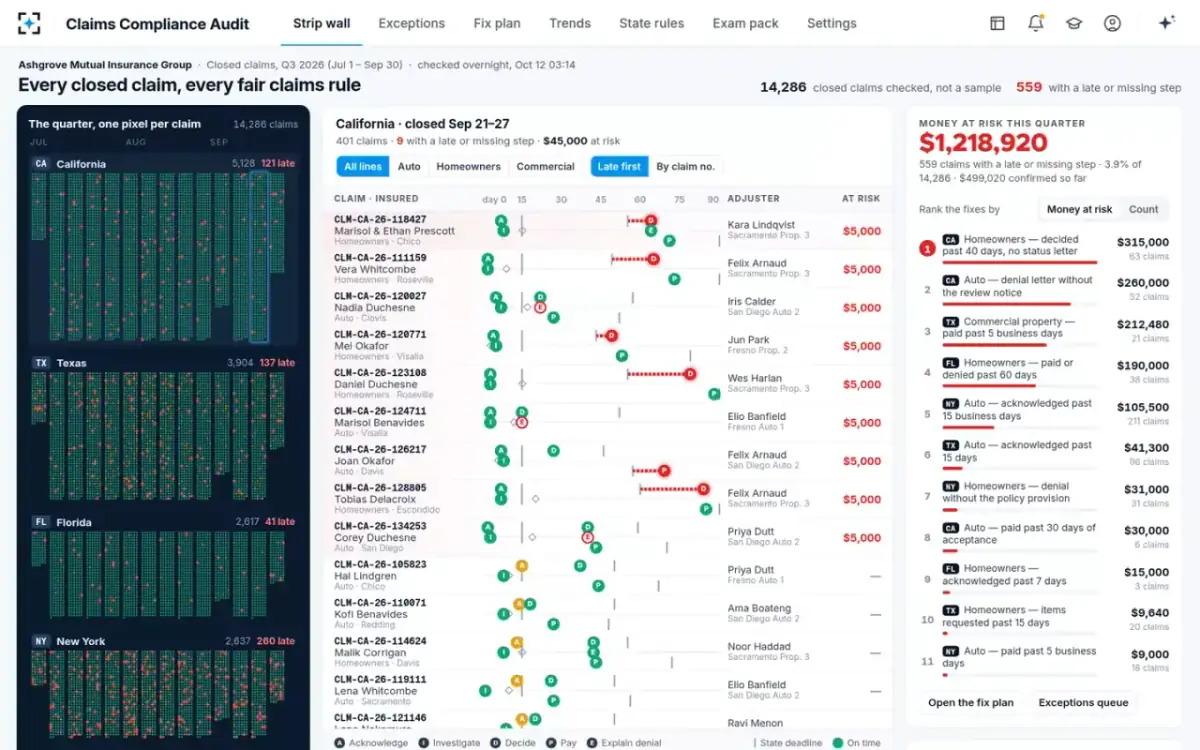
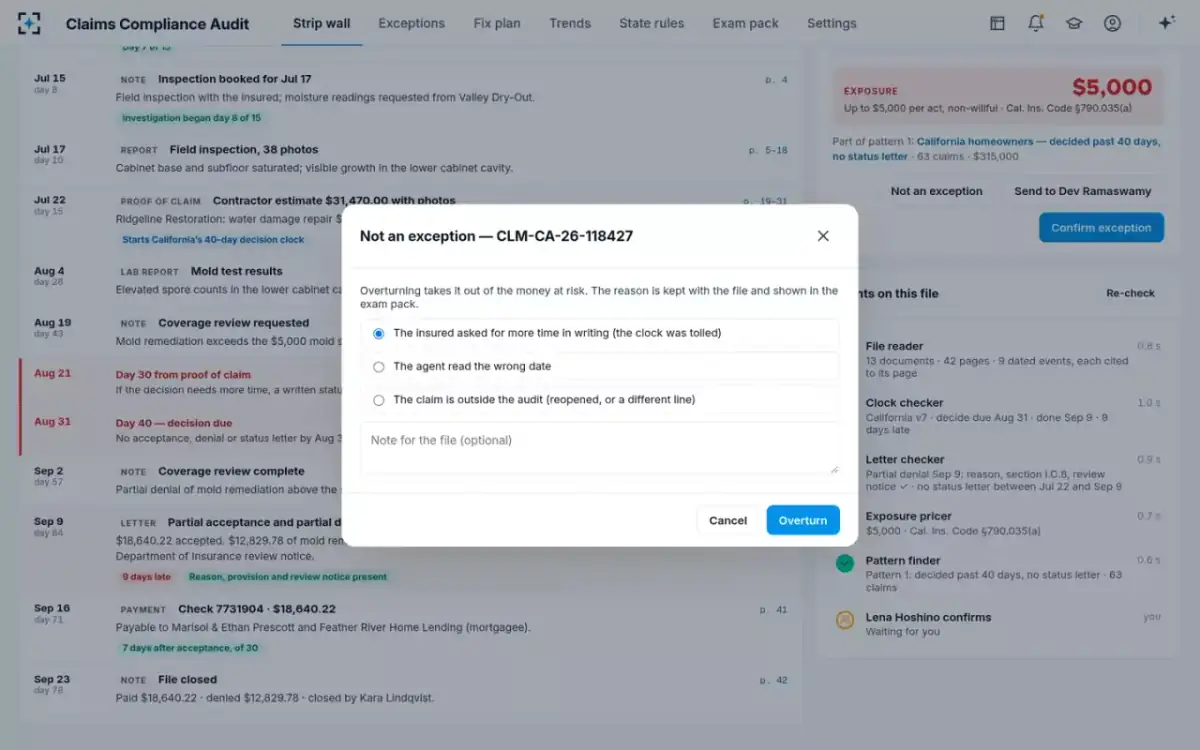
The reviewer's seat changes in a different way: it gets more decisions, each smaller. Nothing counts as an exception until a reviewer confirms it, and overturning one requires a reason that stays with the file and goes into the exam pack. In the sample quarter, reviewers had confirmed 212 exceptions, overturned 16 and had 331 left to confirm when the screens below were taken. The three overturn reasons are the three ways an automated reading can be wrong or incomplete, which is why they are fixed choices rather than free text.
Overturning an exception needs a reason, and the reason travels with the file
The quality manager stops ranking fixes by how often an error occurs and starts ranking them by what it puts at risk. The compliance officer stops assembling the data call: the solution builds it in the regulator's layout and holds it until he signs. What each agent does, and what none of them may decide, is set out in the six agents and their limits. The checklist the desk tests against is in the claim file audit checklist.
Questions people ask
Is a claims compliance analyst the same as a claims auditor?
Often the same seat, sometimes two. An analyst dates and tests the files; an auditor or reviewer decides whether each exception is a real violation and signs off the results. Keeping the two decisions apart is what makes the result defensible when an examiner asks who decided.
What does a claims quality assurance analyst review?
Mainly whether a claim was handled to the company's own standard: coverage, amount, reserve, notes and authority. Compliance testing adds the state's deadlines and letter rules. In Florida the two meet, because examiners test insurers against their own claims manuals; one 2025 report found 47.8% of sampled claims missed the insurer's own 72-hour inspection standard.
What is a claims compliance analyst's salary?
No public series reports pay for this exact title. The US Bureau of Labor Statistics publishes wages by occupation and industry, and the seat falls under Compliance Officers (13-1041) or Claims Adjusters, Examiners, and Investigators (13-1031). For insurers, the table to read is the occupational employment and wage estimates for insurance carriers, industry 524100.
What does a claims compliance manager own?
Usually the testing plan, the rule table for each state, the exception log and the corrective actions. When a regulator sends a data call, the manager assembles the response and the compliance officer signs it. In New York, a corporate officer must be responsible for the department that handles complaints to the regulator (216.4(c)).
How many claim files does a claims compliance analyst review each quarter?
Most desks sample a few dozen files per state or line, because each file takes a long time to date by hand. Examiners using the NAIC handbook's acceptance table draw 76 to 108 claims for one test from populations of 200 to 5,000 (2017 edition). The sample insurer in this guide reviewed 60 files and found 2 exceptions; testing every closed claim found 559.
Does a claims compliance analyst need to know every state's rules?
The desk needs a rule table for every state it writes in, kept current and approved. The NAIC's model regulation is only a starting point: the NAIC's own state chart lists 23 jurisdictions as having adopted it, and many large states, including California and Texas, wrote their own rules. Which state's rule applies is itself the first question on every file.