A closed claim file review process is the routine by which a claims compliance or quality team takes claims that have been closed, rebuilds what happened in each from the file, and tests every step against the rules that applied: the state's deadlines and letter requirements, and the company's own claims manual. Its output is a list of exceptions, an error rate by step and state, the root causes behind them and the corrective actions that follow. Its weakness is coverage. Rebuilding a file by hand is slow, so most desks review a few dozen closed claims a quarter and estimate the rest. Botminds' Claims Compliance Audit runs the same review on every closed claim, with each date cited to its file page. The quickest way to find out whether that is worth doing is to pilot it on a quarter your team has already reviewed by hand.
The pilot below is a plan this guide proposes, not a measured result. The numbers that illustrate it come from the solution's fictional sample insurer, Ashgrove Mutual Insurance Group, whose third-quarter hand sample of 60 files found 2 exceptions.
While it is rarely feasible to review all files of an examinee, the examination must nevertheless produce credible judgments about all files.
NAIC Market Regulation Handbook, chapter 14, 2017 edition
What is a closed claim file review process?
A closed claim file review process is a scheduled test of finished claims against the standards they had to meet. The standard sequence has seven steps: set the scope by state, line and closing period; pull the list of closed claims; select the files; rebuild the dates of each step from the documents; test each step against the governing rule; log and confirm the exceptions; and turn the confirmed ones into root causes and fixes. Everything after the first two steps depends on how well the dates are rebuilt.
Scope is a decision with consequences. Florida's examiners split each Hurricane Ian claims population into claims closed with payment, claims closed without payment, and reopened or supplemental claims, and sampled each separately (Florida OIR, Tower Hill report). A company review that mixes them will under-sample the closed-without-payment files, which carry the denial letters and most of the content rules. A closed claim review for subrogation recoveries is a different exercise with a different scope; it is covered in closed file review for subrogation.
Closed claim review process: where the review should look first
A closed claim review process should look hardest where the exceptions are, and those are rarely spread the way the claims are. In the sample quarter, New York closed 2,637 of the 14,286 claims, 18.5%, and produced 260 of the 559 claims with a late or missing step, 46.5%, most of them business-day acknowledgments. Florida closed almost as many, 2,617, and produced 41, or 7.3%. A hand sample spread evenly across states would spend most of its files where little was wrong.
Claims Compliance Audit's sample quarter: where the claims were, and where the late steps were
Closed claims · 14,286
- California · 36%
- Texas · 27%
- Florida · 18%
- New York · 19%
Claims with a late or missing step · 559
- California · 22%
- Texas · 24%
- Florida · 7%
- New York · 47%
The examiners' handbook makes the same point in its own terms. It warns that results cannot be carried across populations: "A sample can only be representative of the population from which it was drawn—and no other" (Handbook, chapter 14). A review that samples one office or line cannot speak for another, so a desk that wants a defensible quarterly result has to sample each state and line it means to report on, or read all of them.
Why pilot on a quarter you have already reviewed by hand?
Because the hand review is the answer key. The team already knows which files it pulled, which exceptions it found and how long it took. Running Claims Compliance Audit on the whole of that quarter produces three comparisons no demo can: whether the tool finds what the team found, what else it finds in the files nobody pulled, and how often a reviewer disagrees with the tool's reading. Each is measured on the company's own files and rules.
It also avoids a trap. A pilot on the current quarter has no baseline, so a large exception count can be read as either a tool that over-flags or a quarter that went badly, and nobody can tell which. A closed quarter with a signed hand review removes that ambiguity. If the tool finds the 2 exceptions the sample found and 557 others, the reviewers' confirmations decide how many of the 557 are real.
The handbook explains why a small hand sample leaves that question open. The first sample an examiner draws is built only to rule out an error rate above the threshold, and the handbook cautions that it "cannot be used to establish with confidence" that the true rate is above it either (chapter 14). A 60-file quarter that finds 2 exceptions is consistent with a population error rate as low as 1% or as high as 10%. The arithmetic is worked through in the claims audit sample size calculator.
The four-week pilot, week by week
A pilot on one closed quarter fits in four weeks if the data arrives in the first one. The plan below runs the compliance team and the agents in parallel lanes. The agents' work is front-loaded; the people's work is in weeks three and four, when exceptions are confirmed and the comparison is written.
A four-week Claims Compliance Audit pilot on last quarter's closed claims
- Approve rules and scheduleWeek 1
- Spot-check agents’ datesWeek 2
- Confirm every exceptionWeek 3
- Compare and decideWeek 4
- Connect export and filesWeek 1
- Read and test every claimWeek 2
- Price and group patternsWeek 3
- Draft fix plan and packWeek 4
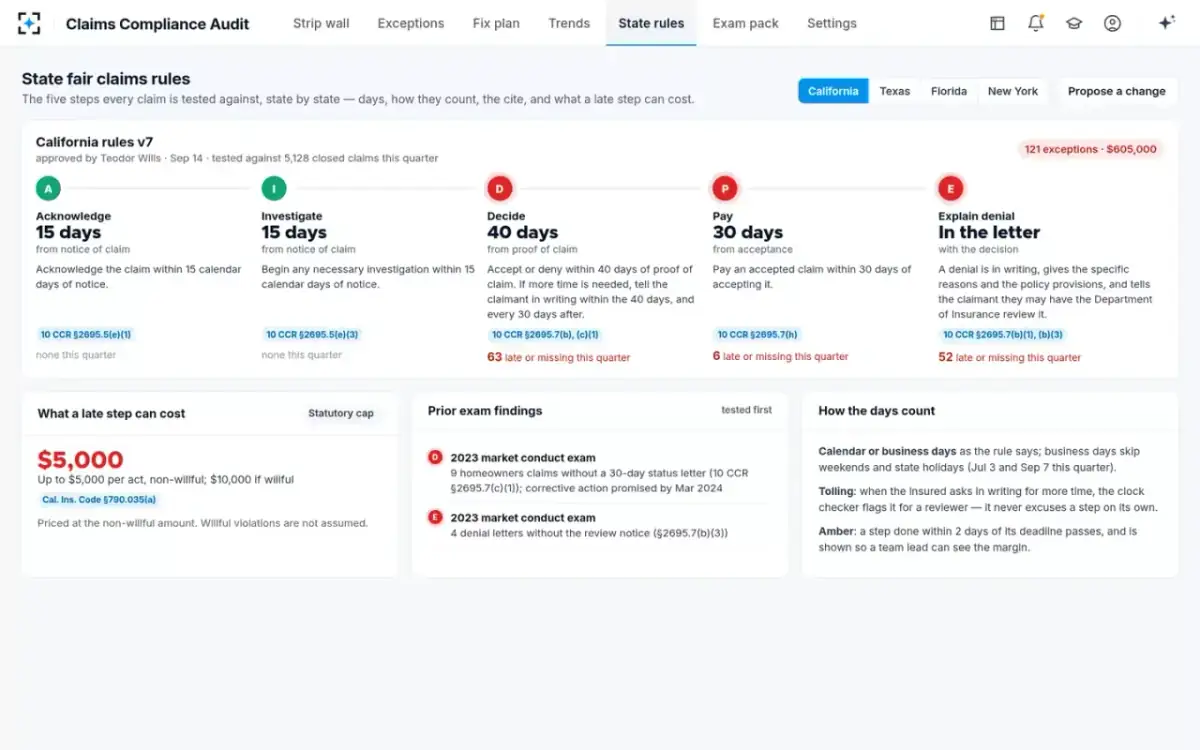
Week one decides the pilot. The rule table for each state has to be approved by the person who will sign exam responses, because every result will cite it. The exposure schedule needs the same approval: statutory caps where a state sets them, statutory interest such as Texas's 18%, and the company's own estimates elsewhere, each labeled. If the prior quarter's exam findings exist, they go in now, so the agents test those steps first.
Week one in Claims Compliance Audit: a state's rules, approved and versioned, with prior exam findings tested first
Week two is the only week in which the team checks the agents' reading rather than their results. Pick 30 files at random, including some from the hand sample, and compare every date the agents recorded with the page they cited. A wrong date here is cheaper to find than a wrong exception in week three.
What to bring to a closed claim file review pilot
A pilot needs six inputs, and four of them already exist in most claims organizations. The export of claims in closed status for the quarter, with claim number, state, line and closing date. Access to the claim files themselves: notes, letters, estimates and payments, page by page. The state fair claims rules the team already tests against, which become the approved rule table. The exposure schedule. Any prior market conduct exam findings, tied to the step they cited. And the hand review of the same quarter: the list of files pulled, the exceptions found and the hours spent.
The last input is the one teams forget to keep. Without the list of sampled files, the pilot can still find exceptions, but it cannot answer whether the tool agrees with the people on the files both of them read. Save the sample list before the pilot starts.
Closed claim file review form: the fields for each file
A closed claim file review form should record, for each file, enough that another reviewer could reach the same result from the file alone. The fields below are the ones Claims Compliance Audit fills for every claim, shown with the values for one sample file, a California homeowners water claim decided nine days after its deadline.
A closed claim file review form, filled in for one sample claim
| Field | Sample claim CLM-CA-26-118427 | Why it is on the form |
|---|---|---|
| Scope | California · homeowners · first party · closed 23 Sep | Decides the rule set and whether the claim is in the review. |
| Rule version | California rules v7 | Proves which text the claim was tested against. |
| Notice of claim | 7 Jul · call note, pages 1–2 | Starts the acknowledgment and investigation clocks. |
| Acknowledgment | 14 Jul · letter, page 3 · day 7 of 15 | Timely, with its evidence. |
| Proof of claim | 22 Jul · contractor estimate, pages 19–31 | Starts California’s 40-day decision clock. |
| Decision | 9 Sep · partial acceptance and denial, pages 38–40 · due 31 Aug | 9 days late; no written notice of the need for more time. |
| Payment | 16 Sep · 7 days after acceptance, of 30 | Timely. |
| Denial letter | Reason, policy section and Department review notice present | Content passes; only the timing fails. |
| Exposure | $5,000 · per act, non-willful, from the approved schedule | An estimate with its basis, never a fine. |
| Reviewer decision | Confirmed by the claims compliance lead | A person decided; the log keeps who, when and why. |
Who does what during the pilot
Four people carry a pilot, and each needs to see a different result. The reviewer needs the exceptions, one by one. The quality manager needs the patterns and their price. A claims team lead needs the team's own files. The VP, Compliance needs to know that the rules were approved and that nothing leaves without a signature.
Four roles in a closed claim file review pilot, and what changes for each
Today
Reviews the 60 sampled files and writes the quarterly memo.
With agents
Confirms or overturns each exception the agents found across the whole quarter, giving a reason for every overturn.
Still theirs: whether an exception is real
Today
Ranks the sample’s errors by how often they occurred.
With agents
Compares the count ranking with the money ranking for the same patterns, and picks the fixes to test first.
Still theirs: which fix is assigned and to whom
Today
Hears about a late decision from the quarterly memo, weeks later.
With agents
Sees the team’s strips and the exceptions sent to the team, without being able to change a result.
Still theirs: the team’s fix, such as a day-30 diary
Today
Signs a memo built from a sample and a spreadsheet.
With agents
Approves the rule versions and exposure schedule in week one, and decides in week four whether to go live.
Still theirs: the go-live decision and every signature
Reading the result: what counts as success
A pilot succeeds if it answers four questions with numbers, and the first one is the easiest to forget. Did the agents find every exception the hand sample found? If they missed one, find out why before anything else: a wrong date, a wrong rule, or a document the export did not include.
Second, what did they find that the sample did not, and is it real? In the sample quarter the agents flagged 559 claims; by the time the screens were taken, reviewers had confirmed 212, overturned 16 and had 331 still to decide. The overturn rate on decided exceptions, 16 of 228 or about 7%, is the most honest accuracy measure a pilot produces, because each overturn carries a reason: the insured asked for more time in writing, the agent read the wrong date, or the claim was outside the audit.
Third, does pricing change the fix plan? In the sample it did. The most frequent pattern was 211 late New York auto acknowledgments; the most expensive was 63 California homeowners claims decided after 40 days with no status letter, at $315,000 on the sample schedule. Fourth, what did it cost in people's time? Botminds estimates a quarter's testing and one data call at 32 working days by hand and 7 with the agents. A pilot should replace that estimate with the team's own figure.
A pilot should also say when to stop. If reviewers overturn a large share of exceptions for "wrong date read", the files or the export are not ready. If the state rule tables cannot be agreed in week one, the problem is in the rules, not the tool, and it would have surfaced in an exam eventually.
Closed claim audit report: what the pilot hands the VP
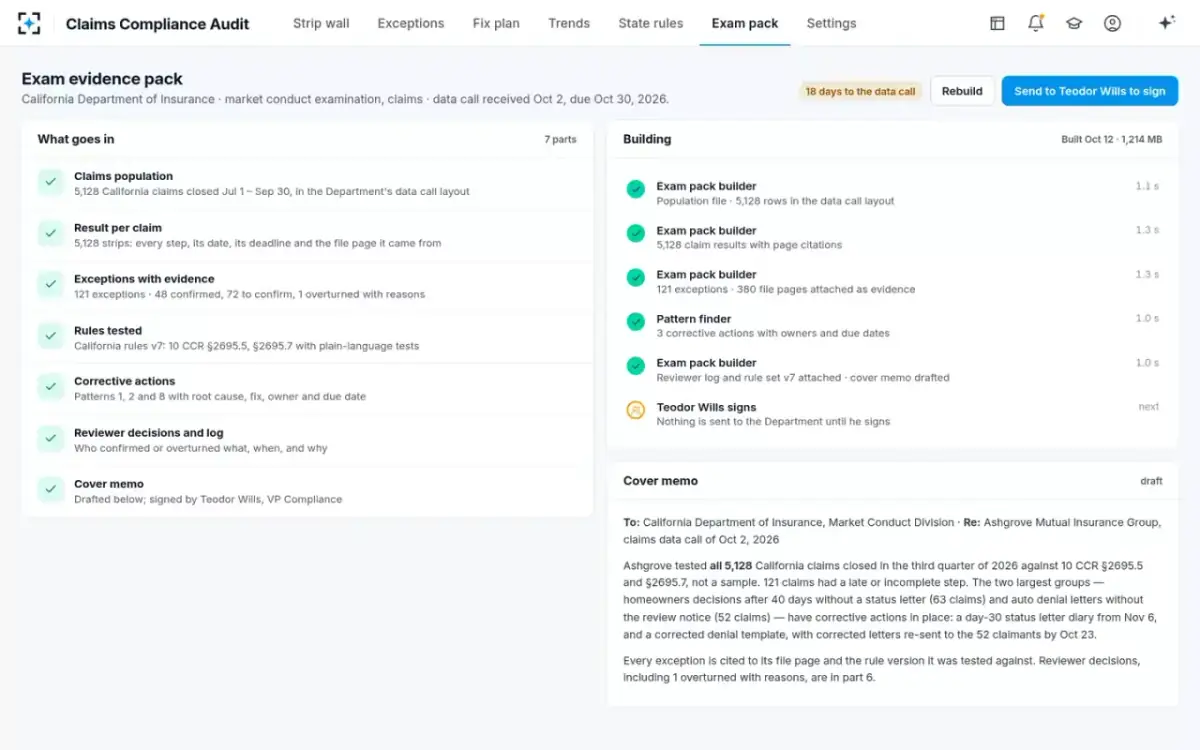
A closed claim audit report from the pilot should be the same document the company would send a regulator, so the pilot doubles as an exam rehearsal. Claims Compliance Audit builds it in seven parts: the claims population, the result for every claim with page citations, the exceptions with their evidence, the rules tested, the corrective actions, the reviewer log, and a cover memo drafted from confirmed numbers only. Nothing is sent until the VP, Compliance signs.
The exam evidence pack, built from the pilot quarter in the regulator's layout
The report should also show what the company did about the exceptions. Florida's statute expects it: if an insurer discovers a nonwillful violation, it must correct it and, where restitution is due, pay every affected person with interest at 12% a year (Fla. Stat. §624.4211(2)(b)). In one 2025 Hurricane Ian examination the insurer issued $46,320.09 in restitution to Florida policyholders after auditing the sampled claims (Florida OIR). California's penalty rules list remedial measures and the number of affected claims among the factors the Commissioner weighs (10 CCR 2695.12(a)). An exception the company found and fixed itself reads very differently from one the examiner found first.
The second thing the report hands over is the fix plan, ranked both ways. How the Texas line on that plan is priced is set out in Texas Insurance Code 542.060; who decides what at each stage is in the AI claims audit tool guide.
Questions people ask
How often should closed claim file reviews be done?
Often enough that a fix can be tested in the next review. A quarterly hand sample is common, as at the sample insurer. With agents reading every file, Claims Compliance Audit checks claims closed the day before every night and re-checks the whole quarter on the 5th of each month against the rules then in force.
What is the difference between a closed claim review and an open claim review?
A closed claim review tests what already happened, for compliance reporting and exam readiness. An open claim review watches clocks that are still running, so a late step can be prevented. Both use the same state deadlines; the open-claim side is covered in prompt payment laws by state.
What should a closed claim audit report include?
The population tested, the result per claim with evidence, the exceptions, the rules and versions applied, the corrective actions with owners, and a log of who confirmed or overturned each exception. A report built this way can answer a regulator's data call without being rebuilt.
Can an insurer fix a claim after a closed claim review finds an error?
Yes, and some states expect it. In Florida an insurer that discovers a nonwillful violation must correct it and pay any restitution due with 12% interest. In one 2025 examination an insurer paid $46,320.09 in restitution after auditing the sampled claims.
How long does a closed claim file review pilot take?
Four weeks is enough for one closed quarter if the claims export and file access arrive in the first week. The agents read and test the whole quarter overnight; the time goes into approving the rules, checking dates and confirming exceptions.
How do you measure whether a closed claim review tool is accurate?
By how often a reviewer overturns its exceptions, and why. In the sample quarter reviewers overturned 16 of the 228 exceptions they had decided, about 7%. Check also that it finds every exception your hand sample found on the same files.