A closed file review in insurance is a structured second read of claims that have already been closed, to check what the insurer did against what it should have done. Three kinds go by the same name. A claims audit checks payments and handling against the company's own standards; the Bureau of Labor Statistics describes that part of the claims examiner's work as reviewing "settled claims to determine that payments and settlements are made in accordance with company practices and procedures" (BLS). A market conduct examination, run by a state insurance department, samples closed files against the unfair claims practices laws. A subrogation review rereads closed files for another party who should have paid and was never pursued. The third is the one this guide is about, and it is the one that pays for itself, because a recovery found while its statute of limitations is still running can still be collected. Botminds' Subrogation Identification runs it every week, on every closed claim.
A subrogation closed file review also does a second job that the other two do not. Because the claims are already closed, the insurer knows how each one ended: recovered, waived, denied or never considered. That makes last year's closed files the best test set a carrier has for any tool that claims to find missed recoveries.
Replaying last year’s closed claims: the steps, and what each never does
Agent
Closed-file rereaderPulls every closed claim from a chosen quarter of losses, and every claim the day it closes.
Never: reopens a claim or changes a reserve; it is read-only on the claim system
Agent
Claim readerReads every note, statement, report and photo caption, and marks each sentence that points to another party.
Never: decides liability
Agent
Responsible party finderNames the party and its insurer from plates, invoices and reports; unknown stays unknown.
Never: contacts a party
Agent
Already-handled checkSets aside files already recovered, waived or under the minimum, with the record that shows it.
Agent
Statute clockDates every theory against every party; files past their date are counted, not listed.
Never: extends a date
Agent
Closed-file rereaderRanks what is left by recoverable money and days remaining.
A person decides
Subrogation supervisorConfirms each find with its sentence in view, or marks it not recoverable with a reason.
A person decides
Validation reviewerScores the replay against how each closed file actually ended.
What is a closed file review in insurance?
It is a review of claims after closing, and the three kinds differ in who runs them, what they sample and what they are looking for. Confusing them is costly: a carrier that passes its market conduct exam on closed files has learned nothing about whether it missed recoveries, because the examiners were not asking.
Three closed file reviews that share a name
| Review | Who runs it | What it looks for | How files are chosen |
|---|---|---|---|
| Claims audit | The insurer’s own quality or audit team, or an outside auditor | Payments, reserves, documentation and handling against company standards | A sample, usually by adjuster, line or size of loss |
| Market conduct examination | A state insurance department’s examiners | Practices that break the unfair claims settlement laws, such as late payment or missing notices | A random sample from a defined population of files |
| Subrogation review | The subrogation unit, an outside firm, or software | Another party who should have paid and was never pursued, while the deadline still runs | Every closed file in the window, or a sample to measure |
Regulators expect the material for all three to exist. California requires claim files to hold "all documents, notes and work papers" pertaining to each claim, in enough detail that events and dates "can be reconstructed", and requires files to be kept for the current year and the preceding four years (10 CCR § 2695.3). For a subrogation review, that retention rule means the closed files for every open limitation period are still on hand.
Can closed claims still be subrogated?
Yes, until the statute of limitations runs. Closing a claim is an internal act; it does not end the insurer's right against the party that caused the loss. When the insurer paid, it stepped into its insured's position. A New York appellate court put the principle plainly: the insurer, "as a subrogee, stands in" the injured person's shoes (Hartford v City of New York). The deadline the insurer must meet is therefore the insured's deadline for that theory against that party.
In Ohio, that means two years from the loss for a product liability claim or for injury to personal property (R.C. 2305.10), and four years for injury to real property and other wrongs not listed elsewhere (R.C. 2305.09). A homeowners claim closed three months after the loss therefore still has between twenty-one months and almost four years of life, depending on what was damaged and who caused it.
How far back can subrogation go?
As far back as the longest limitation period still open for any theory in the states you write, and no further. The practical answer is to work backwards from the calendar: in a state with a two-year product period, losses from the last two years are live for product claims; in a state with a four-year period for damage to buildings, the window for contractor claims on houses is twice as long. A review that starts with the oldest live claims recovers the ones about to expire; a review that starts with last month's closings finds the easiest ones and lets the oldest die.
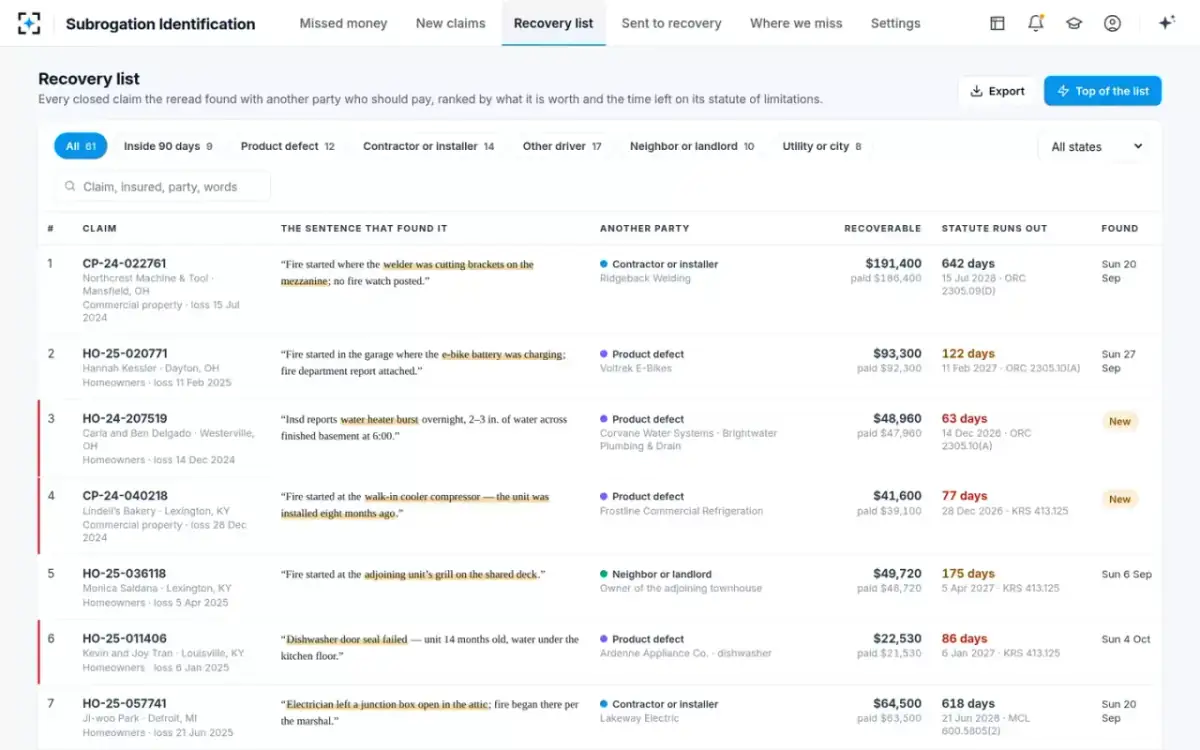
The sample carrier in the solution's story shows the cost of starting late. A homeowners claim from December 2024, closed in March 2025 as wear and tear, was picked up by the weekly reread in October 2026 with 63 days left on the product claim against the water heater's maker and two more years on the negligence claim against its installer for damage to the house.
One sample claim, two theories: the reread arrived with two months left on one and twenty-six on the other
- Loss to reread: closed at month 3, then unread22 mo
- Left at reread
- Loss to reread: closed at month 3, then unread22 mo
- Left at reread26 mo
How many closed files should be reviewed?
For a subrogation review, all of them in the live window, if the reading is cheap enough; a sample, if the goal is only to measure. The two goals need different designs. A sample tells you how often recoverable claims are being missed. Only a full reread recovers them, because a find in an unread file is still lost.
When a sample is the goal, borrow the discipline that state examiners use. The sampling chapter of the NAIC's Market Regulation Handbook, in the revision it exposed in 2014, says that once the population is defined "the sample should be randomly selected from all of the files in the target population" (NAIC). It warns against "pull lists" that quietly drop files, giving as one example a list with no claims closed without payment, which is exactly the population a subrogation sample must include. It also gives the arithmetic. For a large population, about 1,067 files give a 95% confidence interval of three points either side when the true rate is 50%, but only 203 files are needed when the true rate is near 5%. And a sample "can only be representative of the population from which it was drawn".
For subrogation, that last rule has teeth. A sample of auto claims says nothing about homeowners claims, and a sample of last month's closings says nothing about the files from two years ago that are about to expire. A carrier that wants to know its miss rate by line should sample each line.
What do you look for in a closed file review for subrogation?
The sentence, the party, the evidence and the date, in that order, and then a comparison between the closing label and the facts. A closed file review is not looking for adjuster error in the coverage sense. It is looking for a claim whose closing label answered a different question from the one that matters for recovery.
What a subrogation closed file review reads for
- A sentence that names another party
In the first notice, the adjuster’s notes, statements, police and fire reports and photo captions, not only the coded cause of loss.
- A document that names the party
Rating plate, invoice, permit or police report; if none, the document that would.
- Whether it was already handled
Recovered, waived, released, under the minimum or with a written reason. These are not new finds.
- The earliest live date
Every theory against every party; notice periods for public bodies and product repose included.
- Where the evidence is now
Kept, with the insured, with the repairer or gone. A part with a third party needs a hold request first.
- The closing label against the facts
“Wear and tear” on a split seam inside the warranty, or “insured at fault” against the police report.
A replay on one quarter of sample claims
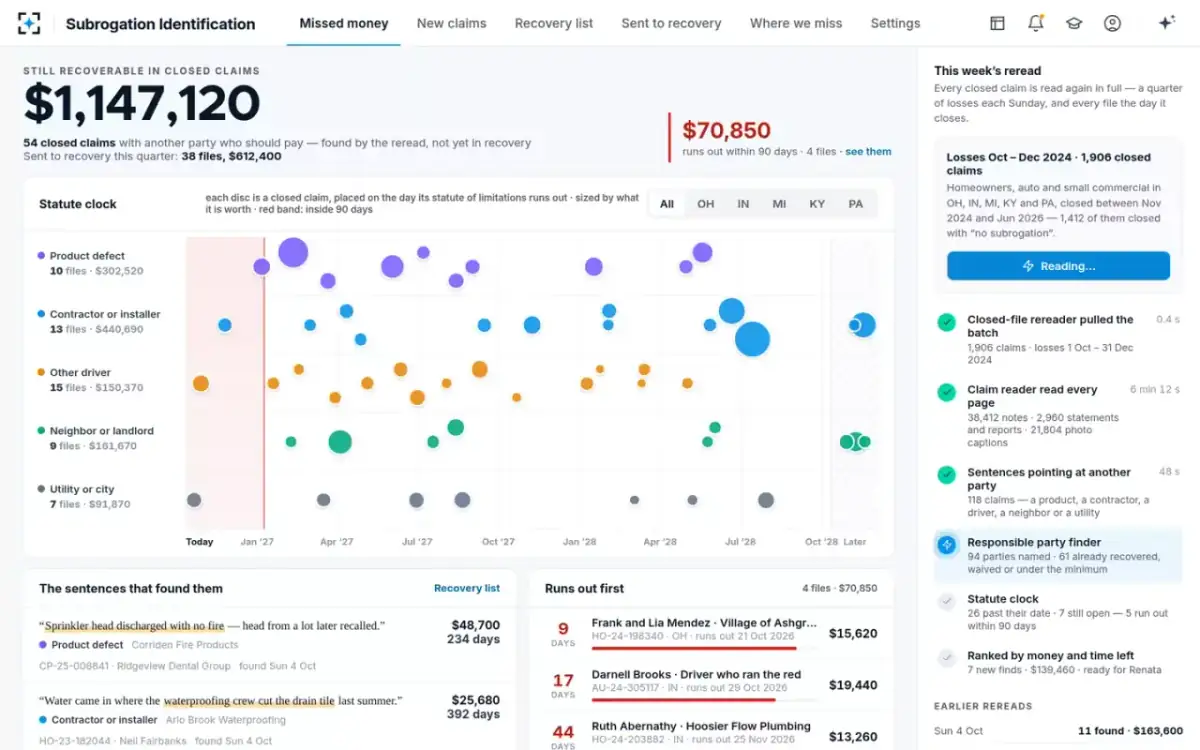
The numbers that matter in a replay are the ones that fall away at each step, because each one tells you something different about the carrier. Take one Sunday batch at the solution's fictional sample carrier, Bramblewood Mutual: losses from October to December 2024, across homeowners, auto and small commercial claims in five states, 1,412 of them closed with "no subrogation". The reread read 38,412 notes, 2,960 statements and reports and 21,804 photo captions.
One quarter of closed claims, reread: what fell away at each step
Read from the top, the funnel says that most closed claims have no other party, which is right: weather, wear and the insured's own acts cause most losses. The gap between 118 sentences and 94 named parties is where the file was silent: 24 claims pointed at a kind of party the documents did not name, and a named party is what turns a sentence into a find. The 61 already handled are the replay's answer key. If a reader cannot find the claims your team did recover, it will not find the ones they missed.
The 26 past their date are the expensive line: $412,800 that could have been recovered in the years before the reread existed, and cannot be now. The seven new finds, $139,460, went onto the statute clock as the week's work.
The reread running: each step in view, from the batch pulled to the finds ranked
How do you measure a closed file review?
With four numbers, and the most important is the one vendors rarely show. The first is the share of known recoveries the reader finds again: take the closed files your team actually recovered, hide the outcome and see whether the reader flags them. The second is the confirmation rate: of the new finds, how many does a supervisor confirm after reading the sentence and the documents? The third is the value lost to expired statutes, which should fall towards zero as the reread catches up. The fourth is time from find to decision, because a confirmed find in the last 90 days of its clock needs action the same week.
A replay should also be scored on what it set aside. A sample of claims marked "no other party" should be read by a person to check that the reader is not missing kinds of party it was never shown. And because the reader is only as good as its rules, each state's limitation, notice and fault rules should be confirmed by counsel and versioned before the replay counts. How those rules go live is set out in insurance subrogation software, from rule table to first reread.
What a replay hands the supervisor: every find ranked by money and time left
The replay is also the first harvest
A replay on last year's closed claims is usually sold as a test, but it is the most valuable work the reader will ever do, because it reaches files whose deadlines are closest. The order matters. Start with the oldest losses still inside their shortest period, then work forwards. In a two-year state, a replay that begins with the most recent quarter will spend its first weeks on claims with eighteen months to run while older ones expire behind it.
The same logic tells a buyer what to ask for in a pilot: a replay of a quarter of the carrier's own closed claims, chosen at random, scored against how those files actually ended, and run in time to act on what it finds. That is the offer Subrogation Identification makes, and it is the fairest test of any alternative. For what the agents may and may not do with a find, see AI for subrogation: the agent finds, a person decides.
Questions people ask
What is a closed file review?
A second, structured read of claims that have already been closed. Insurers use it to audit handling and payments, state examiners use it in market conduct examinations, and subrogation units use it to find recoveries that were never pursued. The subrogation version is the only one that can still recover money, as long as the statute of limitations has not run.
How do you do a closed file review for subrogation?
Define the window by the longest open limitation period, read every note, report and photo caption for another party, name the party from a document, set aside files already handled, date every theory and rank what is left by money and time. A supervisor confirms each find before a specialist pursues it.
How far back should a subrogation review go?
To the oldest loss still inside a live limitation period for any theory: two years for product and personal property claims in Ohio, four for damage to real property there. California requires claim files to be kept for the current year and the four before it, so the files for most live periods should still exist.
How do regulators sample closed claim files?
Randomly, from a defined population, without pull lists that drop inconvenient files. The NAIC's sampling chapter illustrates the arithmetic: about 1,067 files for a three-point margin at 95% confidence when the rate is near 50%, and 203 when it is near 5%. Its 2017 edition keeps the long-standing 7% error rate as the benchmark for claims practices, explained in the NAIC error tolerance chart.
What is the difference between an open and a closed claim file?
An open claim still has payments, reserves or decisions pending; a closed one has been resolved and its reserve released. For subrogation the difference is mostly attention: an open claim has an adjuster reading it, while a closed one usually has nobody, even though the recovery right survives closing.
Can a closed file review reopen a claim?
A subrogation review does not need to. Recovery is pursued against the other party, not the insured, and in Subrogation Identification the reader is read-only on the claim system: it never reopens a claim or changes a reserve. If a review finds a payment error, that becomes a separate claims decision for a person.