The statute of limitations on a subrogation claim is, in most cases, the statute of limitations on the insured's own claim against the party that caused the loss. When an insurer pays, it takes over its policyholder's right to sue, and it takes that right with the deadline attached. So the clock depends on the state, the theory and the kind of damage: two years for a product liability or personal property claim in Ohio and four for injury to real property there; two years for negligence in Florida since 2023; three years for injury to property in California, New York and Michigan; two in Texas. Claims against cities and other public bodies usually carry a much shorter notice period on top. Botminds' Subrogation Identification computes every one of those dates for every theory against every party on new and closed claims, and the earliest date governs.
The table below is a snapshot. The method under it is what keeps a subrogation unit out of trouble, because statutes change: Florida's negligence period and its fault rule both changed in 2023.
The same kind of claim, six states’ clocks: limitation periods drawn to scale
- R.C. 2305.102 yr
- R.C. 2305.094 yr
- § 95.11(5)(a), since 20232 yr
- § 16.0032 yr
- C.C.P. § 3383 yr
- CPLR 214(4)3 yr
- MCL 600.5805(2)3 yr
- Gen. Mun. Law § 50-e90 d
Does subrogation have its own statute of limitations?
Usually not. Subrogation is derivative: the insurer pursues the claim its insured had, so it gets the insured's deadline, not a fresh one from the day it paid. Cornell's Legal Information Institute describes subrogation as the policyholder's right to sue being "transferred from the policyholder to the insurance company" (Wex). A New York appellate court, deciding whether an insurer could rely on its insured's notice of claim, put it more directly: the insurer, "as a subrogee, stands in" the injured person's shoes (Hartford v City of New York).
Some statutes say so expressly. Ohio's limitation for claims against political subdivisions applies to an action "whether brought as an original action, cross-claim, counterclaim, third-party claim, or claim for subrogation" (R.C. 2744.04). Where a statute is silent, the default is the same: identify the insured's cause of action, find its period, and start the clock where the insured's would start.
What is the statute of limitations for subrogation, state by state?
It is the period for the underlying theory, and the theory depends on what was damaged and who caused it. The table sets out the main periods for property subrogation in six states, quoted from their own statutes.
Limitation periods behind common property subrogation claims, in six states
| State | Period | What the statute covers | Statute |
|---|---|---|---|
| Ohio | 2 years | A product liability claim, and injury to personal property | R.C. 2305.10(A) |
| Ohio | 4 years | Trespass on real property, and injuries “not arising on contract” not listed elsewhere | R.C. 2305.09 |
| Florida | 2 years | “An action founded on negligence”, since ch. 2023-15 | § 95.11(5)(a) |
| Florida | 4 years | Trespass on real property; taking, detaining or injuring personal property | § 95.11(3)(f), (g) |
| California | 3 years | Trespass upon or injury to real property; injuring goods or chattels | C.C.P. § 338(b), (c) |
| New York | 3 years | “an action to recover damages for an injury to property” | CPLR 214(4) |
| Texas | 2 years | Trespass for injury to the estate or property of another; conversion | C.P.R.C. § 16.003(a) |
| Michigan | 3 years | Death, or injury to a person or property | MCL 600.5805(2) |
Two things in the table matter more than the numbers. First, one state can carry several periods for what looks like one loss. Second, the periods do not line up with lines of business: a homeowners claim can involve a two-year product theory against a manufacturer and a four-year theory for damage to the house against the installer, and both are live at once.
When does the subrogation clock start?
When the insured's cause of action accrued, which for property damage is usually the date of loss, not the date the insurer paid. Ohio's product and personal property period runs "within two years after the cause of action accrues" (R.C. 2305.10), and Texas's runs "not later than two years after the day the cause of action accrues" (§ 16.003). A claim paid six months after the loss has already spent a quarter of a two-year clock before the insurer owns the right.
Accrual has exceptions, and they are where a rule table needs counsel most. Ohio's four-year section, for example, delays accrual for the wrongful taking of personal property "until the wrongdoer is discovered" (R.C. 2305.09), and Florida runs certain construction-defect periods from discovery of a latent defect. Software should start the clock on the date of loss unless a confirmed rule says otherwise, and should show which rule it used.
What is the statute of limitations for property damage in Florida?
Two years for an action founded on negligence, since Florida's 2023 tort reform, and four years for some other property theories. The negligence line, § 95.11(5)(a), carries the history note "s. 3, ch. 2023-15", the session law that also moved Florida from pure to modified comparative negligence. The same section still lists, among four-year actions, "An action for taking, detaining, or injuring personal property" and "An action for trespass on real property".
For a subrogation unit the safe reading is the shorter one. A water loss caused by a contractor's negligence is "founded on negligence", and a unit that diaries it at four years because personal property was damaged is betting that a court will agree. The solution's statute clock never extends a date and takes the earliest live period across theories, which in Florida usually means two years.
What is the statute of limitations for property damage in Ohio?
Two years for injury to personal property and for product liability claims, four years for injury to real property and other wrongs the code does not list elsewhere. Section 2305.10(A) covers "an action based on a product liability claim and an action for bodily injury or injuring personal property". Section 2305.09 covers trespass on real property and "an injury to the rights of the plaintiff not arising on contract" not enumerated in the neighbouring sections. Claims against an Ohio political subdivision have their own two-year period, though an insurer's subrogation against one is barred altogether by R.C. 2744.05, which is covered in notice of claim against a municipality.
One claim, three dates: the earliest governs
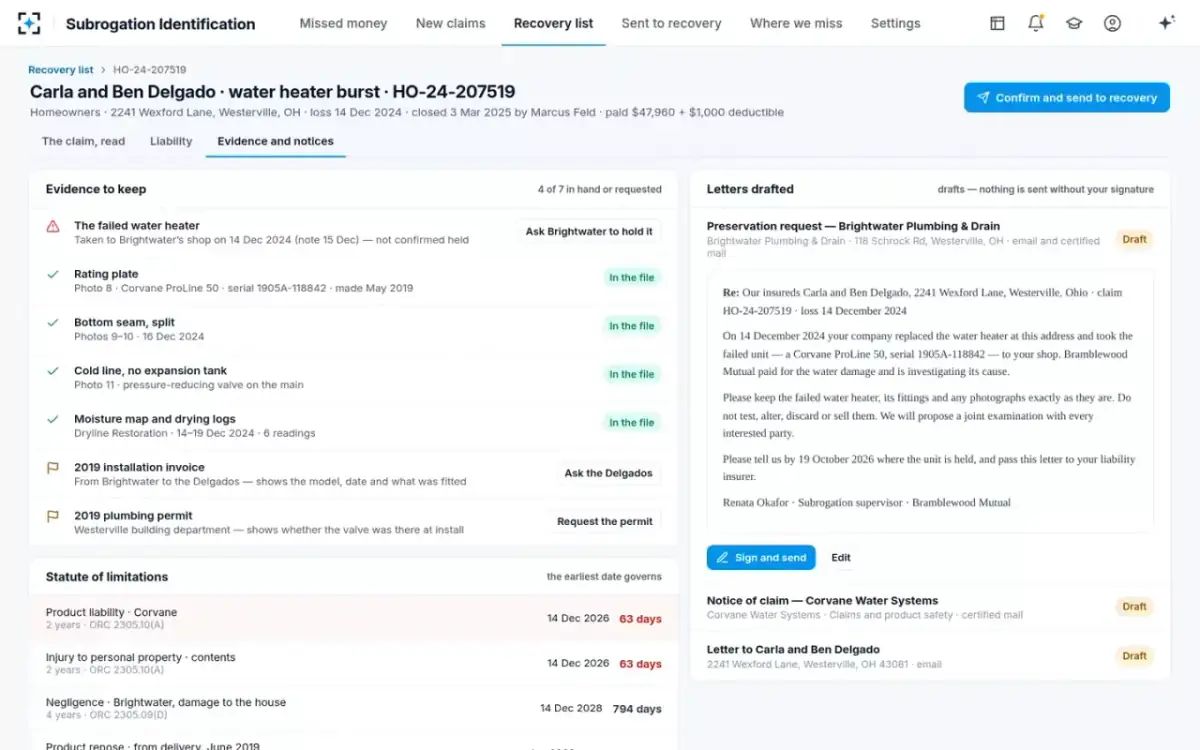
Take the sample claim at the centre of the solution's story: a gas water heater split along its bottom weld in a Westerville, Ohio basement on 14 December 2024. The claim closed in March 2025 as wear and tear and was picked up by the weekly reread in October 2026. It carries three dates.
One fictional Ohio claim, three theories, three dates
Product liability · against the maker
14 Dec 2026
Two years from the loss, R.C. 2305.10(A). The governing date: 63 days left when the reread found it.
Negligence · against the installer, damage to the house
14 Dec 2028
Four years, R.C. 2305.09(D). Live for two more years, but the evidence is the same failed tank.
Product repose · from delivery
June 2029
Ten years from delivery to the first purchaser, R.C. 2305.10(C). Not the binding date here, but it ends every product claim on the unit.
The earliest date governs the work, not the law. Legally the installer claim survives the maker's deadline; practically, the evidence for both claims is the same failed tank, which by then was in the installer's shop, and the hold request had to go out first. The statute clock surfaces the earliest date so the supervisor acts on it, and keeps the later dates so a specialist knows what remains.
Every theory against every party, dated, with the statute behind each
What is a statute of repose?
A statute of repose is an outer limit that runs from a fixed event, such as delivery of a product or completion of a building, regardless of when the damage happened or was discovered. Ohio's says no product liability claim "shall accrue against the manufacturer or supplier of a product later than ten years from the date that the product was delivered to its first purchaser", with exceptions, including written warranties longer than ten years (R.C. 2305.10(C)). If a claim accrues near the end of that ten-year window, the statute allows two years from accrual. Florida's statute sets a seven-year outer limit for actions founded on the design, planning or construction of an improvement to real property, counted from the certificate of occupancy or completion.
Repose matters most for the product claims that closed-file rereads find. An appliance that fails at year eleven may have a defect and no claim, and the rating plate's manufacture date is the first thing to check.
How long do you have to file a claim against a city, compared with a private party?
Usually months, not years, and the notice comes before any suit. New York requires a notice of claim within 90 days against a public corporation; Texas entitles a governmental unit to notice within six months, or less under a city charter; California requires a claim within six months for injury to personal property and one year for damage to real property. These are not limitation periods in the ordinary sense but conditions on suing at all, and the insurer, standing in its insured's shoes, has to meet them. They are covered in full in notice of claim against a municipality.
Can subrogation be filed after the statute of limitations?
Generally no: once the insured's period has run, the insurer's claim is barred with it, unless a tolling rule, an agreement or a forum's own rules extend the time. Tolling exists but is narrow and specific, which is why a rule table should record it as an exception confirmed by counsel, never as a default. Intercompany arbitration between insurers runs under its own rules, and the deadlines in that forum, including filing well before the statute runs, are set out in Arbitration Forums affirmative defenses.
The cost of a missed date is visible on the solution's sample carrier: one weekly reread of 1,906 closed claims counted 26 files already past their statute date, $412,800 that nobody can recover now, against 7 new finds still in time. Every one of the 26 was findable while its clock ran.
The method, because the table goes stale
A state table is a snapshot; a method survives a statute change. Florida's 2023 reform shortened its negligence period and changed its fault rule in one session law, and any table built before it was wrong the day the law took effect. The method below is what the solution's statute clock follows, and what a unit without software can follow by hand.
Dating a subrogation claim: the method
- List every party
Maker, seller, installer, contractor, driver, owner, public body. Each is a separate clock.
- List every theory against each party
Negligence, product liability, breach of warranty or contract, damage to personal or real property.
- Find the period for each, from the statute
With its section number, as counsel has confirmed it in the current rule version.
- Start each clock at accrual
Usually the date of loss, not the date of payment; record any discovery or tolling rule used.
- Add notice and repose periods
Public bodies need notice in months; product and construction repose can end a claim before its limitation does.
- Take the earliest live date, and never extend one
Act on the earliest; keep the later dates for the specialist.
- Version the rules
Every change approved by a named person, with the date it takes effect.
Where the solution fits: Subrogation Identification computes every date for every theory against every party, on new claims as they arrive and on closed claims each week, under a state rule table the carrier's counsel confirms. It shows the statute behind each date and the days left, and never extends one. Once a file is with a specialist, keeping its deadline in view is the job of a statute of limitations tracker. How the rule table goes live is set out in insurance subrogation software.
Questions people ask
Is there a statute of limitations on subrogation?
Yes, but usually it is the insured's own limitation period for the underlying claim, because the insurer stands in the insured's shoes. In Ohio that is two years for product and personal property claims and four for real property; in New York, three years for injury to property under CPLR 214.
What is the statute of limitations for subrogation in California?
For property damage, three years under Code of Civil Procedure § 338 for injury to real property or to goods. Claims against a California public entity need a written claim within six months for personal property and one year for real property, under Government Code § 911.2, before any suit.
What is the statute of limitations for subrogation in Texas?
Two years for injury to the estate or property of another under Civil Practice and Remedies Code § 16.003. Claims against a governmental unit also need notice within six months under § 101.101, or sooner where a city charter requires it.
Does the subrogation clock start when the insurer pays?
No. It starts when the insured's cause of action accrued, usually the date of loss. Time spent adjusting and paying the claim comes out of the insurer's clock.
Do I need a lawyer to check subrogation deadlines?
For the rule table, yes: each state's periods, accrual rules, tolling, notice and repose should be confirmed by counsel before anyone relies on them. Once confirmed, computing the dates for each claim is mechanical, and software can do it without extending any date.
Is the deadline different for auto and property subrogation?
Often not in the statute, but the theory and the forum differ. Texas uses two years for injury to property whether it is a car or a house; Michigan's no-fault law abolishes most tort liability for vehicle use and leaves a capped claim for vehicle damage not covered by insurance under MCL 500.3135. Claims between insurers may also go to intercompany arbitration, which has its own rules.