Comparative negligence is the rule, used in 46 states, that reduces an injured party's recovery by their own share of fault instead of barring it. The comparative negligence states list splits three ways. In pure comparative states a claimant recovers something at any level of fault. In modified states the claimant is barred once their share reaches a threshold: 50% in one group, more than 50% in the other. South Dakota uses its own "slight" standard. Five jurisdictions, Alabama, Maryland, North Carolina, Virginia and the District of Columbia, keep contributory negligence, where any fault by the claimant can bar recovery. For an insurer pursuing subrogation, the rule decides what a recovery is worth, because the insurer stands in its insured's shoes and inherits the insured's share of fault. Botminds' Subrogation Identification applies each state's rule from a rule table counsel confirms, and shows the facts behind every share.
The list below comes from a fifty-state survey by the Maryland judiciary's Standing Committee on Rules, published in 2011, updated for the one change we found since: Florida's move from pure to modified comparative negligence in 2023.
The fault rules across the fifty states and D.C., updated for Florida's 2023 change
11
states with pure comparative negligence
22
states that bar a claimant more than 50% at fault
12
states that bar a claimant 50% or more at fault
5
jurisdictions that keep contributory negligence
Which states are comparative negligence states?
All but four states, plus the District of Columbia. The Maryland survey found that "46 States, the Federal Government, Puerto Rico, the American Virgin Islands, Guam, American Samoa, and the Commonwealth of the Northern Mariana Islands have adopted either a pure or modified comparative fault approach" (Maryland Rules Committee). Thirty-three states changed by statute and twelve by a decision of their highest court; Georgia's came from its Supreme Court's reading of two nineteenth-century statutes.
Comparative negligence states list, by rule
| Rule | How a claimant’s fault works | States |
|---|---|---|
| Pure comparative | Recovery reduced by the claimant’s share at any level, even above 50% | Alaska, Arizona, California, Kentucky, Louisiana, Mississippi, Missouri, New Mexico, New York, Rhode Island, Washington |
| Modified, barred above 50% | Recovers if the claimant’s share is not greater than the others’; reduced by that share | Connecticut, Delaware, Florida (since 2023), Hawaii, Illinois, Indiana, Iowa, Massachusetts, Michigan, Minnesota, Montana, Nevada, New Hampshire, New Jersey, Ohio, Oregon, Pennsylvania, South Carolina, Texas, Vermont, Wisconsin, Wyoming |
| Modified, barred at 50% | Recovers only if the claimant’s share is less than 50%; reduced by that share | Arkansas, Colorado, Georgia, Idaho, Kansas, Maine, Nebraska, North Dakota, Oklahoma, Tennessee, Utah, West Virginia |
| Slight and gross | Recovers if the claimant’s negligence was “slight in comparison with the negligence of the defendant” | South Dakota |
| Contributory negligence | Any fault by the claimant can bar recovery, subject to doctrines such as last clear chance | Alabama, Maryland, North Carolina, Virginia, District of Columbia |
What is pure comparative negligence?
It is the rule that a claimant's fault never bars recovery, only reduces it. New York's statute is the clearest statement: in any action for "injury to property", the claimant's culpable conduct "shall not bar recovery", and damages are diminished in the proportion the claimant's conduct bears to the conduct that caused the damage (CPLR 1411). A claimant 70% at fault recovers 30% of their damages.
For subrogation, pure comparative states make almost every recovery worth something, which matters on auto claims where both drivers share fault. They also make the split the whole argument, because every percentage point moves the money.
What is modified comparative negligence?
It is comparative negligence with a bar: the claimant's share reduces the recovery until it reaches a threshold, and at the threshold the recovery falls to zero. The Maryland legislature's analysts describe it this way: each party is responsible in proportion to its fault "unless the plaintiff's negligence reaches a certain designated percentage of fault" (Maryland DLS). There are two thresholds in use, and the difference between them is a single percentage point at exactly 50%.
Ohio is in the larger group. Its statute lets a claimant recover if their fault "was not greater than the combined tortious conduct of all other persons" (R.C. 2315.33). Texas puts it the other way round: a claimant "may not recover damages if his percentage of responsibility is greater than 50 percent" (§ 33.001). Both mean that a claimant exactly 50% at fault still recovers half.
What is the 51 percent rule?
It is the common name for the modified rule that bars a claimant only when their fault is more than 50%, so that 51% is the first barred share. The "50 percent rule" bars a claimant whose fault is 50% or more. On a two-car collision where an arbitrator or jury splits fault evenly, the difference is everything: under the 51% rule the insured's side recovers half, under the 50% rule it recovers nothing.
What a $48,960 claim returns with the insured 50% at fault, under each rule
Which states still use contributory negligence?
Alabama, Maryland, North Carolina, Virginia and the District of Columbia. Maryland's legislative analysts put the doctrine starkly: "an injured plaintiff's fault, however slight, is a defense to the negligence claim and bars all recovery by the plaintiff" (Maryland DLS, 2018). The doctrine is softened by exceptions such as last clear chance, under which a defendant who had a fresh opportunity to avoid the harm is liable despite the claimant's fault. The District of Columbia carved out collisions between motor vehicles and pedestrians, cyclists and other non-motorised users in 2016, letting those claimants recover if less than 50% at fault.
The trend runs one way. The 2011 Maryland survey found that "no State that replaced contributory negligence with any form of comparative fault has reversed that decision and re-adopted contributory negligence." For a subrogation unit, a loss in one of the five jurisdictions where the file shows any fault by the insured needs a person's attention before a demand goes out.
Is Florida a comparative negligence state?
Yes, but since 2023 a modified one. Florida's statute now provides that "any party found to be greater than 50 percent at fault for his or her own harm may not recover any damages" (§ 768.81(6)), added by chapter 2023-15. Before that, the Maryland survey listed Florida among the pure comparative states. The same session law shortened Florida's general negligence limitation period to two years, so a Florida rule table built before 2023 is wrong on both the split and the clock. The clock side is covered in the statute of limitations on subrogation claims.
How does comparative negligence affect subrogation?
It sets the ceiling on what the insurer can recover, and it can cut what the insured gets back. Because the insurer pursues its insured's claim, the insured's share of fault reduces the recovery exactly as it would reduce the insured's own claim, and in a contributory or 50%-bar state it can end the claim. Some states also tie the insured's deductible recovery to fault; Washington's claims rules reduce the deductible returned to the insured by the insured's comparative fault (WAC 284-30-393), which is part of what decides whether an insured gets the deductible back.
That is why the insured's share should never be guessed. In the solution, the liability estimator gives the insured a share only when a fact in the file supports one, lists the facts for and against every party, and names the rule it applied.
How a suggested split is built, rule first, and where a person takes over
Agent
Liability estimatorReads the state’s fault rule from the confirmed rule table: pure, barred above 50%, barred at 50%, or contributory.
Never: uses a rule the table does not hold
Agent
Liability estimatorLists the facts that point to each party, including the insured, and what each will argue, each fact with its source.
Never: gives the insured a share without a fact
Agent
Liability estimatorSuggests a split and applies the rule: reduce, or flag a bar where the insured’s share reaches it.
Never: shows a split without cited facts
Agent
Statute clockDates every theory against every party; the earliest governs.
Never: extends a date
A person decides
Subrogation supervisorAccepts or changes the split; a change is saved with its reason. Decides whether a barred or marginal claim is pursued.
A person decides
Subrogation specialistArgues the split in the demand, in intercompany arbitration or in court.
When two parties share the blame: can the insurer collect it all from one?
Often not in comparative states, and the answer changes whom a specialist pursues first. Under joint and several liability, each defendant responsible for an indivisible harm can be made to pay all of it. Maryland's contributory system keeps that rule, but the 2011 survey, reporting a Maryland Department of Legislative Services study, found that "of the 46 States that had adopted a form of comparative fault, 38 had either abolished or limited the doctrine of joint and several liability; only eight had retained the doctrine in its entirety" (Maryland Rules Committee).
Texas shows what a limit looks like. A defendant is jointly and severally liable for the claimant's recoverable damages only if, among other cases, "the percentage of responsibility attributed to the defendant with respect to a cause of action is greater than 50 percent" (Chapter 33). On a split like the sample claim's, 75% to a manufacturer and 25% to an installer, a Texas recovery could look to the manufacturer for the whole, but not to the installer. In a state that has abolished the doctrine, each party pays only its own share, and an insolvent or uninsured installer's 25% may simply be lost. That is a reason to name every party, and its insurer, at the start.
How is fault split in a subrogation claim?
By the same evidence a court or arbitrator would weigh, assembled for each party: what the documents show it did, and what it will argue. On the sample claim at the centre of the solution's story, a water heater that split along its bottom weld inside its warranty, the estimator suggested 75% to the manufacturer and 25% to the installer, who fitted it without an expansion tank on a closed system, and 0% to the homeowners, because no fact in the file suggested they caused the failure. It listed the manufacturer's likely argument, that the tank was never flushed, and the installer's, that the valve may not have been there in 2019. Under Ohio's rule the homeowners' recovery would only be barred if their share exceeded the others' combined.
A suggested split under Ohio’s rule, with each party’s facts and arguments
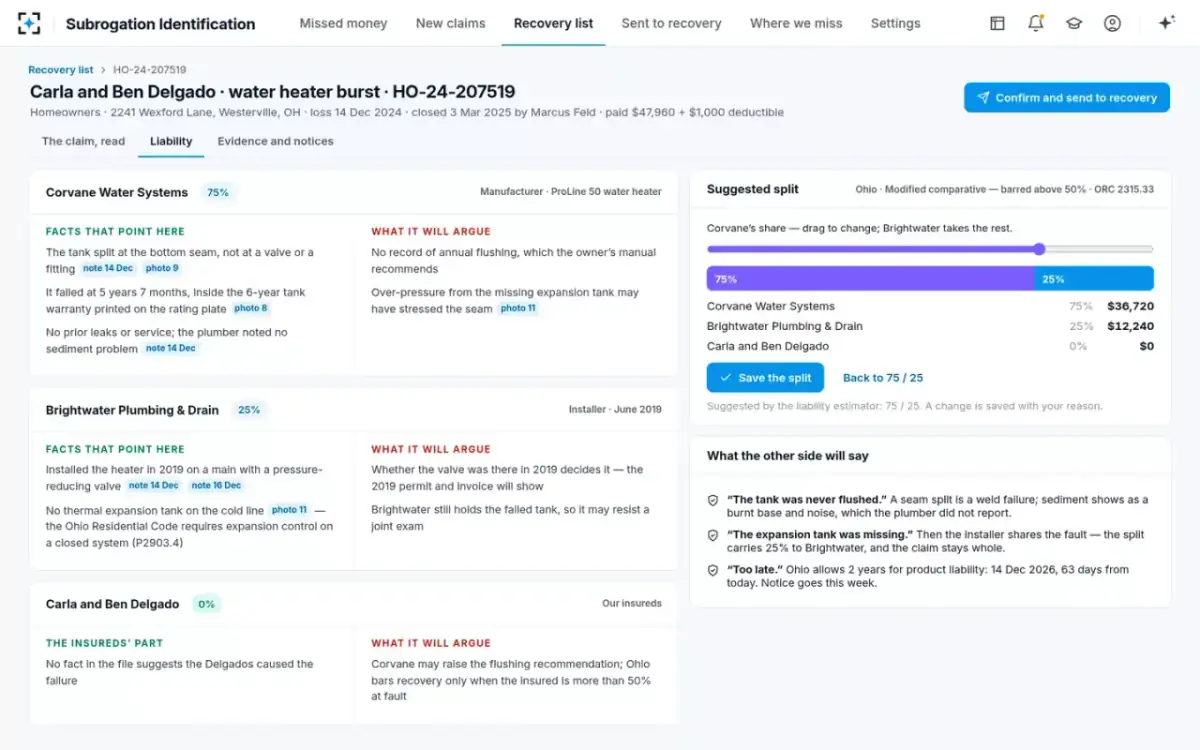
Splits between two other parties, such as the maker and the installer here, matter for whom to pursue and for how much, but they do not touch the insured's recovery under the comparative rules. It is the insured's own share that the rules act on, which is why that share deserves the strictest evidence.
Before a split goes into a demand
- Which state’s rule applies?
Usually where the loss happened; confirm with counsel where parties or contracts point elsewhere.
- Which group is the state in, as of today?
Florida changed in 2023; check the current statute rather than an old list.
- Does any fact give the insured a share?
If not, the share is zero. If so, cite it, and check it against the state’s bar.
- Is the claim in a contributory jurisdiction?
Any insured fault can end it; a person should decide before a demand goes out.
- Does the insured’s share change their deductible recovery?
Some states reduce it by comparative fault; tell the recovery desk.
- Is the split saved with its facts and its reasons?
A changed split without a reason is hard to defend in arbitration.
Where the solution fits: Subrogation Identification applies the confirmed rule for the state, lists the facts for and against every party, keeps the insured's share at zero unless a fact says otherwise, and leaves the decision and the argument to people. What the agents do when the file is silent on fault is set out in what subrogation potential means.
Questions people ask
How many states use comparative negligence?
Forty-six, according to the Maryland judiciary's 2011 fifty-state survey, which a Maryland legislative analysis repeated in 2018. Alabama, Maryland, North Carolina, Virginia and the District of Columbia keep contributory negligence.
What is the difference between comparative and contributory negligence?
Comparative negligence reduces a claimant's recovery by their share of fault; contributory negligence can bar it entirely if the claimant was at fault at all. Cornell's legal encyclopedia illustrates the contrast: under contributory negligence a plaintiff who was 1% negligent receives nothing from a defendant who was 99% negligent (Wex).
Is Texas a modified comparative negligence state?
Yes. Under Civil Practice and Remedies Code § 33.001 a claimant may not recover if their percentage of responsibility is greater than 50 percent; below that, damages are reduced by their share.
Is Ohio a modified comparative negligence state?
Yes. R.C. 2315.33 allows recovery if the claimant's fault was not greater than the combined fault of all others, and reduces the damages by the claimant's share.
Does New York use pure comparative negligence?
Yes. CPLR 1411 says the claimant's culpable conduct "shall not bar recovery" in actions for personal injury, injury to property or wrongful death, and reduces damages in proportion.
What happens to subrogation when both drivers are at fault?
The insurer's recovery is reduced by its insured's share of fault in comparative states, and can be barred in contributory states or where the insured's share reaches the state's threshold. In a 51% rule state such as Ohio or Texas, an even split still recovers half.