A subrogation department is the part of a property and casualty insurer that recovers claim payments from whoever caused the loss: another driver, a manufacturer, a contractor, a landlord, a utility. It does four jobs. It finds the claims with another party behind them, preserves the evidence and notifies the parties, decides which recoveries are worth pursuing, and pursues them through demands, intercompany arbitration or suit. Most departments are staffed for the last job. The first one, finding, is left to adjusters with full desks, so a recoverable claim usually closes as "no subro" and is never read again. Botminds' Subrogation Identification exists for that gap: specialist agents read every new claim and reread every closed one, and a subrogation supervisor decides what reaches the specialists.
The stakes are large and unevenly captured. In 2021, insurers recovered about $51.6 billion in salvage and subrogation on the auto physical damage and auto liability lines alone, according to a peer-reviewed study in the NAIC's Journal of Insurance Regulation. The same study found that in a typical year roughly a quarter of property-liability insurers report no salvage or subrogation recovery at all.
Recovery is large, and insurers differ enormously at it
$51.6B
salvage and subrogation recovered on the auto physical damage and auto liability lines in 2021
1 in 4
property-liability insurers with no recovery in a typical year, 1996–2021
37×
recovery ratio of the top fifth of recovering insurers against the bottom fifth
4.5%
average salvage and subrogation as a share of net claims paid, all firms
What does a subrogation department do?
A subrogation department turns paid claims into recoveries, and the work has four stages, each with a different owner and a different way to fail. The legal ground is simple: when an insurer pays its policyholder, the policyholder's right to sue whoever caused the harm passes to the insurer, which is the definition Cornell's Legal Information Institute gives. The insurer can recover no more than it paid. Bisco and Fier note that the insurer "cannot profit through subrogation."
Identification is spotting that another party exists. The fact is usually one sentence in a first notice, an adjuster's note, a police report or a photo caption. Preservation and notice means keeping the failed part, the invoice and the footage, and putting the other party and its insurer on notice before the evidence goes to a scrap pile. The decision is whether the claim is worth pursuing, given the liability facts, the amount and the time left on the statute of limitations. Pursuit is the demand, the arbitration filing, the suit and the collection, the core of a subrogation specialist's week, which belong to the recovery desk and to Botminds' sibling solutions for demands and arbitration and recovery management.
The stages fail differently. A pursuit failure is visible: a demand denied, an arbitration lost. An identification failure leaves no trace. The claim closes with "no subro" ticked, the file goes to storage, and the money is lost on the day the statute runs, without anyone deciding to lose it.
The subrogation department as most run it, and once every closed file is reread
Today, at many carriers: Adjusters who tick a box at closing, and clear-liability auto claims that announce themselves.
With every file read and reread: Every first notice read as it arrives, and every closed claim read again in full each week.
Today, at many carriers: Nobody, unless a project or an audit pulls a sample.
With every file read and reread: Agents, on a schedule; the supervisor reads only the finds, with their sentences.
Today, at many carriers: Assigning referrals and chasing specialists on demands.
With every file read and reread: Confirming or rejecting finds, with the proof on screen, in order of money and days left.
Today, at many carriers: A claim number and a note to “look at subro”.
With every file read and reread: The party, a suggested split with cited facts, the deadline, the evidence list and signed hold requests.
Today, at many carriers: Diaried when someone remembers; the claim system often has no field for the statute date.
With every file read and reread: Each theory against each party dated; the earliest date governs and none is ever extended.
Today, at many carriers: Anecdote.
With every file read and reread: Each quarter, how the missed files were closed and which phrases should have stopped them.
How much do subrogation departments differ between insurers?
By more than any other number in claims operations that we know of. Sorting insurers in 1996–2021 by the ratio of salvage and subrogation recovered to net claims paid, Bisco and Fier found the bottom fifth recovering nothing and the top fifth averaging 16.55% (Journal of Insurance Regulation). Even among insurers that recovered something, the top fifth's ratio was about 37 times the bottom fifth's: over 20% against roughly half a percent.
Recovery as a share of net claims paid, by fifth of all insurers, including those that recovered nothing
Some of that spread is business mix, not effort. The same study shows that on auto physical damage the industry recovered about one dollar in every five paid in 2021, while on auto liability the average over the period was 1.1% (commercial) and 2% (personal). A specialist liability carrier will never look like a personal auto writer. But mix does not explain the quarter of insurers with no recovery at all, and the authors point to organisation. Drawing on earlier work by Colquitt and Dumm, they note that insurers in a group may pursue less, partly because it may be unprofitable to subrogate against another member of the firm's group, and that stock insurers and insurers with larger average claims recover more.
The research also notes, in a footnote, that some firms run salvage and subrogation internally while others contract it out to vendors. Neither model fixes identification by itself: an outside firm can only work the files it is sent. How a fee compares with a team over three years is worked through in subrogation contingency fee or in-house team.
Where recoverable claims are lost: at closing, not in pursuit
Most recoverable claims are lost at the moment the file closes, because closing is the last time anyone at the insurer reads it. The adjuster records a reason, the reason becomes the claim's permanent label, and nobody revisits a label. A closing note that says "wear and tear" on a water heater that split at the seam does not look like a missed recovery. It looks like a decision.
Take one quarter of a fictional mid-sized carrier, Bramblewood Mutual, as it runs through the solution on sample data. Its weekly reread read back the 99 files found or sent to recovery that quarter and sorted them by how they had been closed.
How 99 recoverable files had been closed at a sample carrier
Closing reason on the 99 files
- “No subro” ticked, no reason · 37.4%
- “Sudden and accidental, covered” · 22.2%
- “Wear and tear” · 18.2%
- Closed at first payment · 13.1%
- “Insured at fault” against the police report · 9.1%
Two of those labels are revealing. "Sudden and accidental, covered" answers the coverage question correctly and the recovery question not at all: a burst supply line is covered and may still be the installer's fault. "Insured at fault" is sometimes contradicted by the police report sitting in the same file. Neither is an adjuster's error in the coverage sense. They are the result of asking the adjuster to close a claim and judge a recovery in the same click.
How is a subrogation department organised?
Around five seats, and only two of them sit in the subrogation unit itself. Intake and the adjusters see the facts first. The supervisor decides. The specialists pursue. A claims executive owns the rules. The design question is which seat is accountable for finding, and in most departments the honest answer is the adjuster, who is measured on closing, not on recovery.
Five seats around a recoverable claim: what each holds today, and once agents do the reading
Today
Types what the caller says, “water heater burst”, and moves to the next call.
With agents
Types the same notice; the sentence that points to another party is marked within the minute.
Still theirs: Asking the follow-up question the flag suggests.
Today
Closes 30 claims a week and ticks “no subro” on most, because nobody asked who installed the heater.
With agents
Sees the flag on an open claim, with the sentence that raised it, and keeps the failed part.
Still theirs: The coverage decision and the claim itself.
Today
Assigns the referrals that arrive and chases specialists on deadlines.
With agents
Opens on the money still recoverable, laid out by deadline, and confirms or rejects each find.
Still theirs: Every pursue-or-release decision, and every signature on a hold request.
Today
Rebuilds each file from scratch: who made the part, which theory, which date.
With agents
Receives the party, the split, the deadline, the evidence list and a signed hold request.
Still theirs: Demands, negotiation, arbitration and suit.
Today
Hears about missed recoveries when a statute has already run.
With agents
Approves each version of the state rule table and reads where the misses come from, team by team.
Still theirs: The rules, the thresholds and the staffing.
Larger carriers split the unit further, by line (auto, property, workers' compensation), by forum (arbitration against other insurers, litigation against uninsured parties) or by region, because limitation periods and fault rules are state law. A specialist who works Ohio and Kentucky property learns two sets of clocks, not fifty.
Should subrogation sit in claims or in finance?
Identification and pursuit belong in claims, because they need the claim file, the adjuster and the evidence; finance owns how recoveries are booked. The two meet in the annual statement. Insurers report salvage and subrogation received in Schedule P, which is where Bisco and Fier took their data, and under statutory accounting an insurer may choose whether to accrue anticipated recoveries. The study notes that generally accepted accounting principles, by contrast, require the accrual.
That split has a practical consequence for the department. Finance sees recoveries when cash arrives, sometimes years after the loss: Bisco and Fier assume, from the statements themselves, that physical damage recovery completes within two years and liability recovery within nine. A department measured only on cash cannot tell whether it is finding fewer opportunities or collecting slowly. It needs its own measures at the front of the pipeline, such as finds per thousand closed claims, the share confirmed and the value lost to expired statutes. Reserving questions about anticipated recoveries belong with the actuaries; the claims side of that conversation is in case reserves and IBNR.
What the department owes its own insured
A subrogation department does not only face the other side; it owes its policyholder decisions and money. California requires every insurer to tell a first-party claimant in writing whether it intends to pursue subrogation and, if it will not, that any recovery is the claimant's own responsibility (10 CCR § 2695.7(p)). The same regulation requires the deductible in every demand and a proportionate share of what is recovered. The NAIC's model regulation includes the deductible when the claimant asks (Model #902).
Those duties turn the pursue-or-release decision into a dated, written act owed to a named person, which is why it cannot be left to a closing checkbox. How the deductible flows back to the insured once money is recovered is covered in subrogation recovery accounting.
How many people work in subrogation?
Federal statistics do not count them separately. The nearest occupation the Bureau of Labor Statistics publishes is claims adjusters, examiners and investigators, whose median wage was $78,000 in May 2025; BLS projects the wider claims occupation group to shrink by 6% between 2025 and 2035, and its outlook expects growing AI capabilities to make claims workers more productive. We found no regulator or academic source that publishes subrogation headcount per claim volume, so the ratio a department uses is its own.
What the numbers do say is that the department's expensive resource is the specialist's time, and that time is mostly spent rebuilding files rather than recovering money. The solution's own estimate for one closed property claim reread by hand is about seven and a half hours: two reading notes and reports, one naming the party, an hour and a half weighing liability, half an hour on the statute date, two on the evidence list and letters, and half an hour of supervisor review. With the agents doing the reading, the estimate falls to about two hours, and the supervisor's half hour stays where it was.
Rebuilding the department around a full reread
When every closed claim is reread, the department stops being limited by what it can find and starts being limited by what it can decide. That is the change worth planning for. On the sample carrier, one Sunday reread of 1,906 closed claims from one quarter of losses found 118 with a sentence pointing at another party. Of those, 94 named a party. Sixty-one had already been recovered, waived or fallen under the minimum, 26 were past their statute date, and 7 were new, worth $139,460.
The supervisor's first screen: money still recoverable, placed on the statute clock
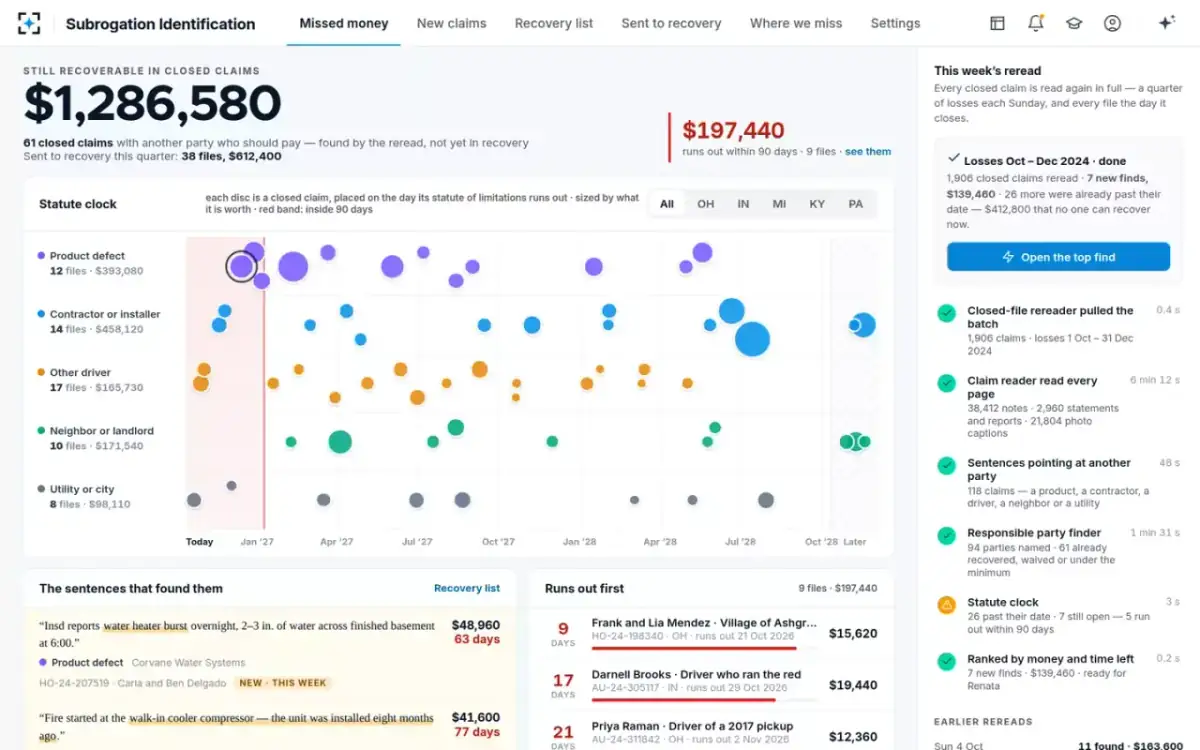
The figure the supervisor should watch is not the seven. It is the 26 that were already past their date, because each one was findable while its clock was still running. That number should fall to near zero once the reread has covered every open limitation period, and when it does, the department's bottleneck has moved from finding to deciding and pursuing.
Three things change in practice. The supervisor's role becomes a decision queue, sorted by recoverable amount and days left, where each find shows the sentence that raised it so it can be confirmed or rejected in minutes. The specialist's intake becomes a complete file: the party, a liability split with the facts for and against each side, the deadline and the evidence list. And the department gains a feedback loop to intake and adjusting, because each quarter it can show which closing labels and which phrases hid recoverable claims.
Questions to settle before the department changes shape
- Who is accountable for finding?
If the answer is still “the adjuster at closing”, a reread will keep surfacing the same misses.
- Who confirms a find, and within how long?
A find in the red band, with under 90 days left, needs a same-week decision.
- Who signs hold requests and notices?
A named person, before the evidence is discarded; no letter should leave unsigned.
- Who owns the state rule table?
Limitation, notice, repose and fault rules by state, confirmed by counsel and versioned.
- What is the minimum worth pursuing?
Below it, finds should be logged, not listed, so the queue stays decidable.
- What will the department measure?
Finds per thousand closed claims, share confirmed, value lost to expired statutes, and recoveries.
Where the solution fits is the front half: Subrogation Identification reads, names, splits, dates and drafts, and is read-only on the claim system. It does not send demands, file arbitration or book recoveries. The agents never contact a party, and a supervisor confirms every find before it reaches a specialist. How the agents decide what to ask for when a file is silent is set out in what subrogation potential means, and how to test a reader on claims you have already closed is in closed file review.
Questions people ask
What is a subrogation unit?
It is another name for the subrogation department: the team that recovers claim payments from the party that caused the loss. In larger insurers the unit is split by line or forum, with separate desks for intercompany arbitration and for suits against uninsured parties. Its legal footing is the right the policyholder had against the wrongdoer, which passes to the insurer when it pays.
How do insurers find subrogation opportunities?
Mostly through adjusters at first notice and at closing, and through clear-liability auto claims where another driver is obviously at fault. Opportunities that depend on a product, a contractor or a public body are easy to miss because the fact is one sentence in a note. Rereading closed files is how the missed ones are recovered while the statute of limitations, two years for product and personal property claims in Ohio, is still running.
Who decides to pursue subrogation?
A person at the insurer, usually a subrogation supervisor or specialist, and in California the decision must be put in writing to the insured under 10 CCR § 2695.7(p). Software can find and rank opportunities and draft letters, but the pursue-or-release decision weighs liability, cost and the relationship with the insured. In Subrogation Identification a supervisor confirms each find or marks it not recoverable with a reason.
Does every insurer have a subrogation department?
No. In Bisco and Fier's data, roughly a quarter of property-liability insurers report no salvage or subrogation recovery in a typical year, and some firms contract the work out to vendors instead of running it internally. Small or specialist insurers often assign subrogation to adjusters or to outside counsel on a contingency fee.
Is subrogation the same as salvage?
No. Salvage is selling the damaged property the insurer took over after paying the claim, such as a totaled car; subrogation is recovering the payment from the party that caused the loss. Insurers report the two together in the annual statement, which is why industry figures usually combine them.
What should a subrogation department measure?
Recoveries, but also the front of the pipeline: finds per thousand closed claims, the share confirmed, time from find to decision and the value lost to expired statutes. Cash recovered lags the loss by years on liability lines, so a department measured on cash alone learns about a finding problem too late.