A notice of claim against a municipality is a written claim served on a city, county, village, school district or other public body before a lawsuit can be brought against it. It tells the public body what happened, when and where, and what damage is claimed, and it must arrive within a deadline far shorter than the ordinary limitation period: within ninety days after the claim arises in New York, within six months of the incident in Texas, within six months for damage to personal property and one year for damage to real property in California. An insurer that paid its insured's loss and wants to recover from the public body is bound by the same notice rule, because it stands in its insured's shoes. That is why claims against public bodies are so often lost: the notice deadline can pass before the claim is even closed. Botminds' Subrogation Identification flags a public body on the day the first notice is read, with its notice period.
Some states go further and take the claim away. In Ohio, no insurer is entitled to bring a subrogation action against a political subdivision for the benefits it paid. A reader that knows the rule saves the unit from chasing a claim nobody can bring.
The public body’s notice deadline against the limitation period for the same loss caused by a private party, in months
- Gen. Mun. Law § 50-e90 d
- CPLR 214(4)36 mo
- § 101.1016 mo
- § 16.00324 mo
- Gov. Code § 911.26 mo
- Gov. Code § 911.212 mo
- C.C.P. § 33836 mo
What is a notice of claim?
It is the claimant's formal first word to a public body, and the statute decides what it must say and when. Texas's version is typical: a governmental unit "is entitled to receive notice of a claim against it under this chapter not later than six months after the day that the incident giving rise to the claim occurred", and the notice must reasonably describe the damage claimed, the time and place of the incident, and the incident itself (§ 101.101). Federal agencies need a claim for money "in a sum certain", usually on Standard Form 95 (28 C.F.R. § 14.2).
The notice is not a lawsuit. It gives the public body time to investigate while the evidence is fresh and, in many states, a period to pay or reject the claim before anyone can sue. Missing it usually ends the claim regardless of how strong the facts are.
The notice of claim shall comply with and be served in accordance with the provisions of this section “within ninety days after the claim arises”.
New York General Municipal Law § 50-e(1)(a)
How long do you have to file a claim against a city?
It depends on the state, the kind of public body and the kind of damage, and the range is wide: from 90 days in New York to three years to present a claim in Florida. The table sets out six jurisdictions from their own statutes.
Notice of claim against a public body: six jurisdictions, from their own statutes
| Jurisdiction | Deadline to give notice | What follows | Limits that change the claim |
|---|---|---|---|
| New York | 90 days after the claim arises (Gen. Mun. Law § 50-e(1)(a)) | A court may allow late notice, but not beyond the time to sue the public body (§ 50-e(5)) | Late notice turns on factors including whether the public body or its insurance carrier knew the essential facts |
| California | 6 months for injury to a person or personal property; 1 year for other claims, including damage to real property (Gov. Code § 911.2) | The agency has 45 days to respond; after a rejection, 6 months to sue | File with the right agency: the state’s program, or the city or county itself |
| Texas | 6 months after the incident, or a shorter city charter period (§ 101.101(a), (b)) | Suit under the Tort Claims Act in the county where the claim arose | No notice needed if the unit actually knew the claimant’s property was damaged (§ 101.101(c)) |
| Florida | Written claim within 3 years of accrual, to the agency (and to the Department of Financial Services, except for municipalities and counties) (§ 768.28(6)) | No decision within 6 months counts as a denial | Payment capped at $200,000 a person and $300,000 an incident without further act of the Legislature |
| Ohio | Suit within 2 years, including any “claim for subrogation” (R.C. 2744.04) | Benefits from insurance are deducted from any award | No insurer may bring a subrogation action against a political subdivision for benefits it paid (R.C. 2744.05) |
| United States | Written claim to the agency within 2 years of accrual (28 U.S.C. § 2401(b)) | No final decision within 6 months may be treated as a denial (§ 2675); suit within 6 months of a mailed denial | An insurer that paid the whole loss may present the claim itself (28 C.F.R. § 14.3(d)) |
Can an insurer file a claim against a city?
In most states, yes, in its insured's shoes and on its insured's deadline. A New York appellate court allowed a workers' compensation insurer to proceed against the City of New York because the injured man had filed a timely notice of claim; the insurer, "as a subrogee, stands in" his shoes and could rely on that notice (Hartford v City of New York). The federal regulations say it outright: a claim for a loss "wholly compensated by an insurer with the rights of a subrogee may be presented by the insurer", and a partly compensated loss may be presented by the parties individually or jointly (28 C.F.R. § 14.3(d)).
Two states in the table change the arithmetic. Ohio's statute is blunt: "No insurer or other person is entitled to bring an action under a subrogation provision in an insurance or other contract against a political subdivision with respect to those benefits" (R.C. 2744.05(B)(1)). The insured may still claim its own uninsured loss, such as a deductible, but the benefits the insurer paid are deducted from any award. Florida allows the claim but caps what the state and its subdivisions pay, at $200,000 to one person and $300,000 for one incident, unless the Legislature acts (§ 768.28).
What happens if you miss the notice of claim deadline?
Usually the claim is lost, with narrow ways back that depend on the state. New York lets a court extend the time in its discretion, but the extension "shall not exceed the time limited for the commencement of an action" against the public corporation, and the court weighs whether the public body, its attorney or "its insurance carrier acquired actual knowledge of the essential facts" in time (§ 50-e(5)). Texas excuses notice where the unit had actual notice that "the claimant's property has been damaged" (§ 101.101(c)). California's own self-help guide warns that "there are exceptions" and points claimants to the statute or a lawyer (Judicial Council).
None of those routes is a plan. Each requires an application, an argument and a judge or an agency persuaded after the fact, and each is weaker when the claimant is an insurer that had the file all along.
Why public-body claims are lost before anyone reads the closed file
Because the notice period is often shorter than the time it takes to close the claim. Take the sample claim at the centre of the solution's story: a homeowners water loss in Ohio on 14 December 2024, closed on 3 March 2025, 79 days later. Had the cause been a city water main in New York, the 90-day notice would have been due on 14 March 2025, eleven days after the file closed. A closed-file reread, however thorough, would have found the claim too late.
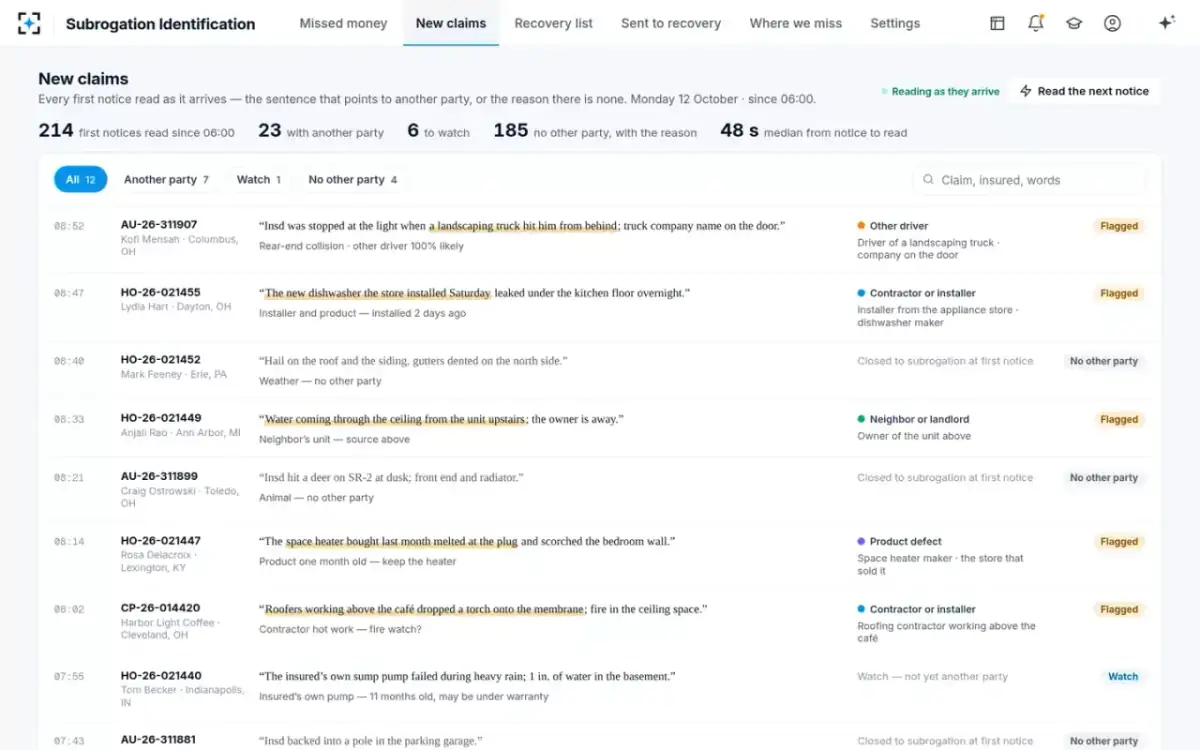
That is why public-body claims have to be caught at first notice, not in closed files. On the solution's sample intake screen, a first notice describing a city crew's backhoe in Fort Wayne, Indiana, was flagged the morning it arrived, with the notice period from the carrier's own rule table, and the flag went to both the adjuster on the claim and the subrogation team.
Every first notice read as it arrives: the party flagged the same morning
What happens after a notice of claim is filed?
The public body investigates and either pays, rejects or stays silent, and each outcome starts another clock. In California the agency has 45 days to respond, and after a written rejection the claimant has six months to sue (Judicial Council). A federal agency that makes no final decision within six months may be treated as having denied the claim (28 U.S.C. § 2675), and suit must then be brought within six months of any mailed denial (§ 2401(b)). Florida treats six months of silence the same way.
A claim against a public body, from the first notice to the decision to sue
Agent
Claim readerMarks the sentence that points to a utility or public body at first notice: a crew, a main, a tree, a road.
Never: decides liability
Agent
Responsible party finderNames the entity that owns the asset; where the file is silent, writes “unknown” and asks for the records that would say.
Never: contacts the public body
Agent
Statute clockDates the notice period and the suit period from the state rule table; flags any bar, such as Ohio’s.
Never: extends a date
Agent
Evidence and notice drafterDrafts the notice of claim with the time, place, incident and damage, and the sum where one is required.
Never: sends it
A person decides
Subrogation supervisorConfirms the find and signs the notice; sends it to the right office before the deadline.
A person decides
Subrogation specialistTracks the response, and decides with counsel whether to sue within the period that follows a rejection.
Which public bodies need a notice of claim?
More than cities, and the statute's own definition decides. New York's rule covers any case founded upon tort where notice is required against "a public corporation, as defined in the general construction law", and to the corporation's officers, appointees and employees (§ 50-e); which bodies count is settled by that separate definition, not by whether the body calls itself a city. Texas's applies to a "governmental unit" under its Tort Claims Act. California's covers claims against any public entity, with the state's own claims going through its Government Claims Program. Federal agencies, from the Postal Service to a military base, are reached through the Federal Tort Claims Act and its two-year presentment rule.
Utilities are the hardest case, because ownership is not visible from the street. A water main may belong to a city, a district or a private company; a power line to a cooperative, a municipal utility or an investor-owned one. The answer decides whether the ordinary limitation period applies or a notice period measured in months, and in Ohio whether the insurer can pursue at all. A first-week question to the utility or the city, "who owns this asset?", is cheaper than a missed deadline.
What is a government claim form?
It is the public body's own form for a notice of claim, and using it is the surest way to include what the statute requires. Federal agencies accept Standard Form 95 or another written notice with a sum certain. California's guide notes that many agencies have claim forms online and that state claims go through the state's Government Claims Program, while city and county claims go to the city or county. New York City and other large municipalities publish their own forms. A specialist who uses the wrong office's form, or none, risks the argument that no valid notice was given.
Does subrogation apply to claims against a city?
Usually, but not everywhere, and the exceptions are worth a rule of their own. In New York, California, Texas, Florida and against the federal government, an insurer that paid can pursue the public body, subject to the notice rules and, in Florida, the payment caps. In Ohio, the insurer's subrogation against a political subdivision is barred, though the insured's own uninsured loss is not. A subrogation unit writing in Ohio should close those finds with the statute as the reason rather than send letters a village is entitled to ignore.
A public-body checklist for the first week of a claim
- Who owns the cause?
The main, the tree, the road, the vehicle or the crew. Utilities are sometimes private companies, sometimes public bodies.
- Is the claim allowed at all?
Check for a bar on insurers’ subrogation against the body, as in Ohio, and for caps on what it pays, as in Florida.
- What is the notice deadline, and from what date?
Ninety days, six months or one year; from the incident, the accrual or the arising of the claim, as the statute says.
- What must the notice contain?
Time, place, incident and damage; a sum certain for federal agencies.
- Which office receives it, and how?
Use the body’s own form where it has one, and keep proof of delivery.
- Has the insured already given notice?
An insurer may be able to rely on its insured’s timely notice, as in New York; get a copy.
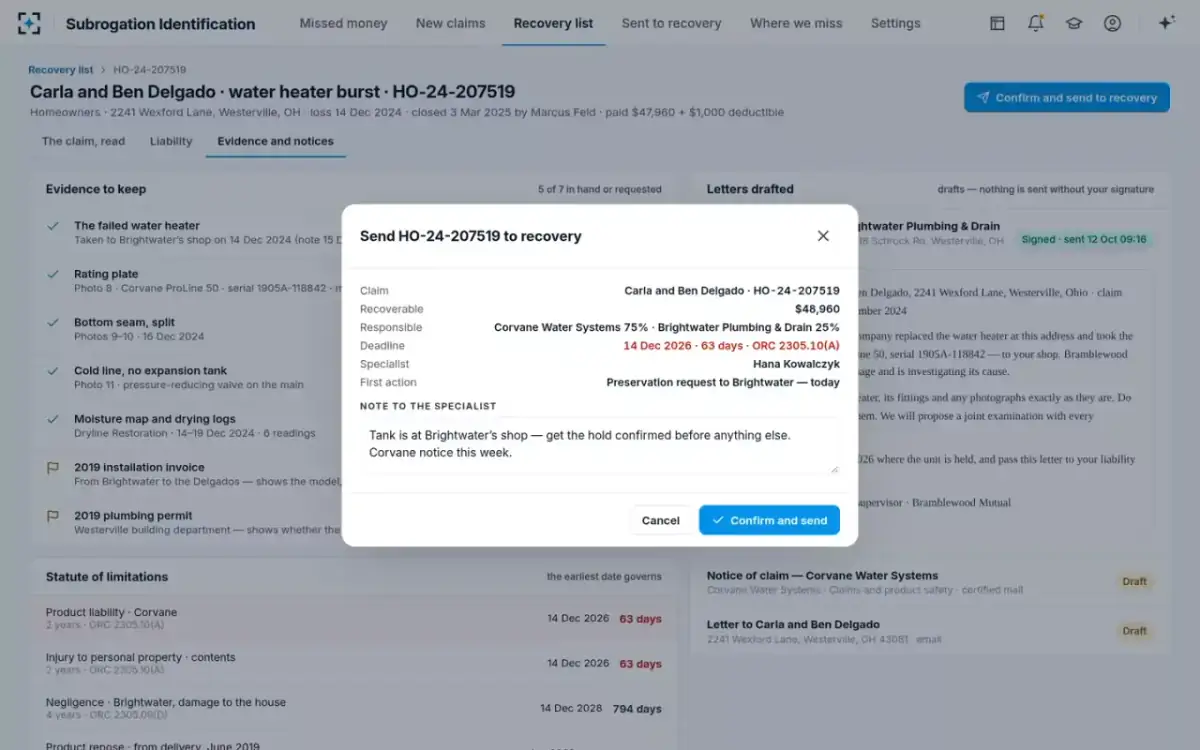
The same claim, once confirmed, goes to a specialist with its deadline attached. The broader set of limitation periods behind these notices is in the statute of limitations on subrogation claims, and the case for reading every first notice as it arrives, rather than waiting for closing, is in the subrogation department guide.
A confirmed find goes to a specialist with its deadline and first action
Questions people ask
How do I file a notice of claim against a city?
Find the city's own claim form or notice requirements, describe the incident, the time and place and the damage, and serve it on the office the statute names, keeping proof of delivery. In New York the notice must be served within 90 days after the claim arises; in Texas the unit is entitled to notice within six months, or less under a city charter.
What is the deadline to file a claim against a public entity in California?
Six months after the cause of action accrues for injury to a person or to personal property, and one year for other claims, including damage to real property, under Government Code § 911.2. The agency then has 45 days to respond, and after a rejection the claimant has six months to sue.
Can you sue a city for property damage?
Usually, after giving notice and within the limits the state's tort claims law sets. Florida, for example, caps payment at $200,000 a person and $300,000 an incident unless the Legislature acts. Ohio bars insurers, though not the owner's own uninsured loss, from subrogating against a political subdivision.
Is a notice of claim the same as a lawsuit?
No. It is a written claim to the public body that must come first, giving it time to investigate and to pay or reject. A lawsuit can follow only after the notice, and often only after the body rejects the claim or lets its response period run out.
How long does the government have to respond to a claim?
It varies: 45 days for a California public entity, and six months for a federal agency or a Florida agency before silence counts as a denial. The response, or its absence, starts the period for filing suit.
Can an insurer rely on the insured's notice of claim?
Sometimes. In Hartford v City of New York, a New York appellate court let an insurer proceed on the injured man's timely notice because, as subrogee, it stood in his shoes. Where the insured gave no notice, the insurer must meet the deadline itself.