Subrogation potential is the realistic chance that an insurer can recover what it paid on a claim from the party that caused the loss. A claim has it when the file shows four things: another party whose act or product caused the damage, a legal basis to hold that party liable, a recoverable amount worth the effort, and time left on the statute of limitations. When adjusters write "no subrogation potential", they are saying one of the four is missing. Often it is not missing at all, only unread: the fact that names who should pay is usually one sentence in a first notice or a note. Botminds' Subrogation Identification reads every claim for that sentence, and when a fact the decision needs is absent, its agents list the document that would supply it rather than guess.
That distinction matters because a guessed fact does more damage than a missing one. A guessed manufacturer sends a notice to the wrong company. A guessed liability split puts a share on the insured that no fact supports, and that can shrink the deductible the insured gets back. Asking for the rating plate costs a phone call.
When the file is silent: the missing fact, what to ask for and who holds it
Product
The missing factWho made it, and when
Ask forThe rating plate or model and serial label, photographed before the part leaves the house
Who holds itThe insured, or the plumber or restorer who removed it
If it never comesParty written as unknown; the claim goes on watch, not on the recovery list
Contractor or installer
The missing factWho did the work, and when
Ask forThe invoice, the contract and the permit
Who holds itThe insured and the building department
If it never comesA named trade without a date is a lead, not a find
Other driver
The missing factIdentity, insurer and fault
Ask forThe police report and the exchange of information
Who holds itThe police department and the insured
If it never comesNo split is suggested until a report or statement supports one
Neighbour or landlord
The missing factWhere the water or fire started
Ask forThe plumber’s or fire report, and the lease or association records
Who holds itThe repairer, the fire department, the building manager
If it never comes“Unit above” stays a question until the source is confirmed
Utility or public body
The missing factWho owns the main, the tree or the road
Ask forUtility or city records for the asset and its crew
Who holds itThe utility or the city
If it never comesFlagged at once anyway: notice periods for public bodies run in months
Cause not known
The missing factWhat failed
Ask forA cause-and-origin report or the fire marshal’s report
Who holds itThe investigator or the fire department
If it never comesNo party, no potential; the reason is written on the claim
What does subrogation potential mean?
It means a paid claim passes four tests, and each one can be checked against the file. The first is a party: someone other than the insured whose conduct or product caused the loss. The second is a legal theory, usually negligence or product liability, sometimes a breach of a contract or warranty. The third is money: a paid loss above the insurer's own minimum, since a $300 recovery rarely pays for a demand. The fourth is time: the insured's limitation period for that theory against that party has not run, because the insurer steps into the insured's position and inherits the insured's deadline.
A claim can pass the first test and still have no potential, and a good reader knows the common reasons. The policy may waive subrogation: Bisco and Fier's study in the Journal of Insurance Regulation points to standard endorsements that remove the insurer's right against named parties in workers' compensation and commercial auto. The law may remove the right. Ohio bars insurers from bringing subrogation actions against a political subdivision for benefits they paid (R.C. 2744.05), and Michigan's no-fault law abolishes most tort liability for vehicle use, leaving a capped claim for vehicle damage only "to the extent that the damages are not covered by insurance" (MCL 500.3135). California spares an insurer the written subrogation notice when "there is no legal basis for subrogation" (10 CCR § 2695.7(p)). Each is a legal judgement, and each should be written on the claim as the reason.
What facts show subrogation potential?
Facts that name a party and connect it to the cause: who made the part, who did the work, who was driving, whose unit the water came from, who owns the main. They arrive as ordinary sentences, and most are typed at first notice while the insured is still on the phone. On new claims read by the solution on sample data, the lines that raised a flag looked like this.
Six kinds of party, the sentence that points to each, and the document that proves it
| Kind of party | A sentence that points to it | The document that proves it |
|---|---|---|
| Product defect | “The space heater bought last month melted at the plug” | Rating plate or label, purchase record, the failed unit itself |
| Contractor or installer | “Roofers working above the café dropped a torch onto the membrane” | Invoice, contract, permit, the crew’s schedule |
| Other driver | “a landscaping truck hit him from behind; truck company name on the door” | Police report, exchange of information, photos |
| Neighbour or landlord | “Water coming through the ceiling from the unit upstairs” | Plumber’s report, lease or association records |
| Utility or public body | A city crew’s backhoe on the street before the basement flooded | Utility or city records of the work, notice of claim |
| Rental, carrier or fleet vehicle | A delivery van, a rental car, a truck with a company name | Police report, vehicle registration, the commercial policy |
Some sentences close the question instead. "Hail on the roof and the siding" names weather, and weather has no insurer. "Insd hit a deer on SR-2 at dusk" names an animal. A reader that marks those claims closed to subrogation, with the reason, is as useful as one that flags the others, because the supervisor no longer has to wonder whether anyone looked.
What does “no subrogation potential” mean, and when is it wrong?
It means someone decided that one of the four tests fails, and it is wrong when the decision was made without reading for the first test. On the solution's sample carrier, the quarterly read-back of 99 recoverable files found 37 closed with "no subro" ticked and no reason at all, and 18 closed as "wear and tear". A water heater that splits along its bottom weld five years and seven months into a six-year tank warranty is not wear and tear in the ordinary sense; it may be a defect.
The phrases that found those files are instructive, because every one of them was in the first notice. A reader trained only on coded fields (cause of loss, line, amount) would not see them. That is the argument made at length in why the sentence beats the claim code.
The phrases that found a quarter’s recoverable files, all typed at first notice
When the file is silent: ask, don't guess
When the sentence names a kind of party but not the party, the right output is a question with an owner, not a probability. "Water heater burst" says a product may be at fault; it does not say whose product. The figure at the top of this page is the rule the agents follow: for each kind of party, the fact that is usually missing, the document that supplies it, who holds that document, and what happens if it never comes. In the last case the claim is not forced onto the recovery list. It goes on watch, or it is closed to subrogation with the reason written down.
Asking also tells the specialist what the file is worth before anyone spends money on it. A product claim with a rating plate, a dated invoice and the failed part in hand can be pursued; the same claim with "unknown maker" and a part already scrapped is a lead at best. The open questions across all claims become a worklist for adjusters and specialists, sorted by the deadline that each one is racing.
How the agents handle a silent file: each step, and what it never does
Agent
Claim readerReads every note, statement, report and photo caption and marks the sentence that points to another party, quoting it with its source.
Never: decides liability
Agent
Responsible party finderNames the party from the rating plate, the invoice or the police report; where the file is silent, writes “unknown” and lists the document that would name it.
Never: contacts a party, or fills a gap with a likely name
Agent
Liability estimatorSuggests a split under the state’s fault rule, with the facts for and against each party.
Never: gives the insured a share without a fact in the file
Agent
Statute clockDates each theory against each party; the earliest date governs.
Never: extends a date
Agent
Evidence and notice drafterLists the evidence to keep and where it is, and drafts the hold request and notices.
Never: sends a letter
A person decides
Adjuster or specialistGets the missing document: asks the insured for the invoice, requests the permit, photographs the plate.
A person decides
Subrogation supervisorConfirms the find and signs the hold request, or marks it not recoverable with a reason that stays on the claim.
Why an agent must not guess the missing fact
Because every downstream step inherits the guess and treats it as evidence. A liability split computed on an assumed installer becomes a demand figure; a statute date computed on an assumed loss date becomes a deadline that may already have passed. Regulators have started to say what they expect of insurers' AI: the NAIC's model bulletin asks insurers to keep a written programme for AI systems that make or support regulated decisions, and the voluntary NIST AI Risk Management Framework asks for trustworthy design. Neither prescribes subrogation practice, but both point the same way: a system that cannot say why it reached a conclusion should not reach it.
The design answer is to make "unknown" a first-class value. In the solution, an unknown party is written as unknown, a split is never shown without the facts it rests on, and the insured's share is zero unless a fact in the file says otherwise. That last rule protects the insured as much as the insurer: in states where the insured's own fault reduces the deductible they recover, an invented share costs the policyholder real money. How fault rules split a recovery is set out in the comparative negligence states list.
What documents prove subrogation potential?
The documents that tie a named party to the cause and fix the dates. For a product, the rating plate gives the maker, the model, the serial number and the manufacture date. That date matters twice: it measures the failure against the warranty, and it starts the product's repose period, which in Ohio bars a product liability claim from accruing more than ten years after delivery to the first purchaser (R.C. 2305.10(C)). For a contractor, the invoice and permit give the name and the date the work was done. For another driver, the police report gives identity, insurer and often a citation.
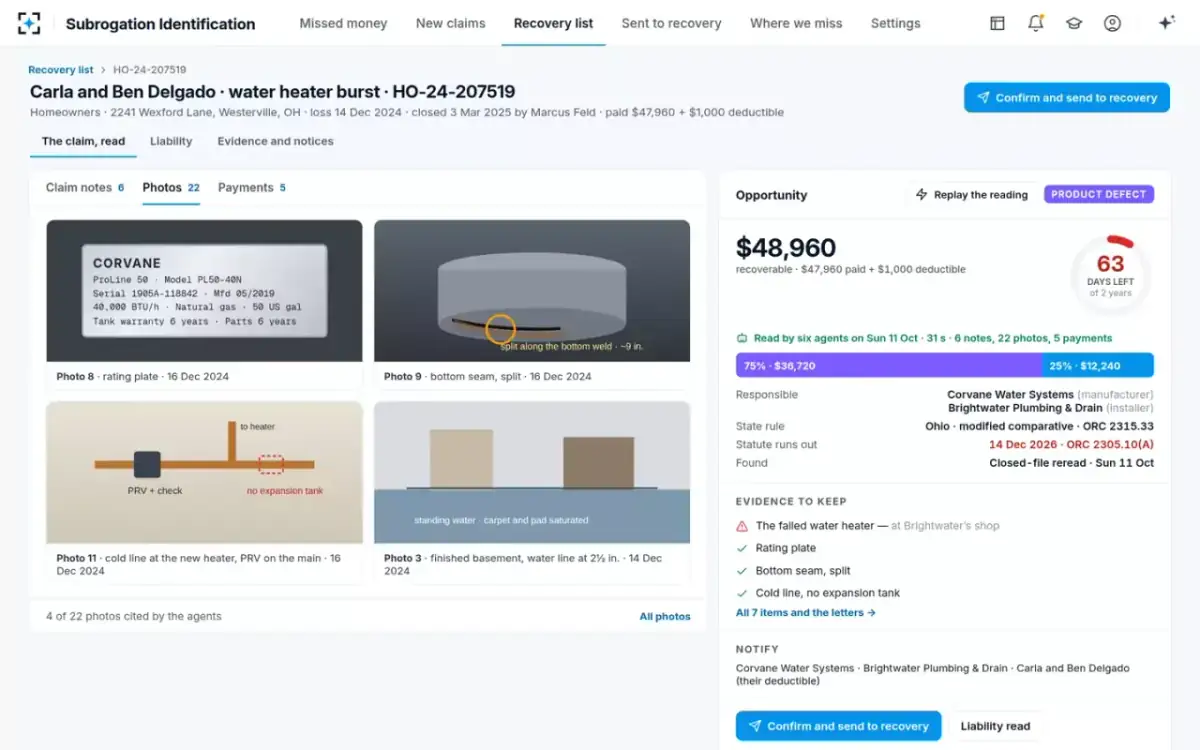
Take the sample claim at the centre of the solution's story: a homeowners loss in Westerville, Ohio, closed as wear and tear. The adjuster's photo 8 was the rating plate, photo 9 the split along the bottom weld, and photo 11 the cold line with a pressure-reducing valve on the main and no expansion tank. Four of the file's 22 photos carried the case.
Four photos out of 22 carry a product claim
Some evidence is electronic and can vanish faster than a water heater: doorbell and dashboard video, telematics, a contractor's emailed schedule. Once litigation is anticipated, the federal rules let a court act when electronically stored information "that should have been preserved" is lost because a party "failed to take reasonable steps to preserve it" (Fed. R. Civ. P. 37(e)), and state courts have their own spoliation rules for physical evidence. A preservation request, sent early and signed by a person, asks the holder to keep the thing exactly as it is.
What is subrogation potential in property damage?
In property claims, potential hides behind the cause of loss; in auto claims it usually announces itself. A rear-end collision names the other party at the scene, and recovery is routine enough that Bisco and Fier's data show salvage and subrogation together returning about one dollar in every five paid on auto physical damage in 2021. A basement flood names water, not a person. The party is the maker of a valve, the plumber who fitted it, the tenant upstairs or the city crew on the street, and the claim system's cause code will say "water damage" in every case.
Property potential also decays faster in the physical sense. The failed part is replaced in the first days, and the replaced part goes with the plumber. On the sample claim the failed tank went to the installer's shop the day the new one was fitted, which is why the first letter the supervisor signed was a hold request to the installer, before any notice to the manufacturer.
Who marks a claim for subrogation?
Traditionally the adjuster, at first notice or at closing, by ticking a box or writing a referral. That puts the decision on the person with the least time and the least incentive to make it. In the solution, the marking moves to the reading: the sentence is highlighted the moment a first notice is typed, a flag goes to the adjuster on the claim and to the subrogation team, and the adjuster still owns the claim. What changes is that nobody has to remember to ask.
A subrogation potential check an adjuster can run on any claim today
- Is there a sentence naming something other than weather, an animal or the insured?
A product, a trade, another vehicle, a neighbour, a utility or a public body.
- Can the party be named from a document?
Rating plate, invoice, permit, police report. If not, write down which document would name it.
- Is the evidence still where it was?
If the part went with the repairer, ask for a hold in writing before anything else.
- Does a public body own the cause?
Notice periods for public bodies run in months, and some states bar the insurer’s claim entirely.
- Is the policy or the law in the way?
A waiver of subrogation, a no-fault regime or an immunity ends the question; record which.
- What is the earliest date?
The shortest limitation, notice or repose period across every theory and party.
A full set of the clocks behind that last check is in the statute of limitations on subrogation claims. Where the solution fits is the reading and the asking: it marks, names, splits, dates and drafts, and a subrogation supervisor confirms every find before it reaches a specialist.
Questions people ask
How do you identify subrogation potential?
Read the claim for a sentence that names a party other than the insured, then confirm the party from a document such as a rating plate, invoice or police report. Check that the law allows the claim and that the amount clears your minimum. Finally, date every theory against every party and take the earliest deadline.
Can AI find subrogation potential?
It can read every note, report and photo caption for the sentence that points to another party, which is the step people skip. It should quote the sentence it relied on and write "unknown" where the file is silent. A person should still confirm the find and decide whether to pursue it; California requires that decision to be given to the insured in writing.
What does subrogation potential mean on an insurance claim?
That the insurer may be able to recover what it paid from whoever caused the loss. If it does, it must include the insured's deductible in the demand in California, and it shares the recovery proportionately with the insured. If it decides not to pursue, California requires it to say so in writing.
Does a waiver of subrogation remove subrogation potential?
Yes, against the parties the waiver covers. Standard endorsements in workers' compensation and commercial auto let the policyholder waive the insurer's rights against named people or organisations. The reader should record the waiver as the reason, so nobody pursues a claim the policy gave away.
Can a claim have subrogation potential after it is closed?
Yes. Closing a claim does not end the insurer's right; the statute of limitations does. In Ohio, product and personal property claims carry a two-year period, which is why rereading closed files finds recoveries that are still alive.
What documents should an adjuster keep for subrogation?
The failed part itself, photos of its label or rating plate, the repair and installation invoices, permits, the police or fire report, statements and any video. Where the part has left the house, a signed preservation request to whoever holds it is the first step.