A subrogation contingency fee is the share of each recovery that an outside subrogation firm or law firm keeps for pursuing it: no recovery, no fee. For an insurer it turns a fixed cost, a team of specialists, into a variable one that rises with every dollar collected. That makes the fee attractive at low volume and expensive at high volume, and the break-even depends on figures only the insurer has: how much it recovers, what its specialists cost and what the contract says. The rules add one constraint that changes the model. In California, and in states that follow the NAIC model regulation, an insurer may not charge its insured's share of the recovery with the fee, except for a pro rata share and only when an outside attorney or collection agency did the collecting. Botminds' Subrogation Identification sits upstream of that choice. It finds the recoverable claims and hands them to whoever pursues them, so it changes how many files reach the fee or the team.
The model below compares three ways of running pursuit over three years. Every input is illustrative and labelled; the point is the structure, which you can rerun on your own contract and payroll.
Three years of pursuit cost on one set of illustrative inputs
What is a subrogation contingency fee?
It is payment by results: the firm is paid a percentage of what it recovers and nothing if it recovers nothing. The insurer refers files, the firm sends demands, files intercompany arbitration or sues, and the fee comes out of each recovery. The percentage, what counts as the fee base, who pays court costs and experts, and when an unrecovered file comes back are contract terms, and they move the economics as much as the headline rate does.
Three things make the fee different from paying a salary. It scales with success, so the insurer carries no cost for files that fail. It scales with volume, so every additional recovery costs the same percentage however easy it was. And it is paid on the recovery, not on the effort, so a clear-liability auto claim that settles on the first demand costs the same share as a contested product case that took three years.
How much do subrogation firms charge?
We found no public benchmark: no regulator, court or academic source publishes market rates for subrogation contingency fees; they are private contract terms, and the studies of subrogation in the insurance literature describe whether insurers recover, not what they pay to do it. Bisco and Fier note only that some firms run the work internally and others contract it to outside vendors (Journal of Insurance Regulation). Any figure on a vendor's website is the vendor's.
One statute does cap fees for one kind of subrogation claim. Claims against the United States under the Federal Tort Claims Act can be presented by an insurer that has paid its insured's loss (28 C.F.R. § 14.3(d)), and federal law limits the attorney's fee on them to 25% of a judgment or litigated settlement and 20% of an administrative settlement (28 U.S.C. § 2678). That is a ceiling for claims against the federal government, such as a crash with a postal vehicle, not a market rate for anything else.
Fee or team: three options over three years
On the illustrative inputs, the mix is cheapest, the all-fee option and the four-person team cost about the same, and the result flips as volume changes. The chart at the top of this page uses $2 million a year of recoveries in every option, which deliberately ignores one real difference: a team that misses fewer recoveries collects more. That effect is real but has to come from the carrier's own data, so it is left out of the bars and handled below.
The structure behind each bar is simple. Contingency fee on everything costs the fee rate times recoveries: 25% of $2 million is $500,000 a year. An in-house team of four costs four loaded salaries, $445,700 a year, plus the fee on the suits it still sends to outside counsel, here 15% of recoveries, or $75,000. A mix keeps two specialists for demands and intercompany arbitration, $222,900 a year, and sends litigation and uninsured debts out on the fee, here 40% of recoveries, or $200,000. Over three years that is $1.50 million, $1.56 million and $1.27 million.
Where a team starts to beat a fee: the break-even in one line
Team cost
specialists × loaded salary
4 × $111,400 = $445,700 a year on the illustrative inputs.
Claims and HR
Fee avoided
fee rate × recoveries the team handles itself
At 25%, every $1 million the team collects avoids $250,000 of fees.
Subrogation unit
Break-even
team cost ÷ fee rate
$445,700 ÷ 0.25 ≈ $1.78 million a year of recoveries handled in-house.
Finance
Capacity limit
files a specialist can work well × average recovery
Above it, the team needs another seat or the fee comes back. Measure it on your own files.
Subrogation supervisor
Is in-house subrogation cheaper than outsourcing?
Above the break-even volume, usually, and below it, usually not; but the comparison most insurers run leaves out the larger variable. Cost per recovery assumes the same recoveries in both options. In practice the number of recoveries depends on how many recoverable claims are found in the first place, and that is set before anyone chooses between a fee and a team. Bisco and Fier's data show recovery as a share of net claims paid ranging from about half a percent to over 20% between the bottom and top fifths of insurers that recover anything. Differences of that size are not about fee rates.
A fair comparison therefore has three columns, not two: what each option costs per dollar recovered, how many recoverable files it will ever see, and how fast it acts on the ones with the least time left. An outside firm can only work the files it is sent, and a team can only work the files it can find. The identification step is common to both.
A contingency fee and an in-house team, on the questions that decide the cost
Contingency fee: None for the fee; the insurer may still pay costs the contract leaves with it.
In-house team: Salaries are paid either way.
Contingency fee: The full percentage, however little work it took.
In-house team: A few hours of a specialist’s time.
Contingency fee: The insurer, before referral; the firm works what it receives.
In-house team: The insurer, the same way.
Contingency fee: Letters go out under the firm’s name; tone and timing are the firm’s.
In-house team: The insurer’s own staff and templates.
Contingency fee: A pro rata share of the expense may be deducted where outside collectors are used, in California and NAIC-model states.
In-house team: No expense may be deducted from the deductible recovery under those rules.
Contingency fee: Firms that are law firms can sue.
In-house team: Suits still go to counsel, usually on a fee.
Can a subrogation fee come out of my deductible?
Only partly, only in some cases, and the rules are specific. California requires the insured's deductible in every subrogation demand and requires recoveries to be shared with the insured in proportion. It forbids deducting legal or other expenses from the recovery of the deductible unless the insurer has retained an outside attorney or collection agency, and even then allows only a pro rata share of the allocated loss adjustment expense (10 CCR § 2695.7(q)). The NAIC's model regulation sets the same limit for auto claims, with the deductible included in the demand at the claimant's request (Model #902).
One sample recovery, collected two ways: what reaches the insured
The recovery
$48,960
$47,960 the carrier paid, plus the insured’s $1,000 deductible. The deductible is 2.04% of the total.
Collected by outside counsel
$750 to the insured
Fee $12,240. The deductible may bear only its pro rata share: 2.04% × $12,240 = $250. The carrier keeps $35,970 after its $11,990 share of the fee.
Collected by the carrier’s own team
$1,000 to the insured
No outside attorney or collection agency, so no expense may come off the deductible. The carrier keeps $47,960, less its own staff time.
The example also shows why the fee base matters in a contract. If the fee is charged on the whole recovery, including the insured's deductible, the carrier must make sure its own accounting gives the insured back everything except the permitted pro rata share. Whether the deductible is returned in full or in part, and when, is covered in subrogation recovery accounting.
What the fee does not buy: the finds
A contingency firm is paid to recover, not to discover. It receives referrals, and a claim that closed as "no subro" is never referred. That is why a carrier can switch from a team to a fee, or back, and see no change in the number of recoverable files: identification sits upstream of both. On the sample carrier in the solution's story, a single weekly reread of 1,906 closed claims found seven new recoverable files worth $139,460, and counted 26 more, worth $412,800, already past their statute date. Those 26 cost nothing in fees because they never reached anyone.
Better identification raises the fee bill, and it should be priced that way. If a full reread doubles the files referred, the fee doubles with it, and the break-even volume for an in-house team arrives sooner. A carrier that expects identification to grow should model the fee and the team at the higher volume, not the current one. The evidence for how much a reread finds should come from a replay of the carrier's own closed claims, which is described in closed file review: definition, then replay.
What a referral can carry: the party, the split, the deadline and the last step
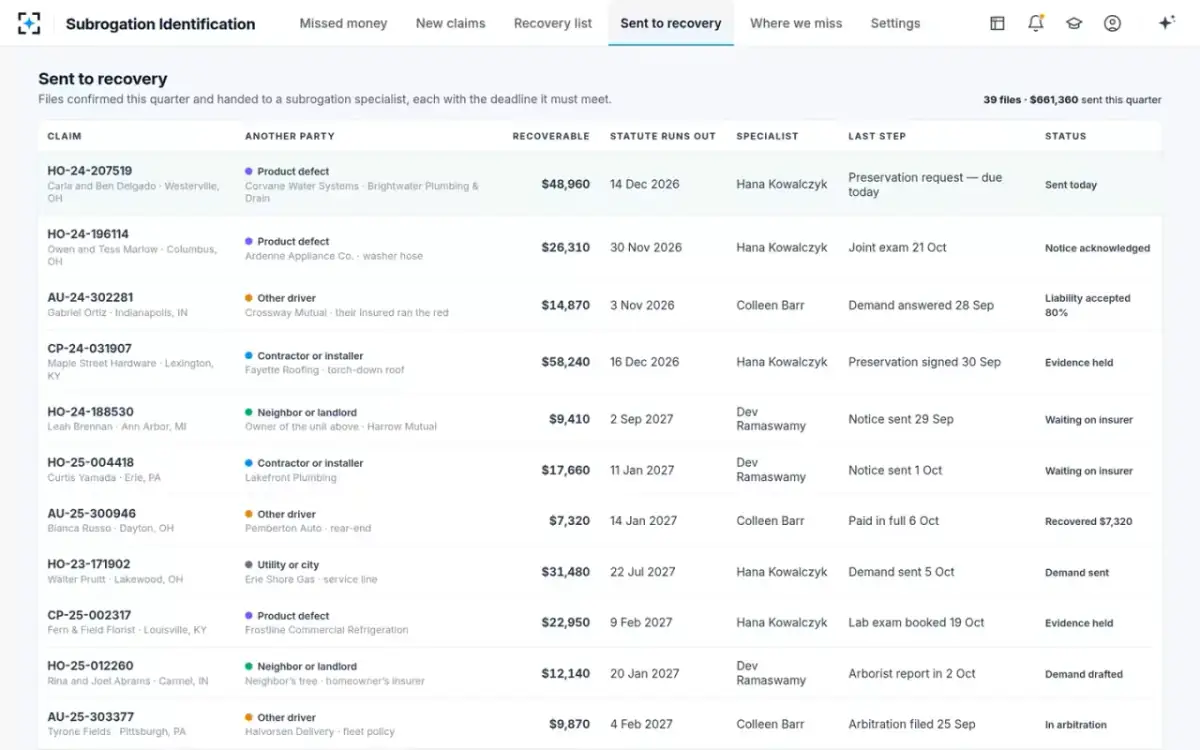
Who pays subrogation attorney fees?
The insurer, out of its share of the recovery, with a narrow exception for the insured's deductible where a pro rata share of outside collection expense may be deducted. Fee-shifting to the other side is rare in ordinary negligence claims. On claims against the federal government, the fee is capped by statute at 25% of a judgment or litigated settlement and 20% of an administrative settlement, and charging more is a federal offence under the same section.
How do you compare subrogation vendors?
On the contract terms that move the cost and the control, before the rate. Two vendors at the same percentage can cost very different amounts once the fee base, the costs clause and the return rules are read. The kinds of vendor, and what the carrier keeps whichever it uses, are set out in a list of subrogation vendors.
Questions for any subrogation firm or vendor
- What is the fee charged on?
Gross recovery, recovery net of the deductible, or only amounts above a threshold? It decides what the insured gets back.
- Who pays costs and experts?
Filing fees, cause-and-origin experts and lab exams can exceed the fee on a product case.
- When does a file come back, and in what state?
A file returned three weeks before its statute date is worse than one never sent.
- How is the insured told, and by whom?
California requires written notice of whether the insurer will pursue; the letter should be the insurer’s.
- Does the vendor see the evidence list and hold requests?
A referral without the failed part on hold is a referral of a weaker claim.
- Are any parties conflicted?
Group affiliates, major customers and the insurer’s own other policyholders need a rule before the first demand.
- What does the vendor report, and how often?
Status by file, money by party and expiring statutes, in a form the insurer can audit.
The three-year horizon, and why recoveries arrive late
Three years is the shortest horizon that tells the truth, because recoveries arrive long after the loss on anything contested. Bisco and Fier's study assumes, from the annual statement data itself, that physical damage recovery is complete within two years of the loss year and liability recovery within nine. A first-year comparison of fee and team will flatter whichever option has fewer contested files.
The time dimension also changes what an hour of specialist time is worth. A specialist who confirms a find in its last 90 days and signs a hold request that week is worth more than a firm that receives the same file a month later. Where the solution fits is that hand-off: Subrogation Identification reads every claim, names the party, suggests a split with its facts, computes the deadline and drafts the letters, and a supervisor confirms each find to a specialist, inside or outside the carrier. It is read-only on the claim system and never contacts a party itself. For the go-live order, see insurance subrogation software.
Questions people ask
What is a typical subrogation recovery fee?
There is no published benchmark from a regulator or academic source; fees are private contract terms and any figure on a vendor's site is the vendor's. The one statutory cap we found applies to claims against the United States, where attorney fees are limited to 25% of a judgment and 20% of an administrative settlement. Model your own contract's rate and fee base.
What does subrogation outsourcing cost?
The fee rate times what the firm recovers, plus any costs the contract leaves with the insurer. At an illustrative 25% on $2 million a year that is $500,000 a year. Whether that beats a team depends on the team's loaded cost and the volume it can handle well.
Is it better to outsource subrogation or keep it in-house?
Most carriers do both: easy, high-volume recoveries such as clear-liability auto claims in-house, and litigation or uninsured debtors outside. The break-even for a team is its cost divided by the fee rate. Neither choice fixes identification, which decides how many files either one ever sees.
Can my insurer take its lawyer's fee out of my deductible?
In California, only a pro rata share, and only when it retained an outside attorney or collection agency to collect; otherwise no expense may come off the deductible recovery. The NAIC model regulation says the same for auto claims. Other states' rules differ, so check your state insurance department's guidance.
Do subrogation firms charge if they recover nothing?
A pure contingency arrangement does not, but the contract may still leave court costs, experts or lab fees with the insurer. Read the costs clause and the file-return clause together, because a file returned late can be worth nothing.
How does a contingency fee change when identification improves?
It grows with every additional recovery referred, at the same rate however easy the claim. If a full reread of closed files raises referrals, model both the fee and an in-house team at the new volume, because the team's break-even arrives sooner.