Insurance subrogation software is software that helps an insurer recover claim payments from the party that caused the loss. It comes in three kinds that are often sold under one name: identification software, which reads claims for another party who should pay; demand and arbitration software, which prepares and files the recovery (see arbitration case management software); and recovery management software, which tracks money, deadlines and the insured's share until the file closes (see subrogation management software). Botminds' Subrogation Identification is the first kind. Its agents read every new claim and reread every closed one, name the party, suggest a liability split with the facts, date every theory under the state's law and draft the letters, and a subrogation supervisor confirms each find. Buying it well depends on understanding what it needs to go live, because most of that is rules and data the insurer already owns.
The order matters more than the timetable. Rules first, because every deadline the software computes comes from them. Then the claim files, read-only. Then the letters and the hand-off. Then a first reread aimed at the claims whose deadlines are closest.
What goes live, in what order, and who owns each part
Weeks 1–2
The rules
- State rule table: limitation by theory, public-body notice, repose, fault rule
- Minimums for property and auto
- Kinds of party to look for, and any waivers or immunities
Claims counsel drafts; VP Claims approves version 1
Weeks 2–4
The claim store
- Read-only access to new and closed claims, policy and payments
- Notes, recorded statements, police and fire reports
- Photos with captions, repair and cause-and-origin reports
Claims IT; security review of the read-only connection
Weeks 3–5
The letters and hand-off
- Preservation request, notice of claim and insured letter templates
- Who signs each, and who receives confirmed finds
- The recovery queue the hand-off lands in
Subrogation supervisor and specialists
Weeks 5–8
The first reread
- Oldest live losses first, inside the shortest period
- Replay scored against how those files ended
- Red band at 90 days, amber at 180
Supervisor confirms; validation reviewer scores
What is insurance subrogation software?
It is any system that moves a paid claim towards a recovery, and the useful question is which step it owns. Identification decides how many recoverable claims the unit ever sees. Demand and arbitration software decides how quickly and well each one is presented. Recovery management decides whether the money, the deductible and the deadlines are accounted for. A carrier with a strong recovery desk and a weak front end gains little from better demand tooling, because the files it is missing never reach the desk.
The three steps are Botminds' three sibling solutions in the same family: Subrogation Identification for finding, Subrogation Demand & Arbitration for the demand and the forum, and Subrogation Recovery Management for the money. A buyer should know which one it is shopping for, and judge each on its own step.
What data does subrogation software need?
The whole claim file, read-only, and not just the coded fields. Identification depends on the sentence that names another party, and that sentence lives in first notices, adjuster notes, recorded statements, police and fire reports, invoices, permits and photo captions. Software that reads only cause codes, amounts and lines of business can score claims but cannot name a party.
The closed files have to be there too, and in many states the law already requires them to be. California, for example, requires claim data and claim files to be kept for the current year and the four before it, in enough detail to rebuild events and dates (10 CCR § 2695.3). That retention window covers the live limitation periods for most property claims, so the first reread has material to work on from day one.
Read-only is a design requirement, not a preference. In the solution, the agents never reopen a claim, change a reserve or a payment, or contact a party. A buyer should ask any vendor what its software can write to the claim system, and get the answer in the contract.
Who confirms the state rules in subrogation software?
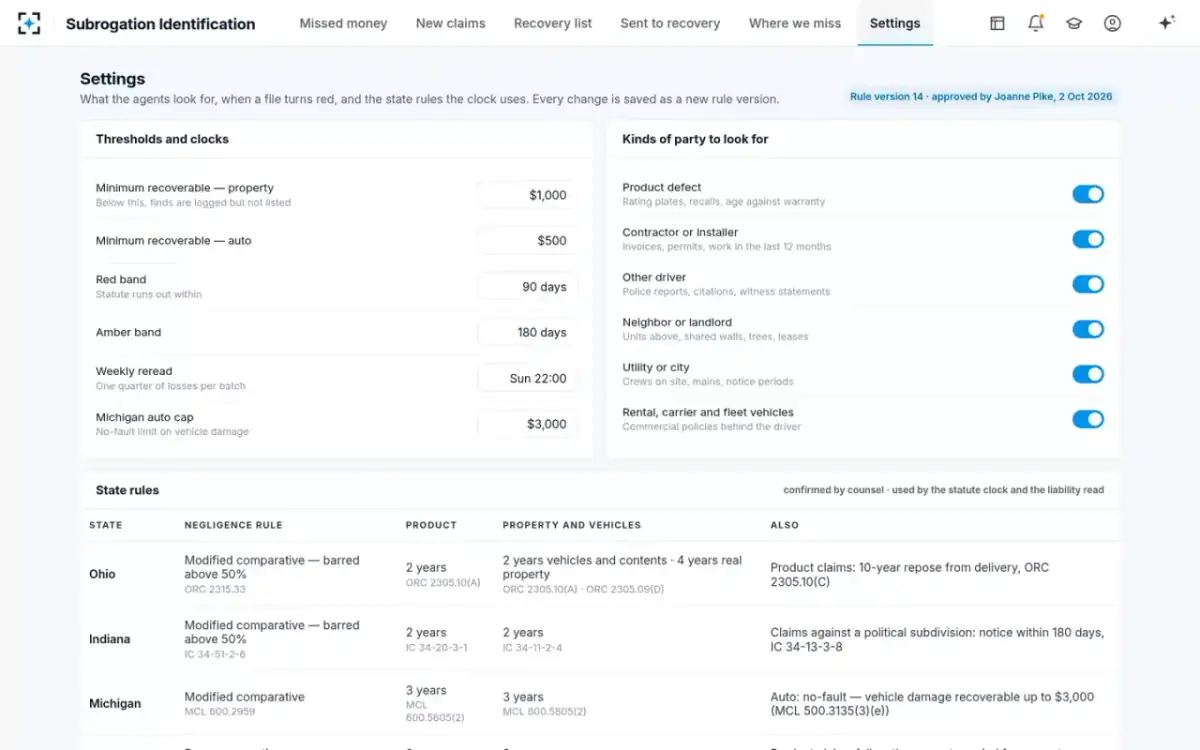
The insurer's counsel, and a named executive approves each version. Every date the software computes depends on a rule table: the limitation period for each theory in each state, notice periods for public bodies, product repose periods, the state's fault rule and any immunity or no-fault limit. These change. Florida shortened its general negligence period to two years and moved from pure to modified comparative negligence in 2023, and a rule table built before that would compute the wrong date and the wrong split for every Florida claim.
Part of a state rule table, with the statute behind each entry
| State | Fault rule | Property and product clocks | Public bodies and limits |
|---|---|---|---|
| Ohio | Modified: barred if the plaintiff’s fault is greater than the others’ combined (R.C. 2315.33) | 2 years for product and personal property (R.C. 2305.10); 4 years for real property and other wrongs (R.C. 2305.09); 10-year product repose | 2 years against a political subdivision (R.C. 2744.04), but insurers may not subrogate against one (R.C. 2744.05) |
| Michigan | Grouped with the 51% bar states in the Maryland Rules Committee’s 2011 survey; confirm against the statute | 3 years for injury to a person or property (MCL 600.5805) | Auto: tort liability largely abolished; vehicle damage recoverable up to $3,000 only where not covered by insurance (MCL 500.3135) |
| New York | Pure comparative: culpable conduct does not bar recovery (CPLR 1411) | 3 years for injury to property (CPLR 214) | Notice of claim within 90 days against a public corporation (Gen. Mun. Law § 50-e) |
| Florida | Modified since 2023: more than 50% at fault recovers nothing (§ 768.81) | 2 years for negligence since 2023 (§ 95.11) | Claim presented within 3 years; recovery capped at $200,000 a person and $300,000 an incident (§ 768.28) |
| California | Pure comparative (Maryland Rules Committee survey, 2011) | 3 years for injury to real or personal property (Code Civ. Proc. § 338) | Claim within 6 months for personal property, 1 year for real property (Gov. Code § 911.2) |
| Texas | Barred above 50% responsibility (Civ. Prac. & Rem. Code § 33.001) | 2 years for injury to property (§ 16.003) | Notice within 6 months, or a shorter city charter period (§ 101.101) |
Two rows deserve a second look from any buyer. In Ohio, the question for a claim against a village sewer or a county road is not when but whether, because R.C. 2744.05 bars an insurer's subrogation action against a political subdivision for the benefits it paid. In Michigan, the $3,000 vehicle-damage figure is a cap on what the owner can recover from the at-fault driver for damage "not covered by insurance" (MCL 500.3135), not a limit on a carrier's own subrogation claim. Software that treats either as an ordinary clock will produce finds nobody can pursue. The full set of clocks, and the method behind them, is in the statute of limitations on subrogation claims.
How long does it take to implement subrogation software?
As long as it takes to agree the rules and open read-only access to the files; the reading itself is not the slow part. A carrier with one claim system and a handful of states can sequence the work into about two months, with the rule table and the data connection running in parallel. A carrier with several claim systems, or one that writes in thirty states, should expect the rule table to take longest, because each state needs counsel's sign-off.
An illustrative two-month go-live: the rules and the data run in parallel
- Rule table drafted2 wk
- Counsel confirms; version 1 approved3 wk
- Read-only connection1 wk
- Claim store and closed files2 wk
- Letters and hand-off2 wk
- Waiting on rules and data5 wk
- Oldest live losses, replayed and scored3 wk
What should the first subrogation reread cover?
The oldest losses still inside their shortest live period, because those are the files about to be lost. In a two-year state, that means starting with losses from nearly two years ago and working forwards. A first reread that starts with last month's closings will produce the easiest finds and let the most valuable ones expire behind it.
The first reread should also be scored, not just harvested. Choose a quarter of losses at random, replay it, and compare the finds with how each file actually ended: recovered, waived, denied or never considered. A reader that cannot find the recoveries the team already made is not ready to be trusted with the ones it missed. The method is set out in closed file review: definition, then replay.
The settings a carrier owns: minimums, bands, the weekly reread and the rule table
Can subrogation software read claim notes?
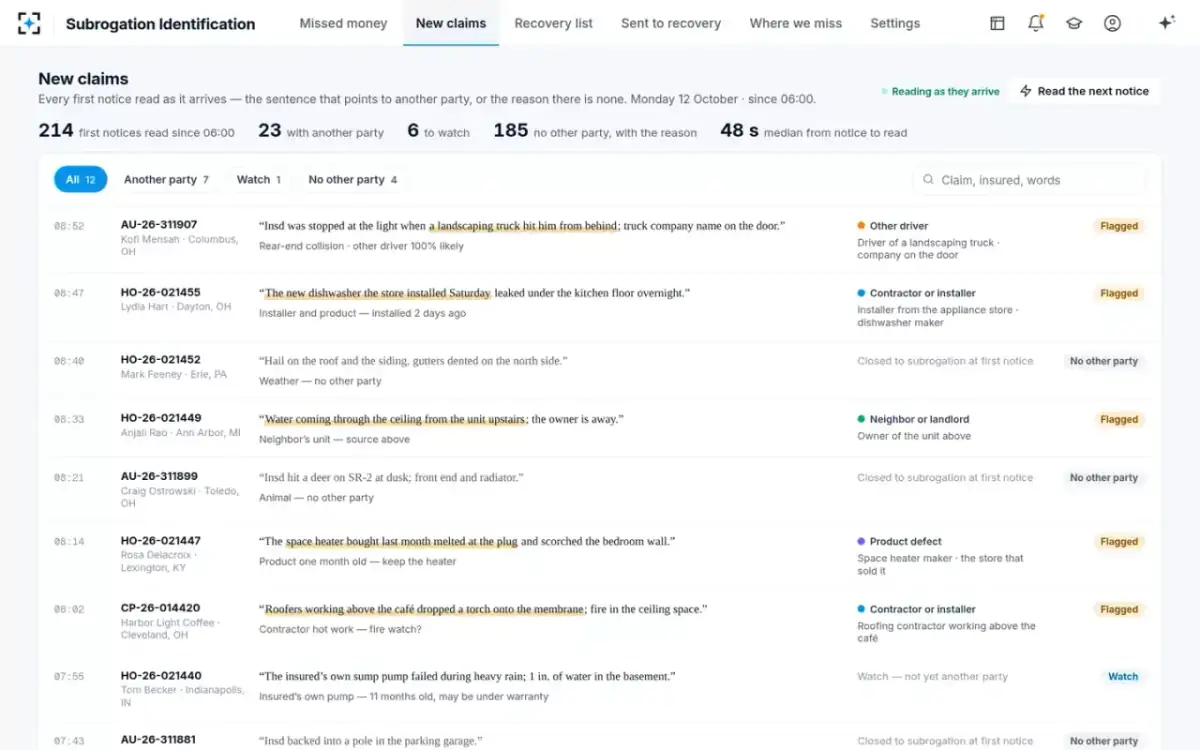
It must, or it is scoring rather than identifying. In the solution the claim reader reads every note, recorded statement, police and fire report, repair and cause-and-origin report and photo caption, and marks each sentence that points to another party, quoting it with its source. New claims are read as they arrive. On the sample carrier, 214 first notices were read between 06:00 and the mid-morning snapshot, 23 had another party, 6 were put on watch, and the median time from notice to read was 48 seconds.
Every first notice read as it arrives, with the sentence or the reason there is none
Does subrogation software track statutes of limitations?
Good identification software computes them; it should never be the only place they are kept. In the solution, the statute clock computes the limitation period for each state and theory, the notice period for public bodies and the repose period for products, and the earliest date governs. It never extends a date, and a file inside the red band is surfaced on the supervisor's first screen. Once a file is confirmed to a specialist, the deadline travels with it into the recovery queue.
The test for any vendor is a claim with two theories and two parties. A product claim against a maker and a negligence claim against an installer for damage to a house can run on different periods in the same state, and the software should show both, with the statute behind each, and the earlier one in red.
What the software should set aside, and say why
Most of what a good reader does on closed files is decide what not to list, and every one of those decisions should carry its reason. On the solution's sample carrier, one weekly reread named 94 parties: 61 files were set aside as already recovered, waived or under the carrier's minimum, 26 were counted as past their statute date, and 7 became new finds. A list of 94 undifferentiated "opportunities" would have buried the seven under work the team had already done or could no longer do.
The reasons a find is set aside are few and specific: already recovered or in pursuit; waived by the policy or by an agreement; barred by law, such as Ohio's bar on subrogation against political subdivisions or a no-fault abolition of tort claims; under the minimum, which in the sample is $1,000 for property and $500 for auto; past the date; or no party named. A buyer should ask to see the set-aside list with its reasons, because that is where a reader's mistakes hide.
How much does subrogation software cost?
We cannot give a market price, and we found no independent source that publishes one; vendors price by claim volume, lines, states and modules. What a buyer can compute is the value side: the recoveries the software finds that would otherwise expire, less the cost of pursuing them. The cost of pursuit depends on whether the carrier uses its own specialists or an outside firm on a fee, and that comparison is worked through in subrogation contingency fee or in-house team.
Who signs what once it is live
Software that finds recoveries should change who decides, not remove the decision. Regulators are moving the same way: the NAIC's model bulletin on insurers' use of AI asks for a written programme covering AI systems that make or support regulated decisions (NAIC), and the NAIC's adoption map listed 29 jurisdictions as of 8 October 2026 (NAIC). A buyer should be able to say, for every output, which person owns it.
Who owns each part of Subrogation Identification once it is live
Today
Owns subrogation results without owning the rules the deadlines come from.
With agents
Approves each version of the state rule table and the minimums.
Still theirs: Every rule change, approved and dated.
Today
Asked about a deadline when a specialist is already worried.
With agents
Confirms each state’s periods, notice rules, repose and fault rule before they are used.
Still theirs: The law behind every computed date.
Today
Assigns referrals that happen to arrive.
With agents
Confirms or rejects every find, signs hold requests, sends confirmed files to specialists.
Still theirs: Every pursue-or-release decision.
Today
Builds extracts and reports on request.
With agents
Runs the read-only connection and its security review.
Still theirs: Access, and the guarantee that nothing writes back.
Questions to put to any subrogation software vendor
- Which step does it own?
Finding, presenting or accounting. Judge each on its own step.
- Does it read the notes, reports and photos, or only coded fields?
Ask to see the sentence behind a flag.
- What can it write to the claim system?
The right answer for identification is nothing.
- Who confirms the state rules, and how are changes versioned?
Ask for the rule table and the approval history.
- How does it handle a claim with two theories?
Both dates, each with its statute, the earliest governing.
- Does it know where a claim cannot be pursued?
Immunities, no-fault limits and waivers should close a find, with the reason.
- Will it replay a quarter of our closed claims first?
Scored against how those files ended, before anything goes live.
Where Subrogation Identification does not fit is just as clear. It does not send demands, file arbitration, sue or book recoveries; those are the recovery desk's and the sibling solutions' work. It does not decide liability or whether to pursue; a supervisor does. And its state rules are the carrier's, confirmed by the carrier's counsel. For the boundary between what the agents find and what people decide, see AI for subrogation: the agent finds, a person decides to chase.
Questions people ask
What is subrogation management software?
Usually software that tracks recoveries once they are pursued: demands, payments, deadlines, the insured's deductible share and reporting. It is different from identification software, which finds the claims worth pursuing in the first place. Many carriers need both, and the identification step decides how many files the management software ever sees.
Can subrogation software work with an existing claim system?
It should, read-only. Identification needs new and closed claims, policy and payment data, notes, reports and photos, and it should write nothing back. Confirmed finds are handed to the recovery queue the carrier already uses.
What should subrogation software never do on its own?
Decide to pursue or release a claim, contact another party, send a letter, extend a deadline or change a claim, reserve or payment. In Subrogation Identification each of those belongs to a named person, and letters are drafts until someone signs them.
How many states should the rule table cover at go-live?
Every state where the carrier has closed claims inside a live limitation period, starting with the states holding the most money. Each entry should be confirmed by counsel; a wrong period produces either missed deadlines or wasted work.
Does subrogation software help with claims against cities?
It should flag them at once, because notice periods for public bodies run in months: 90 days in New York, six months in Texas and for personal property in California. It should also know where the claim is barred, as Ohio bars insurers' subrogation against political subdivisions.
How do you test subrogation software before buying?
Replay a random quarter of your own closed claims and score the finds against how those files ended. A reader should find the recoveries your team already made, explain each new find with its sentence and documents, and set aside files that were already handled.