Subrogation management software tracks every open recovery from the demand to cash received: its limitation date, filing window, replies owed and follow-ups, and the insured's share of the deductible when money comes in. The way to choose one is not a demo on the vendor's data but a 30-day pilot on your own open files, run beside the current team, that answers three questions with evidence: does it find each file's true limitation date, does it calculate each insured's deductible share under the right state's rule, and does it keep insureds informed on the schedule your states require?
This page is a pilot plan. It uses Botminds' Subrogation Recovery Management as the worked example, because its agents re-check statutes nightly and draft letters and filings for people to approve, and a pilot of that kind of software has to test the drafting as well as the dates. The unit, files and figures shown are fictional sample data; the criteria apply to any product.
Thirty days on your own files: what each week proves
- Week 0 · set upcriteria, data
- Week 1 · datesreplay every file
- Week 2 · shadownightly, compared
- Week 3 · draftscount the edits
- Week 4 · moneyshares, letters
What is subrogation management software, and what should it be judged on?
It is the system of work for files the insurer has paid and expects to recover on. Some carriers run it inside a claim system's subrogation module, some in diaries and spreadsheets, some through a vendor's portal, and some with tools that read the correspondence and draft the next step. Whatever the form, it should be judged on outcomes a recovery leader already owes: no file lost to a date, every insured's deductible share paid correctly and on time, and every update the insured is entitled to sent when due.
Artificial intelligence is already part of the category for some carriers. A 2026 article in the NAIC's Journal of Insurance Regulation, drawing on regulators' surveys, reports that among homeowners insurers subrogation is where AI is most used in claims, "with nearly 23% of insurers currently using AI for this purpose, almost 10% having developed an AI/ML claims model prototype, and nearly 6% researching its usage." The regulators' survey memo adds that most models used to help determine subrogation augment human decisions and were built in-house (NAIC working group memo). A pilot is how a carrier that did not build its own finds out whether a bought tool deserves the same trust. Spotting which paid claims have a recovery at all is a different job, covered in insurance subrogation software for identification; this pilot starts from files already open.
How do you evaluate subrogation management software? Four jobs, each with its evidence
Test the four jobs that lose money when they fail, and decide in advance what evidence counts. A dashboard is not evidence; a file-by-file comparison is.
Four jobs a pilot must test, and the evidence each produces
| Job | What to test | Evidence at day 30 |
|---|---|---|
| Limitation dates | Every open file’s statute and file-by date, recomputed from the state’s rule and compared with your diary | A list of every disagreement, with the rule applied, and a reviewer’s verdict on each |
| Deductible shares | The insured’s share on recoveries collected during the pilot, under the loss state’s method | Shares recalculated by finance, matched or explained, file by file |
| Insured updates | Due dates for status letters and pursue-or-not notices under each state’s rule | Letters due in the window, and how many the software and the team each caught |
| Drafts | Follow-ups, final demands and filings drafted from each file’s own correspondence | Share of drafts approved unchanged, edited or rejected, with the reasons |
Limitation dates come first because they are the only failure that cannot be undone. Two recent changes make a good test of any rule table: Florida's negligence period fell from four years to two for causes of action accruing after 24 March 2023 (HB 837, § 28), and Louisiana's delictual period rose from one year to two for actions arising after 1 July 2024 (Act 423). If your book has files in either state, a tool that gets both right on your own diary has shown more than any demo can.
What data do you need for a subrogation pilot?
Less than a migration and more than a sample. The pilot needs every open recovery, because the point is to find the one file whose date is wrong, and enough closed files to test the forecast and replay last year's losses.
What the sample pilot ran on
1,284
open recovery files, every one, with parties, amounts and payments
412
rows from one branch’s spreadsheet diary, matched to claim files
6,912
closed recoveries from 2021 to 2026, to fit payment curves
23
files closed as statute expired in the prior year, replayed
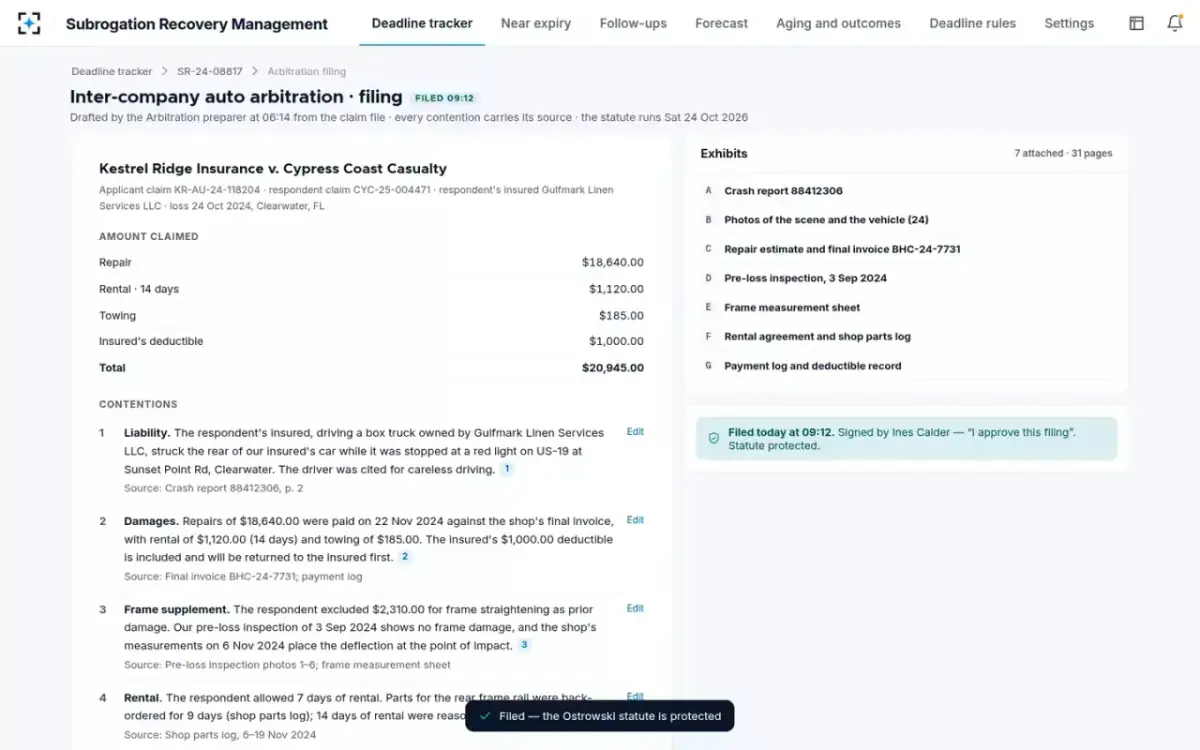
Correspondence is easy to leave out of a pilot, and it is the input that matters most for drafting. A follow-up written from the claim's amounts alone repeats the original demand; one written from the adverse carrier's last offer answers the exclusions it made. In the sample unit's Florida file, the offer excluded $2,310 of frame repair as prior damage and the counter cited a pre-loss inspection. A draft that does not know that is a letter the specialist has to rewrite.
What should a subrogation pilot measure? Pass and fail criteria agreed before day one
Agree them in writing before any data moves, so neither side can redefine success after seeing the results. The thresholds are the carrier's to set; the criteria below are the questions they answer.
Pass and fail criteria for a 30-day subrogation software pilot
- No limitation date later than the true date
Any file where the software’s date is later than counsel’s reading fails the pilot outright: a late date is how files are lost.
- Every date shows its rule
Statute, citation and the version applied for that loss date, visible on the file.
- Last year’s expired files flagged
Replayed with the dates they had, each lost file should have turned red early enough to act.
- Deductible shares match finance
Recalculated under each loss state’s method; every difference explained.
- Insured updates computed per state
Washington’s 60 and 180 days and New York’s 120-day letters, not one schedule for all.
- Draft approval rate above your threshold
Share approved without material edit, set in advance; rejections read for patterns.
- Nothing sent or filed without a person
Check the settings and the activity history, not the brochure.
- Forecast within your tolerance
Expected cash for the pilot weeks against cash received, if forecasting is in scope.
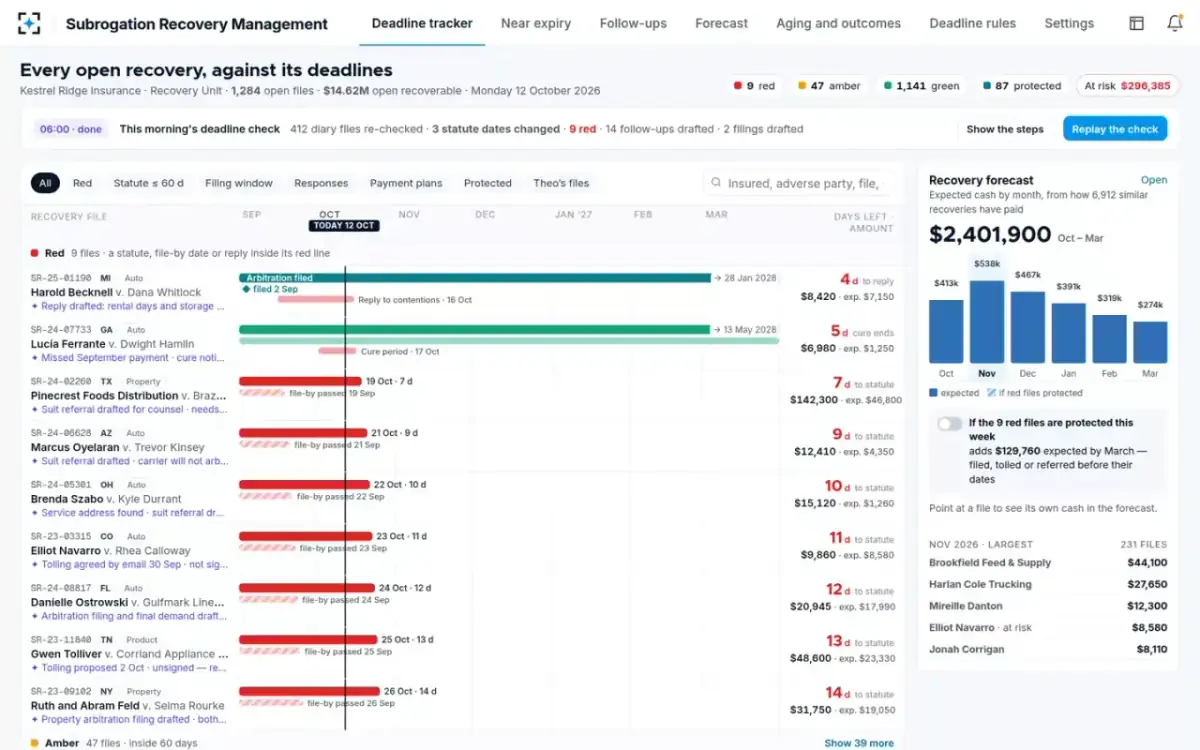
The first criterion deserves its asymmetry. A date that is too early costs a supervisor a look; a date that is too late costs the recovery. In the sample unit's run, the diary carried the Florida file's statute to 24 October 2028 and the rule put it at 24 October 2026, twelve days away. A pilot that finds one such file on a real book may well have paid for itself, which is a reason to put the replay in week one rather than week four.
What week one looks like: every open file against its deadlines, the replay summarised at the top
Can subrogation software run beside the current system during a pilot?
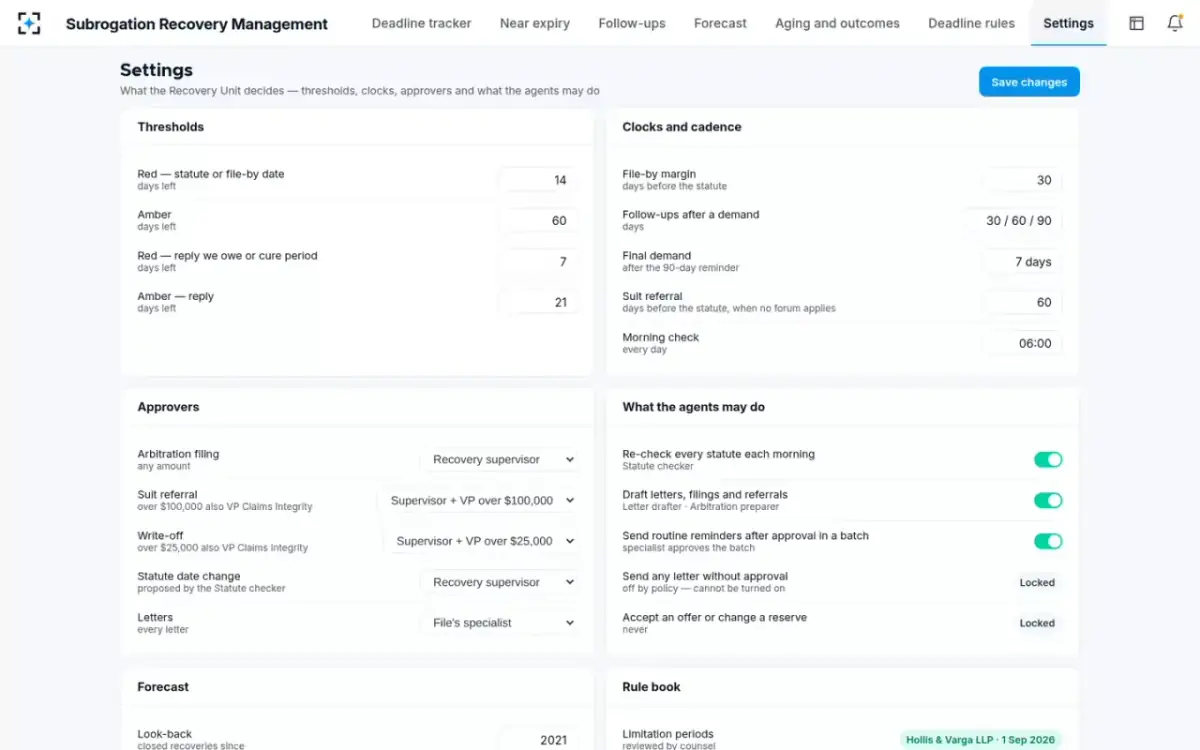
It should, and that is the safest way to test it. In the sample configuration the statute checker is read-only on claim records, the deadline keeper never closes, writes off or files anything, and sending a letter without the specialist's approval is switched off by policy and cannot be turned on. A pilot on those terms changes nothing in the claim system: it reads extracts, produces dates and drafts, and people compare.
Running beside the team also gives the fairest comparison. Each morning the pilot's list of red files can be laid next to the supervisor's own, and each disagreement resolved by reading the file. By the end of week two the carrier knows whether the differences are the software's errors, the diary's, or genuine questions of law for counsel.
The limits a pilot should verify in the settings, not take on trust
What a demo shows, and what a pilot on your files proves
A demo and a pilot answer different questions
A vendor demo: Shows a red bar on a file chosen to have one.
A pilot on your open files: Finds which of your files are wrong, and how many.
A vendor demo: Names the states it covers.
A pilot on your open files: Shows the rule and version applied to each of your loss dates, for counsel to check.
A vendor demo: A polished letter on clean data.
A pilot on your open files: Drafts from your actual correspondence, with your specialists’ edits counted.
A vendor demo: A refund screen.
A pilot on your open files: Your recoveries recalculated under each state’s method and matched to finance.
A vendor demo: A slide on approvals.
A pilot on your open files: Settings and history showing nothing left the building without a person.
Who should run a subrogation software pilot?
A small group that owns each of the outcomes being tested, not an IT project team alone. The recovery supervisor owns the date comparison and confirms or rejects every disagreement. One specialist per line, auto and property at least, judges the drafts, because a letter that reads well to a project manager can still answer the wrong exclusion. A recovery finance analyst recalculates deductible shares and checks the forecast against cash.
Two people outside the unit matter more than they usually get credit for. Counsel reviews the limitation rule table, since a date is only as good as the reading of the statute behind it; in the sample unit, the table carries the name of the counsel who reviewed it and the date. And someone from claims compliance checks the insured-notice schedule against each state's rule, because Washington's 60 and 180 days and New York's 120-day letters are the items a market conduct examiner will test after go-live, not the dashboard.
How much does subrogation management software cost, and what is it worth?
We know of no public price list for the category, and quotes depend on open-file volume, the number of states and lines, the connections needed and whether forecasting or arbitration drafting is in scope. The honest way to judge price is against the two costs the software should reduce: time per file and files lost.
Botminds estimates that a typical auto recovery heading to arbitration takes about 7.25 hours of staff time by hand, of which 3 go on building the filing and exhibits and 1.5 on reading replies, offers and payments, and about 1.85 hours with the agents doing the reading and drafting. That is our estimate, not a measured result; a pilot should time its own files. The other cost is lumpier. In the sample unit, 23 files and $412,600 were lost to expired statutes in the year before go-live, roughly $18,000 a file on fictional figures. A carrier can count its own from closing reasons in an afternoon, and that count, not a vendor's ROI slide, is the number to weigh a price against. How to keep that number visible afterwards is set out in the recovery scorecard.
Where Subrogation Recovery Management fits, and where it does not
It fits a recovery unit that has files open across several states and wants every date re-derived, every reply read and every next step drafted, with people signing. It sits beside the claim system, not instead of it: open files, payments and parties come from the claim system, letters and filings go back to the file, and the forecast is exported to finance.
It is not a claim system, a court docket or a collection agency. Once a file goes to suit, the court's deadlines belong to counsel's docket. It is built for property and casualty recoveries, not health-plan ones. Its rule table is reviewed by the carrier's own counsel, and connecting it to a carrier's claim system and correspondence is the first job of the pilot itself, which is why week zero exists. The nightly run it adds is traced step by step in the statute of limitations tracker, and the money checks it supports in subrogation recovery accounting.
Day 30 evidence: a filing drafted from the file, signed by a person, the statute protected
Questions people ask
How long is a subrogation software pilot?
Thirty days is enough to replay every open file's dates, run nightly checks in shadow for two weeks, test drafts and compare a few weeks of collections. Longer pilots mostly wait on data extracts; shorter ones skip the drafts, which is where specialists' trust is won or lost.
What are subrogation software pass fail criteria?
Questions with thresholds agreed in advance: no limitation date later than the true one, every date showing its rule, last year's expired files flagged early enough, deductible shares matching finance, insured updates scheduled per state and drafts approved above an agreed rate. The first is absolute; the others are the carrier's to set.
Does subrogation software replace the recovery team?
Not this kind. The agents read, recompute and draft; specialists approve every letter and supervisors sign filings, confirm date changes and refer files to counsel. What changes is where the hours go, toward judgement on contested files and away from re-keying dates and assembling exhibits.
Is it safe to run subrogation software on live files during a pilot?
Yes, if it is read-only on claim records and cannot send or file without a person. Verify that in the settings and in the history of actions, not in a contract clause, before the first extract arrives.
What happens after the pilot?
A decision on evidence: the list of date disagreements and how each was resolved, refunds matched to finance, update letters caught and draft approval rates. If the pilot passes, the same configuration goes live with the thresholds, approvers and rule table the unit already agreed.