A list of subrogation vendors usually mixes five kinds of firm: subrogation and recovery law firms, recovery firms and third-party administrators that work files for a share of what they collect, collection agencies that pursue individuals, adjusting firms that handle files under their own licence, and software that a carrier's own team or its vendor uses. We do not publish a list of named vendors, and the more useful list is a different one: what each kind can take off the carrier, and what the carrier keeps however much it outsources. The state rules on this page that protect the insured bind the insurer, not its vendor.
Outsourcing is common enough that researchers note it in passing. Bisco and Fier, writing in the NAIC's Journal of Insurance Regulation, observe that "some firms conduct salvage and subrogation activities internally, while others contract with outside vendors to conduct these activities." Botminds' Subrogation Recovery Management is not a vendor of that kind; it is software that keeps every open recovery against its deadlines with agents doing the reading and drafting, used by a carrier's unit or alongside the vendors it hires. The examples below use a fictional sample unit.
Who can do each step of a recovery, and what the carrier keeps either way
| Step | A vendor can | The carrier keeps | Evidence on the carrier’s file |
|---|---|---|---|
| Demands and follow-ups | Send them under the carrier’s instructions and templates | The decision on what to demand, and the deductible in it where the state requires | Each demand with its amounts by item |
| Compromises | Negotiate within authority the carrier sets | Authority above the limit; any agreement that would short the insured | Who approved each compromise, and why |
| Arbitration and suit | Prepare filings; outside counsel sues | The decision to file or refer, before the statute | The filing, the date protected, the signer |
| Collection from individuals | Pursue payment plans, judgments and enforcement | Write-offs above the limit | Plans, payments and cure notices |
| The insured’s deductible share | Report recoveries promptly | Calculating and paying it under the state’s method and deadline | Recovery date, method, amount and date paid |
| Notices and updates to the insured | Draft them | The duty itself: pursue-or-not notices, status letters, update cycles | Each letter and its date against the rule |
| Limitation dates | Track dates on files it holds | Knowing the true date on every file, held in-house or not | The date, the rule and who confirmed it |
| Oversight | Report on the carrier’s schedule | Monitoring the vendor, as examiners expect | Audits, exceptions and fixes |
What do subrogation vendors do?
They take on some or all of the recovery work after the carrier has paid. Law firms sue and advise, often on large property and product files. Recovery firms and third-party administrators run whole portfolios of smaller files, from demand to collection. Collection agencies pursue individuals after a demand or judgment, typically uninsured drivers. Adjusting firms work files under their own licence. Software vendors sell the tools, not the labour.
They sit in an industry group the Bureau of Labor Statistics can see in its counts. Of the 376,100 claims adjusters, examiners and investigators employed in 2025, 29% worked for agencies, brokerages and other insurance-related firms, the group that includes third-party administrators, against 35% at property and casualty carriers themselves (BLS). Recovery is a small part of that, but it shows how much claims work is already done outside carriers.
Is there a list of subrogation vendors worth using?
Not one we can point to from a neutral source, and a list of names would answer the wrong question. Whether a vendor fits depends on the carrier's lines, states and volumes, and on whether the vendor is licensed where it works. A carrier builds its own list from three checks: what kind of work the firm does, where it holds the licences that work requires, and how it will report every file back so the carrier can meet its own obligations.
The licence check is not a formality. In its 2025 annual report the Texas Department of Insurance records that it "Probated an adjusting firm’s license and ordered it to pay a $117,500 penalty for subrogating certain third-party auto claims for six years without an adjuster license and using unlicensed and licensed individual adjusters to subrogate the claims." The BLS notes that licensing rules for claims work vary by state; a vendor list that does not record licences by state is incomplete.
Four facts to weigh before outsourcing recovery
$117,500
Texas penalty on an adjusting firm that subrogated auto claims for six years without an adjuster licence
29%
of claims adjusters, examiners and investigators worked for agencies, brokerages and related firms in 2025
30days
New York: to pay the insured’s share after a recovery, whoever collected it
1year
Texas: for the insurer to take action, or pay the deductible
Who is responsible for a vendor's subrogation mistakes?
The carrier, in the regulator's eyes. The NAIC's market conduct examination standards expect that "The regulated entity is adequately monitoring the activities of any entity that contractually assumes a business function or is acting on behalf of the regulated entity." The same handbook's claims standards test whether deductible reimbursement to insureds after a subrogation recovery is timely and accurate, whoever collected the money.
The state rules point the same way. Washington's rule on deductibles in subrogation demands is now written as a definition of unfair practices "of the insurer"; New York's 120-day status letters and 30-day refunds are the insurer's duties; Texas's one-year action rule falls on the insurer. A contract can move the work and the cost of a mistake to a vendor; it cannot move the duty to the insured.
Can a vendor keep part of my deductible?
Only as far as the state's rule lets expenses come off the insured's share, and the rules are narrow. California allows a deduction from the deductible recovery only when the insurer has hired an outside attorney or a collection agency, and then only a pro rata share of the allocated expense (10 CCR 2695.7(q)). Washington's text names only an outside attorney: "Deductions for expenses must not be made from the deductible recovery unless an outside attorney is retained to collect the recovery." The NAIC model regulation uses the same attorney-only wording (§ 8D).
Read literally, then, a recovery firm's contingency fee that is not an attorney's comes off the insured's share in neither Washington nor a state following the model, and in California only if the firm is a collection agency. New York deducts allocated loss adjustment expense before sharing the net recovery. A vendor contract that nets its fee from every recovery before reporting it can push a carrier's refunds out of line with the rule, which is why the fee and the insured's share should be calculated by the carrier from the gross recovery. How each method works on one file is set out in subrogation recovery accounting.
Does debt-collection law apply to subrogation collectors?
Not the federal Fair Debt Collection Practices Act, in at least one federal circuit. In Hawthorne v. Mac Adjustment, a recovery firm pursued a driver for $2,020.18 that Liberty Mutual had paid its own insured, under subrogation rights the insurer had given the firm. The Eleventh Circuit held that an obligation arising from an accident is not a consumer "transaction": "Consequently, the FDCPA does not apply because this is not a transaction."
That 1998 decision binds only the Eleventh Circuit, and state collection and licensing laws are separate questions. For a carrier the lesson is narrower: the federal statute may not police how a vendor treats the drivers it pursues, so the carrier's own conduct standards and the state's unfair practices rules have to. Licensing as a collection agency, where a state requires it, is one more line on the vendor list.
How are subrogation vendors paid, and what does that do to incentives?
Mostly by contingency on what they collect, by the hour for law firms, by file or by subscription for software. We know of no neutral public source for typical rates, so a carrier should price each model against its own cost per file. The incentive matters more than the rate. A contingency vendor is paid on collections, so the files it works hardest are the ones most likely to pay quickly; old, small and uninsured files can sit, and those are the files where a statute runs out.
The fix is in the reporting, not the fee. If the carrier holds every file's true limitation date and sees each vendor file against it, a quiet file shows up as a red file whether or not the vendor chases it. The cost of a contingency vendor against an in-house team over three years is worked through in subrogation contingency fee or in-house team.
Should subrogation be outsourced? In-house, vendor, or software beside either
Two ways to work recoveries, and what each leaves the carrier holding
Vendor works the file: The vendor’s staff; the carrier pays per collection, file or hour.
Carrier’s own unit, with software doing the reading and drafting: The carrier’s specialists, with agents reading replies and drafting letters and filings.
Vendor works the file: Tracked by the vendor; the carrier sees what it reports.
Carrier’s own unit, with software doing the reading and drafting: Re-derived from the state rule on every file each morning.
Vendor works the file: Still the carrier’s duty, on data from the vendor.
Carrier’s own unit, with software doing the reading and drafting: Calculated from the carrier’s own amounts by item.
Vendor works the file: In the vendor’s system until reported back.
Carrier’s own unit, with software doing the reading and drafting: On the carrier’s file, with who approved each step.
Vendor works the file: Volume spikes, out-of-state suits, collection from individuals.
Carrier’s own unit, with software doing the reading and drafting: A steady book across several states the carrier wants to control.
The decision is less "outsource or not" than "which files, and on whose clock". A carrier can keep auto files with forum-member insurers in-house, where arbitration is quick, and send uninsured individuals to a collection specialist and large product cases to counsel, while holding every file's dates and the insured's share in one place. In the sample unit, suit referrals over $100,000 and write-offs over $25,000 need the VP Claims Integrity whoever is working the file.
The limits a carrier keeps, written down: approvers, thresholds and what no agent may do
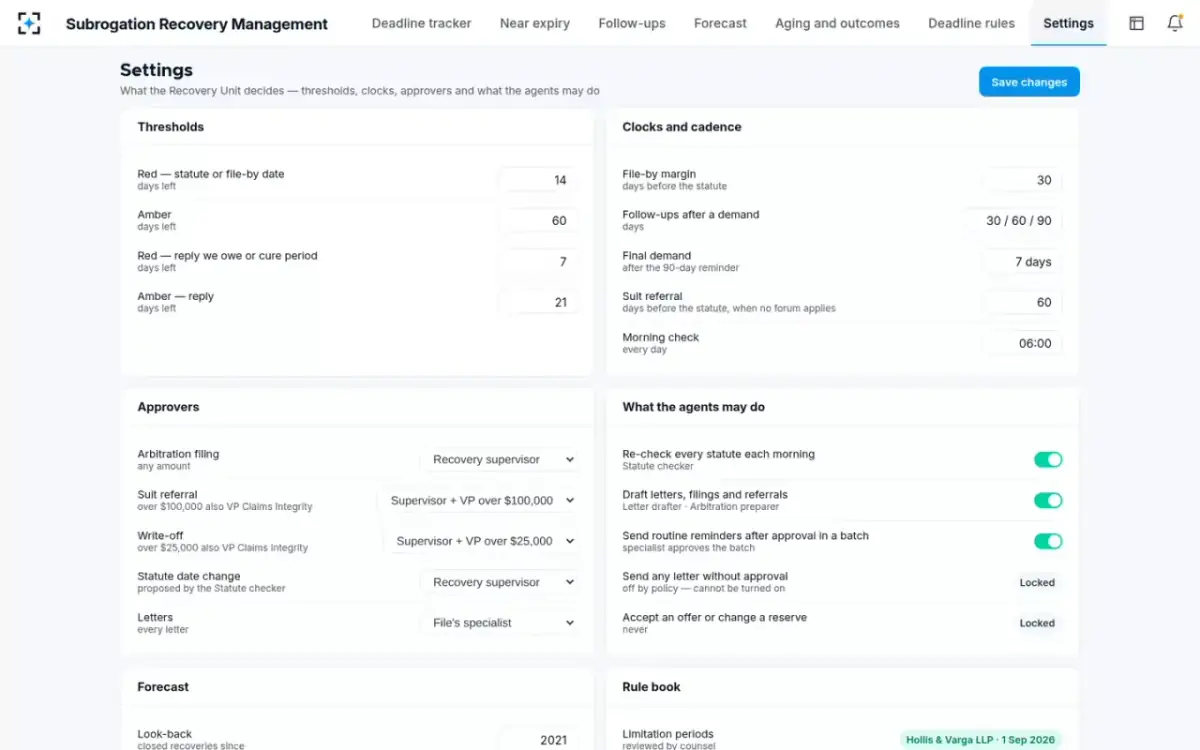
How do you oversee a subrogation vendor?
By holding the data that tells you whether the vendor is doing the job, rather than waiting for its report. The checklist below turns the carrier's duties into contract and reporting terms.
Choosing and overseeing a subrogation vendor: what to require
- Licences by state, checked before work starts
Adjuster and, where required, collection licences in every state the vendor works files.
- Every file’s limitation date, with the rule
Reported on each file and checked against the carrier’s own date.
- Gross recoveries, reported promptly
So the carrier calculates the insured’s share and pays it within the state’s deadline, such as New York’s 30 days.
- Fees deducted only as the state allows
California, Washington and the NAIC model limit what may come off the insured’s share.
- Insured notices and updates drafted on time
Washington’s 60 and 180 days, New York’s 120 days, Texas’s one-year rule.
- Authority limits for compromises and write-offs
Above them, the carrier decides, with the reason kept on the file.
- Conduct standards for pursuing individuals
Federal debt-collection law may not apply to accident claims, so the contract has to.
- Audit rights and a regular file review
Examiners expect the carrier to monitor any entity acting on its behalf.
Software helps oversight most when it holds the dates and amounts independently of the vendor. A carrier that re-derives every file's statute each morning, including files a vendor holds, sees a quiet vendor file the same way it sees a quiet in-house one. The nightly check that does that is traced in the statute of limitations tracker, and the measures that tell a leader whether the whole arrangement works are in the subrogation recovery ratio scorecard.
Questions people ask
What is a subrogation vendor?
A firm that does recovery work for an insurer after a claim is paid: a law firm, a recovery firm or third-party administrator, a collection agency, an adjusting firm or a software provider. The insurer keeps its duties to the insured, including the deductible share and any state-required notices, whichever it uses.
How do you choose a subrogation vendor?
By the files you would send it and the evidence it will return. Check licences in each state, ask how it reports limitation dates and gross recoveries file by file, how it handles the insured's deductible and what authority it needs for compromises. Texas's 2025 penalty against an unlicensed subrogating firm shows why the licence check comes first.
Who pays a subrogation vendor's fee?
The insurer, under its contract with the vendor. Whether any of it can come off the insured's deductible share depends on the state: California allows a pro rata share of allocated expense only for an outside attorney or collection agency, and Washington and the NAIC model only for an outside attorney.
Does a subrogation vendor need a licence?
Often, depending on the state and the work. The BLS notes that licensing rules for claims staff vary by state, and Texas treated subrogating third-party auto claims as adjusting work: it probated a firm's licence and fined it $117,500 for doing so for six years without an adjuster licence.
Can a carrier outsource the duty to inform the insured?
It can outsource the drafting, not the duty. Washington requires the insurer to contact its insured within 60 days of starting subrogation and at least every 180 days; New York requires the insurer's status letters every 120 days. A vendor can send them on the carrier's behalf, but a missed letter is the carrier's finding.