Uninsured motorist subrogation is an insurer's right, after paying its policyholder's claim under uninsured motorist or collision coverage, to recover what it paid from the at-fault driver who had no insurance. The right itself is not in doubt; California's Insurance Code gives it to any insurer that pays an uninsured motorist claim. What is different is the other side. With no insurer to demand from, there is no inter-company arbitration and no award that another carrier pays within 30 days. There is a person, and the levers are a lawsuit, a judgment, a payment plan and, in states such as New York, Florida and Texas, suspension of the driver's licence until the judgment is paid.
These files are not rare. A study by the Insurance Research Council, a research body funded by insurers, estimated that "In 2023, more than one in seven drivers countrywide (15.4%) were uninsured". Botminds' Subrogation Recovery Management handles them on the same deadline tracker as every other recovery, but on a different route: suit referrals raised early, instalments and cure dates watched, and payment curves of their own in the forecast. The sample files below are fictional.
Uninsured motorist subrogation: the route when nobody insures the other driver
Agent
Correspondence readerNotes that no insurer has answered, or that the driver’s insurer denied coverage, with the letter that says so.
Never: decides there is no insurer
A person decides
Subrogation specialistChecks for any policy that could respond: the owner’s, an employer’s, one identified later. If one appears, the file returns to the inter-company route.
Agent
Letter drafterDrafts the demand to the driver, and a payment-plan offer within the limits the supervisor set.
Never: offers below the floor
Agent
Deadline keeperRaises a suit referral 60 days before the statute when no forum applies, and tracks every instalment and cure date.
Never: files or writes off
A person decides
Recovery supervisorRefers the file to counsel for suit; larger referrals need the VP as well.
A person decides
Counsel and the courtSue, obtain a judgment, and where the state allows it, have the judgment sent to the motor vehicle department.
What is uninsured motorist subrogation, and where does the right come from?
It comes from the policy and, in some states, from statute. California's is explicit: "The insurer paying a claim under an uninsured motorist endorsement or coverage shall be entitled to be subrogated to the rights of the insured to whom the claim was paid against any person legally liable for the injury or death to the extent that payment was made. The action may be brought within three years from the date that payment was made hereunder."
The last sentence matters to anyone tracking deadlines. The three years run from the date of payment, not the date of the crash, so a payment made a year after the accident starts its own clock. A file that holds several payments may hold several dates. The way a tracker handles clocks that start from payment is traced in the statute of limitations tracker.
Can my insurer go after an uninsured driver?
Yes, and in Texas it effectively must try, for your deductible at least. Texas requires an insurer on a private passenger auto claim to take action against the third party within a year of paying, or pay the insured's deductible, unless it gives timely written notice and authorises the insured to pursue instead. The statute says plainly: "This section applies regardless of whether the third party who may be liable for the amount of the deductible is insured or uninsured." The definition of action there includes collection efforts, mediation, arbitration and litigation.
Whether it is worth pursuing beyond the deductible is a business decision, and the economics are below. How the insured's deductible is shared when a recovery does come in is set out in subrogation deductible reimbursement rules.
No insurer, no forum: why the file must be built for court
Inter-company arbitration needs two member companies. Against an uninsured individual there is no forum to file in, so the recovery route is a demand letter, then a lawsuit before the statute runs. The exception is the driver who turns out to be insured after all. Arbitration Forums, Inc., the insurer-member not-for-profit that runs the inter-company forums, accepts cases "for reimbursement of payments under UMBI or UMPD coverage from the insurer for the responsible tortfeasor who was identified or acknowledged coverage after the payment."
That makes the first job on any uninsured file a search for coverage, not a demand. A vehicle owner's policy, an employer's policy for a driver working at the time, or a carrier that initially denied and later accepts can each turn a court file back into a forum file. If none exists, everything after that point has to stand up in court: identity, an address where the driver can be served, the crash report, proof of the damages and a limitation date nobody has to argue about.
The same recovery against an insured driver and an uninsured one
At-fault driver with an insurer: The other insurer’s adjuster.
At-fault driver with no insurer: The driver, at an address that may be out of date.
At-fault driver with an insurer: Inter-company arbitration between member insurers.
At-fault driver with no insurer: A lawsuit, before the statute runs.
At-fault driver with an insurer: Forum awards are due within 30 days of the decision.
At-fault driver with no insurer: Voluntary payment, instalments, garnishment within federal limits.
At-fault driver with an insurer: The forum’s rules and the other insurer’s membership.
At-fault driver with no insurer: In some states, the driver’s licence until the judgment is paid.
At-fault driver with an insurer: Months, sometimes a hearing.
At-fault driver with no insurer: A referral, a judgment and a long payment plan.
Can an uninsured driver lose their license for not paying a judgment?
In several states, yes, and it is the strongest lever a recovery unit has against an individual. New York's DMV says it "will suspend the license and registrations if the person fails to pay or satisfy a judgment of more than $1,000 and the judgment is related to a motor vehicle accident, collision, or crash which causes property damage, bodily injury, or death." Florida suspends on receipt of a certified copy of the judgment and keeps the suspension until every such judgment is stayed or satisfied, in full or up to the statutory limits. Texas suspends once the court clerk, at the creditor's written request, sends the department a judgment still unpaid by the 61st day.
Licence rules that follow an unpaid crash judgment, in four states
| State | What triggers it | How it ends | Rule |
|---|---|---|---|
| New York | An unsatisfied crash judgment over $1,000, filed with the DMV on form SR-60 with the judgment and supporting papers | Licence and registrations suspended until the judgment is resolved; the DMV needs proof from the court | New York DMV, unsatisfied judgments |
| Florida | The department receives a certified copy of the judgment | Suspended until every such judgment is stayed or satisfied, in full or to the statutory limits, plus three years of proof of insurance; a creditor’s written consent lets the department allow the licence for six months, then until the consent is revoked | Fla. Stat. §§ 324.121, 324.131 |
| Texas | Judgment still unpaid by the 61st day; the clerk sends it to the department on the creditor’s written request | Suspended until stayed or satisfied and financial responsibility shown; a court-ordered instalment plan or creditor consent can lift it | Tex. Transp. Code §§ 601.331–601.336 |
| California | A different rule: no insurance in a reportable crash, whatever the fault | Suspension of at least one year for failing to show financial responsibility; not a creditor’s remedy | California DMV, financial responsibility |
California's rule is worth understanding even though it is not a collection tool. Its DMV is blunt that "Assignment of fault is not the basis of the proposed action": a driver who cannot show insurance after a reportable crash faces suspension whether or not they caused it. For a recovery unit it confirms the driver's uninsured status; for the money, the route is still a judgment.
The numbers that shape an uninsured-driver recovery
15.4%
of drivers uninsured in 2023, by the Insurance Research Council’s insurer-funded estimate
3years
California: from the date of payment, for an uninsured motorist insurer’s action
$1,000
New York: unpaid crash judgments above this can suspend a licence
25%
federal cap on wages garnished in a week, or less where the minimum-wage test gives less
How do insurers collect from uninsured drivers?
Mostly through payment plans backed by the judgment and the licence. Texas lets a judgment debtor, on notice to the creditor, ask the court for instalments, and the department may not suspend while the debtor keeps to the order and shows financial responsibility; a missed instalment brings the suspension back. In Florida, the creditor's written consent lets the department allow the licence for six months and then until the consent is revoked, even if instalments fall into default.
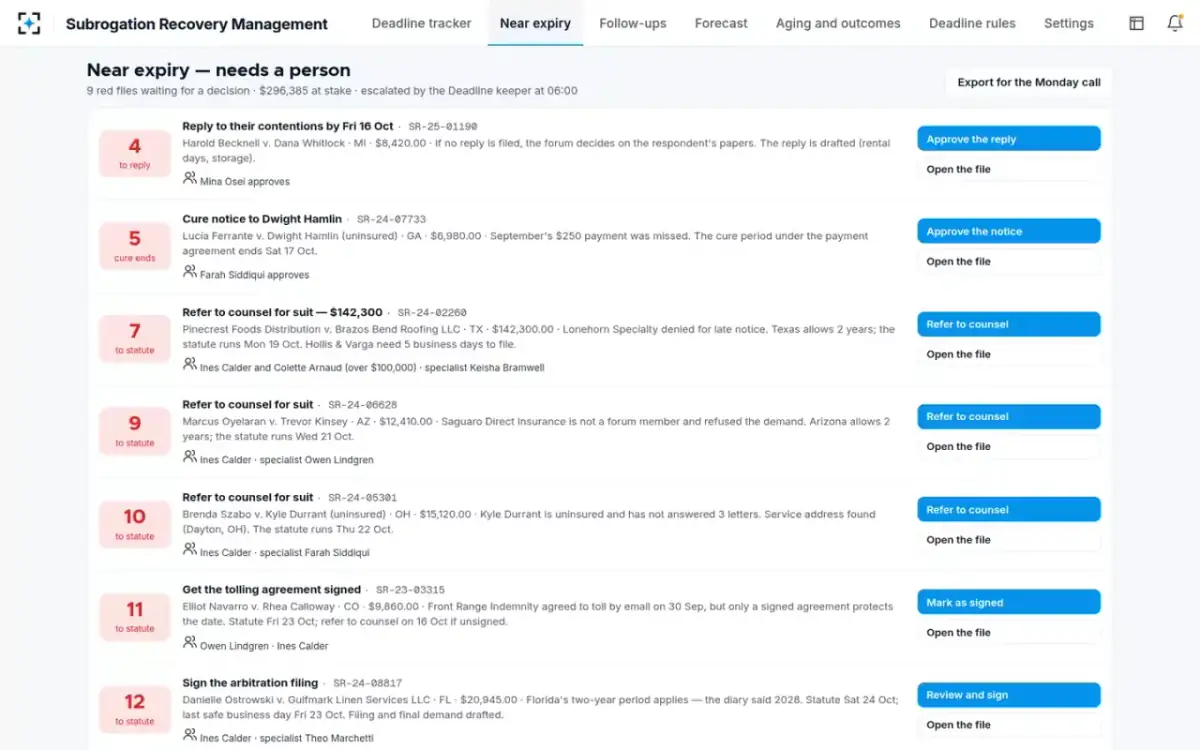
Garnishment is the slower route. Federal law caps weekly wage garnishment at "25 per centum of his disposable earnings for that week", or less where a minimum-wage test gives less, and many debtors in these files earn little. A plan the driver can actually pay usually beats a larger number they cannot. In the sample unit's near-expiry list, a Georgia file against an uninsured driver has a cure notice drafted after a missed $250 monthly payment, with the cure period ending that Saturday. The deadline is not a statute, but it is the date the plan either continues or goes back to enforcement.
Two uninsured-driver files on the same morning: one on a plan, one heading to suit
What happens to the judgment if the driver files for bankruptcy?
It may be discharged, and with it, in Texas, the licence lever. The Bankruptcy Code's exceptions to discharge include debts "for willful and malicious injury by the debtor to another entity or to the property of another entity" and debts for death or personal injury caused by driving while intoxicated. An ordinary negligence judgment for property damage fits neither exception on its face. Texas adds that "A discharge in bankruptcy after a judgment is rendered relieves the judgment debtor from the requirements of this chapter", ending the judgment-based suspension.
The practical lesson is about timing and evidence. A file that might fit the willful-and-malicious or intoxication exceptions needs that evidence preserved from the start, because it is argued in the bankruptcy court, not later. A file that fits neither is worth more early, while a plan can still be agreed, than late.
Underinsured drivers: when the other insurer's limits run out
An underinsured driver has an insurer, but not enough cover. The same Insurance Research Council study, insurer-funded, estimated that "One in three drivers (33.4%) were either uninsured or underinsured in 2023". The at-fault driver's insurer pays up to its limit; anything above that is a claim against the driver personally, which puts the excess on the same route as an uninsured file: demand, suit, judgment and, where the state allows it, the licence.
The forum treats the two differently. Arbitration Forums' guidance is that disputes involving underinsured motorist coverage are not compulsory in its special arbitration forum and can be heard only with consent or if the other member answers without objecting to jurisdiction. For the policyholder, Texas's insurance department explains the order of payment plainly: "If the other driver’s policy limits aren’t high enough to pay for all your car repairs, file a claim with your insurance company." Their own collision or uninsured/underinsured coverage pays the difference, and the insurer then pursues what it can.
Is uninsured motorist subrogation worth pursuing?
Sometimes, and a recovery unit should decide by file rather than by habit. The expected value of a file is roughly the amount, times the likelihood of collecting it, discounted for how long collection takes, less the cost of suit and enforcement. A $15,000 claim against a driver with a job and a licence they need is a different file from the same claim against a driver who has neither. Where a statute such as Texas's makes the insurer pay the deductible if it does not act, the deductible part is owed either way.
What makes these files worth more is starting early and not losing them to dates. The sample unit's forecaster treats "an uninsured individual on a payment plan" as its own segment, fitted from how such files actually paid, rather than averaging them with forum files that pay in months. Those curves are why an uninsured file's cash is forecast in small amounts over many months.
Building an uninsured-driver file for court, not arbitration
- Search for any responding insurer first
Owner’s, employer’s, or one that identifies itself later: each puts the file back in the inter-company forum.
- Confirm identity and a service address
A judgment against the wrong person, or one that cannot be served, collects nothing.
- Keep the crash report and liability evidence on the file
Court standards apply, not a forum’s.
- Set the statute date from the right event
In California, three years from each uninsured motorist payment.
- Refer to counsel early
The sample unit raises the referral 60 days before the statute when no forum applies.
- Plan for enforcement
Licence rules, instalments and garnishment limits differ by state; note any facts that could matter in bankruptcy.
Questions people ask
What happens if the at-fault driver has no insurance?
Your own uninsured motorist or collision coverage pays, subject to its terms and deductible, and your insurer can then pursue the driver personally. Because there is no insurer to arbitrate with, recovery runs through demand letters, a lawsuit and a judgment, which is slower and less certain than recovery from an insurer.
What is a judgment suspension?
A licence and registration suspension a state imposes when a crash judgment goes unpaid. New York applies it to unsatisfied crash judgments over $1,000; Florida and Texas keep it until the judgment is stayed or satisfied, with relief for instalment plans or the creditor's consent.
How long does an uninsured driver have to pay a judgment?
It depends on the state. In Texas the clerk can send the judgment to the department once it is unpaid before the 61st day after the judgment, at the creditor's written request; in Florida suspension follows receipt of the certified judgment. A court-approved instalment plan can keep the licence in both.
Can an insurer recover from an uninsured driver years later?
Within the limitation period, yes, and a judgment, once obtained, stays enforceable for the period state law allows. In California the uninsured motorist insurer's action runs three years from the date it paid, not from the crash.
Does uninsured motorist subrogation ever go to arbitration?
Only if an insurer turns up. Arbitration Forums, an insurer-member not-for-profit, accepts cases for reimbursement of uninsured motorist payments from the insurer of a responsible driver who was identified, or acknowledged coverage, after the payment.