Subrogation recovery accounting tracks five numbers on every recovery file: what the insurer paid, what it demanded from the responsible party, what was agreed or awarded, what was actually collected and what was returned to the policyholder as their share of the deductible. The books are right when each number ties to the one before it with a reason for every difference. The costly errors are not arithmetic. They are a deductible left out of a demand, a compromise nobody explained or a refund calculated under the wrong state's rule.
The fifth number is the one regulators examine, and it is calculated differently in California, New York, Washington and Texas. Botminds' Subrogation Recovery Management keeps the amounts by item on each file and reads every payment as it arrives, so finance closes from the same figures the specialists work from. The unit, files and amounts used as examples below are fictional sample data; the rules are quoted from the states' texts.
Five reconciliations to run on every closed recovery
- Paid ties to the claim payments
Every item in the demand traces to a payment, and the total cannot exceed what was paid plus the insured’s deductible: an insurer cannot profit through subrogation.
- Demanded includes the deductible
California requires it in every demand; Washington requires it; the NAIC model requires it when the insured asks.
- Agreed or awarded is explained
Each difference from the demand carries a reason: liability split, excluded item, compromise approved by a named person.
- Collected matches what was agreed
Awards are payable within 30 days under the inter-company forum’s rules; partial payments and payment plans are dated and matched.
- Returned follows the loss state’s rule
The insured’s share is calculated under the state’s method, expenses deducted only where the rule allows, paid inside any deadline.
How is a subrogation recovery accounted for, file by file?
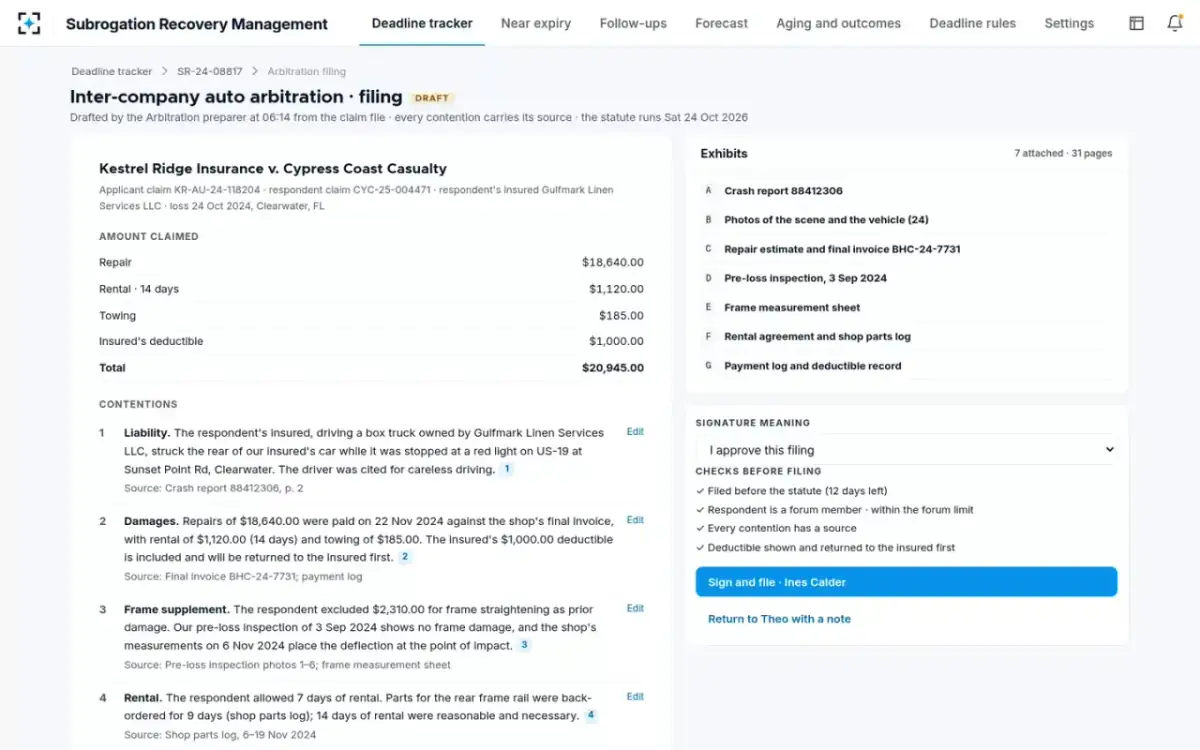
As a chain of five amounts on the claim, each explained by the next. Take the sample unit's Florida rear-end file as it runs through the solution. The insurer paid $18,640 for the repair, $1,120 for 14 days of rental and $185 for towing; its insured paid a $1,000 deductible. The demand to the other driver's insurer was $20,945, the sum of all four, and every item carries the document behind it.
The adverse insurer offered $16,325, excluding $2,310 of frame repair as prior damage and $310 of rental beyond seven days. That offer reconciles to the demand exactly: $20,945 less $2,310 less $310 is $16,325. A reconciliation that can say that in one line is one an auditor can test. One that shows only "demanded $20,945, collected $16,325" is a write-down nobody can explain.
The amounts by item, each with its source: number one and number two on one page
Number one, paid: the ceiling on every recovery
What the insurer paid caps what it can keep. Research published in the NAIC's Journal of Insurance Regulation puts it plainly: "The amount of subrogation is limited to the amount of the loss payment made to the insured (Skurnick, 1973), such that the insurer cannot profit through subrogation." A recovery that exceeds payments plus the insured's own loss is a sign of a keying error or a payment posted to the wrong file.
Paid has to be read by item, not as a total. Rental, towing, storage and diminished value can each be disputed separately, and a reconciliation that tracks only the total cannot show which item the other side refused. It also cannot tell finance which part of a partial payment relates to the deductible.
Number two, demanded: is the deductible in the demand?
It should be, and in several states it must be. California's regulation requires the first-party claimant's deductible in every subrogation demand, Washington's requires it in the insurer's demands, and the NAIC's model regulation requires it when the claimant asks. A demand that leaves the deductible out puts the insurer in breach before any money moves, and it shrinks the base on which the insured's share is later calculated.
Arbitration has a quirk worth knowing. Under the rules of Arbitration Forums, Inc., the insurer-member not-for-profit that administers inter-company arbitration, the deductible does not count toward the total company-paid damages when testing whether a claim falls under the forum's compulsory limit. The deductible still belongs in the demand; it simply does not count toward that limit.
Number three, agreed or awarded: where compromises leak
The gap between demanded and agreed is where unexplained money goes. Some of it is legitimate: a liability split, an excluded item the evidence cannot support, a sensible compromise on an old file. The control is that each difference has a reason and, above a limit, a second signature.
New York adds a rule that limits how compromises may be made on auto physical damage: "Unless the insurer returns its insured's full deductible, it shall attempt to effect full recovery in clear liability cases and shall not enter into any intercompany agreements that provide for the acceptance of lesser amounts on a formula basis." A carrier that accepts a standard percentage from another carrier on clear-liability files owes its New York insureds their full deductible. Finance should know which agreements of that kind exist before it calculates a single refund.
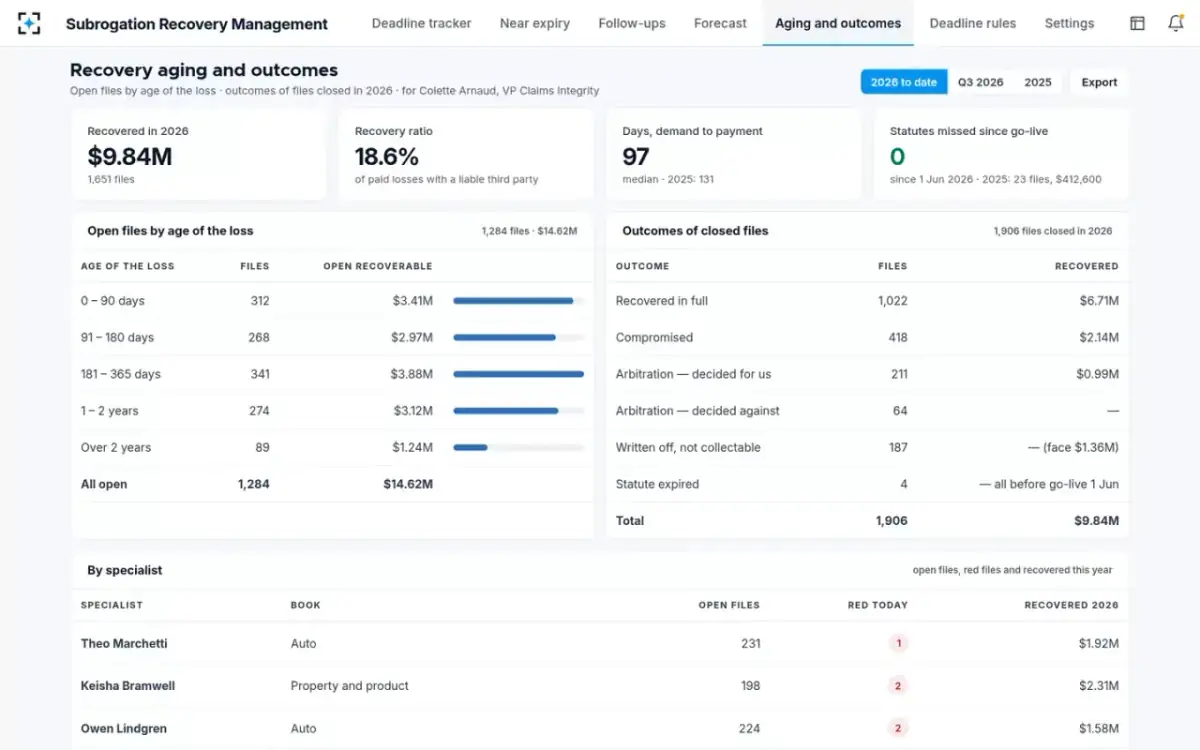
How the sample unit's closed files ended in 2026: what reconciliation has to explain
Number four, collected: net recovery and the expenses a state allows
Collected is gross until expenses come off, and the states disagree about which expenses may come off the insured's part. California lets an insurer deduct expenses from the deductible recovery only when it has hired an outside attorney or collection agency, and then "The deduction may only be for a pro rata share of the allocated loss adjustment expense." Washington and the NAIC model allow the deduction only for an outside attorney; a collection agency's fee does not qualify.
New York writes the calculation out as a formula, which makes it the cleanest one to reconcile against. Net recovery is the total recovery less the allocated loss adjustment expense attributable to it, and the insured's share is the deductible's fraction of the loss applied to that net figure.
New York's deductible-share formula, term by term
Total recovery
What the insurer collected from third parties
All payments on the file, including partial payments.
Allocated loss adjustment expense
− expenses attributable to this recovery
Only the expense tied to this file’s recovery, not general overhead.
Net recovery
= total recovery − allocated expense
The figure the insured shares in.
Insured’s share
deductible ÷ total loss × net recovery
Paid within 30 calendar days of the recovery.
Number five, returned: how is the deductible share calculated?
By the loss state's method, and the methods give different answers on the same file. California shares recoveries proportionately; its consumer guide gives the arithmetic, that if 65% of the paid claim is recovered the insured receives 65% of the deductible (California Department of Insurance). New York uses the formula above. Washington puts the deductible first: recoveries are allocated to the insured's deductible before anything else, less the insured's comparative fault. Texas sets no sharing formula in its statute; it requires the insurer to act within a year of paying or to pay the deductible itself.
One recovery, four states: what the insured gets back
| Rule | Method | Insured’s share on the example | When |
|---|---|---|---|
| California, 10 CCR 2695.7(q) | Proportionate to the recovery; pro rata expense only if an outside attorney or collection agency was hired | $300; $280 if the $200 was outside counsel’s expense | No day count in the rule |
| New York, 11 NYCRR 216.7(g) | Deductible ÷ total loss × (recovery − allocated expense) | $280 | Within 30 calendar days of the recovery |
| Washington, WAC 284-30-393 | Recoveries go first to the deductible, less the insured’s comparative fault; pro rata expense only for an outside attorney | $500 with no fault; $400 at 20% fault, before any allowed expense | Insured updated within 60 days, then every 180 |
| Texas, Ins. Code § 542.204 | No sharing formula; the insurer must take action within a year of payment, or pay the deductible | Set by policy and practice; the consumer guide says the insured will “probably” get it back if the other company pays | Action within 1 year of payment |
The spread on one file, $280 to $500, is why a recovery unit cannot run one refund calculation for every state. It is also why the sample product's own filing screen, which shows the deductible "returned to the insured first" on a Florida file, should be read as one unit's setting rather than a national rule: Washington's text says first, California's and New York's say proportionate. The rules behind that arithmetic, state by state, are set out in subrogation deductible reimbursement rules.
What is salvage and subrogation recoverable on the annual statement?
It is the insurer's estimate of what it will still collect on claims already incurred. A 1988 Casualty Actuarial Society seminar defined it in terms still used: "Salvage Recoverable is the estimated salvage and subrogation (net of expenses) to be recovered on all claims incurred to date, whether reported or unreported."
Statutory accounting makes the accrual a choice. As Bisco and Fier note, "Under Statutory Accounting Principles (SAP), property-liability insurers have the option to accrue for anticipated salvage and subrogation recoveries," while generally accepted accounting principles require it. Salvage and subrogation received is reported by line in Schedule P of the statutory annual statement, which is the data their study of recovery speed is built from. How those estimates are set and reserved belongs to actuaries; the recovery unit's part is that the open-file figures they start from are right.
What the sample unit's books show at the October close
$14.62M
open recoverable on 1,284 files
$1,417,700
expected to be collected in the fourth quarter, from how 6,912 closed recoveries paid
96.4%
of the last six months’ forecast actually collected ($2.13M of $2.21M)
How do auditors and examiners test subrogation recoveries?
Examiners test the refund; internal auditors test the chain. The NAIC's Market Regulation Handbook lists, among its claims standards for property and casualty examinations: "Deductible reimbursement to insureds upon subrogation recovery is made in a timely and accurate manner." That standard is tested on closed files, so the evidence has to be on each file: the recovery date, the amount, the method used and the date the insured was paid.
Internal audit asks the wider question: did every recovery that should have been pursued get pursued, and does every collected dollar tie to a demand? A practical test is to take a quarter's closed files, re-perform the five reconciliations above on a sample and look for three failure patterns: a deductible missing from the demand, a compromise without a recorded reason, and a refund calculated under the wrong state's rule. Each one is cheap to find on a file whose amounts are kept by item, and expensive on one where they are not.
Outcomes, aging and statutes missed, as the leakage leader sees them
What Subrogation Recovery Management keeps reconciled, and what finance still owns
The agents keep the first four numbers current; people own the fifth and the books. The correspondence reader matches each reply, offer and payment to its file with amounts and reasons, so a $4,200 partial payment arrives already attributed. The arbitration preparer builds amounts by item into every filing. The recovery forecaster fits payment curves from closed files and estimates when open ones will pay, and never changes reserves or booked recoveries.
The refund to the insured, the booking and any write-off stay with people under limits the unit sets: in the sample unit, write-offs over $25,000 need the VP as well as the supervisor. For the measures that sit on top of these numbers, such as recovery ratio, speed and statutes missed, see the subrogation recovery ratio scorecard; for why liability recoveries keep the books open for years, see salvage and subrogation recoveries.
Questions people ask
What is net subrogation recovery?
The amount recovered less the expense allocated to that recovery. New York defines it in its auto physical damage rule as total recovery minus the insurer's allocated loss adjustment expenses attributable to the recovery, and shares that net figure with the insured in proportion to the deductible.
Can expenses be deducted from a deductible recovery?
Only in limited cases. California allows a pro rata share of allocated expense only when an outside attorney or collection agency was retained; Washington and the NAIC model allow it only for an outside attorney. An in-house recovery unit's own costs do not come off the insured's share under any of the three.
How do you reconcile subrogation recoveries?
File by file, from paid to demanded to agreed to collected to returned, with a reason for every difference. Keeping amounts by item makes the steps testable: on the sample Florida file, the $4,620 gap between the $20,945 demand and the $16,325 offer is exactly the $2,310 frame repair and $310 of rental the other side excluded.
What reports should a recovery unit produce for finance?
At least open recoverable by age of the loss, outcomes of closed files with amounts, refunds to insureds with dates and methods, and expected cash by month. The sample unit exports expected cash by month for the close, built from how 6,912 closed recoveries actually paid rather than from last year's average.
When must the insured's deductible share be paid?
New York sets the clearest deadline: within 30 calendar days of the recovery for auto physical damage. Other states set the method but not the day, which leaves "timely" to the examiner applying the NAIC standard.