A statute of limitations tracker for subrogation recomputes each open recovery's limitation date from the loss state's rule, compares it with the date on the file and alerts the person who owns the file when a date is close or wrong. The calendar arithmetic is the easy part. The hard parts are that legislatures change the rule after the date was typed in, and that the statute is only one of several clocks on a recovery file, some of which start from the day the insurer paid rather than the day of the loss.
Botminds' Subrogation Recovery Management runs that check every morning across every open file and drafts what the dates call for, while people decide. This page traces one run on a fictional sample unit, Kestrel Ridge Insurance's recovery desk in Tampa, on Monday 12 October 2026. The unit, the people and the files are sample data; the statutes are real.
One morning's statute check on a sample recovery unit
412files
in a branch diary, re-checked against the state rule at 06:01
3dates
that disagreed with the diary: two in Florida, one in Louisiana
743 → 12days
left on the worst one, once Florida’s current period was applied
7minutes
from import to the supervisor’s list of red files
What is a statute of limitations tracker, and why do diary dates go wrong?
It is a calendar that re-derives each date instead of storing it. A diary date typed at intake is a copy of a rule as someone understood it that day. When the rule moves, the copy does not, and nothing on the file looks wrong.
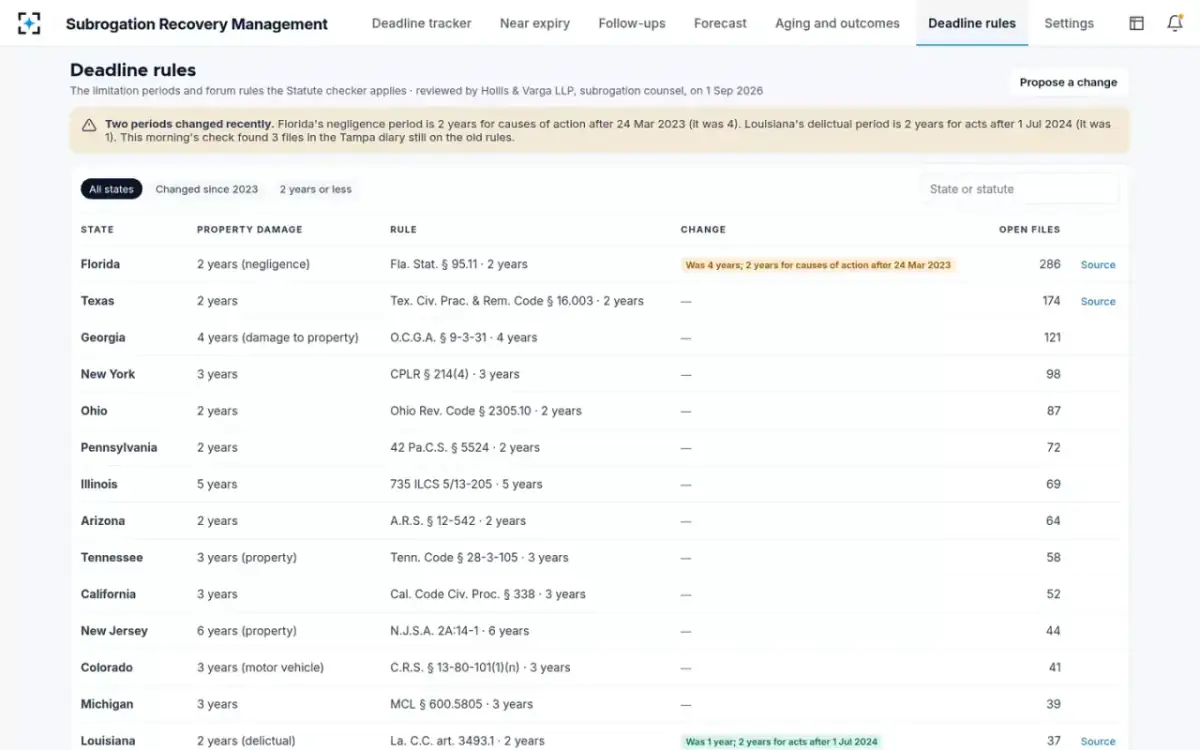
Florida moved the rule in 2023. Its negligence period is now two years under § 95.11(5)(a), and the 2023 tort reform act that made the change says "The amendments made by this act to s. 95.11, Florida Statutes, apply to causes of action accruing after the effective date of this act." The act took effect when the Governor approved it on 24 March 2023. A Florida auto file from before that date still has four years; one from after it has two. A desk that set dates by habit set some of them two years too late.
Louisiana moved its rule the other way in 2024. The Legislature's compiled Civil Code now reads "Delictual actions are subject to a liberative prescription of two years. This prescription commences to run from the day that injury or damage is sustained." Act 423, which made the change, applies only to delictual actions arising after its effective date of 1 July 2024; before that the period was one year. The act enacted the article as 3493.11, while the compiled text numbers it 3493.1, a small discrepancy a rule table should note so nobody cites a number that does not match the act (Act 423). A Louisiana file marked "expired" under the one-year rule may be alive.
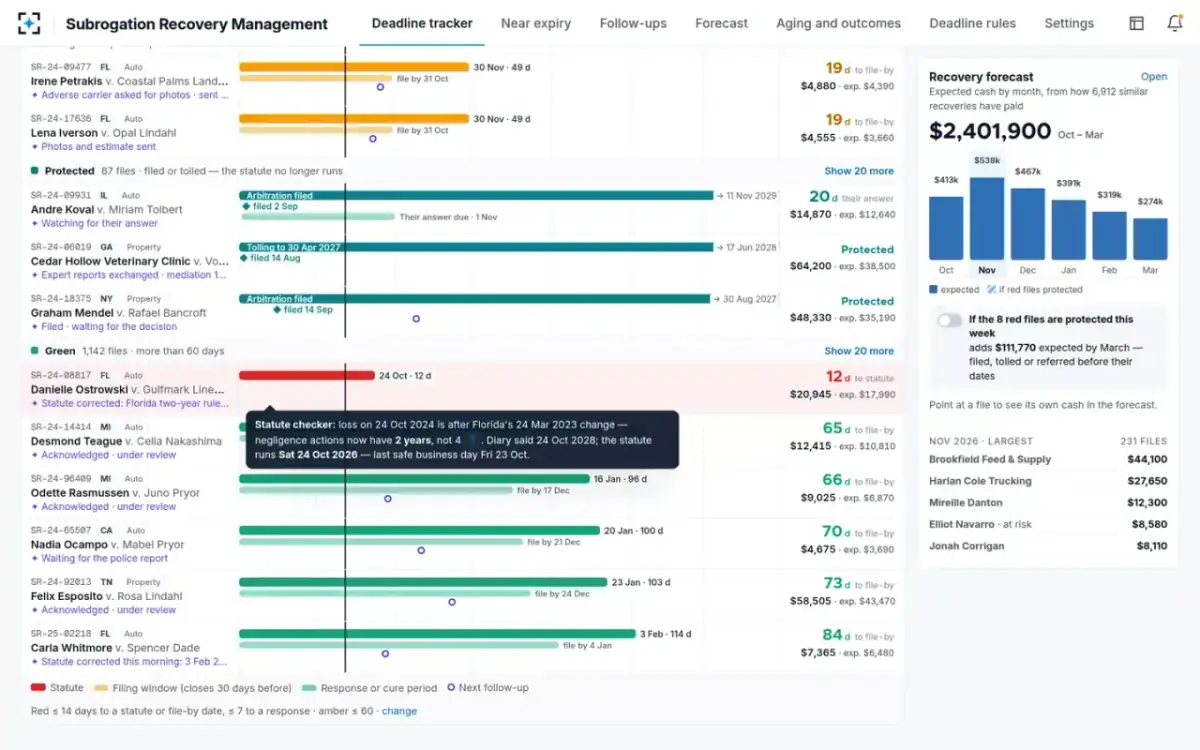
The same Florida file, two limitation dates: what the diary said and what the law says
- Loss to Monday 12 Oct 2026718 days
- Apparent time left743 days left · green
- Loss to Monday 12 Oct 2026718 days
- 12 days left · red
06:00 to 06:07: one night's run, step by step, and who owns each step
The run is eight steps, six of them agents' and two of them people's. The agents read, recompute and draft; the people confirm dates, sign and send. The order matters: dates are fixed first, so every letter and filing drafted afterwards is tied to the corrected date rather than the stale one.
One night's run of Subrogation Recovery Management, and who owns each step
Agent
06:00 · Diary brought inImports the Tampa office’s spreadsheet diary of 412 open files and matches 409 to claim files, 3 of them by claim number only.
Never: creates a file that is not in the claim system
Agent
06:01 · Statute checkerRecomputes all 412 limitation dates from loss state, loss type and loss date; 409 agree with the diary and 3 do not.
Never: changes a date without the supervisor
Agent
06:02 · Deadline keeperRecolours all 1,284 open files, sets file-by dates; red goes from 8 files to 9 and the amount at risk from $275,440 to $296,385.
Never: closes, writes off or files anything
Agent
06:03 · Correspondence readerReads 63 new replies, offers and payments, including two payments, one adjuster change and one request for documents.
Never: accepts or rejects an offer
Agent
06:04–06:05 · Letter drafter and arbitration preparerDrafts 14 follow-ups and a final demand, and two arbitration filings, each tied to the date it protects.
Never: sends or files
Agent
06:06–06:07 · Forecaster and escalationUpdates expected cash, then puts the 9 red files on the supervisor’s list with the action each needs.
A person decides
Recovery supervisorConfirms the 3 changed statute dates, signs the filings, sends suit referrals to counsel.
A person decides
Subrogation specialistsApprove or edit each drafted letter on their own files before anything is sent.
The run as the supervisor sees it at 07:30: every step, with what changed
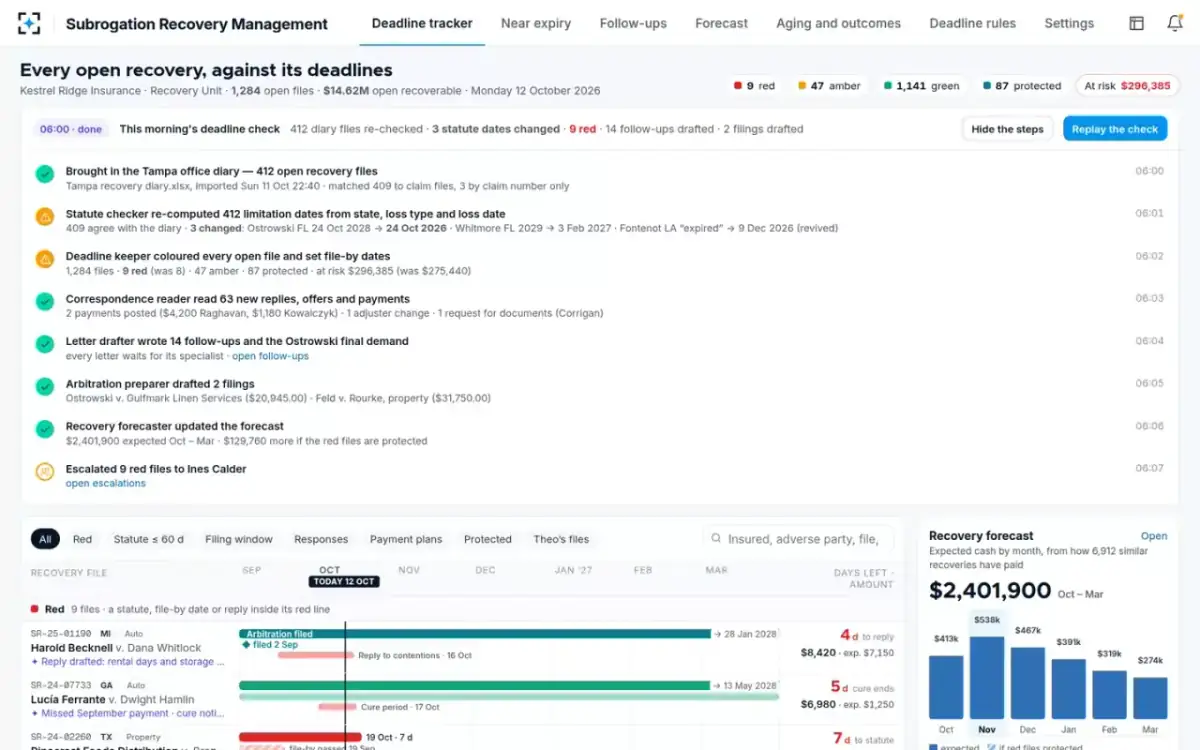
The import step deserves more attention than it gets. Three of the 412 diary rows matched a claim file by claim number only, with no second identifier agreeing. A tracker that silently accepts weak matches can attach a date to the wrong file, so the sample unit's run lists them for a person to confirm rather than treating them as matched.
Can software calculate a statute of limitations? Only if it knows which event starts each clock
Yes, if it knows four things: the loss state, the theory or loss type, the date the clock starts and which version of the rule applies to that date. The fourth is where diaries fail. The third is where trackers built for litigation fail, because several recovery clocks start when the insurer pays its own insured, not when the loss happens.
Recovery clocks that start from different events
| Clock | Starts from | Length | Rule |
|---|---|---|---|
| Florida negligence action | Accrual, for causes of action accruing after 24 Mar 2023 | 2 years (4 before) | Fla. Stat. § 95.11(5)(a); HB 837 § 28 |
| Louisiana delictual action | The day injury or damage is sustained, for actions arising after 1 Jul 2024 | 2 years (1 before) | La. C.C. art. 3493.1 (enacted as 3493.11) |
| New York injury to property | Accrual | 3 years | CPLR § 214(4) |
| California injury to goods or chattels | Accrual | 3 years | Code Civ. Proc. § 338(c)(1) |
| California uninsured motorist insurer’s subrogation | The date the insurer paid the claim | 3 years | Ins. Code § 11580.2(g) |
| New York dispute between insurers, auto physical damage with a deductible | Payment of the claim to the insured | 180 calendar days to arbitrate or sue | 11 NYCRR 216.7(g)(4) |
| Texas deductible recovery, private passenger auto | Payment of the insured’s claim | Act within 1 year, or pay the deductible | Ins. Code § 542.204 |
| A deadline that ends on a weekend, New York | The last day of the period | Next business day | General Construction Law § 25-a |
Two rows deserve a second look. California gives an uninsured motorist subrogation action three years from the date of payment (Cal. Ins. Code § 11580.2(g); see uninsured motorist subrogation), so the date on the file should move every time a new payment is made. New York's rule for auto physical damage disputes between insurers runs "no later than 180 calendar days following the payment of the claim to its insured," which is far shorter than the three-year statute and easy to miss for a desk that only diaries statutes. Claims against public bodies add another family of short notice periods, set out in the notice of claim against a municipality, and a fuller state table is in statute of limitations on subrogation claims.
Weekends need a rule too. New York lets an act due on a weekend or public holiday be done on the next business day under § 25-a. The sample unit takes the cautious side anyway: its Ostrowski statute runs on Saturday 24 October, and the tracker shows Friday 23 October as the last safe business day. That is a setting, not a reading of the law, and a unit can choose differently.
The deadlines that are not statutes, and why a tracker must hold them too
A statute is the last date, not the working date. Before it come the file-by date the unit sets for itself, replies owed in an arbitration, cure periods on a payment plan and the signature date on a tolling agreement. Each is a way to lose a file without the statute ever running.
The file-by margin is a choice. The sample unit files 30 days before the statute; Arbitration Forums, Inc., the not-for-profit whose insurer members use it for inter-company arbitration, suggests to them filing at least 120 days before the statute where possible, to leave time if the other carrier objects that the forum has no jurisdiction. A tracker should let a unit set either and show which files sit between the two.
The corrected date on the tracker: the bar shrinks from 2028 to October and turns red
Tolling agreements are an easy place for a tracker to be fooled. In the sample unit's near-expiry list, a Colorado file shows a tolling agreement the other insurer agreed to by email on 30 September but never signed. The product will not mark that file protected: only a signed agreement counts, so the tracker keeps it red with a referral to counsel scheduled if it stays unsigned. Whether an email exchange binds is a question of the state's law and the words used, and a deadline tool should not decide it.
What happens if a subrogation statute runs?
The recovery is usually lost, and in some states the insured's deductible becomes the insurer's cost. Once the period runs, the other side can raise the statute and end the claim. New Jersey and New York go further on auto physical damage: an insurer that never told its insured it would not pursue, and lets the statute run, must remit the full deductible to the insured. Texas requires action within a year of payment or payment of the deductible itself, unless the insurer gave timely written notice and authorised the insured to pursue (§ 542.204).
In the sample unit's own history, 23 files and $412,600 were lost to expired statutes in 2025, before the tracker went live; the design target since is none. Those are sample figures on fictional files. The useful point for a real unit is that the loss is measurable: count files closed as "statute expired" each year and the amount demanded on them.
Who is alerted when a statute is close, and what may they do?
The file's owner and the supervisor, at thresholds the unit sets. In the sample unit a file turns red at 14 days to a statute or file-by date and amber at 60; replies the unit owes and cure periods turn red at 7 days. When no forum applies, a suit referral is raised 60 days before the statute so counsel has time to file.
The near-expiry list shows why the lead time matters. A $142,300 Texas property recovery against a roofing contractor's insurer that denied for late notice has a statute on Monday 19 October; the unit's counsel needs five business days to file. That referral needs two signatures, the supervisor's and the VP's, because it is over $100,000. A tracker that raised it on the Friday before would have raised it too late, however accurate its date.
How often should limitation dates be checked?
Whenever anything that sets them can have changed, which in practice means daily. Three kinds of change move a date: the law (Florida in 2023, Louisiana in 2024), the facts on the file (a corrected loss date or loss state, a new theory against a product maker) and payments (California's uninsured motorist clock restarts from each payment, New York's 180 days and Texas's year run from payment). A check at intake catches none of them.
Daily is cheap for software and expensive for people, which is why diaries are set once and trusted. The sample unit's morning run took seven minutes of machine time across 1,284 files. What is not cheap is a person reviewing the result, so the run shows only what changed and what is red: three dates and nine files, not 1,284.
What to ask before buying a statute of limitations tracker
Ask how it knows the rule, not how it shows the date. Any tool can draw a bar to a date; the questions below separate a tracker from a calendar.
Eight questions for any statute of limitations tracker used on recoveries
- Where does each date come from?
Every date should show the statute, its citation and the version of the rule applied to that loss date.
- Does it handle rule changes by effective date?
Florida’s two years apply to causes of action accruing after 24 March 2023; Louisiana’s to actions arising after 1 July 2024.
- Does it start clocks from payment where the law does?
California’s uninsured motorist subrogation, New York’s 180-day rule and Texas’s one-year deductible rule all run from payment.
- Does it re-check dates, or only store them?
Ask to see a run that found a date wrong on a file nobody had touched.
- Who may change a date?
A proposed change should need a named person’s confirmation, with the reason kept on the file.
- What counts as protected?
A filed suit or arbitration, or a tolling agreement signed by both sides; not an email promise.
- Can it hold the deadlines that are not statutes?
File-by margins, replies owed, cure periods and insured-update cycles such as Washington’s 60 and 180 days.
- Who reviews the rule table?
Counsel should, on a schedule, and the tool should show who reviewed it and when.
Where Subrogation Recovery Management fits, and where it does not, is plain. It tracks recovery deadlines from the demand to the cash and drafts what each date calls for; it is not a court docketing system, and once a file goes to suit, court-rule deadlines belong in counsel's docket. The distinction is drawn from the litigation side in court deadline calculators against the court's own order. Its rule table is only as good as the counsel who reviews it, and connecting it to a carrier's claim system is the first job of any pilot, as set out in a 30-day pilot on your open files.
The rule table behind every date, with the recent changes flagged
Questions people ask
What is a tolling agreement in subrogation?
An agreement between the recovering insurer and the party or insurer it is pursuing to pause or extend the limitation period, usually to allow negotiation without a protective filing. The sample unit treats a file as protected only when the agreement is signed by both companies, because a date protected by an email promise is a date a court may not honour.
How do insurers track statutes of limitations?
Commonly with a date set on the claim file or in a spreadsheet diary when the recovery is opened. The weakness is that the date is a copy: when Florida halved its negligence period in 2023, every diary date set by habit under the old rule stayed four years out.
Can a statute of limitations tracker handle every state?
Only as well as its rule table. Each state needs periods by theory and loss type, the event that starts each clock, effective dates for changes and any payment-based clocks such as California's three years from an uninsured motorist payment. Counsel should review the table, and the tracker should show which version each date used.
Does filing arbitration stop the statute of limitations?
Filing within the period protects the claim in the forum, which is why the sample unit marks a file protected once the filing is in. The rules of Arbitration Forums, Inc., an insurer-member not-for-profit, also say that where a suit was filed in a matter that belonged in arbitration, filing the suit tolls the statute for 60 days after the suit is dismissed, so arbitration can still follow.
What is a file-by date?
The date a unit sets for itself to file, ahead of the statute, so a jurisdiction objection or a missing document does not consume the last days. The sample unit uses 30 days; Arbitration Forums, Inc., whose members are insurers, suggests at least 120 days where possible.