Subrogation deductible reimbursement is the set of rules that decide how an insurer pursuing a recovery treats its insured's deductible: whether the deductible must be in the demand, how a full or partial recovery is shared between the insurer and the insured, which expenses may come off the insured's share, and what the insured must be told and when. States answer each question differently. California, New York and New Jersey share recoveries in proportion; Washington pays the deductible first, less the insured's share of fault; the NAIC's model regulation shares in proportion but includes the deductible in the demand only on request. For a recovery unit carrying hundreds of open files across states, the deductible is a second obligation running inside every file, with its own deadlines and its own regulator. Botminds' Subrogation Recovery Management tracks each open recovery from the demand to the money, carries the insured's deductible as its own line through demands and arbitration filings, and keeps the deadlines that protect it.
The rules on this page are quoted from the regulations, linked where they appear. The worked example is our arithmetic; the sample file comes from the solution's fictional recovery unit.
Four clocks a recovery unit runs for the insured's deductible
30days
New York: to pay the insured’s share after a recovery
60days
New York and New Jersey: to tell the insured the insurer will not pursue
120days
New York: status letters to the insured while the recovery is pursued
60/180days
Washington: first contact, then at least every 180 days
What does subrogation deductible reimbursement require of an insurer?
Three things in most states that regulate it: include the deductible in the demand, share the recovery with the insured by the state's method, and keep the insured informed, including when the insurer decides not to pursue. California puts the first two in one subsection: "Every insurer that makes a subrogation demand shall include in every demand the first party claimant's deductible. Every insurer shall share subrogation recoveries on a proportionate basis with the first party claimant, unless the first party claimant has otherwise recovered the whole deductible amount" (10 CCR 2695.7(q)).
Washington's rule is stated as an unfair practice for motor vehicle claims. "The insurer must include the insured's deductible, if any, in its subrogation demands. Any recoveries must be allocated first to the insured for any deductible(s) incurred in the loss, less applicable comparable fault" (WAC 284-30-393). The NAIC's model regulation, a template states may adopt, is weaker on the demand: insurers "shall, upon the claimant's request, include the first party claimant's deductible, if any, in subrogation demands," and share recoveries "on a proportionate basis" (NAIC Model Regulation 902, § 8D).
Pro rata or deductible first: the allocation methods by state
The method decides how much of a partial recovery the insured receives, and it is set by the state where the rule applies, not by the unit's preference. Most regulated states use one of three methods.
How six rulebooks allocate a recovery between insurer and insured
| Rulebook | Deductible in the demand | Allocation of a recovery | Expenses off the insured’s share |
|---|---|---|---|
| California, 10 CCR 2695.7(q) | Required in every demand | Proportionate, unless the insured has recovered the whole deductible | Only with an outside attorney or collection agency; pro rata share of allocated expense |
| New York, 11 NYCRR 216.7(g) | Implied by the formula | Pro rata share of net recovery: deductible ÷ total loss × (recovery − allocated expense) | Allocated loss adjustment expense comes off before sharing |
| New Jersey, N.J.A.C. 11:3-10.7 | Implied by the formula | Pro rata share of net recovery, as in New York | Allocated loss adjustment expense comes off before sharing |
| Washington, WAC 284-30-393 | Required | Deductible first, less applicable comparable fault | Only with an outside attorney; pro rata share of allocated expense |
| NAIC Model Regulation 902 | On the claimant’s request | Proportionate, unless the deductible was otherwise recovered | Only with an outside attorney; pro rata share of allocated expense |
| Texas, Ins. Code § 542.204 | Not set as a formula | Not set; the statute is a deadline to act or pay | Not addressed |
The unit's own setting can be more generous than the law but never less. A unit that returns the deductible first in every state meets a proportionate rule as well, at some cost to the insurer's own net recovery. A unit that shares proportionately in Washington breaks Washington's rule on every partial recovery.
One recovery under each rule: a worked example
Take a $6,000 repair with a $500 deductible. The insurer pays $5,500, demands $6,000 from the other carrier and settles at 80%, $4,800. With no expenses and no fault on the insured, the insured's share is $400 under a proportionate rule and $500 under Washington's.
Where an 80% recovery of $6,000 goes under a proportionate rule and a deductible-first rule
California, New York, New Jersey: shared in proportion
- Insured · $400 · 8%
- Insurer · $4,400 · 92%
Washington: deductible first
- Insured · $500 · 10%
- Insurer · $4,300 · 90%
Expenses and fault change the answer. New York's rule states its own formula and works its own example: on a $500 loss with a $100 deductible and $50 of allocated expense, a full recovery returns $90 to the insured and a $300 recovery returns $50 (11 NYCRR 216.7(g)(2)).
New York's deductible share, term by term, on the worked example with outside counsel
Total recovery
What the other side paid
$4,800 on the worked example
Settlement or award
Allocated expense
Loss adjustment expense allocated to this recovery
$600, say, if outside counsel was retained
The recovery file
Net recovery
Total recovery − allocated expense
$4,800 − $600 = $4,200
Rule (g)(2)(i)
Insured’s share
Deductible ÷ total loss × net recovery
$500 ÷ $6,000 × $4,200 = $350
Rule (g)(2)(ii); paid within 30 days
Run the same $600 through the other rules and the differences are visible. In California the deductible's pro rata share of the expense is $50 ($600 × $500 ÷ $6,000), so the insured receives $350 if outside counsel was retained and $400 if the unit's own staff recovered it. In Washington the insured receives $450 with outside counsel and $500 without; with 20% comparative fault and no outside counsel, $400.
Which expenses may come off the insured's share?
Only allocated loss adjustment expense, and in California, Washington and the NAIC model only when the insurer retained an outside attorney (California adds a collection agency). California: "No insurer shall deduct legal or other expenses from the recovery of the deductible unless the insurer has retained an outside attorney or collection agency to collect that recovery. The deduction may only be for a pro rata share of the allocated loss adjustment expense" (10 CCR 2695.7(q)). Washington's wording is the same in substance for outside attorneys.
The practical consequence is an accounting one. An in-house recovery unit's salaries are never deductible from the insured's share under these rules, and a contingency fee paid to an outside firm is deductible only in the deductible's pro rata proportion. A file that records the recovery as one number, with the vendor fee netted off and no allocation, cannot show the insured's share was computed correctly. Subrogation recovery accounting covers the five figures that must reconcile on every recovery.
When the insurer decides not to pursue: the notice duties
Several states make the decision not to pursue a written event with a deadline, and make silence expensive. California requires written notice of whether the insurer intends to pursue subrogation, and where it will not, "a statement that any recovery to be pursued is the responsibility of the first party claimant." The notice is not required where the deductible was waived, there was none, the loss did not exceed it, or "there is no legal basis for subrogation" (10 CCR 2695.7(p)).
New York and New Jersey set a clock. An insurer that "elects not to pursue its subrogation claim where the possibility of recovery exists" must notify the insured in writing "within 60 calendar days after it has paid the claim," and in any event at least 30 days before any statute of limitations runs. If it does not, and the statute expires, it "shall forthwith remit to its insured the full amount of the insured's deductible" (11 NYCRR 216.7(g)(6); N.J.A.C. 11:3-10.7(d)). Texas, for private passenger auto, requires the insurer to act against the responsible third party within a year of paying the claim or pay the deductible, unless it tells the insured in writing that it will not pursue (Tex. Ins. Code § 542.204).
For a recovery unit, these notices are statute dates in a second form. A file that drifts past its limitation date without a pursuit decision costs the insurer its recovery and, in New York and New Jersey, the insured's full deductible as well. The statute of limitations tracker for subrogation follows one night's re-computation of those dates.
Status letters while the recovery is pursued
Two states set a contact cadence. New York requires a written status letter to the insured "120 calendar days after the date of the claim payment," and every 120 days after "until the claim is either honored or rejected" (11 NYCRR 216.7(g)(5)). Washington's amended rule, effective 18 October 2026, defines "regularly informed" as contact "within 60 calendar days after the start of the subrogation process, and no less frequently than every 180 days until the insured's interest is resolved" (WAC 284-30-393).
The letters are short; the burden is the schedule. A unit with a thousand open motor files in New York and Washington owes several hundred status contacts a quarter, each dated to the claim payment or the start of subrogation, and each one is evidence in a market conduct examination. Drafted from the file's own correspondence and queued for a specialist's approval, they become routine work rather than a backlog.
Compromise, arbitration and the insured's deductible
New York and New Jersey limit how far an insurer may compromise while the insured's deductible is unpaid. "Unless the insurer returns its insured's full deductible, it shall attempt to effect full recovery in clear liability cases and shall not enter into any intercompany agreements that provide for the acceptance of lesser amounts on a formula basis" (11 NYCRR 216.7(g)(3)). New York adds a pace: where insurers dispute a recovery and cannot resolve it, the insurer seeking recovery must submit it to binding arbitration, or a court action must begin, "no later than 180 calendar days following the payment of the claim to its insured."
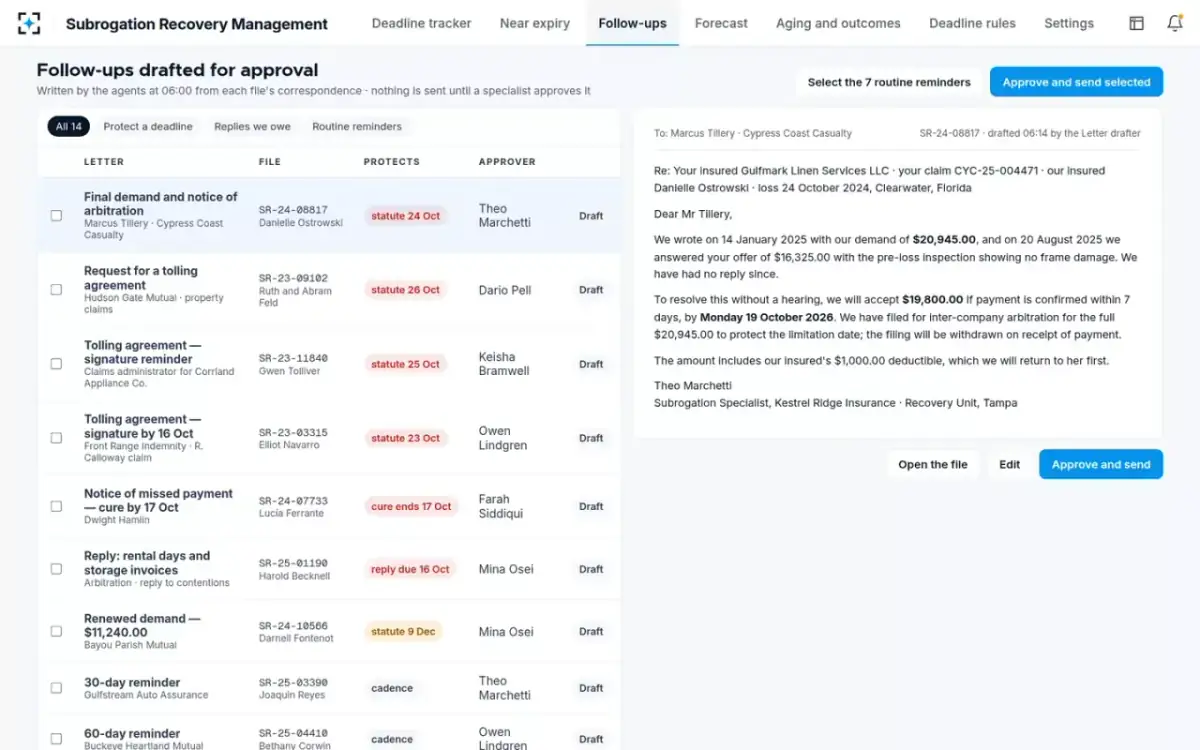
That rule is one reason a unit setting can return the deductible first. In the solution's sample file, a 2022 Subaru rear-ended at a red light in Clearwater, Florida, the unit's final demand offers to settle at $19,800.00 against a $20,945.00 demand, and states that the insured's $1,000.00 deductible will be returned to her first. A compromise that leaves the insured whole is easier to defend than one that cuts her share along with the insurer's. The people and companies in the sample are fictional.
The final demand drafted for approval, with the insured's deductible stated in it
Comparative fault and the deductible
Fault reduces the insured's share, by rule in Washington and by arithmetic elsewhere. Washington's deductible-first allocation is "less applicable comparable fault," so an insured found 20% at fault receives 80% of the deductible from a recovery that covers it. In proportionate states, fault reduces the recovery itself, and the insured's share falls with it.
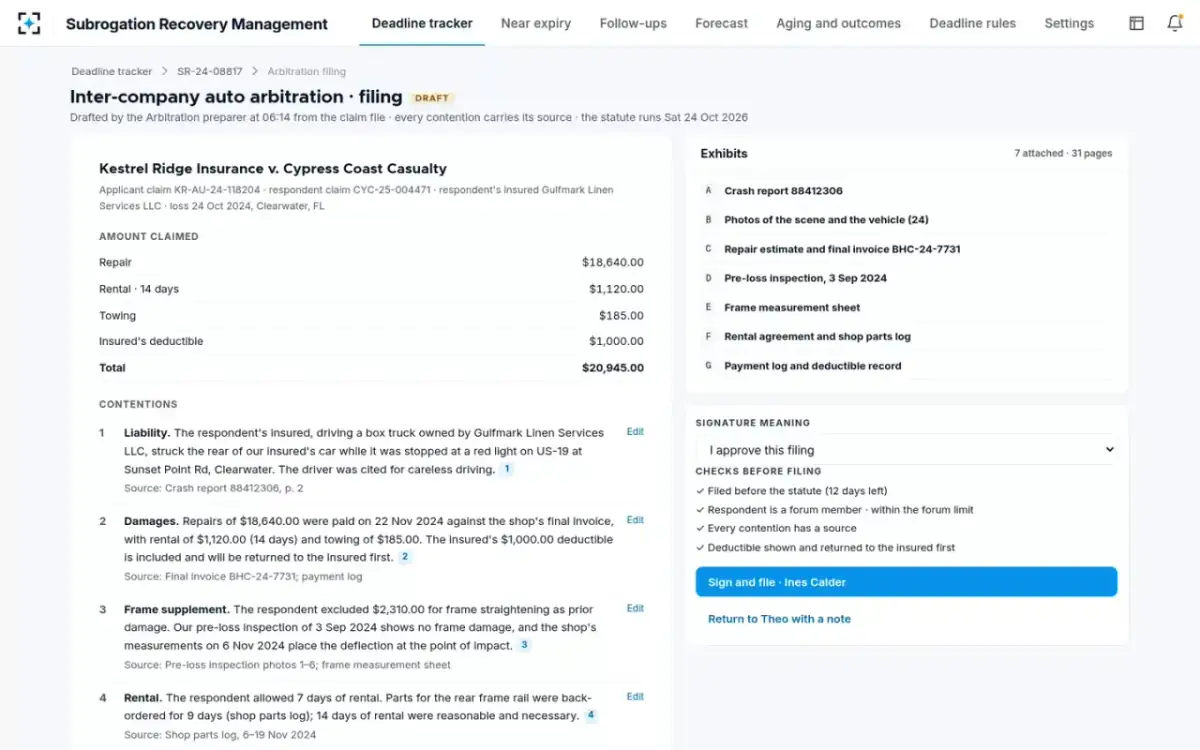
Whether a recovery is possible at all at a given share of fault depends on the negligence rule of the state where the loss happened, and the deductible follows the same rule. When two carriers dispute fault and take it to inter-company arbitration, the decision fixes the recovery and, through it, the insured's share. The deductible line therefore belongs in the arbitration filing as well as the demand; in the sample, it appears as one of four items, beside repair, 14 days of rental and towing.
An inter-company arbitration filing with the deductible as its own item
What the recovery file must show about the deductible
Enough for an examiner to recompute the insured's share and to see every required notice went out on time. The checklist below is what a claims compliance reviewer should be able to find on any closed recovery with a deductible.
Seven things every recovery file should carry for the insured's deductible
- The deductible as its own line in each demand and filing
Required in every demand in California and Washington; on request under the NAIC model.
- The state whose rule applies, and its method
Proportionate, formula on net recovery, or deductible first.
- Total recovery, allocated expense and who incurred it
In-house, outside attorney or collection agency, with the allocation shown.
- Comparative fault found
From the settlement or the arbitration decision, applied to the share.
- The insured’s share, the payment date and the method
Within 30 days of recovery in New York.
- Every notice to the insured, dated
Pursue or not pursue; status letters at the state’s cadence.
- Any compromise, and why it was accepted
In New York and New Jersey, no formula intercompany compromise unless the deductible is returned in full.
How Subrogation Recovery Management carries the deductible
The solution treats the deductible as part of the file, not a reconciliation afterwards. Each demand and arbitration filing it drafts lists the insured's deductible as its own item; the follow-up letters it drafts state how the deductible will be treated; and the statute checker that re-computes limitation dates each night also keeps the dates on which a pursue-or-not decision is owed. In the sample unit, the morning check re-computed 412 limitation dates and drafted 14 follow-up letters, each waiting for its specialist.
The decisions stay with people. Agents never accept an offer, change a reserve, send a letter or sign a filing; the specialist approves each letter and the recovery supervisor signs each filing. The allocation rule each file uses comes from the unit's rules by state, which a person maintains. Uninsured motorist subrogation covers the files where the deductible depends on recovering from an individual rather than a carrier.
Questions people ask
Do insurers have to include the deductible in a subrogation demand?
In California and Washington, yes, in every demand. Under the NAIC's model regulation, only on the claimant's request. New York and New Jersey do not say so in terms, but their formulas give the insured a pro rata share of every net recovery, which assumes the deductible is part of the loss pursued.
What is pro rata deductible reimbursement?
Sharing a recovery between insurer and insured in proportion to their shares of the loss. New York's formula is deductible divided by total loss, times the net recovery after allocated loss adjustment expense; on its own example, a $100 deductible on a $500 loss with $50 of expense returns $90 from a full recovery.
Which states require the deductible to be paid first?
Washington, for motor vehicle claims: recoveries must be allocated first to the insured's deductible, less applicable comparative fault. California, New York, New Jersey and the NAIC model share recoveries in proportion instead.
Can an insurer deduct its recovery costs from the insured's deductible?
Only narrowly. California allows it only when an outside attorney or collection agency was retained, and Washington and the NAIC model only for an outside attorney, in each case limited to a pro rata share of allocated loss adjustment expense. New York and New Jersey subtract allocated expense before computing the pro rata share.
What happens if the insurer does not tell the insured it will not pursue?
In New York and New Jersey, if the insurer elects not to pursue where recovery is possible and fails to notify the insured within 60 days of payment, or at least 30 days before the statute runs, and the statute then expires, it must pay the insured the full deductible.
How often must the insured be updated on a subrogation recovery?
New York requires a status letter 120 days after claim payment and every 120 days after. Washington's rule, as amended effective 18 October 2026, requires contact within 60 days of the start of subrogation and at least every 180 days until the insured's interest is resolved.