Salvage and subrogation recoveries are the amounts an insurer gets back after paying a claim. Salvage is what it receives by selling property it has taken over, most often a totaled car; subrogation is what it collects from the party who caused the loss, or that party's insurer. Together they are large: U.S. insurers recovered nearly $51.6 billion on auto physical damage and auto liability lines alone in 2021. They also arrive on very different clocks. Over half of auto physical damage recovery comes in the year of the loss, while on auto liability lines only 28% to 35% arrives in that first year and roughly 76% by the end of the third.
That gap is the reason this page exists. A recovery unit judged on a quarterly target is judged on salvage's curve while most of its work is on subrogation's. Botminds' Subrogation Recovery Management forecasts each kind of recovery from the curve it actually follows. The industry figures below come from a peer-reviewed study in the NAIC's Journal of Insurance Regulation, built from insurers' statutory annual statements; the unit figures are fictional sample data.
Salvage and subrogation recovered by the end of each year after the loss, by line
What are salvage and subrogation recoveries?
Two ways of getting money back on a paid claim, reported together. A 1988 seminar of the Casualty Actuarial Society gave definitions still used by actuaries: "Salvage is the sale of damaged goods for which the insured has been indemnified by the insurance company," and "Subrogation is the collection by the insurance company of the amount of a paid claim from a negligent third party or his insurer."
The rights behind both come from the policy. As Bisco and Fier describe salvage, after settling the loss "the insurer takes ownership of the damaged property and has the right to sell it." Subrogation gives the insurer the policyholder's right against whoever caused the loss, up to what it paid. On a totaled car the two can meet: the insurer sells the wreck for salvage and pursues the at-fault driver's insurer for what the sale did not cover.
What is the difference between salvage and subrogation?
One is a sale; the other is a claim against someone else. The authors put the contrast in a sentence: they are "very different processes: One involves the sale of damaged tangible items, while the other frequently requires potentially prolonged negotiation and possible litigation." That difference explains almost everything about their timing.
Salvage and subrogation, side by side
Salvage: Selling property the insurer took over after paying, usually a totaled vehicle.
Subrogation: Collecting what the insurer paid from the party at fault, or that party’s insurer.
Salvage: No. The insurer can sell salvage whoever caused the loss.
Subrogation: Yes. No liable third party, no recovery.
Salvage: A buyer, usually at auction.
Subrogation: Negotiation, an inter-company forum or a court.
Salvage: Mostly in the year of the loss on auto physical damage.
Subrogation: About three years to reach three-quarters on auto liability.
Salvage: Title problems, storage costs eating the value.
Subrogation: A disputed liability, an uninsured party, an expired statute.
Salvage: None directly.
Subrogation: The insured’s deductible share rides on it.
"Although subrogation is a liability concept, you may well find that subrogation actually outweighs salvage even in your company's auto physical damage experience."
Casualty Actuarial Society, 1988 Casualty Loss Reserve Seminar
The speaker's reason still holds: to settle quickly, insurers pay their not-at-fault policyholders' physical damage and then collect from the at-fault drivers' insurers. Bisco and Fier make the same caveat about their own data. They treat physical damage recovery as mostly salvage and liability recovery as mostly subrogation, but note that subrogation can be the larger part of physical damage recovery too, depending on how much a carrier pursues.
On a totaled car, salvage is usually the smaller part of the recovery
Salvage looks large in physical damage figures because nearly every total loss produces some, but on any one car it is modest. Bisco and Fier note that "any salvage received is typically a small portion of a totaled vehicle’s total value", and that salvage "primarily occurs with vehicles that have been totaled, and only in rare cases may an insurer have the ability to salvage parts from a vehicle that has been repaired." Where another driver caused the loss, the larger part of the recovery is the subrogation claim for what the sale did not cover.
The two run on different desks and can hold each other up. The salvage sale waits on the title and the yard; the subrogation demand needs the final settlement figure, which is not final until the salvage proceeds are known. A totaled car stuck at a storage yard costs money every day and delays both. One such file, delayed 28 days by a title mailed to an old address, is followed step by step in a total loss title delay case study.
How much do insurers recover through salvage and subrogation?
Tens of billions a year on auto lines alone, and a growing share of physical damage claims. In inflation-adjusted terms, auto physical damage recovery rose from $12.79 billion in 1996 to a high of $31.2 billion in 2021. Commercial auto liability recovery grew far less, from just over $1.4 billion to $1.6 billion, and personal auto liability peaked at $19 billion in 2020.
Salvage and subrogation on U.S. auto lines, from insurers' annual statements
$31.2B
auto physical damage recovery in 2021, up from $12.79B in 1996 (inflation-adjusted)
1 in 5
dollars paid on auto physical damage claims recouped in 2021
2%
average recovery ratio on personal auto liability, 1996–2021
1.1%
average recovery ratio on commercial auto liability, 1996–2021
The ratios tell the line story. On physical damage the ratio of recovery to net claims paid rose from roughly 11% in 1996 to about 20% in 2021; roughly one dollar recovered for every five paid. On liability lines the averages over the period were 2% and 1.1%. The authors link the physical damage growth partly to more registered vehicles and to technology in cars that has raised the cost of repair, replacement and, they expect, salvage values.
How fast are subrogation recoveries collected?
Slowly enough that a quarter of liability recovery is still outstanding three years after the loss. The figures in the chart above come from Schedule P, which reports physical damage recovery over two years and liability recovery over nine. On the commercial side, 35% of liability recovery arrives in the year of the loss and 65% by the end of the second year; on the personal side, 28% and 59%. Both reach roughly 76% by the end of the third year.
Physical damage recovery is front-loaded for the reason the authors give: insurers frequently have a standardized process for heavily damaged or totaled vehicles, so salvage moves quickly. The personal auto liability curve is the slowest start, but it catches up with commercial auto by year three.
Why do liability recoveries take longer?
Because the money depends on other people's decisions. A liability recovery waits for fault to be settled, sometimes for an injury claim from the same crash to resolve, and sometimes for a lawsuit. The authors found that the insurer characteristics that predict faster physical damage recovery, such as size, profitability and how important the line is to the insurer, explain liability speed far less consistently, and suggest the difference may come from forces outside the insurer's hands: social inflation, slow litigation and negotiations it controls less (Bisco and Fier).
Some of the wait is within a unit's control. Replies the unit owes, follow-ups that keep an adverse carrier from going quiet and filings made before the date are all levers. In the sample unit, one Florida file went 418 days without a reply from the other carrier after its adjuster changed; the recovery was not slow because of the law but because nobody chased it.
How are salvage and subrogation reported, and do insurers accrue anticipated subrogation?
Received amounts appear in Schedule P of the statutory annual statement, by line; anticipated amounts are an accounting choice. Under statutory accounting an insurer may report its claim liabilities net of anticipated salvage and subrogation or gross, while generally accepted accounting principles require the accrual. The CAS seminar defined the estimate as salvage and subrogation, net of expenses, still to be recovered on all claims incurred to date, whether reported or unreported.
Most insurers in the study accrued: the share of firm-years with an accrual was about 64% to 69% depending on the line. Who chooses not to is telling. Citing earlier research, the authors report that mutual insurers, firms with weaker AM Best financial strength ratings and fast-growing firms accrue less often, and publicly traded insurers more often (Bisco and Fier). And on commercial auto liability, accruers collected a larger share of their recovery by year three. Setting those estimates is actuarial work; a recovery unit's contribution is accurate open-file amounts, the subject of subrogation recovery accounting.
What a quarterly recovery target gets wrong
It compares a three-year curve with a three-month window. A unit with a growing liability book will miss a quarterly target while doing good work, because this year's files will pay over the next two or three years. A unit with a shrinking book will hit it while the pipeline empties. Neither number says whether files are being worked.
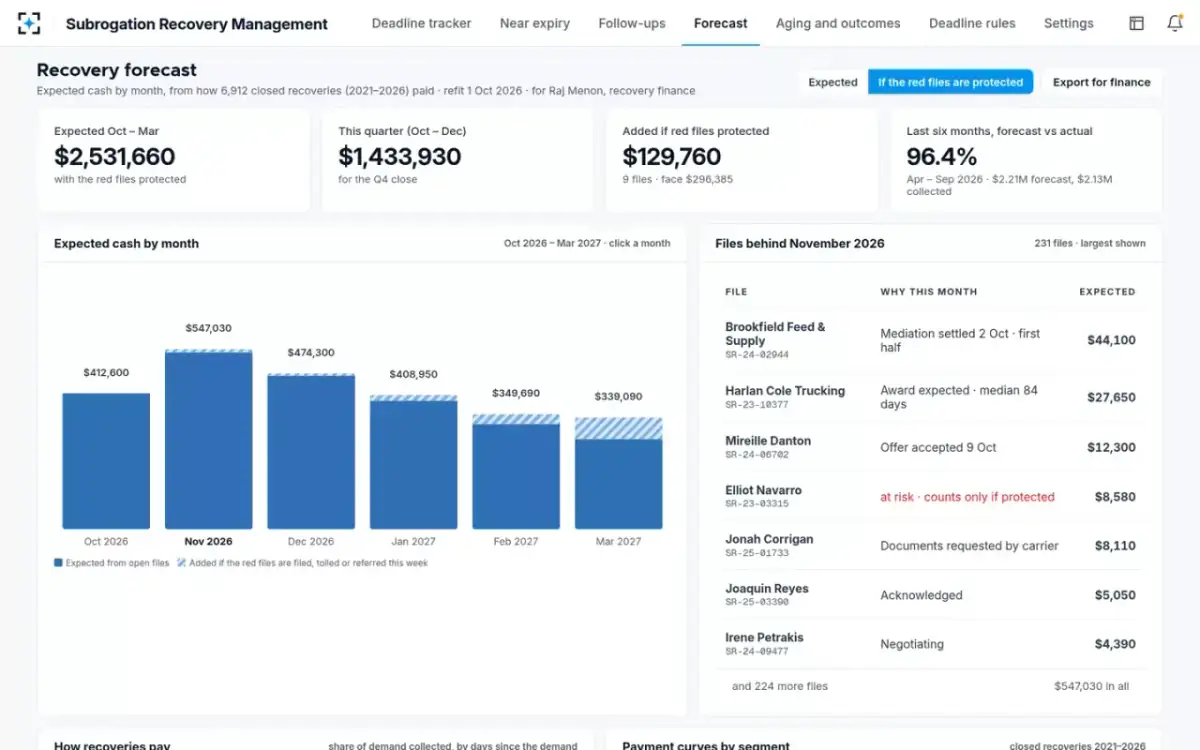
The fix is to forecast by curve and measure against the forecast. The sample unit's recovery forecaster fits payment curves by segment from 6,912 closed recoveries since 2021, so an auto file with a forum-member carrier and an uninsured individual on a payment plan are each forecast on their own curve. Over six months the unit collected 96.4% of what was forecast, $2.13 million of $2.21 million. Those are fictional figures; the method is not, and it turns "did we hit the quarter?" into "did the files pay when files like them usually pay?"
Expected cash by month from how similar recoveries actually paid
How do salvage and subrogation recoveries affect claim costs and premiums?
They reduce net claim costs directly, and the authors argue that this can feed through to prices: salvage and subrogation "may allow insurers to keep rates lower than they would otherwise be", citing earlier work. They add that speed matters as well as size, since faster recovery matches inflows to claim payments and makes future recovery more predictable.
For a claims leader, the practical reading is that recovery is a cost line, not a revenue line, and its speed is part of its value. The scorecard that keeps both visible, ratio and speed by loss year, is set out in the subrogation recovery ratio.
Questions people ask
Can an insurer profit from subrogation?
No. The NAIC journal study notes that subrogation is limited to the amount the insurer paid, such that the insurer cannot profit through subrogation. Anything recovered beyond that, such as the insured's deductible, belongs to the insured under the state's sharing rule.
Who gets the salvage from a totaled car?
Usually the insurer, which pays the car's value, takes ownership and sells it. Where the owner keeps the car instead, the settlement is reduced for the salvage retained; California's insurance department says such deductions "must be fair, measurable, and discernible."
Is salvage part of subrogation?
No, but they are reported together. Salvage is a sale of property the insurer took over; subrogation is a claim against the party at fault. Schedule P combines them, which is why a carrier with many total losses can show a high recovery ratio without pursuing many third parties.
What is anticipated salvage and subrogation?
An estimate of what will still be recovered on claims already incurred, which an insurer may deduct from its claim liabilities under statutory accounting. In the study's data, roughly two-thirds of insurer-years accrued such an estimate on auto lines.
Why have salvage and subrogation recoveries grown?
On auto physical damage, more vehicles and costlier repairs: the authors cite a rise in registered vehicles and the technology built into cars, which raises repair and replacement costs and, they expect, salvage values. Liability recovery grew far more slowly over the same period.
Which lines have the most salvage and subrogation?
Auto physical damage, by a wide margin, where recovery reached about 20% of claims paid in 2021 against averages of 1% to 2% on auto liability lines. A 1988 Casualty Actuarial Society seminar also named workers' compensation and package property as lines with significant salvage, an older observation that shows recovery is not only an auto question.