AI for subrogation is software that reads insurance claim files for recovery opportunities and prepares them for a person to act on. Done well, it does five things people rarely have time for on every claim: it marks the sentence that points to another party, names that party from a rating plate, invoice or police report, suggests a liability split under the state's fault rule with the facts for and against, computes the limitation and notice dates, and drafts the preservation request and notices. It should not decide whether to pursue a recovery, tell the insured that decision, or contact the other side. California makes the boundary concrete: an insurer must tell its insured in writing whether it intends to pursue subrogation, and that is a decision, not a finding. Botminds' Subrogation Identification is built on that line: six agents find, rank and draft, and a subrogation supervisor confirms every find.
The line protects more than compliance. A find that a person confirms with the sentence and the documents in view can be defended to the other side, to an arbitrator and to the insured. A find that a model made and a person rubber-stamped cannot.
Where the agents stop and a person decides, on one recoverable claim
Agent
Claim readerMarks the sentence that points to another party, in any note, statement, report or caption, and quotes it with its source.
Never: decides liability
Agent
Responsible party finderNames the maker, contractor, driver or owner and their insurer from documents in the file.
Never: contacts a party; unknown is written as unknown
Agent
Liability estimatorSuggests a split under the state’s fault rule, listing the facts for and against each party.
Never: shows a split without cited facts, or gives the insured a share without one
Agent
Statute clockDates every theory against every party, with notice and repose periods; the earliest governs.
Never: extends a date
Agent
Evidence and notice drafterLists the evidence to keep and where it is, and drafts the hold request, the notice of claim and the letter to the insured.
Never: sends anything, or admits fault in a letter
A person decides
Subrogation supervisorConfirms the find or marks it not recoverable with a reason; may change the split, with the reason saved; signs every letter.
A person decides
Subrogation specialistPursues: the demand, the arbitration filing, the negotiation, the suit.
How is AI used in subrogation?
Mostly to read, and reading is the bottleneck. A subrogation opportunity is usually one sentence among dozens of notes, statements, reports and photo captions, and an adjuster closing thirty claims a week does not reread them for a party nobody mentioned. Language models can read all of it on every claim and point at the sentence. Insurers already use AI widely in claims: in the NAIC's 2023 survey of homeowners insurers, claims was the function where the most companies reported using AI or machine learning, at 54% (NAIC).
Beyond reading, the useful tasks are the mechanical ones that follow from a find: naming the party from a document, dating every theory, listing the evidence and drafting the letters. Each is checkable. A person can open the rating plate and see the maker; a person can read the statute and check the date. That is what separates helpful AI in subrogation from a score nobody can explain.
What one weekly reread does on a sample carrier
1,906
closed claims reread in full in one batch
63,176
notes, statements, reports and photo captions read
7finds
new and still in time, worth $139,460
0
letters sent without a person’s signature
Can AI decide to pursue subrogation?
It should not, and in California the decision has a legal form that makes the point. The fair claims regulations require written notice to the insured of the insurer's intention, and an extra statement if the insurer decides not to pursue.
“Every insurer shall provide written notification to a first party claimant as to whether the insurer intends to pursue subrogation of the claim.”
California Code of Regulations, title 10, § 2695.7(p)
The same subsection says that where an insurer "elects not to pursue subrogation, or discontinues pursuit", it must tell the claimant that any recovery is the claimant's own responsibility, and it exempts cases where "there is no legal basis for subrogation". Each phrase is a judgement: whether to elect, whether to discontinue, whether a legal basis exists. A model can lay out the facts that bear on each, but the election belongs to someone the insurer can name. Pursuit also costs money: experts, lab examinations, filing fees and staff time, weighed against the amount and the evidence. That is a business decision about a specific claim, made by the people accountable for the unit's results.
In the solution, the supervisor confirms each find to a named specialist with the split, the deadline, the first action and a note, or marks it not recoverable with a reason that stays on the claim. A change to the suggested split is saved with the reason for it.
AI for subrogation: what the agents do, and what only a person does
The agents: Read every claim and mark the sentence that points to another party.
A named person: Confirm the find, or reject it with a reason.
The agents: Name it from a document; write “unknown” where the file is silent.
A named person: Get the missing document from the insured, the repairer or the city.
The agents: Suggest a split under the state’s rule, with the facts for and against.
A named person: Accept or change the split; the change is saved with its reason.
The agents: Date every theory, notice and repose period; flag the earliest.
A named person: Act inside the deadline; counsel confirms the rule table.
The agents: Draft the hold request, notice of claim and insured letter.
A named person: Read, edit and sign each one; nothing leaves unsigned.
The agents: Nothing.
A named person: Demand, arbitration, negotiation and suit.
Does AI contact the other party?
Not in a design you should buy. Every communication to another party creates a record that can be used against the sender: a careless phrase in a notice letter can read as an admission, a demand sent to the wrong company can tip off the right one, and a hold request sent to an installer who no longer has the part is wasted. In the solution the agents draft, a person reads and signs, and no letter admits fault.
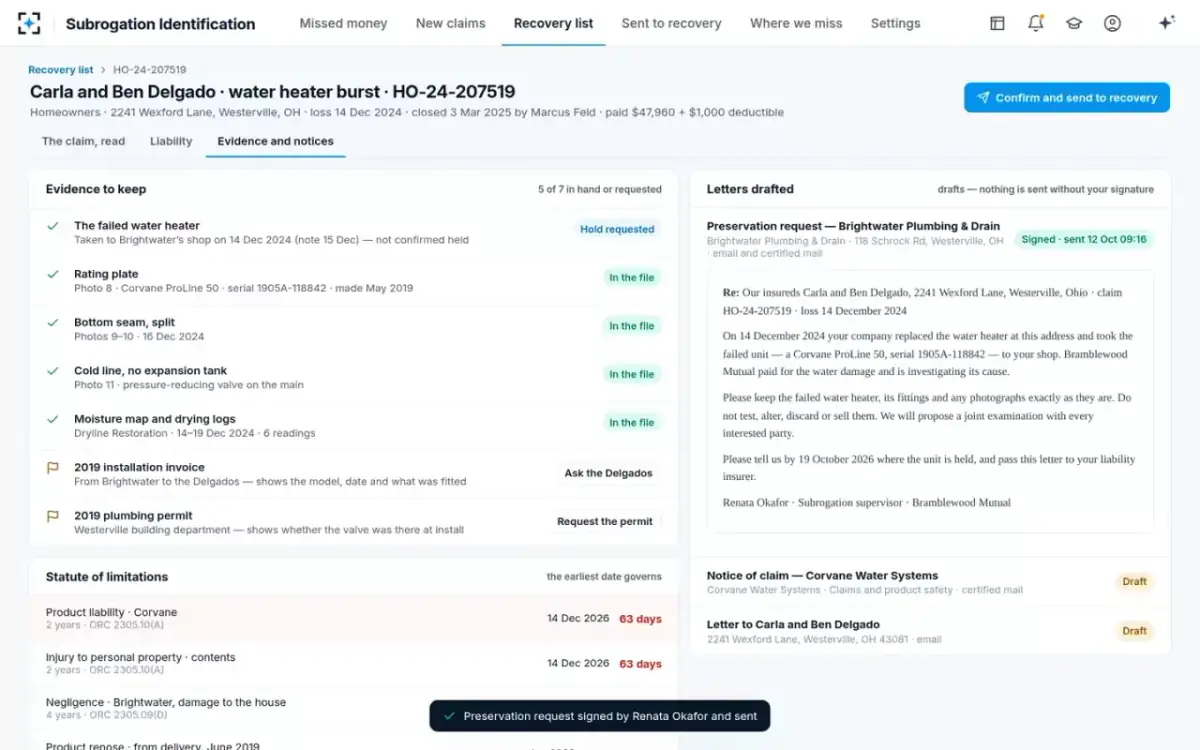
The order of letters matters as much as their wording. On the sample claim at the centre of the solution's story, the failed water heater had gone to the installer's shop the day it was replaced, so the first letter the supervisor signed was a preservation request to the installer: keep the unit, its fittings and any photographs exactly as they are, say where it is held, and pass the letter to its liability insurer. Only then did the notice to the manufacturer go out. Physical evidence held by another party is the first thing a recovery loses, and electronic evidence is not much safer; once litigation is anticipated, a court can act when such information "should have been preserved" and was not (Fed. R. Civ. P. 37(e)).
The hold request goes first, signed by the supervisor
What does AI read to find subrogation?
Everything in the claim file that a person would read if they had the time: first notices, adjuster notes, recorded statements, police and fire reports, repair estimates and invoices, cause-and-origin reports, permits and photo captions, plus the policy and payment data that say what was paid. Coded fields such as cause of loss help to route a claim, but they rarely name the party; that argument is made in subrogation data analytics. A reader that sees only the codes can rank claims; it cannot tell you who should pay.
What are the risks of AI in subrogation?
Five, and each has a control that can be checked in a demonstration. The risks are not exotic; they are the same mistakes a rushed person makes, made faster and at scale.
The risks of AI for subrogation, and the control that answers each
| Risk | What goes wrong | The control |
|---|---|---|
| A false find | A claim with no real party is sent for pursuit; letters go out, the insured is confused, staff time is wasted. | Every find quotes its sentence and source; a supervisor confirms before anything happens. |
| An invented party or fact | A likely maker or a plausible installer is named without a document. | Unknown is written as unknown; the missing document becomes a request. |
| A split without evidence | The insured is given a share of fault, which can cut the deductible they recover. | No split without cited facts; the insured’s share is zero unless a fact says otherwise. |
| A wrong deadline | A date computed on the wrong theory or an old rule passes unnoticed. | Every theory dated, earliest governs, never extended; rules versioned and confirmed by counsel. |
| An unsent or careless letter | Evidence is lost while a draft waits; a letter reads as an admission. | Drafts are listed with their deadline; a person signs; no letter admits fault. |
Regulators frame the same risks in general terms. The NAIC's model bulletin expects insurers to keep a written programme for AI systems that make or support decisions in regulated insurance practices, with controls proportionate to the potential harm to consumers (NAIC), and 29 jurisdictions had adopted it as of 8 October 2026 (NAIC). The NIST AI Risk Management Framework is voluntary but asks the same questions about trustworthiness. A subrogation reader that touches what an insured is told, or how much of the deductible they get back, sits inside that programme.
What AI for subrogation should leave in the claim file
Everything it relied on and everything a person decided, because the claim file is what a regulator, an arbitrator or a court will read later. California's fair claims regulations already require claim files to hold every document, note and work paper on a claim, in enough detail that someone else could rebuild what happened and when (10 CCR § 2695.3). A find that rests on a sentence the reviewer cannot locate, or a split changed with no recorded reason, fails that test.
In the solution, every read, confirmation, override and letter is kept on the activity trail; a split changed by hand is saved with its reason; and the state rules change only by a new rule version that a named executive approves. The test for any vendor is simple: pick one closed find and ask to see, from the record alone, which sentence raised it, which rule version dated it, who confirmed it and when.
How accurate is AI subrogation detection?
Nobody can tell you in general, and you should distrust anyone who does. We found no independent benchmark of subrogation detection accuracy from a regulator or academic source. Accuracy depends on the carrier's files, lines and states, and it has to be measured on them.
The measurement is straightforward because closed claims carry their own answers. Replay a random quarter of closed claims, hide how each ended, and score four things: how many of the recoveries the team actually made the reader finds again; how many new finds a supervisor confirms after reading the sentence and the documents; how many claims the reader closed to subrogation that a person, reading a sample, would have flagged; and how many dates match counsel's reading of the statute. The method is set out in closed file review: definition, then replay.
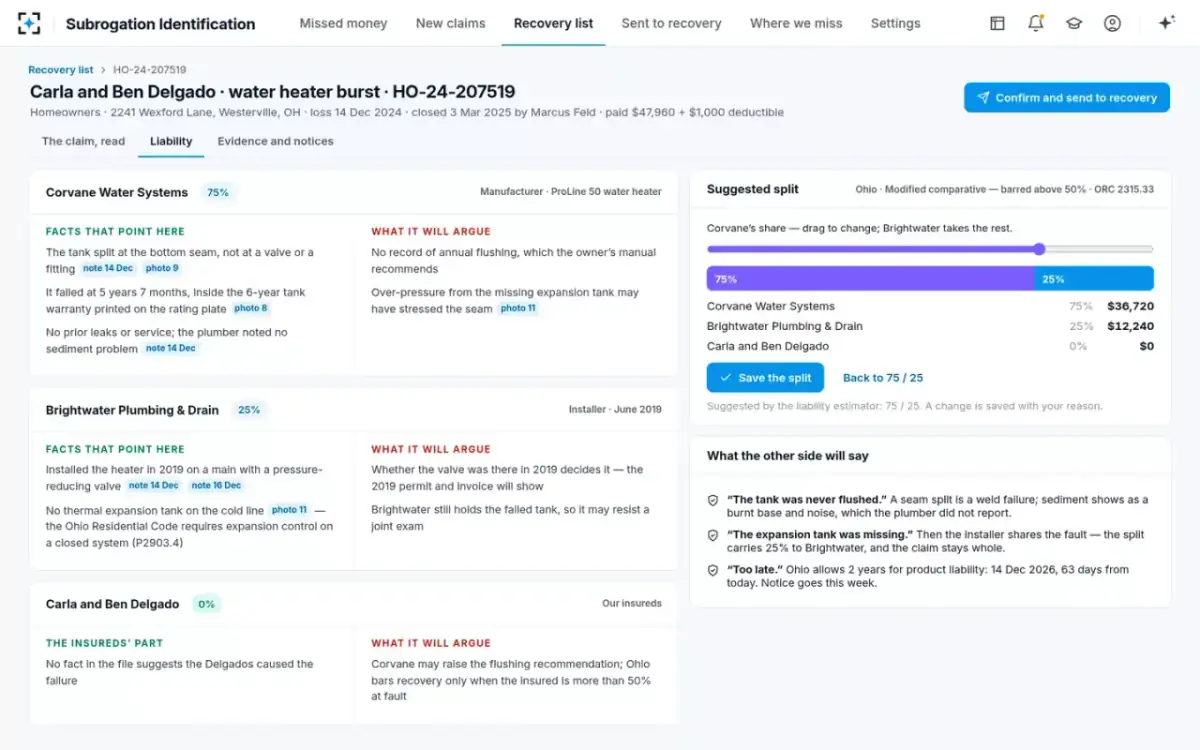
A suggested split a person can check: facts for and against, each with its source
Do insurers have to tell me if they pursue subrogation?
In California, yes, in writing, and if they decide not to pursue they must say that any recovery is yours to pursue. Other states set their own rules, and many follow the NAIC's model regulation on the deductible: it requires insurers to include the first-party claimant's deductible in subrogation demands when the claimant asks (Model #902). For the insurer, those duties mean the pursue-or-release decision is a dated act owed to a named person, which is one more reason it cannot be delegated to a model. What happens to the deductible once money comes back is covered in subrogation recovery accounting.
Where Subrogation Identification sits on the line
Subrogation Identification is the find half of the boundary. It reads new claims as they arrive and rereads closed ones each week, names the party, suggests the split, dates the clock and drafts the letters, and it is read-only on the claim system: it never reopens a claim, changes a reserve or payment, or contacts a party. The decide half stays with the people who already own it: the supervisor who confirms, the specialist who pursues, the executive who approves the state rules. Demands and arbitration are handled by Subrogation Demand & Arbitration, where a subrogation demand package is built from the same cited file. How the department reorganises around that division of labour is set out in the subrogation department, seat by seat.
Questions people ask
Can AI identify subrogation opportunities?
Yes, by reading every note, report and photo caption for a sentence that names another party and confirming the party from a document. The useful output is the find with its sentence and source, not a score. A person should confirm each find before anyone acts on it.
Will AI replace subrogation specialists?
It changes what they spend time on. Reading files, naming parties and computing dates move to the agents; negotiation, arbitration, litigation and judgement stay with people. BLS projects the wider claims occupation group to shrink 6% between 2025 and 2035, and its outlook expects AI to make claims workers more productive.
Is it legal to use AI in insurance claims?
Yes, within the rules that already govern claims handling. The NAIC's model bulletin asks insurers to govern AI systems that make or support regulated decisions through a written programme, and 29 jurisdictions had adopted it as of 8 October 2026. Decisions owed to an insured, such as California's written notice on subrogation, remain the insurer's.
Can AI suggest who was at fault?
It can suggest a split under the state's fault rule if it lists the facts for and against each party and cites where each fact is. It should never give the insured a share without a fact, because in some states the insured's share reduces the deductible they recover. A person accepts or changes the split.
Does AI for subrogation need access to the whole claim file?
Yes, read-only. The sentence that names another party is usually in notes, statements or reports, not in coded fields. Read-only access also means the software cannot reopen a claim, change a reserve or alter what was paid.
What should a buyer ask to see in a demo?
A find with its sentence and source, a claim with two theories and two deadlines, a party written as unknown, a split with facts against as well as for, and a letter that waits for a signature. Then ask for a replay on your own closed claims.