A subrogation demand package is what an insurer sends the at-fault party's insurer to get back what it paid on its own policy: a letter that says who caused the loss and why, a damages summary of every amount paid, the insured's deductible, and the documents that prove each point, from the crash report to the repair invoice. Writing it is the easy half. The package also has to satisfy rules that are nowhere in the claim file: California, for one, requires the deductible in every demand, and if the other carrier refuses, the same papers become an arbitration filing that must have its evidence attached on the day it is submitted. That is why, in Botminds' Subrogation Demand & Arbitration, the agent that drafts a demand is never the agent that checks it, and a named person decides whether it goes. The solution drafts demand packages and arbitration contentions from the claim file, every fact cited to its page, for property and auto recovery desks.
The drafts and screens below come from a fictional sample recovery unit, Harborline Mutual, as its files run through the solution; the people, carriers and amounts are invented. Rules and statutes are quoted from their own texts and linked where they appear.
One demand package in Subrogation Demand & Arbitration: written, checked, then decided
Agent
Claim file readerReads the whole file into facts, each with its page or photo number: crash report, statements, recorder data, estimate, invoices, payments.
Never: Never fills a gap; marks what it could not read
Agent
Damages reconcilerTies every amount claimed to a payment and an invoice, keeps the deductible apart, checks rental days against repair dates.
Never: Never claims an amount that was not paid
Agent
Contention writerDrafts the demand letter and damages summary, plain and factual, every factual sentence cited.
Never: Never writes an uncited fact
Agent
Forum rules checkerReads the draft against the state’s deductible rule, the forum’s rules and the unit’s settings, and pins each finding beside its paragraph.
Never: Never files; never waives a point; same draft, same result
A person decides
Subrogation specialistReads the findings, fixes or overrides each one with a reason, and sends.
A person decides
Recovery supervisorApproves anything above the unit’s limit, and any offer below full liability.
What goes in a subrogation demand package?
A package has three parts, and each answers a different reader's question. The letter answers the other adjuster's question, ‘why is my insured liable?’, with facts and the rule of the road behind them. The damages summary answers the payment desk's question, ‘what exactly are we paying for?’, line by line. The documents answer the doubter's question, ‘says who?’, and they are what an arbitrator would read if the demand fails.
No statute prescribes the contents for insurer-to-insurer demands, but the arbitration rules that sit behind most of them set a floor. Arbitration Forums, the not-for-profit whose insurer members write those rules, requires a filing company at minimum to “identify the insured name, claim file number or policy number, and correct and current address, if requested, for the representative/company handling the claim for the adverse party”, and warns that getting it wrong “may cause a filing to be closed or a decision to be voided.” A demand that starts with the right claim number and handler saves a closed filing later. The full element-by-element layout, with the source of each line, is in the subrogation demand letter template.
The documents are the part that most often goes missing. Arbitration Forums tells its members that proof of payment is not strictly required to prove damages but is recommended, because “Many arbitrators find it useful to verify if the recovering company has listed its damage claim correctly (e.g., not included its deductible twice, deducted its salvage return).” Those two errors, a deductible counted twice and a salvage return not deducted, are both arithmetic, and both are invisible to someone who only reads the letter.
A note on words: claims staff say "demand package" and "demand packet" for the same thing, and injury lawyers use "demand package" for something else entirely, a claimant's bundle of medical records and bills sent to a liability insurer. That trade is explained in what is a demand package in the casualty claims guides. This page is about the insurer-to-insurer kind.
Does a subrogation demand have to include the deductible?
In some states, yes, by regulation; in arbitration, the deductible is kept out of the company's own damages. Both are true, and a draft that confuses them fails one test or the other. California's fair claims rules are categorical: every demand must carry the insured's deductible (10 CCR § 2695.7(q), quoted in the demand letter template). Washington's rule, amended from 18 October 2026, says the same and adds that recoveries go to the insured's deductible first, “less applicable comparable fault.” The NAIC's model regulation is softer, requiring the deductible in the demand “upon the claimant’s request”.
The arbitration rules then separate it out. Rule 1-3(d) keeps the deductible out of the company-paid total (AF Rules). The deductible travels as the insured's interest, and the responding carrier's payment of an award must include it. So the demand letter asks for the company-paid amount plus the deductible, and the arbitration filing that may follow enters the company-paid amount alone, with the deductible shown separately. A writer copying one into the other moves $500 or $1,000 to the wrong line. On the sample unit's Delgado file that is exactly what happened: the draft entered $16,333.40 as company-paid damages, which included the insured's $500 deductible; the right entry was $15,833.40, with the $500 claimed as the insured's interest.
Who reviews a subrogation demand before it is sent?
Whoever has the authority to send it, and if that is only the writer, the demand has not been checked. A specialist sending 30 or 40 demands a week, as the sample unit's subrogation specialist does, re-reads her own letter for tone and typos. She does not re-derive the damages from the payments, re-read California's deductible rule, or count the enclosures against every citation, because she believes, reasonably, that she got them right while writing.
“Half my day is copying the estimate into a letter.”
Lena Castellanos, subrogation specialist in the fictional sample unit
Control frameworks have a name for the fix. The federal security control catalogue's separation-of-duties control explains that “Separation of duties addresses the potential for abuse of authorized privileges and helps to reduce the risk of malevolent activity without collusion.” A demand letter is not a fraud risk, but the logic carries: the person or program that produces a thing is the worst-placed to find its errors, because it carries the same assumptions into the review. Maker-checker is the claims-desk version of the same idea. The question is what the checker reads.
Why an AI writer should not grade its own draft
Asking the drafting model to check its own work does not create a second pair of eyes. Researchers who tested exactly that, letting large language models revise their own answers without outside information, reported at ICLR 2024 that the models could not reliably correct themselves without outside feedback, and sometimes got worse after trying (Huang et al., ICLR 2024). The finding is about reasoning tasks, but the mechanism is general: a model asked to review its own text has no new information, only the same text.
A checker earns its place by reading things the writer did not. NIST's generative AI profile names the failure it has to catch, which it calls confabulation: false content stated with confidence (NIST AI 600-1). In a demand that might be a rental total that matches no invoice, a statute section that does not say what the letter claims, or an enclosure listed and never attached. None of those can be found by re-reading the letter. Each can be found by comparing the letter with something outside it. Whether a general-purpose AI tool can draft a subrogation demand at all is taken up in AI demand letter generator or a cited demand.
The writer and the checker read different things
What the writer reads: The crash report, statements, photos and recorder data, to tell what happened.
What the checker reads instead: Whether every liability sentence carries a citation, and whether each cited page exists in the package.
What the writer reads: The estimate, supplements and invoices, to describe the loss.
What the checker reads instead: The payments actually made on the claim, line by line, and whether the total matches them.
What the writer reads: The policy, to state the insured’s deductible.
What the checker reads instead: The loss state’s rule (in every demand in California and Washington) and, for a filing, Rule 1-3(d).
What the writer reads: Whatever supports the story.
What the checker reads instead: The enclosure list against every citation: anything cited must be attached, anything attached must be cited.
What the writer reads: Statements, to quote them.
What the checker reads instead: Whether a written transcript of each quoted statement is in the package, as the forum requires for audio.
What the writer reads: Not needed to write well.
What the checker reads instead: The forum rules edition the file would be filed under, and the unit’s own approval limits.
Three problems the checker caught on one draft
On the sample unit's Delgado contention the rules check found three problems the writer had not, each pinned beside the paragraph it concerned. A rental invoice was cited in the damages section and never attached. The $500 deductible sat inside company-paid damages. And a witness, Alan Pruett, was quoted in the liability section while his recorded statement was not listed as evidence. Each would have cost money in arbitration, where Rule 3-5 says the arbitrator may only consider “(c) Evidence listed and attached.”
Margin notes from the rules check, each with its fix
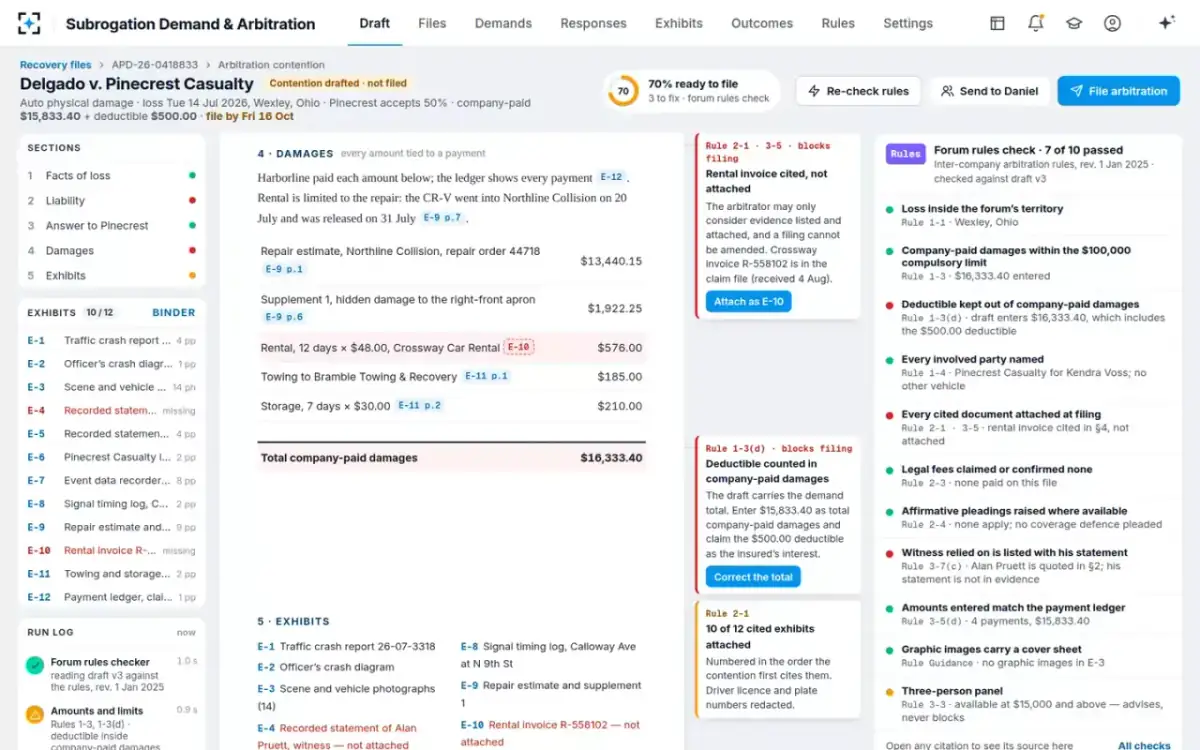
Every note carries its fix, but the fix is a person's click. The specialist attached the invoice as exhibit E-10, corrected the total and claimed the deductible as the insured's interest, and listed the transcript of Pruett's call as E-4. The readiness meter moved to ready to file, 10 of 10 checks passed. Had the same draft gone out as a demand letter instead, two of the three problems would still have mattered: the other adjuster would have asked for the rental invoice, and California's rule would have been met only by luck.
The sample unit's rules check, by the numbers
12checks
drawn from the forum’s rules and guidance; each draft gets the ones that apply
9block
filing until cleared; three only advise, such as offering a three-person panel
9hits
for “cited but not attached” since 1 October, the most frequent finding
4hits
for a deductible counted inside company-paid damages
What the checker must never do
A checker that can change the draft is a second writer, and the separation is lost. In the solution the forum rules checker reads and reports, with a fix beside each finding for the specialist to apply; it never files and never waives a point on its own, and the same draft always gets the same result. The other agents carry their own limits: the damages reconciler never claims an amount that was not paid and always shows the deductible as the insured's interest, and the writer never states a fact without its source.
The person at the end is not a formality. Some findings are judgments: a quoted witness may be worth attaching even though the quote is minor, and a three-person panel is a cost decision on a disputed-speed file. The specialist decides each one, and an override is kept with its reason. Filings above $25,000, and any offer to accept less than full liability, go on to the sample unit's recovery supervisor.
What a demand-package check should read, and why
- Every amount against a payment
A total that matches the estimate but not the payments is the commonest arithmetic error; arbitrators compare the itemized amounts with the evidence.
- The deductible against the loss state’s rule
In every demand in California and Washington; on request under the NAIC model; outside company-paid damages in an arbitration filing.
- Salvage and prior payments deducted
A total loss demand that forgets the salvage return claims money the carrier already has.
- Every citation against the enclosures
Cited and not attached loses the point in arbitration; attached and not cited confuses the reader.
- Quoted witnesses against their transcripts
The forum wants the written transcript of a recorded statement, not the audio.
- The responding carrier’s details
Insured name, claim or policy number and handler address; the wrong ones can void a later decision.
- Personal identifiers out of the exhibits
Driver licence and plate numbers, dates of birth, phone numbers: the sample unit redacts all four.
- Approval limits
Who must see the package before it goes, by amount and by any compromise of liability.
How Subrogation Demand & Arbitration builds the package around the payments
The sample unit's water-loss demand shows the shape. A supply-line fitting installed by a plumber failed in an insured's basement in Fenwick, Ohio. The letter to the plumber's liability carrier states the installation date, the forensic engineer's finding with its page, the notice and acknowledgement dates, the $38,416.92 paid and the $1,000 deductible, for a demand of $39,416.92, and asks for a reply within 30 days. The damages summary beside it lists mitigation, rebuild, contents and ten nights of additional living expense, each with the document behind it.
A demand package with its damages summary and a short list of weak points
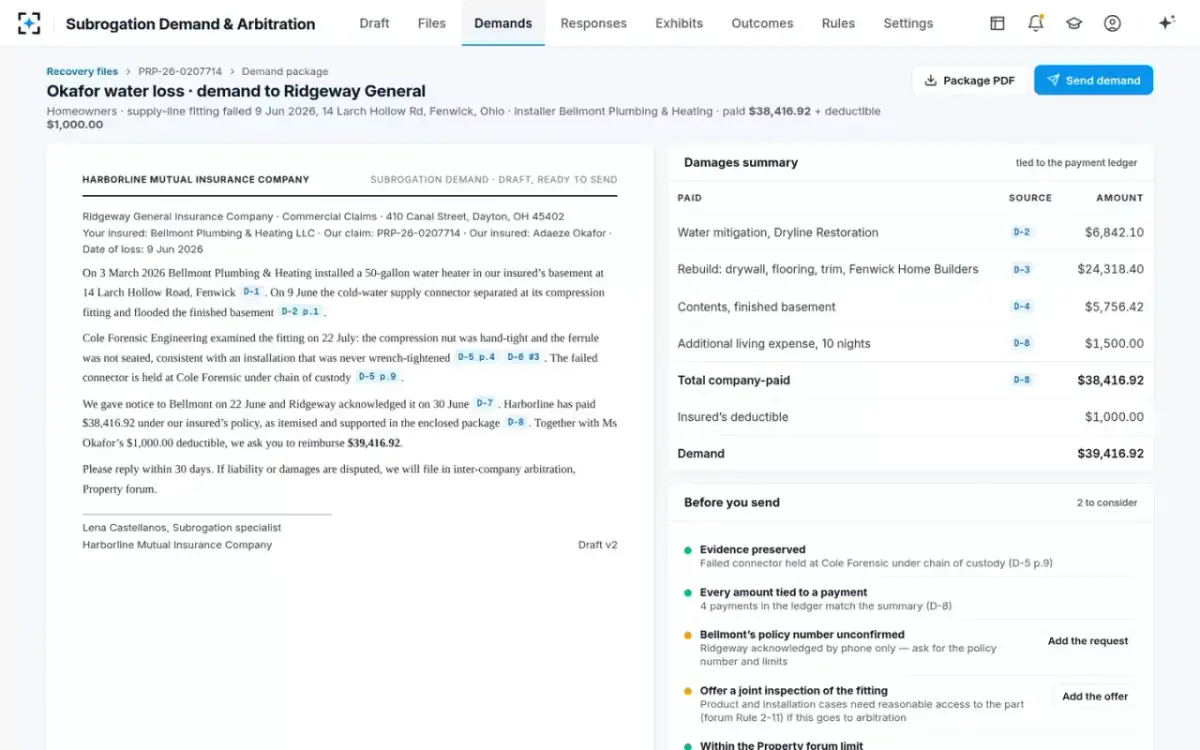
The weak points are the checker's work too, and they look forward. The failed connector is held by the engineer under chain of custody, which matters because Rule 2-11, written by Arbitration Forums' insurer members, expects reasonable access to an allegedly defective product, and failing to give it can end a case if the inspection is critical to the defence. Offering a joint inspection in the demand costs a sentence now and removes a defence later. How such defences work, and the other ways a filing fails, is set out in Arbitration Forums affirmative defenses.
Where the package goes, and what changes if it fails
Demands can also travel electronically between member carriers. Arbitration Forums describes its E-Subro Hub as a way to “Electronically send and receive subrogation demands, attach supporting documents, manage subrogation claims, and electronically move demands over to intercompany arbitration if necessary, all from a single platform.” Its members commit to the channel: the forum's FAQ answers “No, E-Subro Hub members agree to issue and receive demands through the system.” The solution drafts and checks the package; the specialist sends it through whatever channel the carrier uses.
If the other carrier refuses, the package becomes the filing, and the tolerance for error falls to zero. The rules say evidence “must be attached to the filing when it is submitted” and allow no amendments afterwards. A package that was checked as a demand is most of the way to a filing that will survive; one that was only proofread starts again. That is the practical case for the separation: the check that costs a minute at the demand saves a point at the hearing.
Questions people ask
What is the difference between a subrogation demand and a demand package?
The demand is the request itself, usually a letter stating liability and the amount; the package is the letter plus the damages summary and the supporting documents. In practice claims staff use the terms interchangeably, and "demand packet" means the same thing.
What evidence should a subrogation demand include?
Whatever proves liability and the amount: the police crash report, scene and damage photographs, recorded statements as written transcripts, event data recorder or video where they exist, the estimate and supplements, rental, towing and storage invoices, and proof of payment. Arbitration Forums recommends proof of payment so arbitrators can check the deductible was not counted twice and salvage was deducted.
How do you check a demand package before sending it?
Compare it with things outside it: every amount with the payments made, the deductible with the loss state's rule, every citation with the enclosures, and the responding carrier's details with its last letter. Re-reading the letter itself finds typos, not those errors.
Can AI write a subrogation demand?
It can draft one, and do it fast, if it works from the claim file and cites each fact; it should not be the one to check it, and it should not send it. Research presented at ICLR 2024 found that language models struggle to correct their own answers without outside feedback, so the check has to compare the draft with the payments, the rules and the enclosures.
How long should the other insurer have to reply to a subrogation demand?
We found no statute that sets a reply time for insurer-to-insurer property and auto demands; the date in the letter is the carrier's choice. The sample unit asks for a reply within 30 days and follows up after 30 days without one; the arbitration rules ask both sides to try to settle before anyone files.