Intercompany arbitration is how two insurers settle a subrogation dispute without a lawsuit. The insurer that paid its own customer's loss files against the insurer of the party it says caused it; the other insurer answers by a due date; an arbitrator, usually a claims professional at another member company, decides on the written file; and the loser pays within 30 days. It runs under the agreements and rules of Arbitration Forums, Inc., a not-for-profit whose members are insurers and self-insureds, and in a few places under statutes that make it compulsory. The hearing is rarely what takes the time. A disputed recovery spends most of its life waiting on someone: the other carrier, the forum, the payer, and on the side, an insured who wants a deductible back. Botminds' Subrogation Demand & Arbitration is software for the recovery desk that drafts each demand and arbitration contention from the claim file with every fact cited, checks it against the forum's rules before it goes, and keeps every date in view.
The examples below come from a fictional sample recovery unit, Harborline Mutual, as its files run through the solution; the people, carriers and amounts are invented. The rules quoted are the forum's own edition effective 21 October 2024, revised 1 January 2025, and its Reference Guide revised 9 June 2026. Statutes are linked where they appear.
Intercompany arbitration in four numbers
$100K
compulsory limit ($100,000) on company-paid damages in the Auto, Property, Medical Payment and Uninsured Motorists forums
$250,000 in Special Arbitration
30days
to pay an award once the decision is published
1extension
per response, adding 15 days, for a fee
5statutes
we read that make insurer-to-insurer arbitration mandatory for some disputes
What is intercompany arbitration, and who runs it?
It is a contract among insurers to decide their recovery disputes in a private forum instead of court. Arbitration Forums' Reference Guide, written for its insurer members, puts the bargain plainly: “Signatory members must forego litigation and arbitrate claim disputes as specified by Article First of the respective Agreement.” Each forum has its own agreement: Automobile, Property, Special, Personal Injury Protection and Medical Payment. A carrier can sign some and not others, so the first question on any file is whether the other company signed the agreement for this kind of damage.
The idea is old. The same guide dates it to 1943, when New York claim managers agreed to arbitrate auto physical damage subrogation claims among themselves; the industry later rewrote it as a nationwide agreement. The arbitrators are still claims people: the forum's guide says they “must have at least three (3) years of claims experience” and supervisor approval, and that each member company should hear as many cases as it files. Members pay per filing, not per membership. In the Auto forum a member paid $42 a feature until 30 June 2026, pays $50 now, and will pay $60 from 1 January 2027, according to the forum's own fee schedule.
What arbitration is not is a substitute for talking. The Reference Guide, again in its members' voice: “Arbitration is never intended to be a substitute for negotiation.” The rules ask the parties to attempt a settlement before filing, as a condition precedent to using them, which is why the first two waits on any file happen before the forum hears about it.
Who waits on whom: the parties and the clocks between them
Four parties hold a disputed recovery at different moments, and at almost every moment three of them are waiting. The figure follows one contested auto recovery from demand to payment and marks, step by step, who holds the file and who waits.
Who holds the file, and who waits, from demand to a paid award
Two things stand out. Our own desk holds the file in only four of the ten steps, and three of those (the demand, the filing and a revisit) are moments when everything has to be right first time, because the forum's rules allow no amendments and no reschedules (AF Rules). And the insured waits in every row without ever appearing in the case: Arbitration Forums tells its members plainly that the policyholder is no party to the agreement, the point worked through in is intercompany arbitration binding.
The responding carrier's clocks are firmer than people expect. The rules allow it a single extension of its response date (AF Rules), and the Reference Guide sets that at 15 days. If it never answers, nothing stops: the case is heard regardless (AF Rules). The recovering company still has to prove its case, since “Arbitration panels may not render default judgments.”
How long can each party hold the file?
Most clocks in the rules run 15 to 60 days. One runs a year, and it is the one that decides how long a contested file stays open. Any party may add a one-year deferment, for example while a companion bodily injury claim threatens the other carrier's policy limits. The first is free; later ones cost a fee.
One deferment outweighs every other clock in the rules
The deferment rule has a trap for the recovering side. A filing made only to stop the statute of limitations running, then deferred, closes if nobody acts: the Reference Guide warns that when “no subsequent action is taken within 90 days of the deferment expiration” the case is closed and no further recovery is allowed. A desk with a few hundred open files will have deferments expiring every week. That is a date to diarise, not a judgment call, and it is exactly the kind of wait a machine can watch.
After the decision, the clocks protect the payer more than the payee. For 30 days either side can claim a clerical or jurisdictional error. For 60 days the responding carrier can still raise no liability policy, a denial of coverage, policy limits or a liability deductible, provided it does so at least 60 days before the statute of limitations runs. While either is pending the award should be held. A recovery that looks won on publication day is, in practice, two months from certain. For how those months add up across a whole case, and what each one costs, see how long inter company arbitration takes, stage by stage.
Is intercompany arbitration mandatory?
For companies that signed the agreement, yes, within each forum's limits; in a handful of places, the law says so too. A signatory that sues instead must drop the suit within 60 days of learning the other side signed. Above the compulsory limit, or against a non-signatory, arbitration is voluntary: both sides must consent in writing, or the recovering company can cap its claim at the limit and give up the balance.
Five statutes we read make insurer-to-insurer arbitration compulsory for some disputes. New York's no-fault law makes arbitration “the sole remedy” for loss-transfer recoveries, run under 11 NYCRR 65-4.11. The District of Columbia requires insurers to “arbitrate and settle all disputed claims made for automobile physical damage between them” under the nationwide agreement. Maryland requires motor vehicle physical damage claims between authorized insurers to go through “an automobile subrogation program sponsored by the intercompany arbitration organization chosen by the authorized insurer that requests the arbitration”. Delaware sends disputes among insurers over its required motor vehicle coverages to the Wilmington committee “or its successors”, and Minnesota enforces certain no-fault indemnity claims “only through mandatory good faith and binding arbitration procedures”. Arbitration Forums' own list adds Kentucky and Virginia and notes that it may change. The detail by forum, with limits and evidence rules, is in intercompany arbitration rules in plain words.
The waits an agent can chase, and the ones only a person can end
Every wait in the forum's rules is either a date or a decision. A date needs watching: a response due, an extension used or not, a deferment expiring, an award past day 30. A decision needs a person with authority: whether to ask for the extension, whether to accept a responding carrier's policy limits as final settlement, whether to settle for less than full liability, whether to file at all. Software that blurs the two either nags people about dates they could have been spared, or takes decisions nobody gave it.
In the solution the dates are settings, not memory. The recovery files list orders every demand, filing and response against us by its next date; a warning comes ten days before a response is due, with whether the one extension is still unused; a demand the other carrier has not answered comes back for follow-up after 30 days; and an unpaid award gets its payment request on day 31. Those are the sample unit's choices, and a carrier sets its own. The decisions stay with named people, and the six agents do the reading, drafting and checking that each decision rests on.
In Subrogation Demand & Arbitration, agents prepare and check; people end the waits
Agent
Claim file readerReads the crash report, statements, photos, recorder data, estimates, invoices and payments into facts, each with its page.
Never: Never fills a gap; marks what it cannot read as unread
Agent
Contention writerDrafts the demand, our contention or our response to theirs, every factual sentence cited.
Never: Never writes an uncited fact
Agent
Forum rules checkerChecks the draft against the edition of the forum rules it will be filed under and pins each finding beside its paragraph.
Never: Never files, never waives a point on its own
A person decides
Arbitration specialistDecides on extensions, deferments, panels and revisits, fixes what the checker flags, and files.
A person decides
Recovery supervisorApproves filings above the unit’s limit and any offer to accept less than full liability.
A person decides
Claims counselReviews legal fees, affirmative pleadings and Special Arbitration filings.
The split is not cosmetic. The rules let a recovering company, when a responding carrier pleads policy limits, accept the limits as final settlement and give up pursuing the balance against the other carrier's insured. That is a money decision with a customer's out-of-pocket loss attached, and it belongs to a person who can be asked why. The same goes for impleading: if the responding carrier argues that an unnamed party was at fault and the recovering company lets the case be heard, Rule 1-4 says it “agrees to accept any award against a responding company and waive its right to pursue the balance directly from any unnamed party”.
The insured waits too, outside the case
The person with the most at stake in many recoveries has no seat in them. A policyholder's deductible is often the first money they want back, and arbitration treats it as a courtesy. The Reference Guide says the deductible “is not “awarded” per se but is included in the decision as a courtesy calculation for the members”, and Rule 5-1 asks the paying carrier to include any deductible interest as a matter of goodwill between companies (AF Rules).
State regulators set the insured's clock instead. Washington's rule, as amended from 18 October 2026, requires the insurer to put the deductible in its demand, to allocate recoveries to the insured's deductible first, and to contact the insured “within 60 calendar days after the start of the subrogation process, and no less frequently than every 180 days until the insured's interest is resolved”. California requires written notice telling the first-party claimant whether it will pursue subrogation. Those are dates a recovery desk owes its own customer while it waits on everyone else. Why the decision binds the carriers but not the customer is the subject of is intercompany arbitration binding.
Who carries a recovery file, seat by seat
Four roles touch a disputed recovery, and each spends a different share of its week waiting. Nationally the work sits inside a large occupation: the Bureau of Labor Statistics counts about 376,100 jobs for claims adjusters, examiners and investigators in 2025, with a median wage of $78,000 in May 2025. Recovery specialists are a small, specialised slice of it.
The four seats on a recovery desk, before and after
Today
Carries 46 open arbitration matters and about 15 new filings a week, each contention built from the claim file by hand. “The arbitrator only reads what I attach. One missing invoice and I lose the rental.”
With agents
Opens a contention already drafted and cited, fixes what the margin notes flag, and files with every cited exhibit attached.
Still theirs: Every filing decision and every submit
Today
Sends 30–40 demands a week, and spends about half of each day retyping estimates into letters.
With agents
Reviews a demand package whose damages summary is tied to the payments on the claim, adds what the weak-point list suggests and sends.
Still theirs: What the demand asks for, and when it goes
Today
Approves any filing over $25,000 and any compromise of liability below 100%, and wants the weak points shown before the filing fee is paid.
With agents
Sees every file’s readiness and next date on one list; only filings above his limit come to him.
Still theirs: Approvals above the unit’s limits
Today
Reviews contentions with pleadings or legal fees, where a missed point cannot be recovered. “If it is not raised, it is waived.”
With agents
Gets the filings that need him, with the rules check already run on each.
Still theirs: Legal fees, affirmative pleadings, the Special forum
What a recovery desk sees when every wait has a date
When each file carries its next date, the desk's question changes from ‘what is overdue?’ to ‘what is not ready?’. On the sample unit's list, twelve files sit in order of their next date: three due within seven days, six drafts that a forum rule would reject if filed today, one filing waiting on the supervisor because it is above $25,000, and three awards owed to Harborline. The list does not hide the waits; it names who each one is on.
Twelve recovery files, ordered by the next date that matters
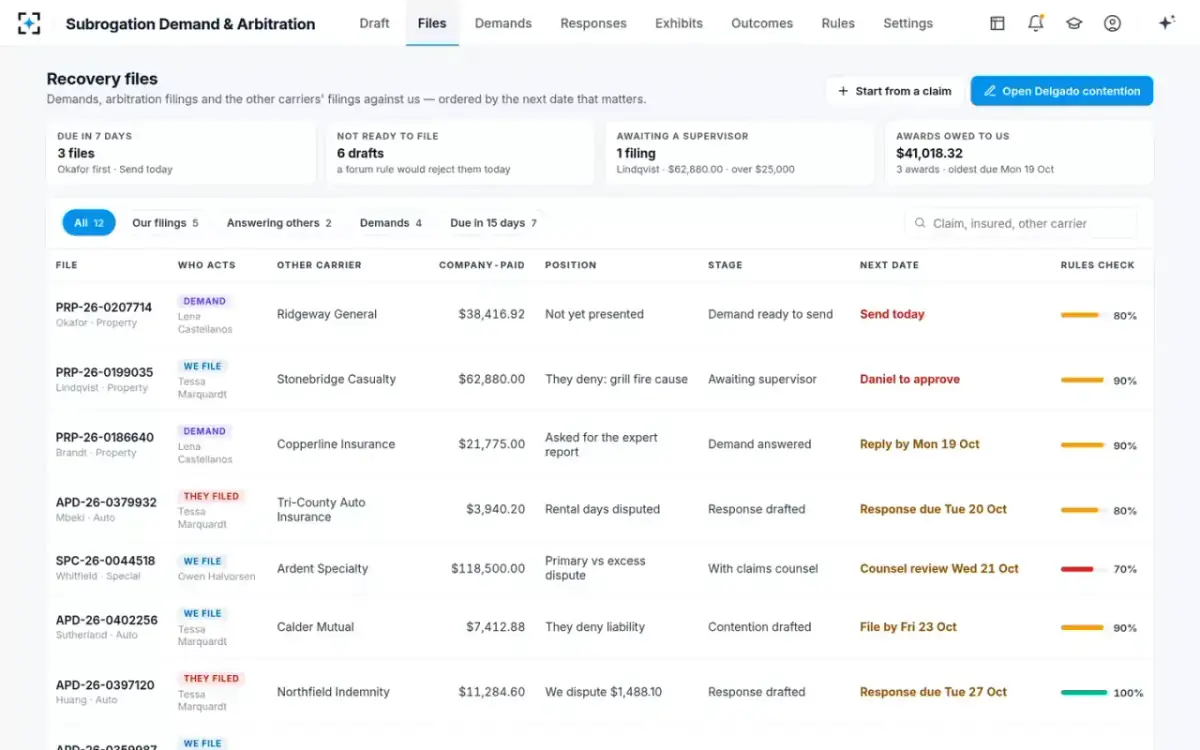
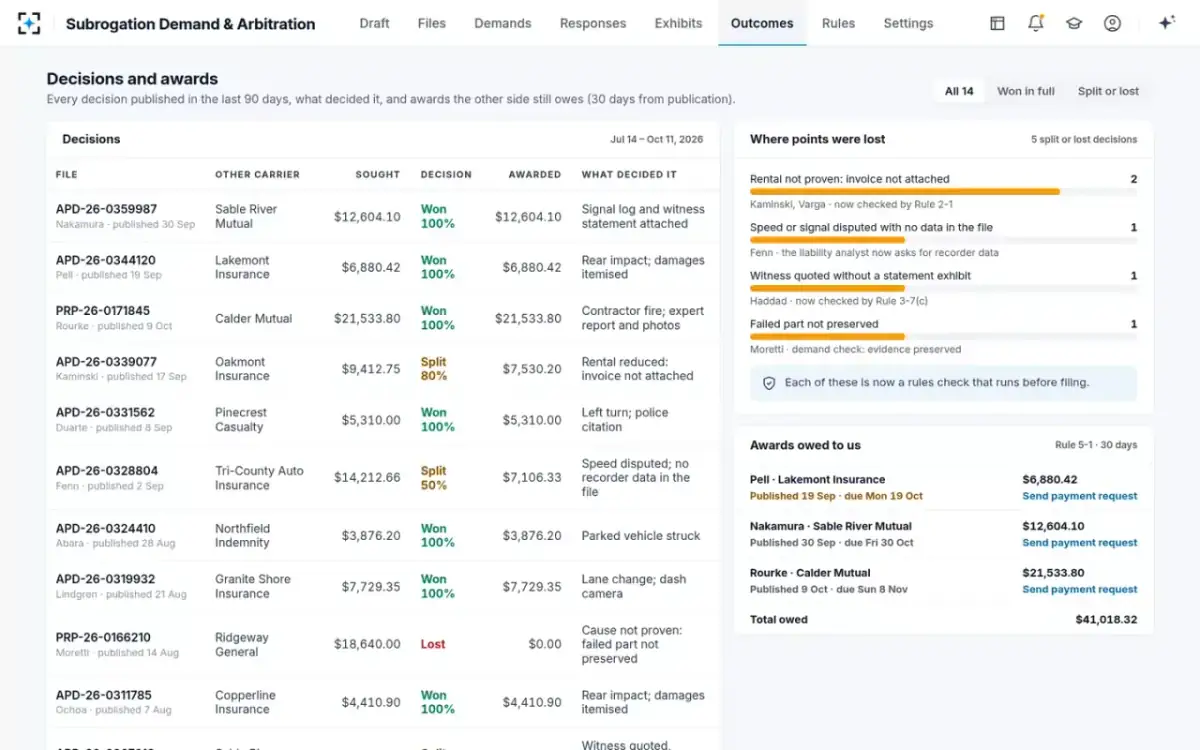
The award side is where waiting turns into money owed. Three awards totalling $41,018.32 sit on the sample unit's outcomes page, each with its 30-day clock from publication and a payment request ready for the day after. None of this needs a decision until a carrier fails to pay twice; until then it is arithmetic on dates.
Decisions, what decided them, and awards on their 30-day clock
Where Subrogation Demand & Arbitration stops
The solution drafts, checks and watches; it does not file, concede liability or claim an amount that was not paid, and it does not replace either the forum's own filing system or the claims system that holds the file. It covers property and auto recoveries between insurers. Finding which closed claims had a recovery in them is the job of Subrogation Identification, and following a recovery through to cash after the decision belongs to Subrogation Recovery Management; who does what in a subrogation department covers the desk beyond arbitration. Injury demands from claimants' lawyers are a different trade with different rules, covered by the casualty claims guides.
Within its lane, the measure that matters is simple: how many of the waits on a desk are spent on dates a machine could have watched, and how many filings were lost to a point nobody had time to check. The four seats above are where that time comes back.
Questions people ask
Who runs intercompany arbitration in the United States?
Most of it is administered by Arbitration Forums, Inc., a not-for-profit founded in 1943 whose members are insurers, self-insureds and commercial insureds with large retentions. Its Board of Directors is made up mainly of senior claim executives from member companies, and its arbitrators are claims professionals employed by members. New York's mandatory loss-transfer arbitration is run by an administrator the state's superintendent designates.
Does the insured take part in intercompany arbitration?
No. The agreements bind the signatory companies only, and the forum's answer to members is that decisions may not be shared with insureds. An insured or witness may join a hearing call only to clarify a statement already listed as evidence, and only alongside a company representative.
What happens if the other insurer does not answer an arbitration filing?
The case is heard anyway under Rule 3-2, but the recovering company still has to prove it, because panels may not render default judgments. The arbitrator decides on the evidence filed, on a preponderance of the evidence, so an unanswered filing with thin evidence can still lose.
How is an intercompany arbitration award paid?
The responding company pays within 30 calendar days of publication, only to the recovering company, including any deductible interest. If it does not, the recovering company sends a request for payment, a second request 30 days later, and after another 30 days may go to court, where the rule entitles it to statutory interest and collection costs.
How much does it cost to file intercompany arbitration?
The recovering company pays a filing fee per feature. Under the forum's 2026 schedule a member pays $50 in the Auto forum and $90 in the Property forum from 1 July 2026, rising to $60 and $100 on 1 January 2027; a three-person panel, an extension and an appeal each cost extra.
Can an intercompany arbitration decision be appealed?
Only in the Property forum, where total company-paid damages are $10,000 or more, and the Special forum, where the total settlement is $100,000 or more. The appeal must be lodged within 30 days of publication, costs $1,000 under the 2026 schedule and is decided on the original file and the parties' appeal positions alone. Auto, PIP and Medical Payment decisions cannot be appealed.